Project 2025
By Prof. Nassir Hussein Kahin, Political Analyst, International Affairs Writer and Executive Managing Editor of hornofafricastrategicreview.com
As geopolitical tensions escalate across the Red Sea and the Horn of Africa, an emerging theory is quietly gaining ground among political insiders, diplomats, and military analysts: that the Taiwan–Somaliland maritime agreement is not just a pact—it is a prelude.
A prelude to what?
To what some in Washington are now calling Project 2025—a long-term strategic initiative aimed at establishing a U.S. military presence in Somaliland in exchange for international recognition, securing Red Sea trade routes, and containing rising authoritarian influence in the region.
But this plan, observers argue, could not unfold openly. The region is a minefield of sensitivities—between pan-African solidarity, non-recognition norms, and a delicate balance of diplomatic friendships. For the United States to act boldly, it needed a proxy. It needed plausible deniability. It needed Taiwan.
And that’s where the pieces begin to fall into place.
⸻
The Red Sea Turning Red
————————
For years, U.S. strategists have watched with growing concern as the Red Sea—one of the world’s most critical maritime corridors—turns “Red” in more ways than one. Red with conflict, red with blood, and red with expanding Chinese and Russian influence.
From Chinese bases in Djibouti to the Wagner Group’s fingerprints in Sudan, from Iranian-backed Houthi strikes to Turkey and Egypt’s creeping militarization of Somali affairs, the entire western rim of the Red Sea is becoming a chessboard where democracy is in retreat.
Somaliland, however, stands as a rare exception: a democratic, pro-Western state that governs itself peacefully, holds elections, and guards a 850 km Red Sea coastline—unclaimed by the great powers, and unbound by Chinese debt.
The U.S. sees the writing on the water. But until now, it lacked the political cover to act.
⸻
Enter Taiwan: A Strategic Shift
———————————-
Washington couldn’t afford to openly recognize Somaliland—not without inciting backlash across Africa, where most nations still cling to the AU’s rigid doctrine of colonial borders. The falsely claim that Recognizing Somaliland, (even though it doesn’t apply to Somaliland’s case, a contradiction in AU’s Charter and its 2005 Fact Finding Mission to Somaliland) could set off a cascade of secessionist claims—an African Pandora’s box.
So, Washington turned to Taiwan.
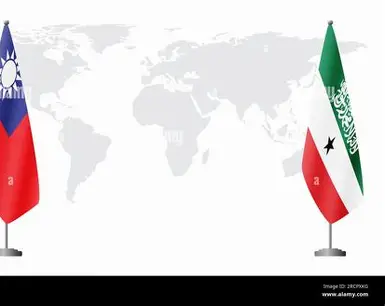
Taiwan is both a democratic ally and a diplomatic outlier—unrecognized by most of the world, but increasingly central to U.S. strategy in countering China. Taiwan, like Somaliland, exists in a gray zone—recognized in practice, but not on paper. Their diplomatic destinies are mysteriously parallel.
By encouraging Taiwan to deepen relations with Somaliland—starting with the opening of representative offices in Hargeisa and Taipei in 2020, and culminating in the July 2025 maritime pact—the U.S. achieved several objectives at once:
1. It opened a strategic corridor without drawing direct fire.
2. It tested international reaction to Somaliland–Taiwan cooperation.
3. And it laid the groundwork for invoking the TAIPEI Act.
⸻
The TAIPEI Act: Washington’s Magic Trick
——————————————-
The Taiwan Allies International Protection and Enhancement Initiative (TAIPEI) Act of 2019 gives the U.S. legal authority to reward states that strengthen ties with Taiwan—and punish those who isolate it.
By supporting Taiwan diplomatically and militarily, Somaliland has now become a textbook case for U.S. protection under the Act. And this may be the legal framework through which Washington accomplishes what some call Project 2025: recognition of Somaliland, the establishment of a U.S. military and intelligence base in Berbera, and a full a transformative shift of U.S. policy in the Horn.
Critics will ask: why not just do it outright?
Because in diplomacy, timing and optics are everything.
⸻
Saving Face, Making History
—————————–
Openly recognizing Somaliland or establishing a base would alienate partners like Kenya, Djibouti, and even Egypt—many of whom are hesitant to break ranks with the African Union consensus on Somalia’s territorial integrity.
By allowing Taiwan to initiate the relationship, the U.S. appears to be a neutral observer, rather than the grand architect of regional chaos and disruption. But behind the scenes, insiders say Washington’s fingerprints are everywhere—from capacity-building grants to quiet high-level meetings with Somaliland’s new leadership.
The U.S. wants to protect Somaliland—not just for democratic ideals, but for access, critical minerals, security, and leverage. And once Somaliland is seen as a legitimate player—thanks to its pact with Taiwan—then Project 2025 becomes less of a provocation and more of a logical step.
⸻
The Trap for China—and Somalia
——————————–
This strategy also puts China in a check-mate.
If China retaliates against Somaliland the way it did against Lithuania for recognizing Taiwan, it risks being seen as bullying yet another small, self-governing democracy. Worse, it will invite deeper U.S. involvement in a region it has long considered within its own expanding orbit.
And for Somalia—still struggling to control its capital and increasingly reliant on Egypt and Turkey—the pact isolates Mogadishu further. Villa Somalia’s loud condemnations of the Somaliland–Taiwan relationship now mean nothing. It can’t stop it. It can’t reverse it. And the more it protests, the more it reveals its own weakness.
⸻
Recognition by Stealth?
————————-
Somaliland may not receive de jure recognition overnight. But it has that recognition which is already underway—through security cooperation, economic development, and high-level visits.
Once a U.S. base is in place—likely framed as a “maritime coordination facility” or “regional anti-piracy hub”—the final piece will be political (de jure recognition).
Recognition will no longer be an “if,” but a “when.” And Project 2025 will have succeeded without ever being formally declared.
⸻
Conclusion: The Quiet Revolution
———————————-
If this theory is correct, then what we are witnessing is not just diplomacy—it’s geostrategic theater. A slow-moving, tightly choreographed plan to integrate Somaliland into the Western security architecture, contain Chinese expansion, and prove that democracy can flourish in Africa without international permission.
What began as a small maritime pact may soon become a defining alliance of the 21st century, linking the coasts of East Africa to the ports of East Asia—and eventually, to the power corridors of Washington, D.C.
This isn’t just about Somaliland anymore. It’s about a model for democratic resilience, stealth diplomacy, and strategic alignment in a world that is rapidly choosing sides.
Somaliland, Taiwan, and the United States may soon find themselves bound not just by shared values—but by shared destiny.
hornofafricastrategicreview.com will continue to monitor latest developments on this topic.
About the Author