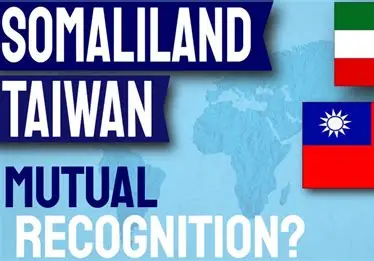
Somaliland-Taiwan-Mutual Recognition
By Prof. Nassir Hussein Kahin, Political Analyst, International Affairs Writer and Managing Editor of hornofafricastrategicreview.com
In the shifting sands of international diplomacy, where alliances are tested and sovereign decisions punished by stronger powers, the recent maritime agreement between Taiwan and Somaliland stands out as an act of quiet defiance and democratic will. It is in this context that a little-known but increasingly relevant U.S. law—the Taiwan Allies International Protection and Enhancement Initiative Act of 2020—deserves renewed attention.
Signed into law in March 2020 with broad bipartisan support, the TAIPEI Act was created to defend Taiwan’s diplomatic partnerships and international presence in the face of mounting coercion from China and its allies. It empowers the United States to adjust its diplomatic, economic, and security posture toward nations that seek to isolate Taiwan and, conversely, to reward those that strengthen ties with the island democracy.
The July 25, 2025 maritime agreement between Taiwan and Somaliland marks a historical moment in this evolving landscape. The Pact outlines cooperation in maritime security, coast guard training, and intelligence-sharing—components that signal not just friendship but strategic alignment in a region increasingly contested by China, Turkey, Egypt, and their partners in the Horn of Africa. Somaliland, despite lacking formal international recognition, has consistently demonstrated democratic governance, stability, and a willingness to engage with like-minded partners. In establishing reciprocal diplomatic offices with Taiwan and now forging a maritime security accord, Somaliland has positioned itself—intentionally or not—within the protective reach of the TAIPEI Act.
What makes this legislation remarkable is its flexibility. It does not limit U.S. support to countries with full recognition; rather, it includes “partners and allies” that have sought or deepened cooperation with Taiwan. Somaliland, therefore, qualifies for full protection under the TAIPEI Act. Should nations such as Somalia, Egypt, or Turkey attempt to nullify the Taiwan–Somaliland agreement—through naval intimidation, diplomatic isolation, economic retaliation, or disinformation campaigns—they may find themselves subject to the countermeasures authorized under U.S. law. These may include targeted sanctions, reductions in military assistance, and enhanced U.S. support to both Taiwan and its partners.
This is not theoretical. When Lithuania opened a Taiwan representative office in Vilnius in 2021 and faced swift Chinese economic retaliation, the United States and its allies responded decisively, providing economic aid and diplomatic backing. The precedent is clear: Washington will not quietly allow authoritarian powers to punish democratic choices made by small or emerging partners. Somaliland now stands on similar ground.
For China and its regional allies, the temptation to test this alliance will be strong. Already, there are murmurs of naval deployments, pressure campaigns at the African Union, and backchannel warnings issued to Somaliland leadership. Should those threats escalate into action, the TAIPEI Act provides the United States with a legal and moral basis to respond—with sanctions, with support, and with solidarity.
In a world increasingly defined by polarization, the Taiwan–Somaliland partnership is more than a bilateral agreement. It is a symbol of agency for small democracies and a warning to those who seek to dominate them. The United States has tools at its disposal to protect such alliances, and the TAIPEI Act is among the sharpest.
This is not just a moment for Somaliland or Taiwan. It is a moment for the principles they represent—and for those who claim to defend them. As threats mount, the real test will be whether the China is willing to act when it knows the reciprocal consequences in store.
hornofafricastrategicreview.com will continue monitoring U.S. congressional responses and regional developments closely.
About the Author