By Nassir Hussein Kahin
For more than three decades, the international community has maintained an increasingly fragile diplomatic fiction in the Horn of Africa: that Somaliland is merely a temporary regional question inside Somalia rather than what it has demonstrably become — a functioning, self-governing, strategically indispensable state.
That fiction may now be approaching its end.
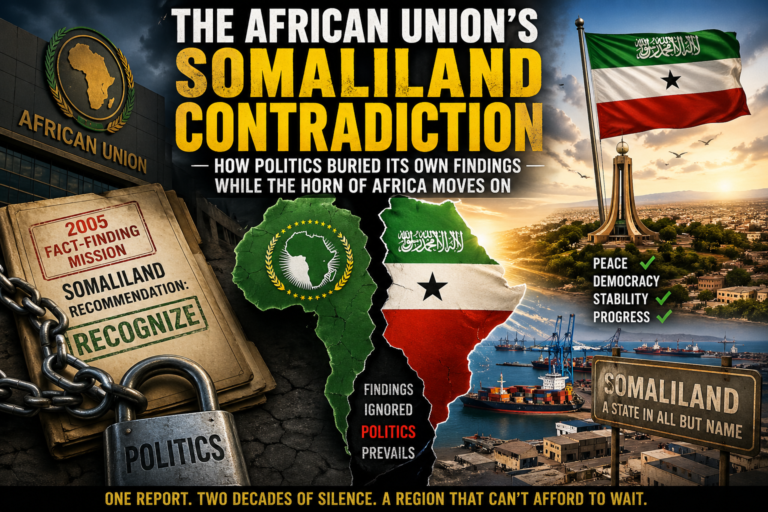
Across diplomatic circles in the Gulf, Africa, Latin America, and the Eastern Mediterranean, growing indications suggest that Somaliland could be on the verge of a coordinated wave of international recognition that would fundamentally reshape the geopolitics of the Red Sea and the Horn of Africa. Reports emerging from regional diplomatic sources indicate that countries such as Eswatini, Dominican Republic, Argentina, Zambia, and potentially others aligned with Gulf strategic interests, are being encouraged to move toward formal recognition of Somaliland — possibly on or before May 18, the anniversary of Somaliland’s restoration of sovereignty in 1991.
If such a coordinated recognition package materializes, it would represent far more than symbolic diplomacy. It would mark the collapse of the long-standing “wait-and-see” approach that has kept Somaliland trapped in de facto limbo despite meeting every practical and legal criterion of statehood.
Since reclaiming its independence from Somalia in 1991, Somaliland has achieved something extraordinary in one of the world’s most volatile regions. While southern Somalia descended into civil war, insurgency, piracy, and repeated cycles of externally managed state-building, Somaliland constructed functioning institutions through locally negotiated reconciliation conferences, indigenous conflict resolution mechanisms, constitutional governance, and electoral legitimacy.
It did so without foreign occupation armies, massive UN protectorates, or externally imposed political engineering.
Today, Somaliland possesses all the core attributes of sovereign statehood defined under the Montevideo Convention: a permanent population, defined territory, an effective government, and the capacity to conduct international relations. Its borders correspond to the former British Somaliland Protectorate, which briefly became an internationally recognized independent state in June 1960 before entering into an unconstitutional union ( a bogus union which was never ratified) with Somalia just days later.
For more than thirty years, Somaliland has maintained effective control over its territory, held multiple elections, achieved peaceful transfers of power, maintained its own currency, security institutions, judiciary, and diplomatic engagements, while remaining largely insulated from the extremist violence that continues to destabilize much of Somalia.
Recognition is therefore no longer primarily a legal question.
It is a geopolitical one.
The strategic importance of Somaliland has risen dramatically as global competition intensifies across the Red Sea corridor and the Gulf of Aden. Somaliland sits adjacent to the Bab el-Mandeb Strait — one of the world’s most critical maritime chokepoints linking Europe, the Middle East, Asia, and Africa. A substantial portion of global trade and energy shipments passes through these waters.
The destabilization of Red Sea shipping routes by regional conflicts, Houthi attacks, and growing great-power rivalry has elevated the value of reliable coastal partners. In this emerging geopolitical environment, Somaliland’s stability has become impossible to ignore.
The expansion of DP World investments in Berbera Port has already transformed Somaliland into a rising logistics and maritime hub connecting the Horn of Africa to Gulf and international trade networks. Gulf states increasingly view Berbera not merely as a commercial port but as part of a broader strategic architecture tied to maritime security, energy routes, counterterrorism cooperation, and regional power projection.
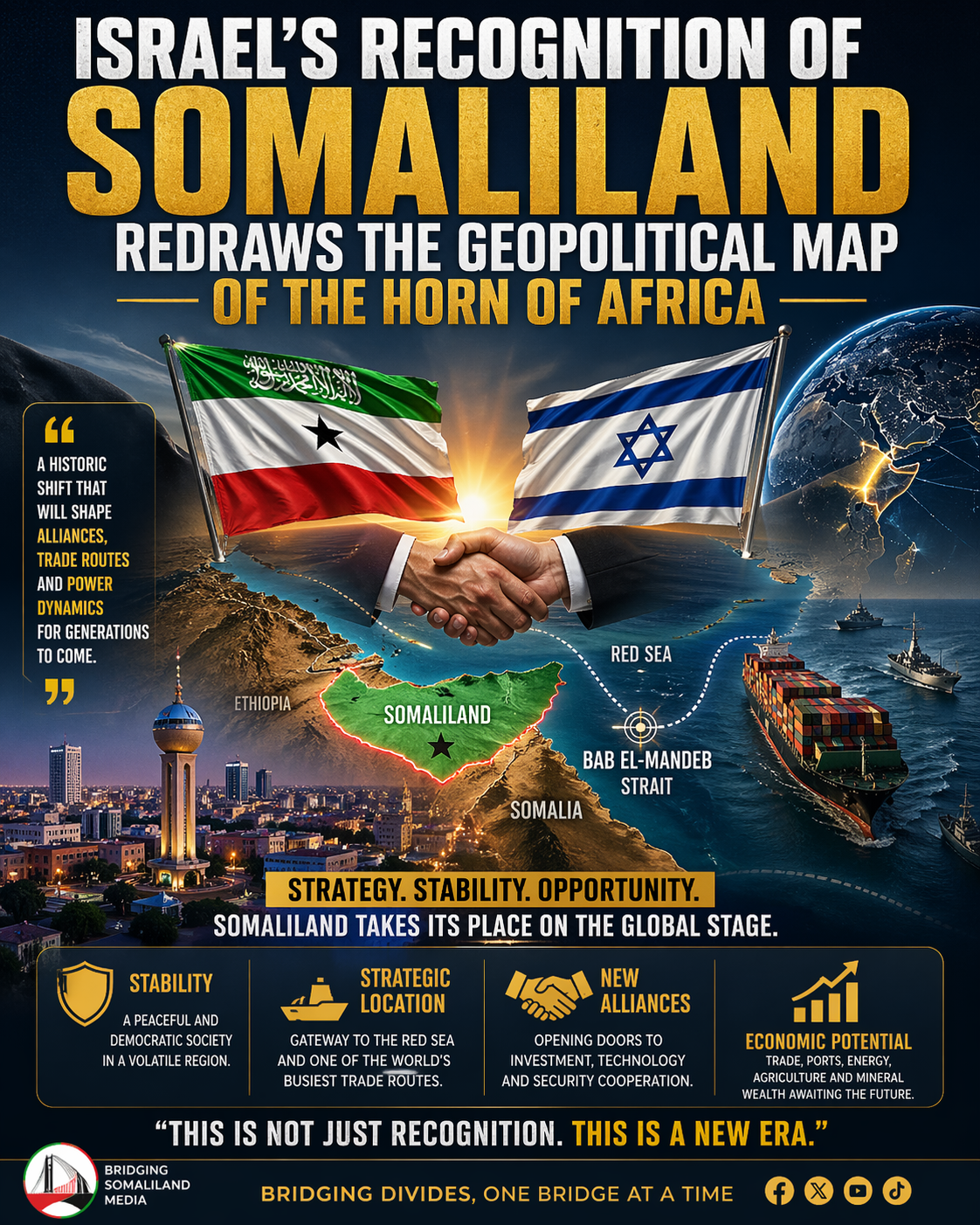
Meanwhile, Israel’s formal recognition of Somaliland in December 2025 fundamentally altered diplomatic calculations across the region. The move shattered a psychological barrier that many governments had quietly maintained for decades. Israel’s recognition demonstrated that Somaliland’s diplomatic isolation was not permanent but political.
Since then, relations between Israel and Somaliland have deepened rapidly through ambassadorial appointments, official visits, and expanding strategic engagement. Reports surrounding quiet diplomatic contacts involving the United Arab Emirates, Greece, Cyprus, and African partners suggest that discussions are now moving beyond whether Somaliland will gain broader recognition toward when and how it will happen.
This shifting alignment helps explain the growing anxiety among regional actors such as Somalia, Egypt, Turkey, and Djibouti, all of whom strongly condemned Israel’s recognition decision. Each of these states understands that Somaliland’s formal emergence as a recognized state would alter the balance of power in the Horn of Africa and the Red Sea.
For Turkey, it would complicate Ankara’s growing influence in Mogadishu. For Egypt, it would introduce a new strategic actor into the Nile and Red Sea security equation amid tensions involving Ethiopia. For Djibouti, it would create a direct competitor to its long-standing monopoly over regional port logistics. For Somalia’s federal government, it would formalize a separation that Mogadishu has diplomatically resisted for decades despite exercising no meaningful authority over Somaliland since 1991.
The argument that Somaliland should be recognized gradually, one country at a time, increasingly appears outdated.
A coordinated multistate recognition initiative would produce a fundamentally different geopolitical effect. Rather than allowing opponents to isolate and pressure individual recognizing states sequentially, simultaneous recognition by multiple countries across Africa, the Middle East, and Latin America would create immediate diplomatic momentum and normalize Somaliland’s statehood within the international system far more rapidly.
Such a move would also send a powerful message that stability, democratic governance, maritime security cooperation, and strategic reliability still matter in international politics.
Critics often warn that recognizing Somaliland could encourage separatist movements elsewhere in Africa. Yet Somaliland’s case is historically unique. It is not attempting to redraw colonial borders; it seeks restoration of sovereignty within the boundaries of the former British Somaliland Protectorate — borders that briefly existed as an internationally recognized state in 1960 before union with Somalia. Somaliland’s case therefore aligns with the African principle of respecting inherited colonial boundaries rather than violating it.
More importantly, refusing recognition despite Somaliland’s extraordinary record risks sending the opposite message: that democratic governance, peace-building, and political maturity offer no path toward international legitimacy, while instability and violence attract endless diplomatic engagement and aid.
That is neither morally sustainable nor strategically wise.
The world is entering a new geopolitical era shaped by maritime competition, supply-chain insecurity, energy corridors, and strategic port access. In that environment, Somaliland is no longer a peripheral question. It is becoming a central strategic actor in one of the world’s most contested regions.
If reports of coordinated recognition efforts prove accurate, May 18 may become remembered not simply as Somaliland’s independence anniversary, but as the moment when the international system finally acknowledged a political reality that has existed for more than three decades.
About the Author