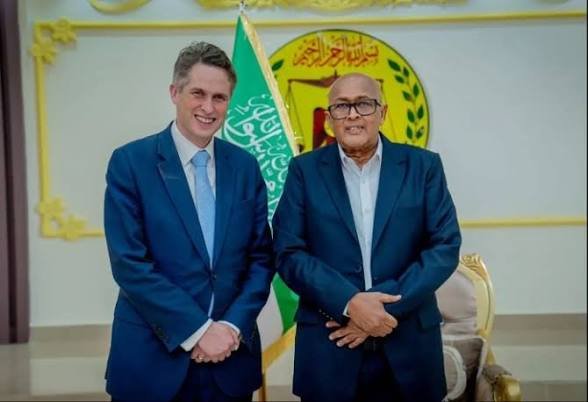
Sir Gavin Williamson’s Relentless Campaign for Recognition Places Him in Somaliland’s Modern History
By Prof. Nassir Hussein Kahin
As fireworks illuminated the skies above Hargeisa during the 35th anniversary celebrations of Somaliland’s restoration of sovereignty on May 18, 2026, one foreign guest stood out among diplomats, ministers, elders, military officers, intellectuals, and thousands of jubilant citizens waving the red, white, and green flag of the Republic of Somaliland.
That man was Sir Gavin Williamson — a British parliamentarian whose name has become deeply woven into Somaliland’s modern diplomatic struggle for international recognition.
For many Somalilanders, Williamson is no longer viewed merely as a foreign politician. He is increasingly regarded as one of the most courageous international advocates ever to champion Somaliland’s cause on the global stage.
His presence in Hargeisa was not ceremonial diplomacy alone. It marked the culmination of years of relentless advocacy in the British Parliament, strategic lobbying in Western political circles, and outspoken support for Somaliland’s right to reclaim the international recognition it voluntarily surrendered in 1960 during its union with Somalia.
Now, history has entered a new chapter.
In a landmark move that electrified Somaliland’s political landscape, Somaliland President Abdirahman Mohamed Abdullahi Irro announced the establishment of the Somaliland Independence Recognition Institute and named Sir Gavin Williamson as its Director and international lead figure tasked with advancing Somaliland’s quest for international recognition.
The announcement was met with thunderous applause across Somaliland and throughout the diaspora.
“This commission,” President Irro declared during the celebrations, “will coordinate Somaliland’s diplomatic, legal, historical, and strategic case for international recognition, and we are honored that Sir Gavin Williamson has accepted this historic responsibility.”
For Somalilanders, the appointment represented something far greater than politics.
It was recognition of loyalty.
It was recognition of moral courage.
And above all, it was recognition that one influential Western statesman chose to stand publicly with a nation long ignored by the international community despite decades of peace, democracy, and stability in one of the world’s most volatile regions.
During his emotional address in Hargeisa, Williamson delivered words that resonated deeply among Somalilanders:
“Somaliland is a beacon of democracy, freedom, and rule of law in the Horn of Africa.”
He went further still, declaring:
“I am deeply privileged to call myself a Somalilander.”
Those words carried extraordinary significance in a society whose people endured one of the darkest chapters in modern African history.
For Somalilanders, the struggle for recognition is inseparable from the trauma of the atrocities committed by the regime of Somali dictator Mohamed Siad Barre during the 1980s.
The Isaaq genocide remains deeply embedded in Somaliland’s national consciousness. Entire cities such as Hargeisa and Burao were reduced to rubble by aerial bombardment. Tens of thousands of civilians were massacred. Mass graves continue to be discovered across the country decades later.
Human rights organizations and scholars have documented the systematic targeting of the Isaaq population through executions, disappearances, torture, and indiscriminate bombings.
Many Somalilanders believe the world abandoned them during those years.
That is why Williamson’s unwavering recognition of Somaliland’s historical suffering has earned him extraordinary respect among ordinary citizens, veterans, intellectuals, and survivors alike.
Unlike many Western politicians who cautiously avoid controversial diplomatic issues, Williamson repeatedly addressed Somaliland’s painful history directly in speeches and parliamentary debates.
He argued that Somaliland’s achievements were even more remarkable because they emerged from genocide, destruction, and state collapse — yet Somaliland rebuilt itself through reconciliation, indigenous peacebuilding, democratic elections, and institution-building without significant international assistance.
To Somalilanders, this acknowledgment matters profoundly.
It validates memory.
It validates sacrifice.
And it validates the legitimacy of Somaliland’s separation from Somalia.
For years, Williamson championed Somaliland inside the British Parliament when few others dared to elevate the issue internationally.
As Chair of the All-Party Parliamentary Group on Somaliland, he pushed for debates urging the United Kingdom to reconsider its long-standing policy toward Somaliland.
He consistently argued that Somaliland met the practical requirements of statehood:
- A permanent population
- Defined territory
- Functioning government
- Capacity to engage internationally
- Democratic legitimacy
- Relative regional stability
But Williamson’s advocacy evolved beyond legal arguments alone.
Drawing from his experience as Britain’s former Defence Secretary, he framed Somaliland as a strategic democratic ally in the increasingly unstable Red Sea corridor and Horn of Africa.
He emphasized Somaliland’s geopolitical importance near the Bab el-Mandeb Strait — one of the world’s most critical maritime trade routes connecting Europe, the Middle East, and Asia.
In strategic circles, this argument carries enormous weight.
As global powers compete for influence across the Red Sea region — including China, Russia, Iran, Gulf states, Turkey, and Western powers — Somaliland’s location has transformed from historical obscurity into geopolitical relevance.
Williamson understands this reality clearly.
To him, Somaliland is not merely a humanitarian case deserving sympathy.
It is a strategically valuable democratic partner deserving recognition.
That distinction could prove decisive in future Western foreign policy calculations.
The timing of Williamson’s appointment is equally historic.
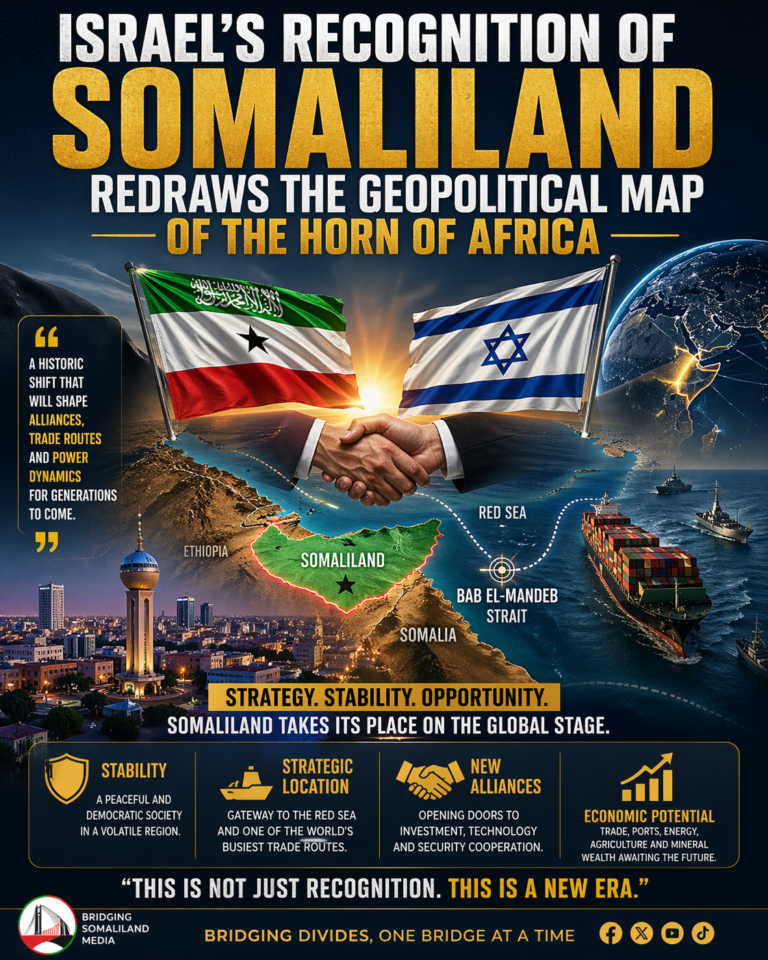
Somaliland’s diplomatic fortunes shifted dramatically after the State of Israel formally recognized Somaliland in late 2025, becoming the first United Nations member state to do so.
That breakthrough shattered a psychological and diplomatic barrier that had existed for more than three decades.
Recognition was no longer theoretical.
It became possible.
Now Somaliland’s leadership appears determined to capitalize on that momentum by building a sophisticated international recognition campaign with Williamson at its forefront.
Across Hargeisa during the May 18 celebrations, citizens openly praised the British politician.
Young Somalilanders took photographs with him in the streets.
Veterans saluted him.
Social media platforms across Somaliland and the diaspora filled with tributes describing him as:
- “A true friend of Somaliland”
- “A defender of justice”
- “A man who stood with us”
- “A statesman history will remember”
Across Somaliland in tea shops, universities, media studios, and political forums, one sentiment echoed repeatedly:
Sir Gavin Williamson chose principle over political convenience.
That matters enormously in Somaliland’s political culture, where loyalty to the national cause is regarded with deep reverence.
His supporters believe history will remember him as one of the first major Western political figures who openly and consistently defended Somaliland’s right to self-determination when much of the world remained silent.
Whether or not immediate international recognition arrives soon, Williamson has already secured something rare in international politics:
The enduring respect and gratitude of a nation that believes its story has too often been ignored.
And as Somaliland enters a new era of diplomatic assertiveness under President Irro’s administration, Sir Gavin Williamson now occupies a unique place in the republic’s unfolding history — not merely as a British politician, but as a foreign statesman who stood beside Somaliland during one of the most consequential chapters of its long struggle for recognition, justice, and sovereignty.
About the Author