July 1st, a Day of Mourning
By Prof. Nassir Hussein Kahin.
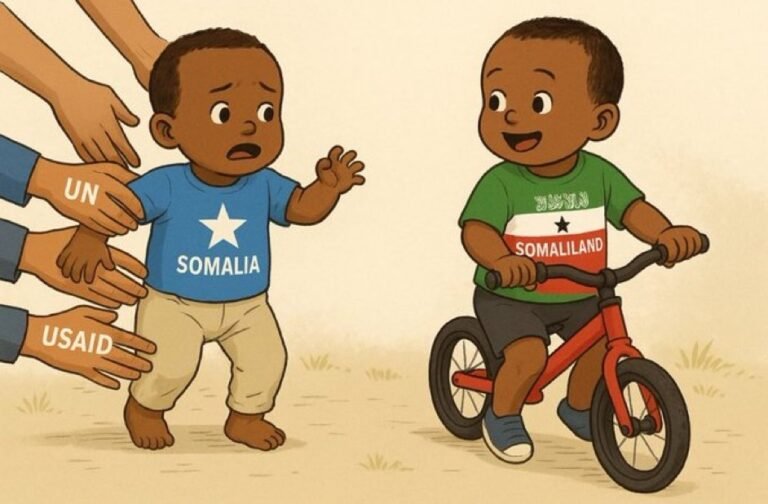
In “Becoming Somaliland”, scholar and author Mark Bradbury chronicles a remarkable and often overlooked political experiment in the Horn of Africa. The book presents an in-depth analysis of how Somaliland, a self-declared independent republic in northern Somalia, has quietly defied the odds to build peace, institutions, and a functioning state from the ashes of civil war—unlike Villa Somalia, without the crutches of international aid or foreign intervention.
At the heart of Bradbury’s work lies a powerful theme: Somaliland’s journey represents a bottom-up, locally driven model of state-building. Rooted in traditional clan-based governance, customary law (xeer), and community consensus, Somaliland’s experience stands in sharp contrast to the internationally led, top-down reconstruction efforts that have failed time and again to this day in Villa Somalia and other post-conflict societies in Africa.
The story begins with the collapse of the Somali Democratic Republic in 1991. As Somalia plunged into chaos, Somaliland’s leaders—drawing on their own history, grievances, and cultural norms—declared restoration of sovereignty and independence. Chapter One introduces this historical backdrop and Bradbury’s core argument: that the stability and political coherence seen in Somaliland are the result of local, indigenous peace processes rather than foreign prescriptions.
Chapter Two delves deeper into the roots of the Somali crisis. Colonial legacies, especially the unification of British Somaliland and Italian Somalia in 1960, that sowed seeds of marginalization and discontent in the north. The subsequent civil war under Siad Barre devastated the region but also reaffirmed the resilience of traditional clan structures and the pastoralist way of life that underpins Somaliland identity.
Unlike the endless series of externally sponsored peace talks in Somalia, Somaliland’s leaders chose a different path. As Chapter Three recounts, peace conferences held in Berbera, Burao, and Borama between 1991 and 1997 were entirely locally organized and funded. Traditional elders, clan leaders, and community representatives came together to demobilize militias, resolve disputes, and agree on transitional governance structures. This process, according to Bradbury, amounted to a “home-grown peacebuilding model” that offered both credibility and legitimacy in the eyes of the people.
In Chapter Four, Bradbury describes how governance emerged in the absence of external support. Somaliland constructed a bicameral system that merged modern representative institutions with customary authority. The House of Representatives is elected by the people, while the Guurti (House of Elders) plays a vital role in conflict mediation and maintaining inter-clan balance. The legal system, too, is a hybrid—blending xeer, Islamic Sharia, and statutory law.
Somaliland’s economic recovery has mirrored its political one: improvised, self-reliant, and grassroots. Chapter Five examines the critical role of livestock exports—especially to Gulf countries—and the lifeline of diaspora remittances, which account for up to 40% of the region’s GDP. While infrastructure remains underdeveloped, the private sector has stepped in to provide basic services and sustain the informal economy. This adaptability, Bradbury argues, is both a strength and a limitation.
Chapter Six focuses on the diaspora, one of Somaliland’s most vital assets. From London to Toronto to Dubai, expatriates have been instrumental in financing peace conferences, lobbying foreign governments, and participating in civil society. Their dual role—as both financial supporters and political influencers—has helped bridge gaps between local and global, tradition and modernity.
Chapter Seven explores Somaliland’s evolution into a democratic polity. Since 2002, the region has held multiple elections—presidential, parliamentary, and local—marking a shift from purely clan-based power-sharing to open political competition. However, challenges persist: political parties are often weak, clan-based voting remains influential, and the representation of women and minorities is minimal. Still, these elections have bolstered Somaliland’s legitimacy, both domestically and on the international stage.
Yet, as Chapter Eight makes clear, Somaliland’s path is far from smooth. Internal clan rivalries and contested territories like Sool and Sanaag continue to threaten stability. Externally, the lack of international recognition severely limits access to aid, investment, and diplomatic engagement. The region also faces pressure from Villa Somalia, Puntland, and a geopolitically divided Horn of Africa.
Despite these formidable challenges, Somaliland endures. Bradbury’s “Becoming Somaliland” is not just a chronicle of survival—it is a compelling case study in how peace and governance can be built from the ground up. By relying on local norms, traditional leadership, and consensual politics, Somaliland has created a functioning, if imperfect, state in one of the world’s most troubled regions.
The world, Bradbury implies, has much to learn from Somaliland. While foreign-led interventions often fail to understand or respect local contexts, Somaliland’s experience shows that sustainable peace is most likely when it grows organically from within.
As debates over recognition continue, “Becoming Somaliland” reminds us that legitimacy, stability, and effective governance cannot be dictated from outside—they must be built by the people themselves.
About the Author