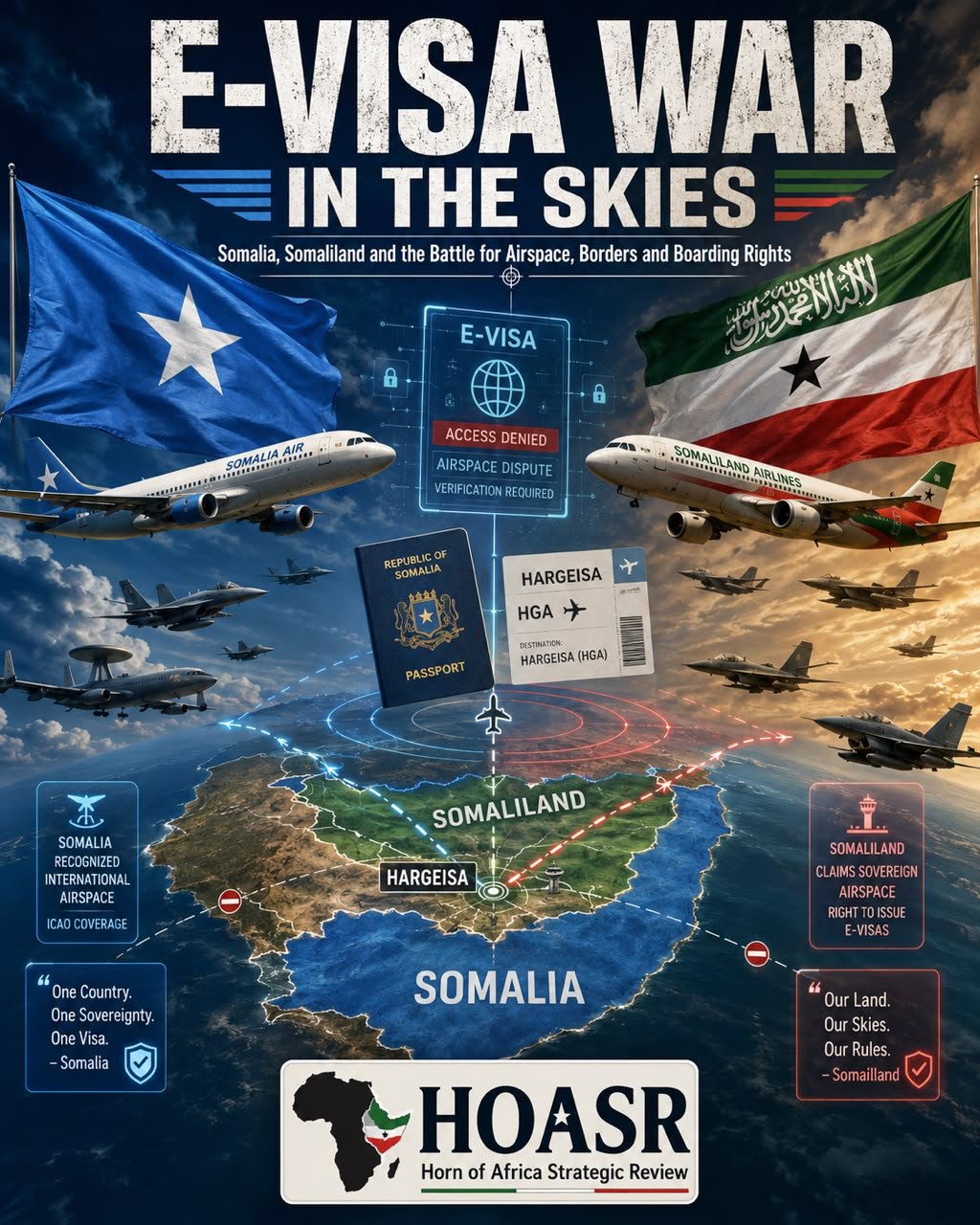
Somalia’s e-Visa requirement for Somaliland-bound passengers has turned airline documentation and airspace management into a wider confrontation over borders, sovereignty and international recognition.
Somaliland, Somalia and the Battle for the Skies
By Prof. Nassir Hussein Kahin
How Somalia’s e-Visa turned an airline boarding requirement into the latest battle over Somaliland’s independence, sovereignty and control of its skies!
A traveler books a flight to Hargeisa.
The passenger is not visiting Mogadishu. The aircraft will not land in Mogadishu. The traveler will not pass through a Somali federal immigration counter, meet a Somali federal border officer or enter territory administered by the government in Mogadishu.
Yet before boarding, the traveler may be told to obtain an electronic visa or travel authorization issued by Somalia.
Upon arrival in Hargeisa, that same document may not be accepted as permission to enter. The passenger must instead comply with Somaliland’s immigration requirements and may be required to purchase a separate Somaliland visa.
The British government’s travel guidance now reflects precisely this contradiction: passengers flying to Hargeisa may be asked to present Somalia’s e-Visa before boarding, but it will not be considered valid for entry when they arrive in Somaliland. They must obtain Somaliland’s own entry visa.
This is not simply bureaucratic confusion.
It is not merely an inconvenience caused by competing websites, poorly informed airline staff or incompatible immigration systems.
It is the latest chapter in a sovereignty dispute that began with two separate territories, two separate colonial histories, a hurried union in 1960, the destruction of that union through dictatorship and mass violence, Somaliland’s restoration of independence in 1991, and an international aviation system that still treats the skies above Somaliland as though political history stopped more than six decades ago.
For travelers, the dispute may appear at the check-in counter.
For Somaliland, it reaches to the foundations of statehood.
The dispute over Somaliland’s airspace is often described as a technical disagreement about aviation administration. It is much more than that. It concerns sovereignty, international recognition, border control, public revenue, passenger data, diplomatic leverage and the practical meaning of Somaliland’s restoration of independence in 1991.
1. Two territories entered 1960 with different legal histories
British Somaliland became the independent State of Somaliland on 26 June 1960. The former Italian Somaliland remained a United Nations Trust Territory administered by Italy until 1 July 1960. On that date, the trust territory became independent and the two territories joined as the Somali Republic. The new republic was admitted to the United Nations on 20 September 1960.
This distinction matters.
British Somaliland was not part of the Italian-administered UN Trust Territory. It entered the proposed union as a separately independent state. The former Italian territory entered independence through the UN trusteeship process.
Therefore, the United Nations did not create one jointly administered “Somali airspace” before independence. Each territory had previously been governed through its own colonial or trusteeship aviation arrangements. After the union, the Somali Republic inherited responsibility for the airspace above both territories as one internationally recognized state.
Under Article 1 of the Chicago Convention, every state has “complete and exclusive sovereignty” over the airspace above its territory. Article 2 connects that airspace to the state’s land territory and territorial waters.
From 1960 until the collapse of the Somali government in 1991, civil aviation was therefore administered by the Somali Republic, not by the United Nations.
2. Sovereignty and air-traffic management are not the same thing
The distinction between airspace sovereignty and air-navigation service provision is central to understanding the dispute.
Airspace sovereignty means the legal authority of a state over the skies above its territory and territorial waters. Air-traffic management means the technical provision of services such as:
* flight information;
* separation of aircraft;
* communications with pilots;
* publication of aeronautical information;
* emergency coordination;
* collection of overflight charges;
* administration of flight plans.
A state may delegate these technical services to another state or organization without transferring sovereignty. The International Civil Aviation Organization (ICAO) itself has emphasized that sovereignty cannot be delegated, although responsibility for providing air-navigation services can be delegated.
This is why the entity operating a Flight Information Region, or FIR, does not necessarily possess sovereignty over every territory covered by that FIR.
The internationally designated Mogadishu Flight Information Region extends across the airspace associated with the former Somali Republic and adjoining oceanic sectors. ICAO and international aviation operators continue to treat it as one FIR. That administrative configuration strongly favors Somalia diplomatically, but an FIR is an aviation service area, not a final judicial determination of territorial sovereignty.
3. Collapse in 1991 and the international caretaker system
After the collapse of the Somali central government in 1991, there was no functioning national authority capable of safely managing the Mogadishu FIR.
Somaliland restored its sovereignty on 18 May 1991 and gradually rebuilt its own institutions, airports, immigration system and civil aviation administration. In southern Somalia, however, political fragmentation and warfare prevented the restoration of national air-navigation services.
To prevent a dangerous vacuum, the United Nations authorized ICAO to act on civil aviation matters concerning Somalia. In May 1996, ICAO established the Civil Aviation Caretaker Authority for Somalia, commonly known as CACAS. It was based in Nairobi, Kenya, rather than Mogadishu or Hargeisa.
The project was funded substantially through air-navigation charges collected from airlines using the Mogadishu FIR. ICAO documents state that the project was based on authority given by the UN Secretary-General and was intended to maintain essential facilities and services for international, humanitarian and local aviation operations.
CACAS performed several functions:
* receiving and processing flight plans;
* providing flight-information services;
* coordinating international overflights;
* supporting airport operations;
* collecting navigation charges;
* maintaining basic communications;
* supporting humanitarian aviation;
* helping preserve the international integrity of the Mogadishu FIR.
In December 2003, CACAS was reorganized into the Flight Information Services for Somalia, or FISS, project. Although the institutional name changed, the fundamental arrangement remained: the FIR continued to be managed from Nairobi under ICAO supervision.
Official Somali aviation documentation now describes the airspace as having been remotely managed under an ICAO-administered project from approximately 1995 until 2018.
4. Somaliland’s fundamental objection
Somaliland’s objection was not simply that ICAO managed the FIR from Nairobi. The original caretaker arrangement was created because no effective Somali national government existed. Somaliland could tolerate international management more readily than management by Mogadishu because ICAO’s role was comparatively neutral.
The political balance changed when the internationally recognized Somali government began demanding that ICAO transfer the entire system to Mogadishu.
Somalia’s position was straightforward:
1. Somalia remained the internationally recognized successor state of the Somali Republic.
2. The Mogadishu FIR was registered internationally under Somalia.
3. Somaliland was, in Somalia’s view, a region of the Federal Republic of Somalia.
4. Therefore, Somalia’s federal government was entitled to resume administration of the entire FIR.
Somaliland’s position was fundamentally different:
1. The 1960 union joined two formerly separate territories.
2. Somaliland withdrew from that failed union and restored the sovereignty it had possessed on 26 June 1960.
3. Mogadishu had exercised no governmental authority in Somaliland since 1991.
4. Somaliland controlled its own airports, immigration, internal security and aviation infrastructure.
5. Transferring airspace management to Mogadishu would allow Somalia to acquire through ICAO administration a sovereignty that it did not exercise on the ground.
For Somaliland, the transfer was therefore not an ordinary technical handover. It represented international recognition, in practice, of Mogadishu’s jurisdiction over Somaliland.
5. The 2013 Istanbul agreement
The most important negotiated compromise emerged during the Somaliland–Somalia talks hosted by Turkey.
In July 2013, the parties agreed in the Istanbul II Communiqué to establish a body that would jointly control or manage the airspace associated with Somalia and Somaliland. Crucially, the body was to be located in Hargeisa.
The proposed arrangement was politically ingenious, at least in theory.
For Somalia, it avoided formally recognizing Somaliland as an independent state. For Somaliland, locating the authority in Hargeisa would prevent Mogadishu from exercising exclusive control and would acknowledge Somaliland as an indispensable and equal participant in airspace administration.
The anticipated institution is often described as a joint air-traffic control board or joint airspace management authority. Its likely responsibilities would have included:
* administration of the FIR;
* allocation of revenues;
* training of controllers;
* development of technical infrastructure;
* coordination with ICAO and IATA;
* aviation safety oversight;
* resolution of operational disputes.
But the agreement was never properly implemented.
Somaliland accused Somalia of abandoning the Hargeisa-based joint arrangement while continuing to press ICAO for a direct transfer to Mogadishu. Somalia, conversely, maintained that responsibility belonged to its internationally recognized federal government and resisted any arrangement that appeared to confer state-like equality on Somaliland.
The disagreement exposed the central weakness of the talks: the two parties were discussing an aviation mechanism while holding mutually exclusive understandings of their relationship.
Somalia regarded the negotiations as discussions between a central government and a constituent territory. Somaliland regarded them as talks between two political entities that had entered—and later exited—a union.
6. Why the joint mechanism failed
Several factors prevented implementation.
First, neither side trusted the other’s interpretation of the agreement. Somaliland believed the joint board was intended to prevent unilateral control by Mogadishu. Somalia treated joint participation as a temporary accommodation that could not override Somalia’s international legal personality.
Second, air-navigation revenue was significant. Overflight charges produced income, employment and institutional leverage. Control of the FIR meant control over fees collected from international airlines.
Third, the location of the control center carried symbolic weight. A Hargeisa-based institution would have demonstrated that Somalia could not administer Somaliland’s skies without Somaliland’s agreement. A Mogadishu-based center suggested the opposite.
Fourth, ICAO is a specialized agency composed of recognized states. Because Somalia is an ICAO contracting state and Somaliland was not independently admitted to the organization, Mogadishu possessed the stronger formal position.
Fifth, Somaliland had not yet built the complete internationally certified technical architecture required to replace the FIR system independently. It controlled airports and lower-level local aviation operations, but high-altitude en-route control requires certified controllers, secure communications, surveillance equipment, redundancy, international coordination and globally accepted aeronautical publications.
7. The transfer to Mogadishu
The transition process accelerated after Somalia established a federal government in 2012. But the creation of the federal government was not itself the final transfer of operational control.
ICAO initiated a transition project intended to move services from Nairobi to Somalia while maintaining safety and continuity. ICAO documentation from 2015 describes a project designed to transfer the Mogadishu FIR from the Nairobi-based FISS project to the Federal Government of Somalia.
The handover became operational Tin late 2017 and early 2018. Somalia announced that it had regained control of its airspace after approximately 27 years of management from Nairobi. ICAO continued to provide technical guidance during the transition. Documents from 2018 refer to the Mogadishu Flight Information Centre and continued ICAO assistance with operational changes, communications and air-traffic control services.
From Somaliland’s perspective, the transfer violated the spirit and substance of the Istanbul agreement because:
* the agreed joint authority was not established in Hargeisa;
* revenue was placed under Mogadishu’s authority;
* Somaliland was not given an equal institutional role;
* international airlines increasingly received instructions through Mogadishu;
* Somalia gained a practical instrument for asserting jurisdiction over Somaliland.
From ICAO’s institutional perspective, however, the transfer was made to the government recognized internationally as responsible for the Mogadishu FIR. ICAO does not normally adjudicate competing claims to statehood. It operates through its contracting states and the decisions of the wider international system.
8. Somaliland still controls important parts of aviation on the ground
Mogadishu’s management of the FIR does not mean Somalia physically controls Somaliland’s airports.
Somaliland continues to exercise effective authority over:
* Hargeisa Egal International Airport;
* Berbera Airport;
* local airport security;
* runway access;
* customs and immigration;
* landing authorizations;
* local aviation administration;
* visas on arrival and entry permission;
* domestic security around aviation facilities.
Thus, two layers of authority coexist.
Somaliland exercises territorial and airport control on the ground. Somalia exercises internationally recognized administrative authority over the larger FIR and upper-airspace services.
This divided reality is the source of repeated confrontation. A flight may require air-traffic coordination through the Mogadishu FIR while still requiring Somaliland’s permission to land at Hargeisa or Berbera.
In late 2025, the dispute reportedly escalated further, with Somaliland announcing requirements for prior authorization for overflights while Somalia reaffirmed control over the whole Mogadishu FIR. Aviation-risk analysts warned that competing instructions could create safety concerns if pilots received conflicting climb, descent or routing directions.
Any Somaliland strategy must therefore avoid actions that could produce contradictory cockpit instructions. Political assertion must not endanger civil aviation.
9. The e-visa dispute: immigration policy used as a sovereignty instrument
Somalia introduced a mandatory electronic visa and travel-authorization system in 2025. Mogadishu presented it as a modernization measure intended to enhance border security, improve transparency and standardize immigration procedures. Somalia’s official eTAS portal states that travelers intending to enter Somalia must obtain electronic authorization.
The dispute arose when Somalia and some airline or travel-information systems treated that requirement as applying to passengers whose actual destination was Somaliland.
Somaliland rejected the system, stating that:
* Somalia-issued visas are not valid for entry into Somaliland;
* Somaliland operates its own immigration system;
* passengers arriving at Hargeisa or Berbera must comply with Somaliland law;
* travelers should obtain Somaliland visas or visas on arrival;
* Mogadishu has no personnel at Somaliland’s border posts or airports.
Somaliland’s Ministry of Foreign Affairs currently states that Somalia-issued visas or travel authorizations are not valid for entry into Somaliland.
British travel guidance illustrates the resulting contradiction. It warns that travelers flying to Hargeisa may be asked by an airline to show a Somalia e-visa before boarding, but that the document will not be accepted as the actual entry visa upon arrival in Hargeisa, where a separate Somaliland visa must be purchased.
This produces an extraordinary situation: a passenger may be required to pay one government for permission to board an aircraft and another authority for permission to enter the territory.
Why the e-visa is politically explosive in Somaliland
For Somalilanders, the requirement is not merely an inconvenience.
It allows Somalia to:
* register foreign travelers going to Somaliland;
* collect personal and passport data;
* collect fees from passengers not entering territory Somalia controls;
* produce statistical records suggesting that travelers entered “Somalia”;
* pressure airlines to recognize Mogadishu’s jurisdiction;
* reinforce Somalia’s sovereignty claim through digital infrastructure;
* potentially track diplomats, businesspeople, investors and officials visiting Somaliland.
This is especially sensitive after more than three decades in which Somaliland has presented its independent control of borders as evidence of effective statehood.
A state’s border-control system is one of the most visible manifestations of sovereignty. If Mogadishu can oblige passengers bound for Hargeisa to obtain its authorization, it can claim that Somaliland’s external borders remain legally subordinate to Somalia even though Somaliland administers those borders in practice.
The China claim requires qualification
There is clear evidence that China strongly supports Somalia’s territorial-integrity position and opposes international recognition of Somaliland. China has also praised Somalia’s measures against Taiwan in disputes arising from Taiwan’s relationship with Somaliland.
There is also a plausible strategic convergence:
* Somaliland maintains official relations with Taiwan;
* China regards Taiwan as part of China;
* Somalia regards Somaliland as part of Somalia;
* Beijing and Mogadishu reinforce one another’s territorial-integrity narratives;
* Somalia has used aviation and immigration measures against Taiwanese travelers;
* China has publicly supported Somalia’s sovereignty claims.
The e-visa policy is consistent with the sovereignty strategy encouraged by Somalia’s close political alignment with China, but direct Chinese authorship or operational advice has not been publicly demonstrated.
10. International law: what Somaliland can and cannot claim today
Somaliland’s historical case is unusually strong compared with many separatist territories because it claims the restoration of the borders of a formerly independent colonial territory rather than the creation of entirely new borders.
Nevertheless, the practical international aviation system remains state-centered.
Somalia is:
* a recognized UN member state;
* an ICAO contracting state;
* internationally recorded as responsible for the Mogadishu FIR;
* able to issue aeronautical information through internationally accepted channels;
* recognized by airlines and aviation organizations as the formal state authority.
Somaliland has:
* effective control of most of the territory it claims;
* functioning airports and aviation institutions;
* an independent immigration system;
* direct relations with foreign governments;
* a growing record of external security cooperation;
* formal recognition from Israel since December 2025, but not yet sufficiently broad recognition to displace Somalia within ICAO’s institutional framework.
Recognition by one state is strategically important, but ICAO membership and FIR restructuring usually require broader international acceptance and technical agreements with neighboring aviation authorities.
11. What Somaliland can learn from Kosovo
Kosovo offers a useful model.
After the 1999 conflict, the NATO-led Kosovo Force assumed responsibility for the control, coordination and use of Kosovo’s airspace. Kosovo did not immediately exercise complete independent control of all aviation services.
In 2014, Kosovo’s upper airspace was reopened for civilian overflights. Hungary’s air-navigation service provider, HungaroControl, was assigned to provide control services above approximately 21,000 feet under arrangements facilitated by NATO and KFOR.
Hungary’s provision of services did not mean that Hungary claimed sovereignty over Kosovo. NATO documentation specifically distinguishes the technical service function from sovereign authority.
The Kosovo lesson is that disputed status need not prevent safe and internationally accepted airspace arrangements. A politically neutral or friendly third party can provide technical air-navigation services while final-status disputes remain unresolved.
For Somaliland, an equivalent arrangement might involve:
* an internationally supervised Somaliland airspace sector;
* technical management from Hargeisa;
* temporary service provision by a recognized foreign air-navigation authority;
* ICAO auditing and safety supervision;
* a clear separation between service provision and final sovereignty claims.
Possible partners could include Ethiopia, the UAE, Israel, Kenya or a European aviation provider, but the partner would need international credibility and the capacity to coordinate safely with adjacent FIRs.
12. What Somaliland can learn from Taiwan
Taiwan presents a different lesson.
Taiwan is excluded from formal ICAO membership because of the People’s Republic of China’s diplomatic position, yet Taiwan operates the Taipei Flight Information Region, one of the world’s busiest aviation zones. ICAO working papers submitted by Taiwan’s diplomatic partners emphasize the Taipei FIR’s importance to Asia-Pacific aviation and Taiwan’s professional aviation capabilities.
Taiwan demonstrates that:
* full UN membership is not technically necessary to operate sophisticated air-traffic services;
* de facto control, infrastructure and professional capacity matter;
* airlines will cooperate with an authority that reliably provides essential services;
* international exclusion can be partly mitigated through bilateral and technical networks;
* aviation legitimacy can develop through performance even when diplomatic recognition is incomplete.
But Taiwan’s circumstances are also exceptional. It inherited established state institutions, a mature air force, advanced aviation infrastructure, a historic FIR and substantial economic leverage. Somaliland cannot simply declare a new FIR and expect airlines to accept it.
The relevant Taiwan lesson is therefore not unilateral proclamation. It is institution-building.
Somaliland must become technically indispensable before it can become institutionally unavoidable.
13. A realistic strategy for Somaliland to reclaim airspace administration
Phase one: establish technical credibility
Somaliland should build a fully professional and independently auditable civil aviation authority.
Priority requirements include:
* ICAO-compliant civil aviation legislation;
* separation of regulatory and airport-operating functions;
* certified air-traffic controllers;
* an area-control or flight-information center in Hargeisa;
* radar or advanced ADS-B surveillance;
* secure VHF and satellite communications;
* meteorological services;
* search-and-rescue coordination;
* aeronautical information management;
* incident-reporting and safety-management systems;
* cybersecurity protection;
* backup power, communications and disaster-recovery facilities.
International aviation will respond more positively to an evidence-based safety case than to political declarations alone.
Phase two: document the 2013 breach
Somaliland should publish a legal and diplomatic white paper containing:
* the complete Istanbul II Communiqué;
* records of subsequent technical meetings;
* Somaliland’s proposed implementation arrangements;
* correspondence with ICAO;
* evidence that the Hargeisa-based joint authority was never created;
* records concerning air-navigation revenues;
* the timeline of the transfer from Nairobi to Mogadishu;
* Somaliland’s formal objections;
* operational consequences for passengers and airlines.
The argument should be that ICAO and Somalia proceeded with a transfer despite an unresolved political agreement concerning joint management.
This would not automatically reverse the transfer, but it would establish a coherent diplomatic record.
Phase three: demand transparency concerning revenues
Somaliland should seek an independent account of:
* total overflight charges collected from the Mogadishu FIR;
* the share attributable to routes crossing Somaliland’s land territory and adjacent waters;
* expenditures on infrastructure in Somaliland;
* controller training allocated to Somaliland;
* ICAO project revenues and liabilities;
* Somalia’s post-transfer accounting mechanisms.
The demand for revenue transparency is politically powerful because it shifts the debate from abstract recognition to measurable questions of equity and service provision.
Phase four: propose a Somaliland Airspace Sector
Rather than initially demanding immediate reconfiguration of the entire Mogadishu FIR, Somaliland could propose a defined Somaliland Airspace Sector corresponding broadly to its land territory and territorial waters.
The sector could initially remain technically coordinated within the broader regional FIR architecture while services are gradually transferred to Hargeisa.
This approach would separate three questions:
1. Who is sovereign?
2. Who provides aviation services?
3. How should the larger FIR be technically organized?
Such separation made the Kosovo arrangement possible.
Phase five: revive the Hargeisa-based joint mechanism—with guarantees
Somaliland could offer to revive the 2013 agreement only under stronger conditions:
* the control center must be physically located in Hargeisa;
* staffing must be equally appointed;
* revenues must be independently audited;
* neither party may use the arrangement as evidence prejudicing final political status;
* ICAO or another neutral party must supervise implementation;
* disputes must be referred to agreed international mediation;
* Somalia must cease using aviation systems to enforce immigration jurisdiction over Somaliland;
* Somaliland must guarantee uninterrupted safe passage for international civil aviation.
This would test whether Mogadishu genuinely seeks cooperation or merely exclusive jurisdiction.
Phase six: pursue a Kosovo-style third-party arrangement
If bilateral negotiations fail, Somaliland should seek a recognized partner such as Israel or U.A.E. to provide temporary upper-airspace services on its behalf.
A potential model would be:
* Somaliland controls airports, approach services and lower airspace;
* an internationally recognized foreign air-navigation provider manages upper-airspace traffic;
* a Hargeisa-based coordination center gradually assumes responsibility;
* ICAO audits the system;
* neighboring FIRs sign technical coordination agreements;
* all arrangements are explicitly without prejudice to final political status.
Phase seven: use recognition strategically
Each state recognizing Somaliland should be asked to undertake practical aviation measures, not merely issue political statements.
Recognizing states like Israel could:
* accept Somaliland-issued visas and travel documents;
* instruct their airlines that Somalia’s e-visa is not required for direct travel to Somaliland;
* negotiate bilateral air-services agreements with Somaliland;
* provide air-traffic control training;
* recognize Somaliland’s civil aviation authority;
* sponsor Somaliland participation in ICAO technical meetings;
* support an independent aviation safety audit;
* establish direct routes to Hargeisa or Berbera;
* support restructuring of the relevant airspace sector.
Recognition becomes operationally meaningful when it changes airline practice.
14. Responding to the e-visa policy
Somaliland’s most effective response would combine diplomacy, technology and commercial pressure.
First, it should maintain an authoritative multilingual travel portal setting out Somaliland’s entry requirements.
Second, it should negotiate directly with Ethiopian Airlines, flydubai, Air Arabia, Kenya Airways, Israel Airlines and other carriers serving or considering Somaliland. Airlines rely heavily on the IATA Timatic system used at check-in desks. Somaliland must ensure that Timatic clearly distinguishes Hargeisa and Berbera from destinations controlled by Somalia.
Third, Somaliland should issue formal notices to foreign ministries and civil aviation authorities explaining that:
* Somalia e-visas are not valid at Somaliland ports of entry;
* Somaliland authorities alone conduct immigration inspection;
* passengers may otherwise pay twice;
* unnecessary submission of personal data presents privacy and cybersecurity risks;
* airlines should not deny boarding to passengers who possess valid Somaliland travel authorization.
Fourth, Somaliland should provide electronic pre-travel authorization of its own. Reliance exclusively on visa-on-arrival procedures may make airlines more susceptible to Mogadishu’s claim that passengers need prior approval. A secure Somaliland electronic travel authorization would give passengers documentary proof before departure.
Fifth, Somaliland could challenge misleading airline practices through consumer-protection regulators in the countries where the carriers operate.
15. What Somaliland should avoid
Somaliland should not issue conflicting tactical instructions to aircraft already under recognized en-route control. Dual or contradictory air-traffic commands could endanger passengers and damage Somaliland’s international credibility.
It should also avoid attempting to collect navigation charges without a transparent and technically recognized system. Airlines will resist double billing, and any perceived coercion will be portrayed as a safety threat.
Most importantly, Somaliland should avoid making claims that cannot be proven——when the stronger, demonstrable case is already available: Somalia is using internationally recognized aviation and immigration mechanisms to extend a sovereignty claim into territory it does not govern.
The airspace dispute reveals the central contradiction in Somaliland’s international position.
Somaliland controls the land, airports, immigration desks and security institutions within its territory. Somalia controls the internationally recognized legal channels through which global aviation is organized. One possesses effective territorial authority; the other possesses multilateral recognition.
The 2013 Hargeisa-based joint airspace agreement offered a possible bridge between those realities. Its non-implementation and the subsequent transfer of FIR management to Mogadishu converted air-traffic administration into a weapon of statehood politics.
The e-visa controversy is the newest expression of the same struggle. Through airline databases, passenger authorizations and aviation notices, Somalia can project a digital jurisdiction that it cannot exercise physically in Hargeisa or Berbera.
Somaliland is unlikely to reclaim internationally accepted upper-airspace administration through unilateral declarations alone. Its strongest route is a phased strategy combining technical capacity, legal documentation, recognition diplomacy, airline agreements and a Kosovo-style third-party service arrangement.
Taiwan demonstrates that an excluded political entity can nevertheless operate a highly credible international aviation system. Kosovo demonstrates that disputed sovereignty can be separated from technical service provision. Meanwhile, Somaliland’s task is to adapt both lessons: build Taiwan-level operational credibility while pursuing a Kosovo-style transitional architecture.
The decisive principle is simple: Somaliland must transform its airspace claim from a political assertion into an internationally usable aviation system.
And until the world addresses that reality, every passenger forced to obtain Mogadishu’s permission to travel to Hargeisa will carry more than a visa.
They will carry the unresolved history of two states, one failed union and a sovereignty dispute now being fought through the digital gates of international aviation.

Prof. Nassir Hussein Kahin is a researcher, educator, journalist, and geopolitical analyst specializing in the Horn of Africa, the Red Sea, international law, diplomacy, and strategic affairs. To read Full Bio click on this link: ABOUT THE AUTHORProf. Nassir Hussein Kahin