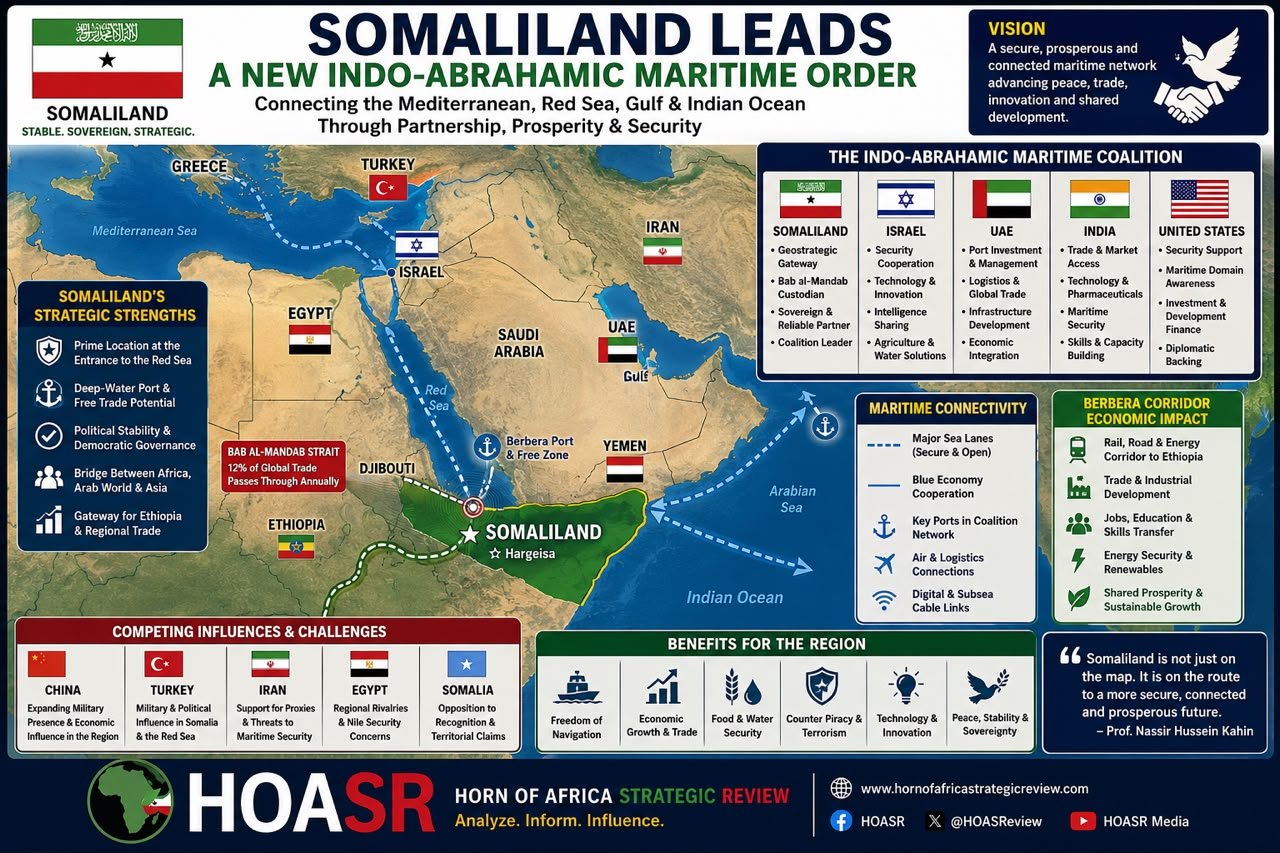
Berbera’s strategic location places Somaliland at the crossroads of emerging maritime partnerships linking Africa, the Middle East and the Indo-Pacific
By Prof. Nassir Hussein Kahin
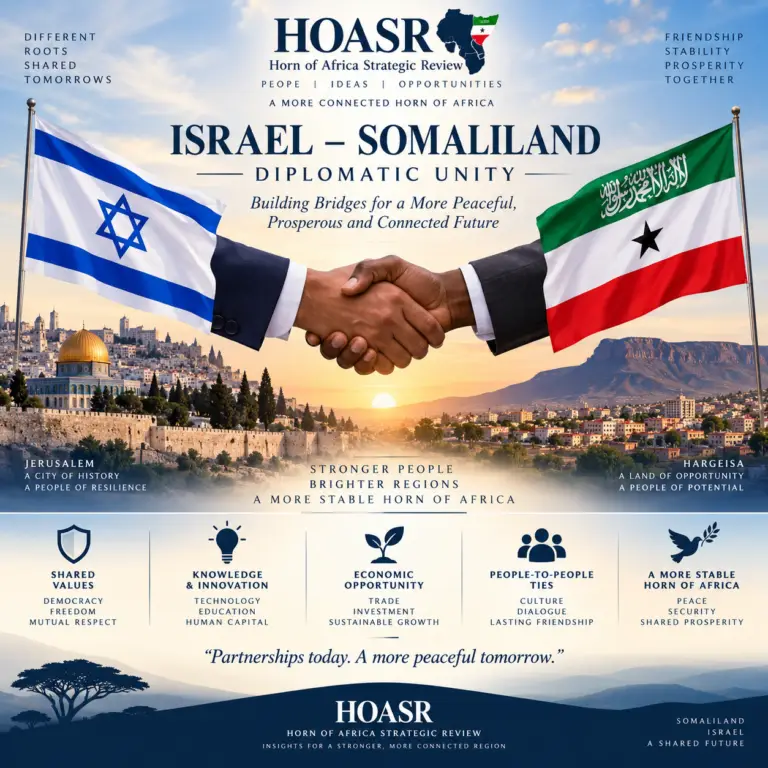
Israel’s recognition of Somaliland was a major diplomatic breakthrough. But its real importance may lie in what follows.
The new relationship between Jerusalem and Hargeisa could become part of a much wider strategic network linking the Mediterranean Sea, the Red Sea, the Gulf of Aden and the Indian Ocean. If carefully developed, the Israel–Somaliland partnership could give Somaliland an important role in an emerging order involving Israel, the United Arab Emirates, India and, potentially, the United States.
This would not necessarily be a formal military alliance. It would be a practical partnership based on shared interests: secure shipping routes, modern ports, trade, technology, intelligence cooperation, food production, energy security and protection of the seas.
Somaliland would not join such a framework simply because it deserves international recognition. It would join because of its strategic location, political stability and growing importance to regional security.
The central question is therefore no longer whether Israel’s recognition matters. It clearly does. The more important question is whether that recognition can become the foundation of a broader maritime and economic partnership.
Recognition should be the beginning, not the end
For many years, Somaliland’s foreign policy focused mainly on gaining international recognition. That struggle remains important. Additional recognition would strengthen Somaliland’s legal position, attract investors and reduce uncertainty surrounding international agreements.
However, recognition should not be viewed as the final achievement.
The long-term value of recognition will depend on whether Somaliland can turn diplomatic support into practical gains. These gains should include investment, infrastructure, education, security partnerships, technology transfer and access to international markets.
Somaliland must therefore move from a diplomacy of recognition to a diplomacy of strategic integration.
This means becoming useful to powerful partners while protecting its own sovereignty and national interests.
A country becomes difficult to ignore when other states depend on its ports, markets, institutions, security cooperation and geographic position. Somaliland’s future strength will not come only from the number of countries that recognize it. It will also come from becoming an essential partner in the Red Sea and the Horn of Africa.
What is an Indo-Abrahamic order?
The term “Indo-Abrahamic” refers to the growing cooperation among India, Israel and the United Arab Emirates.
These countries are very different in history, religion, political culture and geography. Yet they share several major interests.
India wants secure trade routes, reliable energy supplies and stronger access to the Gulf, the Middle East and Europe.
Israel wants regional partnerships, economic integration, access to Asian markets and protection of its shipping routes through the Red Sea.
The UAE wants to strengthen its position as a global centre for trade, ports, finance, transport and logistics.
The United States has also encouraged closer cooperation among India, Israel and the UAE through the I2U2 group. That framework focuses on food security, energy, technology, transport, investment and private-sector development.
This model is important because it is not based only on military cooperation. It is based on economic connectivity.
The same logic can be seen in the India–Middle East–Europe Economic Corridor, which is intended to connect India with the Gulf, Israel and Europe through ships, railways, energy systems and digital infrastructure.
However, these emerging projects have one major weakness: they lack a strong African base near the southern entrance to the Red Sea.
Somaliland could fill that gap.
Somaliland as the African gateway
Somaliland lies along the Gulf of Aden, close to the Bab al-Mandab Strait. This is one of the most important maritime routes in the world. Ships passing through the strait connect the Indian Ocean with the Red Sea, the Suez Canal and the Mediterranean.
The location has become even more important because of war, piracy, regional competition and attacks on commercial shipping.
The port of Berbera gives Somaliland a natural advantage. It can serve not only Somaliland’s economy, but also Ethiopia and the wider Horn of Africa.
This places Somaliland at the meeting point of several strategic interests.
The UAE already has major commercial interests in Berbera through DP World.
Israel has a direct interest in protecting Red Sea shipping and maintaining access to the port of Eilat.
India depends heavily on secure maritime trade between Asia, the Middle East and Europe.
Ethiopia needs access to reliable ports because it is landlocked.
The United States also wants secure shipping routes, stable partners and alternatives to excessive dependence on a small number of military and commercial facilities in the region.
Somaliland therefore has the potential to become the African gateway of a wider Indo-Abrahamic maritime system.
Berbera can become more than a port
Berbera should not be seen only as a place where ships load and unload cargo.
It could become a full strategic and commercial centre.
A future Berbera maritime complex could include expanded port facilities, a free-trade zone, warehouses, cold-storage systems, fuel reserves, ship-repair services, coastguard installations, aviation facilities, customs centres, digital infrastructure and maritime surveillance systems.
Different partners could contribute in different ways.
The UAE could provide capital, port expertise, international shipping connections and logistics management.
Israel could provide water technology, desalination systems, cybersecurity, agricultural innovation, medical expertise and coastal surveillance technology.
India could contribute information technology, pharmaceuticals, technical education, industrial equipment and maritime training.
The United States could provide coastguard training, investment guarantees, intelligence cooperation and support for maritime security.
Somaliland would provide the location, legal authority, local security, political partnership and access to Ethiopia.
This model would offer much greater value than simply allowing foreign powers to use Somaliland as a military base.
A base may provide short-term revenue. A complete maritime economy could create employment, institutions, professional skills, infrastructure and long-term national strength.
Ethiopia is essential to the project
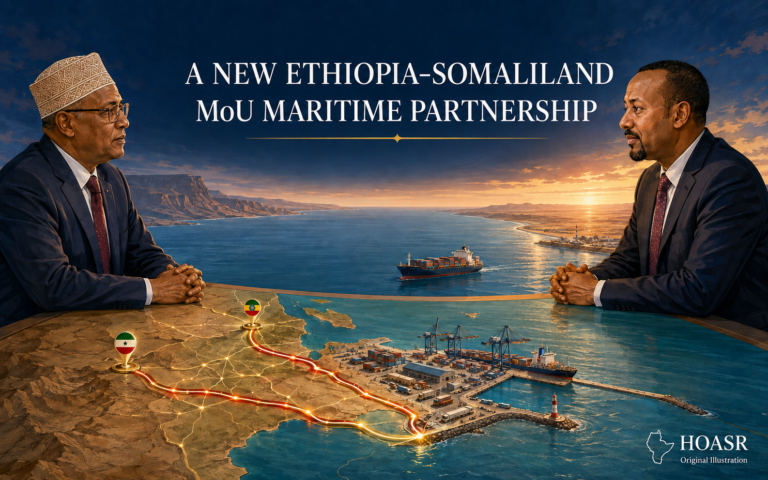
No major Berbera-based economic strategy can succeed without Ethiopia.
Ethiopia has a large population, a growing market and a constant need for port access. Somaliland, in turn, needs a large commercial hinterland to make Berbera more competitive.
The Berbera Corridor could therefore connect Somaliland’s coast with Ethiopia’s markets, farms, industries and transport networks.
Ethiopian products could be exported through Berbera. Indian, Israeli and Emirati companies could establish processing centres, storage facilities and industrial projects along the corridor. Agricultural technology could improve production in both Somaliland and Ethiopia.
Digital cables, energy links and improved roads could strengthen the connection between the port and inland markets.
However, this relationship must be based on clear agreements and mutual respect.
Somaliland should not give away political control in exchange for commercial traffic. Any arrangement with Ethiopia must recognize Somaliland’s authority over its ports, territory, laws and customs systems.
Somaliland should act as a sovereign commercial partner, not merely as a route to the sea.
This must not become an anti-Muslim alliance: Read more at:
Somaliland Antisemitism Propaganda: Defending Unity After Israel Ties
Somaliland must also be careful regarding how this strategy is presented.
Opponents may try to describe an Indo-Abrahamic partnership as an Israeli-led alliance against Muslim or Arab countries. That would be both misleading and dangerous.
Somaliland is a Muslim country with deep religious, cultural and commercial ties to the Arabian Peninsula. Its relationship with Israel should not require hostility toward Arab societies or the Palestinian people.
The proposed partnership should be presented in practical terms.
Its purpose should be to protect trade, improve ports, strengthen food security, fight piracy, develop technology and create jobs.
It should not be built around religion, ideology or permanent hostility toward other countries.
Somaliland should remain open to cooperation with Saudi Arabia, Kenya, Ethiopia, Greece, Cyprus, European countries and any other government willing to respect its sovereignty.
The strongest strategic position is not dependence on one bloc. It is the ability to build several partnerships without surrendering national independence.
A region of competing powers
Somaliland’s growing importance must also be understood within the wider struggle for influence in the Horn of Africa and the Red Sea.
China has established a military base in Djibouti and has invested heavily in infrastructure across Africa.
Turkey has developed strong military, economic and political relations with Somalia.
Egypt views the Horn of Africa through its rivalry with Ethiopia and its concerns over the Nile.
Iran and the Houthis have shown that they can threaten international shipping and disrupt trade through the Red Sea.
Somalia continues to oppose Somaliland’s recognition and receives diplomatic support from several Arab, African and Islamic countries.
These competing interests create both opportunity and danger.
Somaliland is no longer operating at the edge of international politics. It is becoming part of a highly contested strategic region.
This means Somaliland must think carefully before entering security agreements.
Outside powers may seek access to Somaliland for their own conflicts. Hargeisa must ensure that cooperation with foreign states strengthens Somaliland rather than turning its territory into a battlefield.
The risk of excessive militarization
Somaliland needs strong security partnerships. It must protect its coastline, ports, airspace and territorial integrity.
It also has legitimate reasons to cooperate against piracy, terrorism, arms trafficking and attacks on commercial shipping.
But there must be a clear difference between defensive cooperation and participation in foreign wars.
If Somaliland becomes an open platform for military attacks against Yemen or other regional actors, it could face retaliation. Its ports, airports and population could become targets.
This would also allow opponents to claim that Somaliland exchanged strategic access for recognition.
That perception would be damaging even if it were not true.
Somaliland must therefore establish firm legal safeguards for all foreign military agreements.
Parliamentary approval, public accountability, environmental protections, defined mission limits and clear legal authority should be required.
The main goal should be to strengthen Somaliland’s own coastguard, air defence, intelligence institutions and emergency services.
Somaliland should become a provider of security, not simply a location used by others.
What each partner would gain
A successful Indo-Abrahamic maritime partnership could offer clear benefits to all sides.
Israel would gain a friendly partner near the southern Red Sea and better access to the Horn of Africa.
The UAE would protect and expand its investments in Berbera while strengthening its regional logistics network.
India would gain another commercial connection near an important global shipping route.
Ethiopia would gain wider access to international markets through an additional port corridor.
The United States would gain a relatively stable security partner in a strategic location.
Somaliland would gain investment, diplomatic support, technology, training, employment and stronger security institutions.
However, Somaliland would also carry the greatest local risk because the ports, airports and facilities would be located on its territory.
For that reason, Somaliland must negotiate carefully and from a position of national confidence.
A Somaliland doctrine for foreign partnership
Somaliland needs a clear national doctrine to guide its relations with foreign powers.
First, recognition must not be treated as a favour that allows another country to demand unlimited access.
Somaliland’s sovereignty must remain unconditional.
Second, every security agreement should include economic benefits. Foreign partnerships should create jobs, education, infrastructure and technology transfer.
Third, Somaliland must retain legal and operational authority over its territory.
Fourth, it should avoid dependence on a single outside power.
Fifth, major agreements should be transparent and subject to public and parliamentary oversight.
Sixth, the benefits of foreign investment should reach all regions and communities, not only a narrow political or commercial elite.
These principles would allow Somaliland to cooperate internationally without losing strategic independence.
From the Red Sea to the Indian Ocean
A future Indo-Abrahamic maritime order would be a network rather than a single alliance.
It could connect Israel’s ports, the UAE’s logistics centres, Berbera, Ethiopia and India’s western coastline.
This network could later connect with existing trade and infrastructure projects linking India, the Gulf, Israel and Europe.
Berbera could serve as the African branch of that larger system.
This would not replace Djibouti, the Suez Canal or established Gulf ports.
Instead, it would provide an additional route and increase resilience.
In a world of conflict, blocked shipping lanes and rising political risk, countries increasingly value alternative trade routes.
Somaliland can present itself as a reliable additional gateway, not as a threat to every existing regional port.
That approach would attract more partners and reduce unnecessary hostility.
Can this vision become reality?
The basic elements already exist.
Israel has recognized Somaliland.
The UAE has invested in Berbera.
India has strong relations with Israel and the UAE.
The United States works with all three countries.
Ethiopia needs diversified access to the sea.
But these relationships are not yet part of one clear strategy.
To build such an order, Israel and Somaliland must move beyond official ceremonies and implement practical agreements.
India would need to develop direct economic and technical relations with Hargeisa.
The UAE would need to connect its Berbera investments to a wider development strategy.
Ethiopia and Somaliland would need clear and stable agreements.
The United States would need to reconsider whether its traditional Somalia policy reflects current strategic realities.
Somaliland would also need to prove that it can manage major investment while maintaining political unity, legal stability and public trust.
These steps will not be easy.
But they are possible.
Conclusion: recognition must lead to strategic power
Israel’s recognition of Somaliland may eventually be remembered as a symbolic diplomatic act.
Or it may be remembered as the beginning of a wider transformation in the Red Sea and the Horn of Africa.
The outcome will depend on what Somaliland and its partners build.
The interests of Israel, the UAE, India, Ethiopia, Somaliland and the United States increasingly overlap in maritime security, trade, ports, technology and regional stability.
That creates a genuine opportunity for a new Indo-Abrahamic maritime network.
But Somaliland must not enter such a system as a passive military location or a junior partner.
It must participate as a sovereign state with clear laws, national priorities and long-term development goals.
The success of the Israel–Somaliland partnership should not be measured only by diplomatic visits, signed agreements or new embassies.
It should be measured by whether it creates employment, improves infrastructure, protects the coastline, modernizes the economy and strengthens Somaliland’s sovereignty.
Recognition opened the door.
Somaliland must now decide how to use it. Read more at:
Israel’s Recognition of Somaliland Redraws the Geopolitical Map of the Horn of Africa

Prof. Nassir Hussein Kahin is a researcher, educator, journalist, and geopolitical analyst specializing in the Horn of Africa, the Red Sea, international law, diplomacy, and strategic affairs. To read Full Bio click on this link: ABOUT THE AUTHORProf. Nassir Hussein Kahin