An unverified story about a private encounter in Manhattan is already doing political work. Somaliland should protect the value of quiet diplomacy without allowing ambiguity to be turned against its claim to sovereignty.
A report published by Horn Review has introduced a potentially consequential claim into the final days of President Abdirahman Mohamed Abdullahi Irro’s American visit. It says Somalia’s foreign minister, Abdisalam Abdi Ali, and President Irro held an unannounced private meeting in Manhattan and that Somalia’s President Hassan Sheikh Mohamud was displeased.
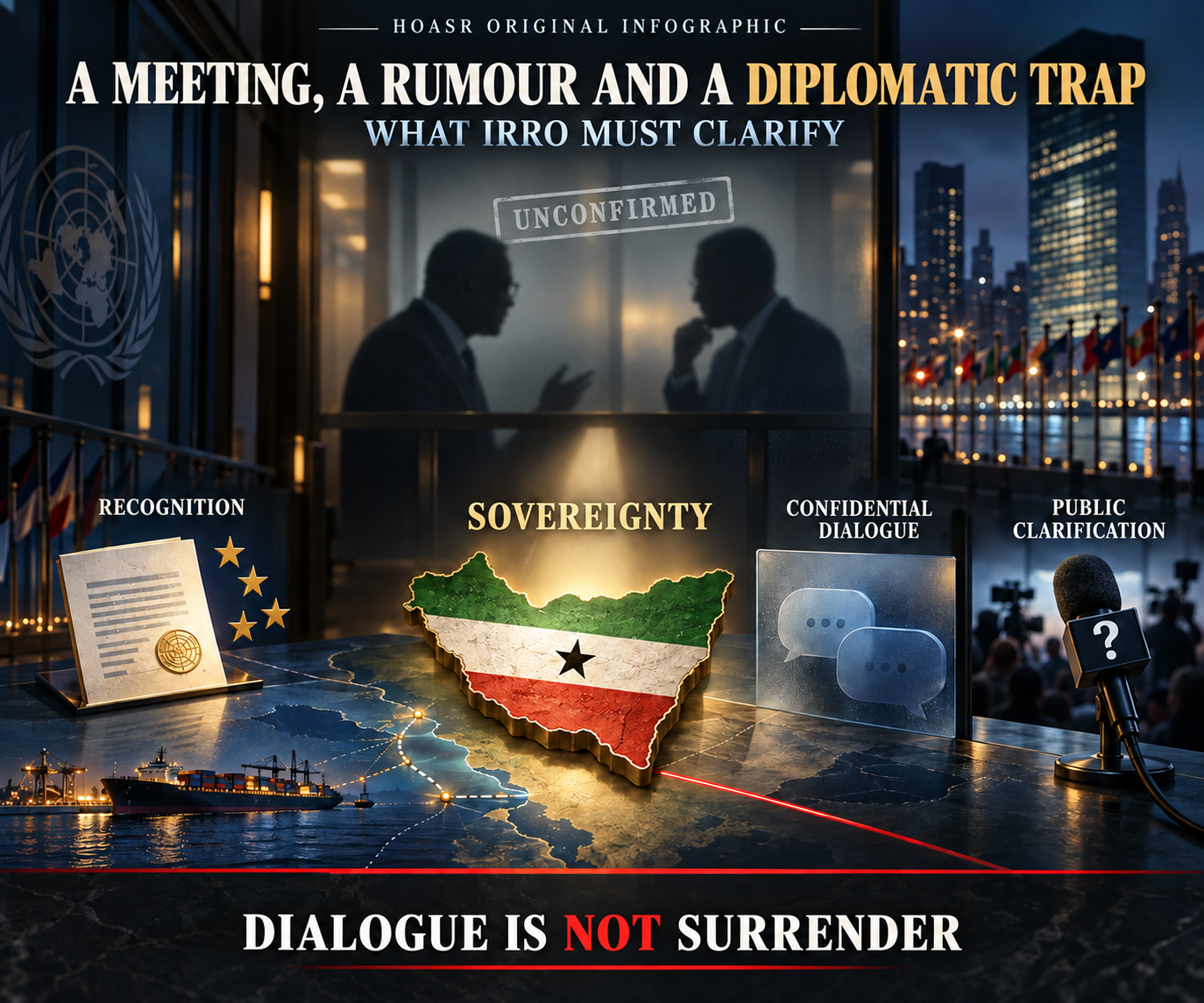
The article itself concedes that the encounter has not been confirmed by Villa Somalia, Somalia’s foreign ministry, the Somaliland presidency or Somaliland’s foreign ministry. It provides no time, venue, photograph, named witness or official record. At this stage, the meeting is a rumour—not an established event.
That distinction must govern every responsible reading of the story. A rumour can still produce real diplomatic effects. It can test reactions, weaken a negotiating position, create suspicion within a government or allow one side to claim a concession that was never made. The question is therefore larger than whether two officials occupied the same room. The question is who benefits from the uncertainty and what Somaliland must say before others define the meaning of the alleged encounter for it.
The public record does not yet establish a meeting
The Horn Review article is best understood as a speculative interpretation built around an unverified report. Its broader argument—that confidential contact can expose the limits of public positions—is worth considering. Its more specific suggestions of internal fracture in Mogadishu, a foreign minister acting independently or movement toward a two-state formula are not demonstrated by the evidence it publishes.
HOASR has found no publicly available confirmation from the two governments or from a major independent news organization. Nor is there evidence in the article identifying the original source of the allegation. Until corroboration appears, analysts should not repeat the claim as fact or build conclusions about Hassan Sheikh’s authority, Somalia’s policy or Irro’s intentions upon it.
The absence of confirmation does not prove the meeting did not occur. Presidents and foreign ministers frequently hold discreet conversations on the margins of the United Nations General Assembly.
New York offers crowded schedules, hotel meetings, diplomatic receptions and intermediaries through which contact can occur without public ceremony. But possibility is not proof. Journalism must keep those categories separate.
Dialogue is not surrender
Somaliland has spoken with Somalia before. The formal dialogue launched in 2012 produced meetings in London, Dubai, Ankara, Istanbul and Djibouti. The Ankara Communiqué of April 2013 explicitly committed both parties to continue dialogue, while international partners welcomed another leaders’ meeting in Djibouti in June 2020. Those contacts did not erase Somaliland’s separate institutions or compel Hargeisa to abandon its independence claim. They demonstrated that dialogue and sovereignty are not mutually exclusive.
This history is important because Mogadishu may try to describe any contact as an internal consultation between a national government and one of its regions. Somaliland’s answer should be equally clear: if contact takes place, it is between two political authorities addressing a dispute created by the failed 1960 union and Somaliland’s restoration of sovereignty in 1991. Dialogue can cover practical questions and the future relationship, but it cannot begin from the presumption that Somaliland has already surrendered the matter under discussion.
Irro also has no reason to fear dialogue conducted from a position of confidence. During his American visit, he presented Somaliland directly to members of Congress, policy institutions and the Council on Foreign Relations as a functioning state and a potential security and economic partner. The CFR publicly described its September 24 event as a discussion of Somaliland’s bid for international recognition and the regional security landscape.
In New York, Irro also met Israel’s ambassador to the United Nations as the president of a country Israel formally recognized on December 26, 2025. These public engagements form the documented context. An unverified private contact should not be allowed to replace them as the defining story of the visit.
The diplomatic trap
The trap has two sides. A categorical denial could become damaging if credible evidence of contact later emerges. Unqualified silence, however, gives opponents room to write their own account. They can portray Irro as negotiating Somaliland’s status secretly, claim that his recognition campaign is a bargaining device, or suggest that Somalia still exercises political authority over Hargeisa. None of those conclusions follows from a meeting, but political narratives are often established before evidence catches up.
There is another risk. Demanding full disclosure of every confidential exchange would make serious diplomacy impossible. Somaliland needs room for backchannels, especially as the Horn and Red Sea become more militarized and competing powers seek access, alliances and influence. Confidentiality can prevent misunderstanding and allow officials to test proposals without producing a public crisis. The answer is not to publish a transcript of every conversation. It is to state the principles that govern any contact.
What Irro’s government should clarify
The presidency should issue a short, disciplined clarification. It should state whether a formal meeting with Somalia’s foreign minister took place.
If the encounter was only incidental, that should be said plainly. If substantive contact occurred and confidentiality must be preserved, the government should confirm only the institutional framework: who authorized it, whether it constituted negotiations, and whether Somaliland’s sovereignty or constitutional position was discussed or altered.
The statement should reaffirm four points. First, Somaliland remains an independent political entity pursuing broader international recognition.
Second, no official has authority to negotiate away the country’s sovereignty outside Somaliland’s constitutional institutions.
Third, Somaliland is prepared to communicate with Somalia on peace, security, trade, humanitarian issues and the future relationship between the two sides.
Fourth, any formal political dialogue must have an agreed agenda, authorized delegations and safeguards against its misrepresentation as an internal Somali process.
This is not a call for defensive politics. A confident government clarifies the rules without allowing every rumour to dictate its movements. It can welcome dialogue while rejecting ambiguous formulas. It can keep sensitive channels open while preventing Mogadishu or partisan media from assigning them a meaning Somaliland never accepted.
The larger message
The alleged Manhattan meeting may ultimately prove false, incidental or important. Until evidence emerges, none of those possibilities should be treated as settled.
What is already clear is that Somaliland’s diplomatic environment has changed. Israel’s recognition, Irro’s meetings in Washington and New York, and the growing strategic value of Berbera have raised the stakes surrounding even an informal encounter with a Somali official.
Somaliland should not allow a rumour to reverse the message of Irro’s American mission. His visit was designed to show that Hargeisa can deal directly with governments, legislators, investors and policy institutions as a responsible partner. If he also spoke privately with Somalia’s foreign minister, the meaning should be defined by Somaliland’s stated principles—not by Mogadishu’s sovereignty narrative, anonymous accounts or speculative commentary.
Irro does not need to choose between silence and disclosure of sensitive diplomacy. He needs a precise public line: establish what can be established, protect what must remain confidential, and make unmistakably clear that dialogue is not subordination.
Until that clarification comes, the rumour will continue to do the work of those who benefit from ambiguity.
Selected Sources
• Horn Review — What a Quiet Somalia and Somaliland Contact Would Actually Reveal, September 28, 2026
• Reuters — Israel Becomes First Country to Formally Recognise Somaliland, December 26, 2025
• Council on Foreign Relations — Somaliland The Horn of Africa’s Breakaway State
Editorial note
This analysis was prepared from publicly available information as of September 28, 2026. The alleged Manhattan meeting remained unconfirmed at the time of publication. HOASR will revise the assessment if authoritative evidence or an official statement emerges.

Prof. Nassir Hussein Kahin is a researcher, educator, journalist, and geopolitical analyst specializing in the Horn of Africa, the Red Sea, international law, diplomacy, and strategic affairs. To read Full Bio click on this link: ABOUT THE AUTHORProf. Nassir Hussein Kahin