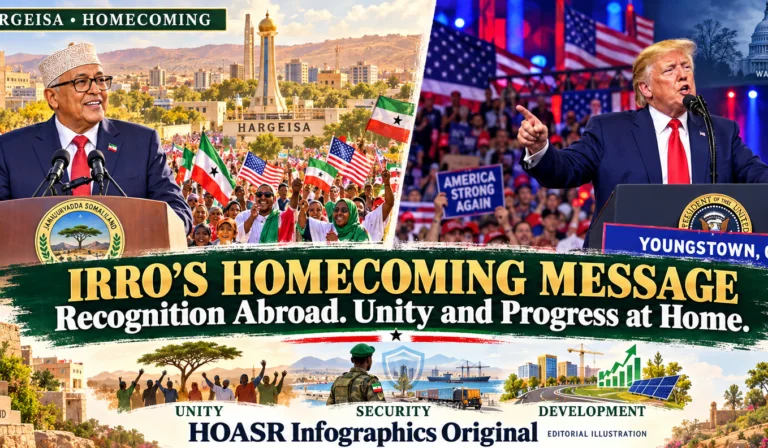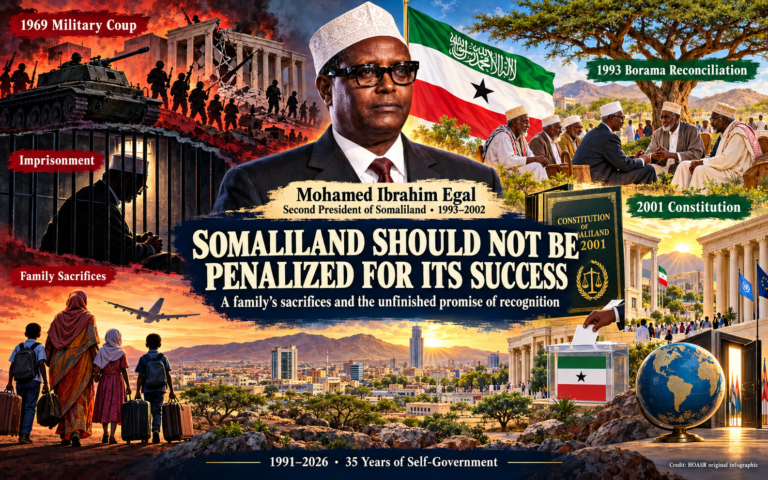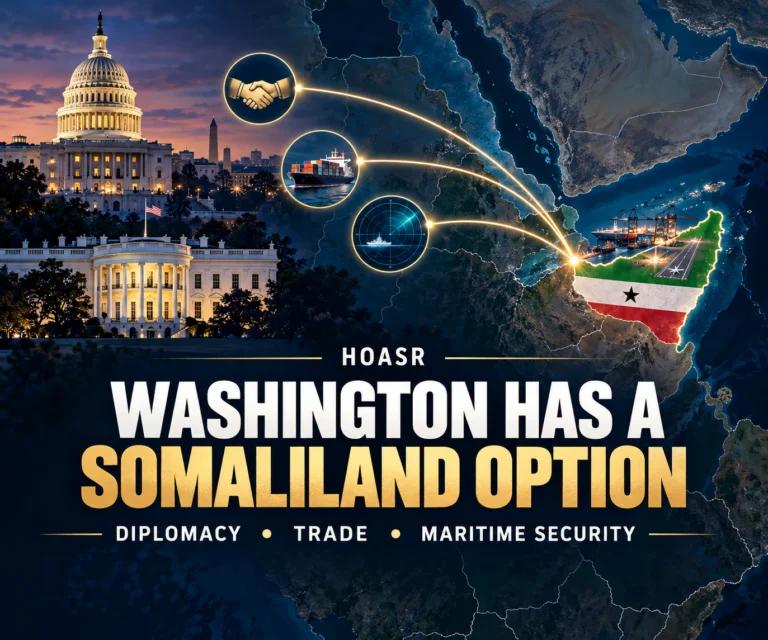
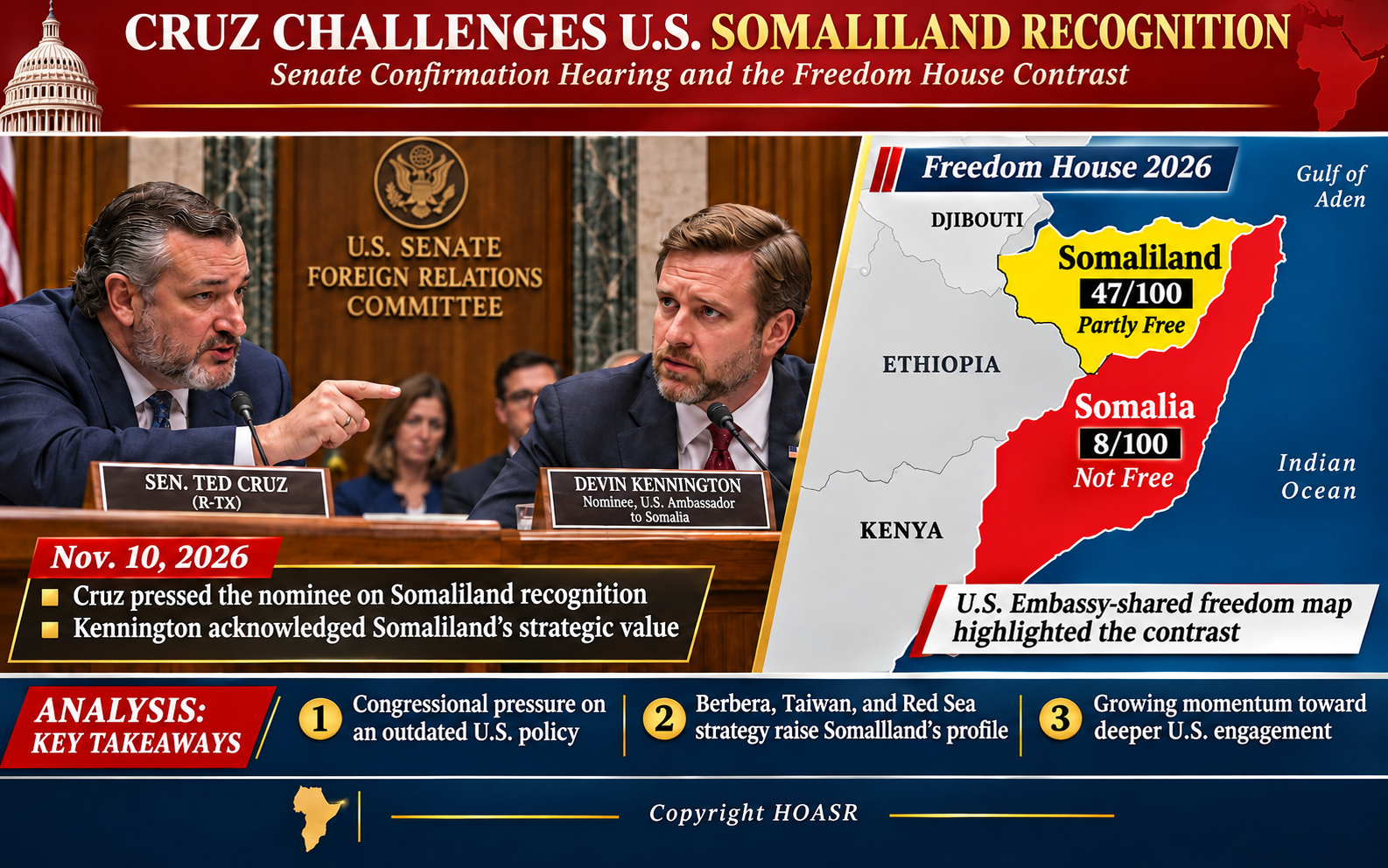
Senator Ted Cruz challenges Washington's Somaliland recognition policy during a Senate confirmation hearing, as Freedom House 2026 scores highlight the difference between Somaliland and Somalia. Illustration © HOASR.
A Senate confrontation and a U.S. embassy freedom map expose the gap between Washington’s diplomatic policy and Somaliland’s distinct political reality.
The question of Somaliland’s international recognition has entered a new phase in Washington. What was once largely confined to diplomatic correspondence, congressional advocacy and strategic policy discussions has now reached the confirmation process for America’s next ambassador to Somalia.
On November 10, 2026, Senator Ted Cruz challenged Devin Kennington, President Donald Trump’s nominee for ambassador to Somalia, during a Senate Foreign Relations Committee confirmation hearing. Cruz asked why the State Department had not moved toward recognizing Somaliland following Trump’s description of it as “a totally different country” from Somalia. Kennington declined to endorse that interpretation and maintained Washington’s established policy supporting Somalia’s territorial integrity.
On the same day, the U.S. Embassy in Australia circulated a global freedom map distinguishing Somaliland from Somalia. The visualization was prepared by Statista using Freedom House data and placed Somaliland in the “Partly Free” category, in contrast with Somalia’s “Not Free” classification, according to contemporaneous reporting on the embassy post.
Neither event amounts to a change in American recognition policy. Together, however, they illustrate the persistent tension between Washington’s acknowledgment of Somaliland’s separate political experience and its reluctance to recognize the republic diplomatically.
Cruz Moves From Advocacy to Confirmation Pressure
Cruz has advocated recognition for some time. In an August 2025 statement and letter to President Trump, he emphasized Somaliland’s democratic institutions, strategic coastline, security partnerships and relationship with Taiwan. He presented recognition as a matter of American national interests, not merely diplomatic sympathy.
At the November 10 hearing, Cruz moved beyond advocacy. He pressed the nominee to explain the obstacles to recognition and indicated that his support for the nomination would depend on the State Department following what he considered the president’s guidance. Kennington did not commit himself to backing recognition.
This was neither a Senate rejection of the nomination nor proof of a formal White House order to recognize Somaliland. A single senator does not control confirmation. But using the nominations process in this way subjects the administration’s Somaliland policy to direct congressional oversight and demands a clearer explanation of the diplomatic status quo.
The U.S. Embassy Freedom Map: 47 for Somaliland, Eight for Somalia
The U.S. Embassy in Australia’s November 10 post shared a freedom map highlighting differences in political rights and civil liberties. Its message emphasized the shared freedoms of the United States and Australia and contrasted them with China; it did not mention Somaliland or Somalia by name or announce a recognition decision. The map, rather than the embassy’s caption, supplied the distinction. Read the account of the published map.
Freedom House’s 2026 Somaliland assessment gives Somaliland 47 out of 100: 21 points for political rights and 26 for civil liberties, placing it in the “Partly Free” category. Its separate 2026 Somalia assessment assigns Somalia eight out of 100: two points for political rights and six for civil liberties, classifying it as “Not Free.” The scores are identical to those used in the earlier assessment associated with the embassy map.
Crucially, Freedom House explicitly says the Somalia report does not reflect conditions in Somaliland, which it evaluates separately. Such separate assessments measure conditions in defined geographic areas; they do not decide legal sovereignty. Freedom House itself marks Somaliland as a territory rather than a recognized independent country.
The 39-point gap nevertheless demonstrates that the two political environments differ substantially under this particular methodology. Somaliland’s score is not an unqualified endorsement: the report also identifies postponed elections, pressure on journalists, marginalization of minority clans and restrictions on civil liberties. Those limitations deserve acknowledgment alongside its history of competitive elections and transfers of power.
The diplomatic distinction is important. The U.S. embassy shared an independently produced infographic; it did not create the data or adopt a new territorial policy. Still, the circulation of a map that treats Somaliland and Somalia as separately assessed political environments makes the discrepancy between practical political classifications and formal diplomatic arrangements more visible.
The Nominee Acknowledged Somaliland’s Strategic Importance
Kennington’s testimony deserves attention for what he acknowledged as well as what he declined to support. He discussed Somaliland’s distinct political experience, relationship with Taiwan, commercial opportunities and importance to Red Sea security. Stronger engagement with Hargeisa, he suggested, could serve American national-security and economic interests.
States can maintain extensive working relations with authorities they do not recognize as sovereign governments. The policy question is whether that arrangement remains adequate as Washington’s practical interests in Somaliland continue to grow.
Trump’s Remarks and the State Department’s Established Policy
Trump’s description of Somaliland as a different country attracted particular attention because the president exercises the United States’ recognition power. Yet a public remark does not automatically establish formal diplomatic recognition. Cruz treats the president’s words as guidance for a policy change; Kennington did not endorse that interpretation.
Nor should the exchange be presented as conclusive evidence of insubordination by the State Department. No formal recognition instruction was established during the hearing. What Cruz has done is force a sharper public question: does the administration intend to increase cooperation while preserving nonrecognition, or is it contemplating a change in diplomatic status?
The Strategic Context Has Changed
Somaliland’s Gulf of Aden coastline sits near the approaches to Bab al-Mandab and the Red Sea, linking commercial routes across the Arabian Peninsula, the Horn of Africa and the Indian Ocean. Berbera’s port infrastructure and its potential contribution to Ethiopia’s trade diversification add a commercial dimension to the security argument.
Somaliland’s ties with Taiwan also intersect with American concerns about China’s regional influence. Israel’s recognition of Somaliland on December 26, 2025 introduced a further geopolitical dimension, while opposition from Somalia and regional organizations underscores the diplomatic costs that any additional recognition decision would have to address.
Supporters of recognition emphasize strategic access, economic cooperation and Somaliland’s institutional record. Critics emphasize Somalia’s internationally recognized borders, the African Union’s territorial-integrity position and the possibility of wider regional tensions. A credible American review would have to assess both sets of considerations.
A Separate Historical and Political Experience
The former British Somaliland Protectorate became independent on June 26, 1960, before joining the former Italian-administered territory five days later to form the Somali Republic. Following the collapse of Somalia’s central state, Somaliland declared the restoration of its sovereignty on May 18, 1991.
Somaliland maintains that its claim concerns restoration of sovereignty previously exercised in 1960 rather than the creation of a new state with historically unprecedented borders. Somalia disputes that position and maintains its claim to Somaliland as part of its sovereign territory. The legal consequences remain contested.
Since 1991, separate elections, public institutions, security structures and international partnerships have reinforced Somaliland’s political distinctiveness. Freedom House’s separate assessments offer additional empirical evidence of different institutional conditions, while not settling the legal dispute.
Washington’s Recognition Question Is Becoming More Difficult to Avoid
The Senate has not rejected Kennington’s nomination. The United States has not recognized Somaliland. The embassy in Australia has not issued a recognition declaration. Those limits must remain clear.
But the developments are politically meaningful. A prominent senator has used diplomatic oversight to demand answers about recognition. A prospective ambassador has acknowledged Somaliland’s strategic relevance while maintaining the established policy. And an American embassy has shared independent data portraying the two political environments in contrast.
For Hargeisa, the opportunity is to translate that visibility into an evidence-based diplomatic strategy explaining what recognition would change, how it could advance American interests, and how legitimate regional concerns could be managed.
The Scoop: Two Political Realities, One Unresolved American Policy
The developments of November 10 do not constitute a coordinated change in U.S. policy. They do, however, expose a question that deserves a more explicit answer from Washington. The Freedom House scores are not sovereignty ratings, but the distance between Somaliland’s 47 and Somalia’s eight underscores why their political circumstances merit a separate examination.
Washington already engages with Somaliland as a strategically unique partner. The unresolved issue is whether those differences should eventually be reflected in separate diplomatic recognition. Cruz has brought that question into the confirmation process; the embassy’s freedom map has made a related distinction visible through an official American channel.
The next consequential step would be an authoritative White House or State Department explanation of whether the United States intends to maintain its present position, expand practical engagement, or reconsider formal recognition.

Prof. Nassir Hussein Kahin is a researcher, educator, Lecturer at (CSI), journalist, Director of Hussein Kahin Educational Foundation (HUKEF), Founder and Managing Editor of Horn of Africa Strategic Review (HOASR) and geopolitical analyst specializing in the Horn of Africa, the Red Sea, international law, diplomacy, and strategic affairs. To read Full Bio click on this link: Prof. Nassir Hussein KahinABOUT THE AUTHORNassir Hussein Kahin