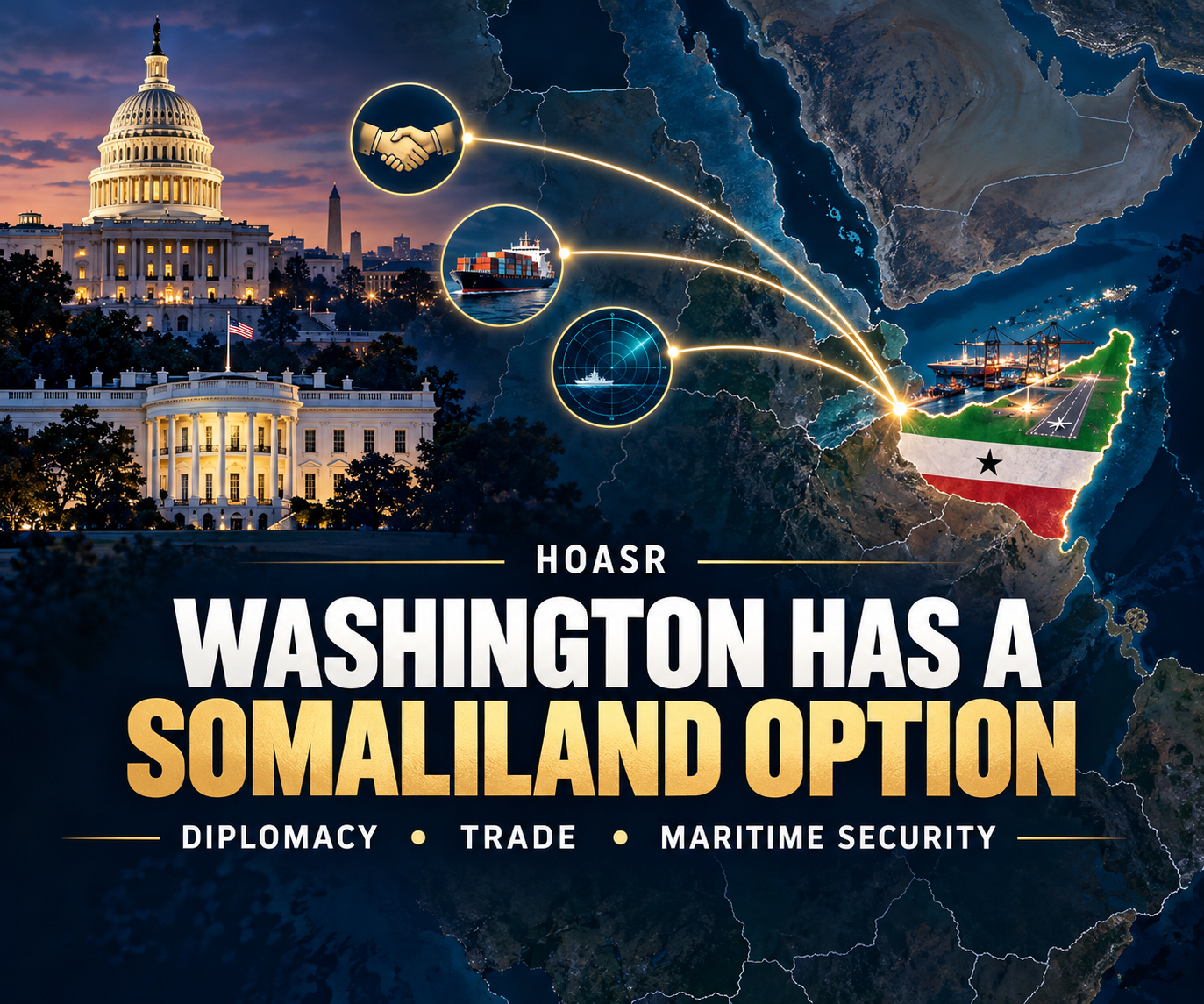
Washington has a practical Somaliland option built around direct engagement, economic cooperation and Red Sea security.
Recognition remains the ultimate objective but the United States can establish a direct and separate Somaliland policy now
Washington does not need to settle every question surrounding Somaliland before it begins dealing with the country as the political and strategic reality it has become. Formal recognition remains the clearest and most honest destination, but American policy should no longer be trapped between that final step and the fiction that Somaliland can be handled as an administrative extension of Mogadishu. President Abdirahman Irro’s visit to Washington has placed a practical alternative before the United States: build a direct relationship with Hargeisa now, expand it through security, trade and diplomacy, and allow the question of recognition to proceed on its own political timetable.
A new Foreign Policy analysis by Joshua Keating captures how far the debate has moved. Keating interviewed Irro after the president’s Washington engagements and before the New York phase of his visit. The article does not predict imminent recognition, nor does it dismiss the possibility. Instead, it treats Somaliland as a serious American policy question shaped by the Iran war, Houthi pressure on the Red Sea, competition with China and Washington’s counterterrorism operations in Somalia. That framing is an achievement in itself. Somaliland is being discussed less as a distant constitutional dispute and more as a possible partner near one of the world’s most vulnerable maritime corridors.
Irro’s argument in Washington was direct. Somaliland has spent years warning that security around the Gulf of Aden and Bab el-Mandeb cannot be managed while its coastline is excluded from serious planning. The danger has now become visible. Attacks on shipping, Houthi advances and the wider confrontation with Iran have raised the cost of relying on a narrow group of regional facilities. Berbera offers a modern deep-water port, a long runway and access to a government that has openly declared where it stands. At the Hudson Institute, Irro described Somaliland as a stable democratic partner without the strategic ambiguity that surrounds some of Washington’s existing relationships in the region.
The message has been reinforced by events beyond the president’s speeches. Israel’s recognition in December 2025 broke the assumption that Somaliland’s diplomatic isolation was permanent. Relations with Taiwan have survived sustained pressure from Beijing. Members of Congress have promoted recognition, separate treatment and financial access. Representative John Rose used a House Financial Services Committee hearing to press Treasury Secretary Scott Bessent on the barriers separating Somaliland from the international financial system. These developments do not amount to American recognition, but together they show that the old policy is losing its intellectual hold even when the bureaucracy continues to repeat it.
Keating’s article also identifies the most immediate obstacle. The Trump administration has expanded military operations against al-Shabaab and Islamic State elements in Somalia, and parts of the American security establishment depend on cooperation with Mogadishu. Officials may therefore fear that recognizing Somaliland would disturb an existing counterterrorism arrangement. This concern helps explain why the State Department still says that the United States recognizes Somalia’s territorial integrity, including Somaliland, even as other American institutions explore closer contact with Hargeisa.
That concern should not become an excuse for strategic paralysis. Cooperation with Mogadishu against armed groups does not require Washington to deny the political reality in Hargeisa. The United States routinely separates tactical security cooperation from wider diplomatic disagreements. It can continue operations against al-Shabaab while developing direct relations with Somaliland. In fact, treating the two relationships separately would produce greater clarity. Somalia would remain a counterterrorism partner where cooperation is possible, while Somaliland would become a maritime, commercial and security partner in territory it has governed for more than three decades.
Irro offered a useful bridge when he told Foreign Policy that Somaliland would welcome treatment similar in principle to Taiwan’s relationship with the United States. The comparison has limits. Taiwan possesses a far larger economy, extensive technological capacity and a specific legal framework in American law. Somaliland’s history and legal claim are also different: it was an independent state in June 1960 before entering a union with the former Italian territory, and it restored its sovereignty within its inherited colonial borders in 1991. The relevant lesson from Taiwan is narrower. Washington can maintain substantial political, economic and security relations with a partner even when it postpones full diplomatic recognition.
For Somaliland, such an arrangement would be more than symbolism. The United States could open an official presence in Hargeisa or Berbera, negotiate direct maritime-security cooperation, issue a separate travel advisory and treat Somaliland distinctly in development programs. Congress could authorize regular senior-level dialogue and remove obstacles to banking, insurance and investment. American agencies could work directly with Somaliland’s coast guard, port authorities and security institutions under transparent agreements. None of these measures requires Washington to wait for Mogadishu, the African Union or a future negotiation that may never produce consent.
A separate policy would also serve American interests. Djibouti remains important, but its simultaneous hosting of American and Chinese military facilities creates an obvious vulnerability. Somalia remains central to counterterrorism operations, yet its government cannot provide the same political stability or control over the Gulf of Aden coast. Berbera would give Washington an additional option for logistics, maritime surveillance, evacuation and commercial access without requiring the immediate construction of a permanent American base. Strategic resilience often begins with access and dependable relationships rather than a large military footprint.
Hargeisa should nevertheless resist reducing the national case to the availability of a port and an airfield. Somaliland did not rebuild its institutions and maintain its peace merely to become a platform for somebody else’s war. Its value includes democratic government, a population that has defended moderation against extremism, an emerging commercial corridor and a coastline capable of supporting fisheries, energy and trade. Berbera’s military relevance may attract immediate attention, but its commercial future will outlast the present crisis. Any security agreement must therefore protect Somaliland’s sovereignty, civilian economy and local population while delivering clear benefits in training, infrastructure, investment and national defence.
The same caution applies to the argument that the Iran war may create Somaliland’s chance for recognition. A crisis can open a diplomatic door, but it cannot provide the entire foundation of a foreign policy. Wars end, administrations change and strategic priorities move. Somaliland must use the present opening to build institutions and agreements that remain useful when the Red Sea is quieter. Its case should rest on a combination of law, democratic performance, economic opportunity and security cooperation. Geography creates leverage; credible government turns that leverage into a lasting partnership.
The Semafor interview with Irro made clear that Hargeisa is approaching Washington in transactional terms. Somaliland can discuss facilities, resources and investment opportunities, but it expects a meaningful return. That is reasonable, provided the government defines its terms before negotiations deepen. Access to strategic assets should be governed by law, approved through legitimate national institutions and connected to measurable benefits. Recognition should not be exchanged for vague promises, and Somaliland should not surrender long-term control of its most valuable infrastructure for short-term political attention.
Washington also needs to reconsider the claim that engagement must await an agreement between Somaliland and Somalia. Dialogue is necessary for managing borders, security, assets and future neighbourly relations. It should be encouraged. But dialogue cannot mean granting Mogadishu a permanent veto over Somaliland’s international status. A government that claims Somaliland’s territory has little incentive to approve its recognition. Making consent a precondition guarantees delay while rewarding the party most committed to preventing an agreement.
Somaliland’s case is also poorly described as an attempt to redraw Africa’s inherited borders. Its claim follows the borders of the former British Somaliland Protectorate, the territory that became independent on 26 June 1960. The dispute concerns the failure and dissolution of a union, not the invention of a new colonial boundary. Washington may still weigh the regional consequences of recognition, but it should evaluate the actual Somaliland case rather than a generalized fear that every separatist movement would acquire the same standing.
The Irro visit has therefore produced a more useful question than whether President Donald Trump will announce recognition during a single meeting. The question is whether the United States will continue allowing the absence of recognition to prevent policies that already serve its interests. A direct American office, separate economic treatment, financial access and negotiated security cooperation would give substance to the relationship. They would also allow both governments to test the partnership before making larger commitments.
President Irro has presented Somaliland as an option at a time when American planners need more options around the Red Sea. Washington can accept that offer without abandoning counterterrorism cooperation elsewhere or resolving every diplomatic dispute in the Horn of Africa. It can begin with the reality it can already see: Somaliland governs itself, controls Berbera, chooses its own partners and has demonstrated a willingness to work with the United States and its allies. Recognition should remain the destination. A separate Somaliland policy should begin now. For more analysis read my article “Short of Recognition: What is Next For Somaliland in the Times of Israel:
Short of Recognition: What Is Next for Somaliland?
Selected Sources
Hudson Institute Somaliland as a Strategic Partner in the Horn of Africa 14 September 2026

Prof. Nassir Hussein Kahin is a researcher, educator, journalist, and geopolitical analyst specializing in the Horn of Africa, the Red Sea, international law, diplomacy, and strategic affairs. To read Full Bio click on this link: ABOUT THE AUTHORProf. Nassir Hussein Kahin