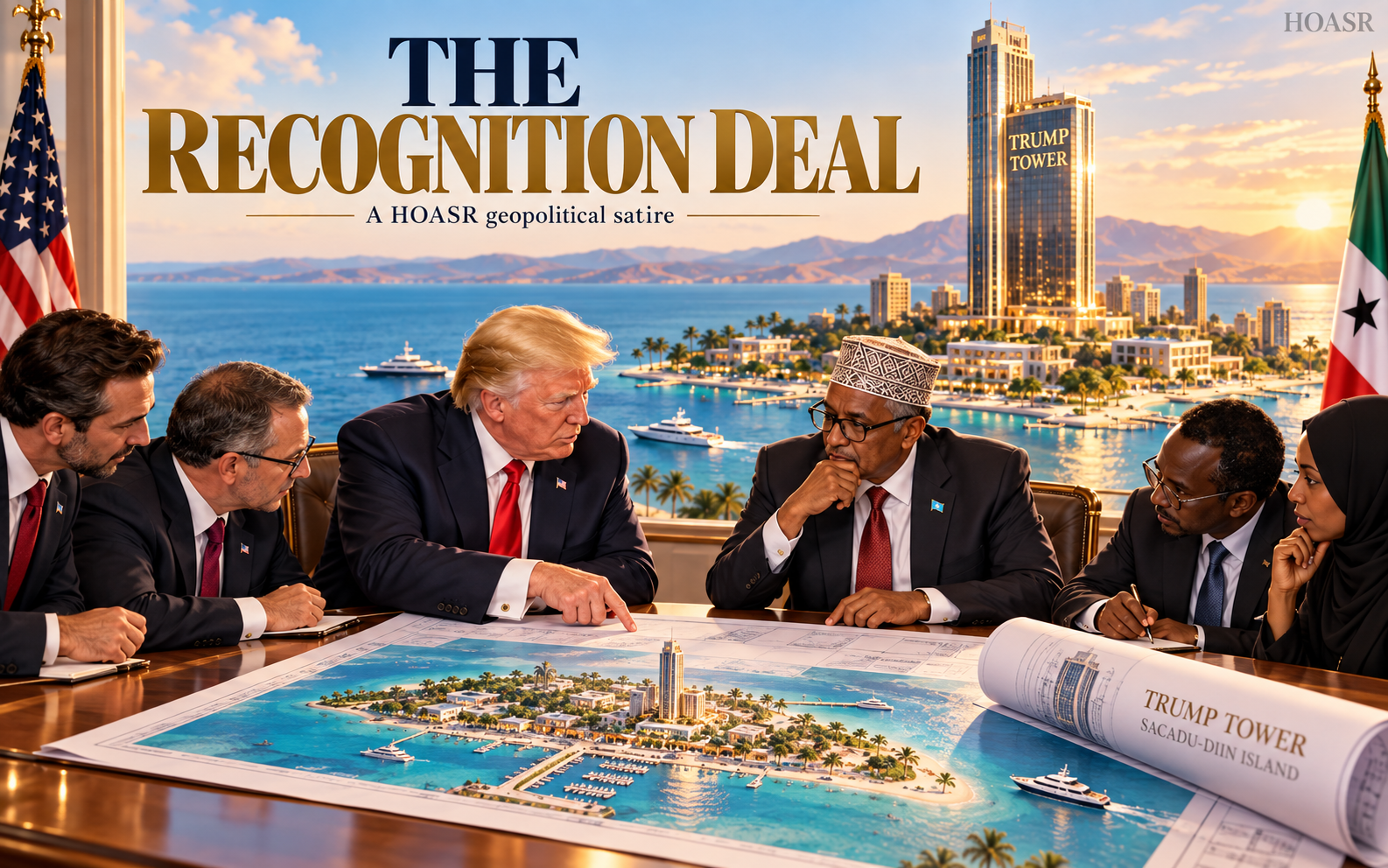
Trump and Irro study the Sacadu-diin master plan in this HOASR political satire, where recognition, architecture and Red Sea geopolitics meet around one negotiating table.
Editor’s Note — A HOASR Geopolitical Satire
Forget diplomatic cables and international conferences. In this imaginary encounter, President Irro arrives in Washington with beachfront property, architectural drawings and a most unusual condition: recognition before construction.
Washington has spent decades discussing Somaliland through diplomatic memorandum, regional consultations and international legal arguments. Perhaps the entire exercise needs a property developer. In an imaginary diplomatic encounter, President Abdirahman Mohamed Abdillahi Irro arrives at the White House carrying something considerably more interesting than another petition for recognition: architectural drawings of a luxury Trump Tower overlooking the Red Sea.
The proposed location? Sacadu-din Island. The attraction? Pristine beaches, spectacular ocean views, a yacht marina, a five-star hotel and a casino where the largest jackpot would not be measured in dollars. It would be American diplomatic recognition of Somaliland.
There is, however, one small complication. Before the first construction permit is issued, Somaliland wants its independence recognized. No recognition, no reservation.
Welcome to the art of transactional diplomacy, where international relations meet international real estate and the road to sovereignty apparently passes through a presidential penthouse.
Imagine the White House meeting. President Trump studies the architectural drawings while his imaginary advisers whisper about maritime security, Chinese influence and America’s strategic interests in the Red Sea. But Trump has spotted something considerably more urgent. Why is the proposed tower only 40 stories tall? And who approved the size of the presidential suite?
Irro explains that Somaliland has something more valuable than beachfront property. It sits opposite Yemen, overlooking strategically significant maritime routes connecting the Red Sea to the Gulf of Aden. The proposed development could be presented as an American commercial venture, although whether Washington would find the arrangement strategically attractive would remain another matter.
Trump interrupts. Forty stories are simply not enough. Make it 60.
Irro agrees to review the architectural specifications. Recognition, however, remains a separate item on the agenda.
Suddenly, the imaginary negotiations become complicated.
Somewhere in Mogadishu, an emergency cabinet meeting is convened. The fictional Somali government has discovered a serious threat to its territorial-integrity position: an unauthorized presidential penthouse. Officials immediately demand that Washington recognize Somalia’s exclusive jurisdiction over all future swimming pools, beachfront restaurants and casinos constructed anywhere within its claimed borders.
An imaginary Turkish delegation offers to build a competing luxury hotel, complete with a diplomatic conference center. A Chinese construction consortium produces drawings of a 100-story tower, a commercial port and a financing arrangement sufficiently complicated to require its own international arbitration tribunal.
Not to be outdone, an imaginary United Nations committee requests an environmental impact assessment and proposes six months of consultations to determine whether the presidential suite overlooks disputed territorial waters.
Meanwhile, the European Union expresses concern about the absence of a comprehensive framework for regional casino governance. The African Union establishes a special committee to investigate whether the development might encourage other African territories to demand their own Trump Towers.
Back in Washington, the imaginary negotiations continue. Trump’s fictional commercial advisers are delighted with the investment possibilities. His diplomatic advisers are considerably less enthusiastic about exchanging recognition for a building permit. They point out that American foreign policy involves institutions, laws, competing strategic interests and relationships extending well beyond luxury real estate.
Irro has anticipated this objection. His imaginary presentation includes something the property brochure initially neglected: a detailed explanation of Somaliland’s political history, its claim to sovereignty and the potential economic and security implications of a closer American relationship.
The meeting takes an unexpectedly serious turn. Behind the ridiculous drawings of infinity pools and golden elevators lies a genuine diplomatic question. How should Washington weigh Somaliland’s political claims, Somalia’s territorial-integrity position and America’s interests along the Red Sea?
Unfortunately, the fictional real-estate team is still debating whether the tower should have a revolving rooftop restaurant.
For President Irro, the imaginary negotiating challenge is straightforward. He must convince Washington to discuss recognition without allowing the proposed casino to become the most important issue in Somaliland’s foreign policy.
Trump, meanwhile, has an additional question: who gets naming rights to the island?
Perhaps this is where the entire arrangement begins to collapse.
The Somaliland delegation insists that Sacadu-din Island must retain its historic name. The commercial representatives propose Trump Sacadu-din International Resort. A compromise is suggested: the island retains its name, the hotel gets the Trump branding and the presidential suite comes with an unobstructed view of the Bab El-Mandeb.
The imaginary negotiations conclude without a diplomatic breakthrough, although both delegations express satisfaction with the architectural progress. An international news agency mistakenly reports that the parties have reached a historic agreement on regional maritime security.
In reality, they have only agreed to examine a proposal for a larger swimming pool.
And what of Somaliland’s recognition? That question remains where it began: with diplomacy, international law and political decisions that no beachfront development can automatically resolve.
Nevertheless, the imaginary Sacadu-din negotiations leave one final question hanging over the Red Sea.
If every major power has strategic interests in the region, and every regional government has something to offer, what happens when international diplomacy begins to resemble the world’s most expensive property auction?
Perhaps the next diplomatic summit should invite fewer real-estate developers and more international lawyers.
Then again, international lawyers have never been particularly good at selling penthouses.
<Irro’s Washington Mission: The Real Test for Somaliland Recognition/p>

Founder, publisher& Managing Editor of HOASR