A New Era for Somaliland-U.S. Relations
The Week the Two Shores Moved Together
WEEK ENDING
25 September 2026

Somaliland’s American Campaign Meets a Harder Horn and Red Sea Order
President Irro carried Somaliland’s case from Washington’s strategic-policy circles to one of New York’s most influential foreign-policy forums. At the same moment, Ethiopia’s old wars began to merge into a new anti-government front and the Houthis tightened their hold on the approaches to Bab El-Mandeb. The week’s lesson: recognition is not imminent. Nevertheless, Somaliland’s diplomatic opportunity is widening just as the regional environment becomes more dangerous.
| THE WEEK’S JUDGMENT
|
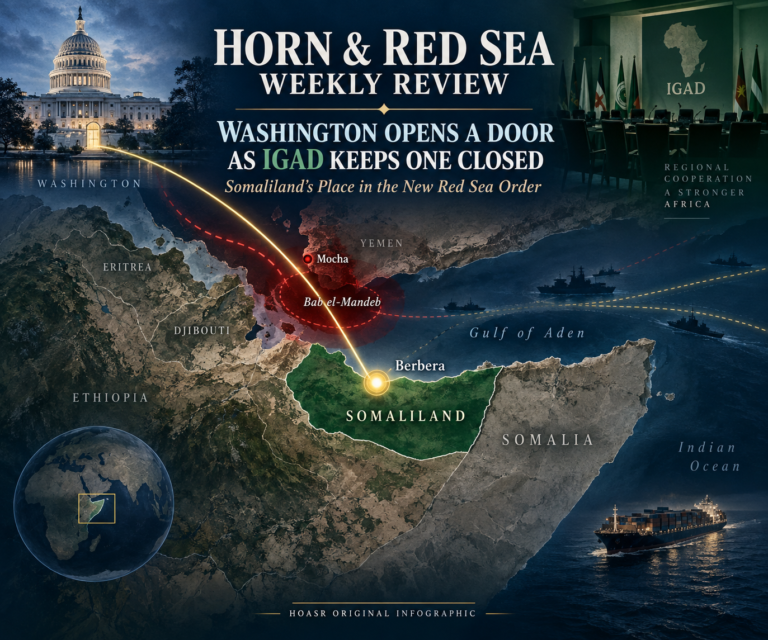
The Horn of Africa and the southern Red Sea can no longer be analyzed as adjacent regions. They are one strategic theater. Decisions made in Mekelle now affect Ethiopia’s access to ports. Territorial gains in Yemen alter the risk calculations around Djibouti and Berbera. Washington’s debate over Somaliland is shaped by China’s position in Djibouti, Iran’s relationship with the Houthis and the reliability of regional security partners.
This week made those connections unusually visible. President Abdirahman Mohamed Abdullahi Irro concluded an American visit that moved Somaliland beyond the familiar advocacy circuit. In Ethiopia, seven armed movements announced an alliance against Prime Minister Abiy Ahmed, and fighting in Tigray escalated fast enough to shatter the remaining confidence in the 2022 Pretoria peace. Across the Gulf of Aden, Houthi forces consolidated positions after seizing Mocha and continued fighting for the coastal heights overlooking routes to Bab El-Mandeb.
The events do not point to one simple outcome. They do establish a harder operating environment. Somaliland has more opportunity to present itself as a reliable partner, but less room for diplomatic improvisation, strategic overstatement or dependence on a single external relationship.
Irro’s American Campaign: The Achievement Was Access
President Irro’s visit should be judged against the institutional reality of Washington. American policy rarely changes because of one speech, one senator or one favorable article. It changes when an issue enters several parts of the system at once: Congress, the executive branch, financial regulators, defense planners, think tanks and influential media. Irro’s trip touched more of those centers than any recent Somaliland visit.
The public arc began with an address at Hudson Institute, where Somaliland was presented as a strategic partner in a region shaped by the Iran war, Houthi expansion, Chinese influence and the contest for maritime access. It continued on Capitol Hill, where Representative John Rose used a Treasury hearing to press the problem of Somaliland’s exclusion from international financial systems. Senator Ted Cruz’s longstanding recognition campaign gave the delegation an important congressional ally. The visit then moved to New York, where the Council on Foreign Relations hosted Irro on 24 September to discuss recognition and the regional security landscape.
The sequence was more important than any single event. Hudson offered a sympathetic strategic audience. Congress supplied political sponsorship and a route into the machinery of government. CFR placed the president before a broader and more skeptical establishment audience. Foreign Policy’s decision to publish a major analysis of Somaliland’s opening during the visit reinforced the shift: Somaliland was being treated as a live American policy question rather than an obscure African territorial dispute.
What Irro Got Right
Irro’s strongest choice was to connect recognition with American interests without abandoning Somaliland’s historical case. The argument rested on several propositions: Somaliland governs a strategic coastline; Berbera offers port and aviation capacity outside the crowded base environment of Djibouti; Hargeisa has maintained relations with Taiwan despite Chinese pressure; Somaliland can contribute to maritime security and counterterrorism; and its democratic transfers of power distinguish it from many security partners Washington already supports.
This is the language in which serious policy is made. Moral and legal arguments establish legitimacy, but governments act when legitimacy and interest reinforce one another. Irro’s visit presented Somaliland not only as a people awaiting justice, but as a state capable of helping the United States solve problems it already has.
The CFR appearance added a subtler gain. CFR described him publicly as “President, Republic of Somaliland.” That wording does not alter US recognition policy, yet it normalises direct, high-level treatment of Somaliland’s elected leader. Diplomatic change often begins in the gap between formal doctrine and practical behaviour. The visit widened that gap.
What the Visit Did Not Deliver
There was no American recognition announcement, no public security agreement and no confirmed executive-branch decision on Berbera. The administration’s formal position therefore remains the controlling fact. Enthusiastic reporting that treats access as recognition risks weakening Somaliland’s credibility by promising outcomes that institutions have not granted.
The same caution applies to basing. Berbera’s value is real, but the most credible American proposition is not an enormous replacement for Camp Lemonnier. It is a distributed role: contingency access, logistics, surveillance, refueling, emergency diversion, maritime awareness and redundancy. A disciplined offer would complement Djibouti while reducing over-dependence on it.
Somaliland should also resist allowing its case to become entirely dependent on Israel or the Iran war. Both relationships increase strategic relevance, but recognition must survive changes in governments and crises. The durable case rests on governance, geography, commercial access, democratic legitimacy and the ability to cooperate without becoming a platform for another state’s regional war.
From a Successful Visit to an Executable Programme
The trip now needs a ninety-day follow-through plan. A photo archive and celebratory statements will not be enough. Hargeisa should convert each contact into a defined policy track:
- Treasury and financial access: a technical dossier on banking supervision, remittances, sanctions compliance, beneficial ownership and the steps required for direct engagement with international financial institutions.
- Congress: additional sponsors for economic-access and engagement legislation, supported by a concise implementation memorandum rather than a general recognition appeal.
- Security: a written proposal for maritime-domain awareness, coast-guard development, intelligence liaison and limited access arrangements at Berbera under Somaliland law.
- Commerce: bankable projects in the Berbera corridor, energy, fisheries, digital infrastructure and aviation, each with clear investment protections and dispute-resolution rules.
- Diplomacy: a wider coalition that includes African states and avoids the impression that Somaliland’s future is being negotiated only through Middle Eastern rivalries.
Recognition remains the strategic objective. Practical agreements can build the evidentiary case for it by demonstrating that Somaliland is already a responsible counterpart. They can also create benefits before Washington is ready to cross the formal threshold.
Ethiopia: A Coalition of Enemies, and a Peace Deal in Ruins
Ethiopia’s crisis moved faster than its diplomatic vocabulary this week. Seven armed and opposition movements announced the Ethiopian Peoples’ Forces Alliance for Survival, pledging to remove Abiy Ahmed’s government and establish a transitional administration. The membership spans Tigray, Amhara, Oromia, the Somali Region, Afar and Benishangul-Gumuz. Its political breadth is striking. Its military coherence is not established.
Reuters reported on 21 September that the alliance brought together former enemies, including the Tigray People’s Liberation Front and the Amhara Fano National Movement. During the 2020–22 war, Fano fought beside the federal government against the TPLF. The new partnership is therefore less a reconciliation than an agreement that Abiy is the immediate adversary.
That limited consensus should not be dismissed. Armed coalitions do not need ideological unity to raise the state’s costs. They can exchange intelligence, coordinate pressure across distant fronts, share external sponsors and deny federal forces the ability to concentrate. The announcement also gives separate rebellions a common political frame, making Ethiopia appear less like a collection of regional emergencies and more like a national challenge to the governing order.
The Alliance Is Broad—but Built on Contradictions
The coalition’s weakness is visible in its composition. Tigrayan and Amhara forces still advance incompatible claims over western Tigray. Oromo constituencies carry memories of abuses attributed to Fano. The Ogaden National Liberation Front has its own internal divisions and regional priorities. Geography separates the fronts, command structures remain independent and the founding statement named no credible joint military command.
A detailed 23 September assessment by Al Jazeera captured the central problem: the coalition has not created one force capable of marching on Addis Ababa. It has placed several wars inside the same political calculation. That is dangerous because local clashes can now trigger responses elsewhere, even when the participants disagree about the Ethiopia they want after Abiy.
Addis Ababa retains important advantages: a recognised government, greater manpower, superior access to finance and diplomatic channels, and a growing drone capability that proved decisive in the previous Tigray war. Yet military superiority has not ended the Fano insurgency or resolved grievances in Oromia. A government can win repeated engagements while steadily losing the political capacity to close its wars.
Tigray Has Allies Abroad and Fracture at Home
Reuters’ 24 September analysis found a reversal from 2020. The TPLF is less isolated externally, but far less cohesive internally. Veterans and civilians have protested hunger, displacement and unpaid compensation. Political rivals have grown. Senior military figures who questioned renewed war were reportedly detained. Reuters also reported that Tigrayan forces seized regional airports and attacked federal forces in neighboring regions as a new conflict began.
This produces a volatile balance. The TPLF may gain operational help from new allies and, according to the Ethiopian government and several analysts, from Eritrea—an allegation Asmara denies. But a leadership with weakened domestic legitimacy may struggle to mobilize society as it did in 2020. Forced recruitment allegations, which the TPLF denies, would deepen that problem.
The Pretoria agreement has not merely weakened; its basic architecture has broken. It excluded Eritrea and Amhara forces, postponed the territorial question and relied on cooperation between Addis Ababa and the TPLF. Those two signatories are again fighting. Diplomats should stop treating Pretoria as self-executing and begin designing a wider process that includes the actors capable of wrecking any settlement.
Why Ethiopia’s Crisis Matters to Somaliland
Ethiopia is not only Somaliland’s largest potential market and the inland anchor of the Berbera corridor. It is also the state whose sea-access ambitions brought Somaliland’s recognition question back into regional diplomacy through the 2024 memorandum. A renewed Ethiopian war affects each pillar of that relationship.
- Trade and corridor risk: fighting, fiscal stress and political fragmentation can reduce cargo volumes and delay road, customs and logistics integration.
- Diplomatic bandwidth: an Ethiopian government fighting on several fronts may lack the confidence or capacity to make a consequential decision on Somaliland.
- Security spillover: movements from the Somali Region and Afar inside a national anti-government alliance complicate the frontier and the politics of port access.
- External competition: Eritrea, Egypt, Türkiye, Gulf states and other actors may use Ethiopia’s internal crisis to shape the Red Sea balance.
Somaliland should neither abandon Ethiopia nor tie its entire external strategy to Addis Ababa’s stability. The practical response is diversification: preserve the Berbera corridor, maintain direct relations across Ethiopia’s political spectrum, strengthen ties with Kenya and the Gulf, and ensure that no recognition bargain depends on a single Ethiopian leader surviving a national crisis.
Across the Gulf: Houthi Control Is Becoming a System
The Houthis’ capture of Mocha was initially understood as a dramatic battlefield gain. This week’s fighting showed that the movement is trying to convert that gain into a durable security architecture. Battles around the Kahboub mountains and the coastal heights matter because control of the elevation can protect access routes, threaten Saudi-backed forces and consolidate the approaches to Bab El-Mandeb.
The Guardian’s reporting from 22 September described heavy fighting, civilian displacement toward Djibouti and a limited Saudi air response. The military picture remains fluid, but the strategic direction is clearer: Houthi influence is moving from the northern Red Sea coast toward the southern choke-point, bringing the war closer to the Horn’s ports, bases and shipping lanes.
The danger is not limited to a formal closure of the strait. Missiles, drones, vessel seizures, threats, insurance surcharges and the fear of miscalculation can alter shipping behavior long before traffic stops. Commercial coercion works through uncertainty. A movement that can raise the cost of using a route possesses leverage even when most ships still pass.
The G7 Response Is Politically Clear and Operationally Thin
G7 foreign ministers called on Iran to stop arming the Houthis and demanded an end to attacks on shipping. The statement aligns the group politically and increases pressure on Tehran. It does not explain who will reverse Houthi territorial gains, secure the Yemeni coast or absorb the risks of escalation.
Official attribution and independently demonstrated control should remain separate. Iran’s material and advisory support to the Houthis is extensively reported; the degree of Iranian command over particular operations remains contested. Policy built on the assumption that Tehran can simply switch Houthi activity on or off may misread a movement with its own leadership, territorial interests and revenue networks.
The gap between condemnation and enforcement creates an opening for capable coastal partners. Somaliland can offer surveillance, port security, coast-guard cooperation and logistics. It should avoid presenting Berbera as a platform for an open-ended war. The most sustainable proposition is defensive, transparent and rules-based.
Berbera: Strategic Value Is Rising Faster Than Commercial Use
A Middle East Eye field report from Berbera offered a useful corrective to geopolitical excitement. The port has received major investment and occupies exceptional geography, yet it reportedly operates far below capacity. Strategic attention does not automatically produce cargo, industrial activity or revenue.
This is the central policy challenge. Somaliland must not confuse foreign interest in access with a development strategy. A port becomes national power when it supports customs revenue, transport networks, warehousing, manufacturing, services and dependable trade with the hinterland. Military or intelligence arrangements may add value, but they should not displace the commercial logic for which Berbera was expanded.
Hargeisa therefore needs a clear hierarchy of interests. Somaliland sovereignty and civilian control come first. Commercial throughput and domestic economic benefit follow. Security agreements should protect those goals, not subordinate them. Any access arrangement should specify duration, jurisdiction, environmental and labor obligations, infrastructure investment, review mechanisms and the circumstances under which Somaliland can terminate it.
The HOASR Bottom Line
This was not the week the United States recognized Somaliland. It was the week Somaliland’s president showed that the issue can be carried through Washington’s policy ecosystem with seriousness and strategic relevance. The achievement should be neither minimized nor inflated.
The regional map is becoming harsher. Ethiopia is entering another phase of organized conflict. The Houthis are consolidating power near Bab El-Mandel. Great powers and Gulf states are reconsidering the security of ports, bases and supply routes. These conditions strengthen Somaliland’s argument for direct engagement, but they also raise the cost of error.
Irro’s next success will not be another prestigious appearance. It will be evidence that American institutions are working on concrete Somaliland files: financial access, maritime cooperation, investment, travel treatment, diplomatic presence and security planning. The country’s strongest message is not that crisis makes recognition inevitable. It is that a stable, governed and strategically useful Somaliland offers partners something increasingly scarce in the Horn and Red Sea: a relationship that can be built before the next emergency arrives. Read the previous HOASR WEEKLY REVIEW | The Houthis Hold the Choke Point and Somaliland Must Move

Prof. Nassir Hussein Kahin is a researcher, educator, journalist, and geopolitical analyst specializing in the Horn of Africa, the Red Sea, international law, diplomacy, and strategic affairs. To read Full Bio click on this link: ABOUT THE AUTHORProf. Nassir Hussein Kahin