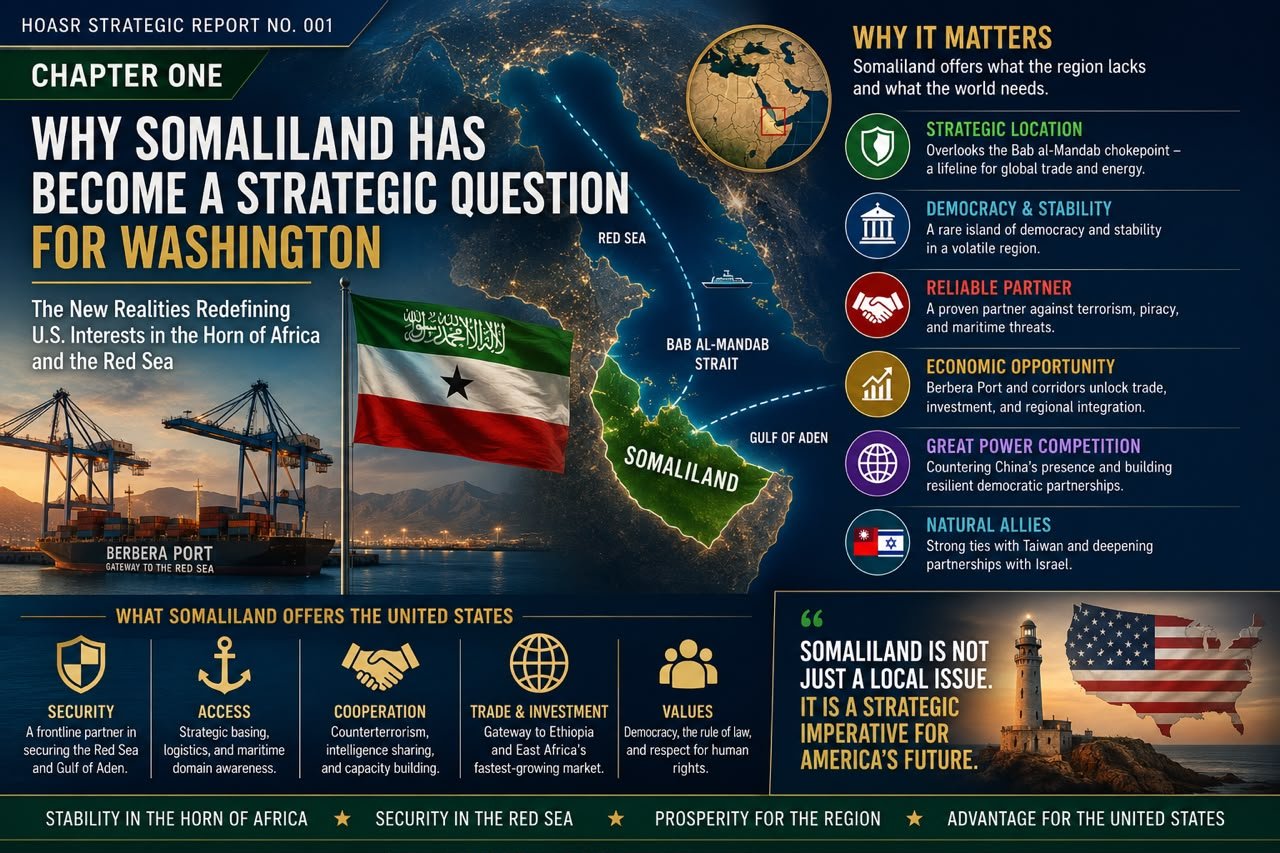
THE SOMALILAND FILE MOVES TO THE WHITE HOUSE
Chapter One
Introduction: Why Somaliland Has Become a Strategic Question for Washington
By Prof. Nassir Hussein Kahin
Introduction
For much of the three decades following Somaliland’s restoration of its self-declared sovereignty in 1991, United States policy toward toward Somaliland remained largely unchanged. Washington continued to recognize the Federal Republic of Somalia as the sole sovereign state while engaging Somaliland through limited development assistance, humanitarian programs, and security cooperation conducted within the framework of Somalia’s internationally recognized borders.
Although American officials frequently acknowledged Somaliland’s relative stability, democratic governance, and effectiveness in maintaining security, these characteristics rarely translated into sustained high-level policy initiatives or congressional attention.
That landscape has changed significantly over the past four years.
Between 2022 and 2026, Somaliland moved from the margins of U.S. foreign policy discussions to the center of an expanding congressional debate encompassing maritime security, counterterrorism, great-power competition, diplomatic engagement, and the future of stability in the Red Sea and Horn of Africa. This evolution has not resulted from a single legislative proposal or executive decision. Rather, it reflects a cumulative process in which members of Congress, congressional committees, and successive legislative initiatives have increasingly treated Somaliland as a distinct strategic actor deserving separate consideration.
This report examines that evolution and places it within the broader transformation of the international security environment.
A Changing Strategic Environment
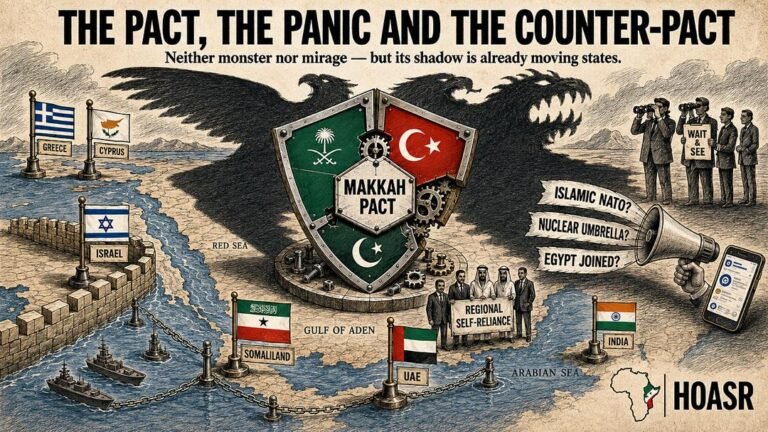
The Horn of Africa occupies one of the world’s most consequential geopolitical crossroads. The Bab al-Mandab Strait, linking the Red Sea with the Gulf of Aden and the Indian Ocean, serves as a critical maritime choke-point through which a substantial share of global commerce, energy shipments, and military traffic passes each year. Disruptions along this corridor have immediate implications for international trade, energy markets, and global supply chains.
Since late 2023, attacks on commercial shipping by Yemen’s Houthi movement have exposed the vulnerability of this maritime route. International naval coalitions have expanded operations to safeguard freedom of navigation, while regional states and external powers have reassessed their security strategy along the Red Sea corridor. The result has been renewed strategic attention to coastal infrastructure, naval access, logistics hubs, and reliable regional partners.
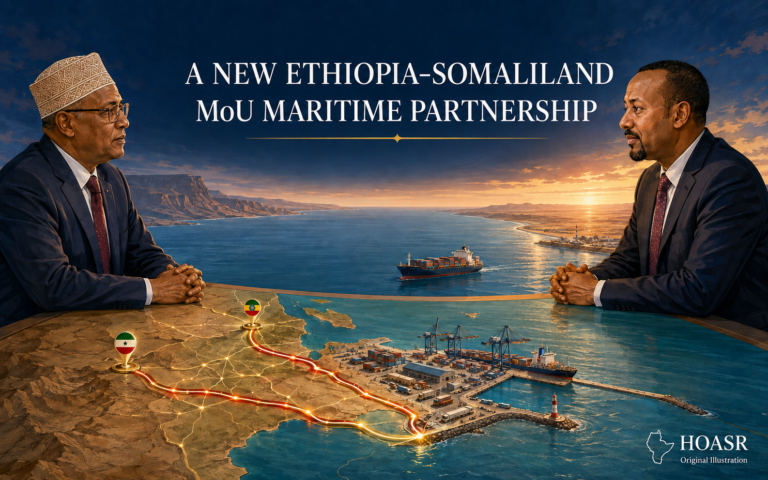
Within this context, Somaliland’s location on the Gulf of Aden has assumed renewed significance. The Port of Berbera, modernized through substantial investment over the past decade, offers one of the region’s deepest-water commercial ports and occupies a position overlooking maritime approaches to the Bab al-Mandab. Adjacent infrastructure, including Berbera International Airport and transportation links to Ethiopia, further increases the territory’s strategic profile.
Geography alone, however, does not explain Somaliland’s emergence within U.S. congressional discussions.
Beyond Geography
Congressional interest has been shaped by a combination of factors extending beyond Somaliland’s physical location.
Unlike many conflict-affected areas in the Horn of Africa, Somaliland has maintained comparatively stable political institutions, conducted multiple competitive elections, peaceful transfer of power, and sustained homegrown ways for conflict resolution. Its security forces have generally succeeded in preventing the establishment of sustained operational bases by internationally designated terrorist organizations within most of its territory, even while neighboring regions have continued to face threats from groups such as al-Shabaab.
At the same time, Somaliland has established international partnerships that increasingly align with wider strategic priorities. Cooperation with Taiwan, expanding commercial investment in Berbera by U.A.E.and evolving relationships with regional and international partners have placed Somaliland within broader discussions concerning supply-chain resilience, maritime security, and strategic competition.
These developments have unfolded during a period in which the United States has sought to strengthen partnerships with like-minded actors capable of contributing to regional stability without requiring extensive American military commitments.
Congress as a Driver of Policy Debate in Washington
One of the central findings of this report is that the contemporary U.S. debate over Somaliland has been driven less by executive branch initiative than by congressional engagement.
Beginning in 2022, members of both the Senate and House of Representatives introduced legislation, proposed amendments, requested formal studies, and advocated expanded engagement with Somaliland. Their efforts have addressed issues including security cooperation, diplomatic representation, travel guidance, and, in some instances, formal diplomatic recognition.
It is important to distinguish between congressional advocacy and established U.S. policy. Many legislative proposals remain pending or expired without enactment, while others have been incorporated into law through broader defense authorization measures. Similarly, letters from individual members of Congress or committees represent policy recommendations rather than executive decisions.
Nevertheless, taken collectively, these initiatives reveal an unmistakable trend: Somaliland is increasingly being evaluated on its own strategic merits rather than solely through the lens of Somalia’s internal political framework.
Recognition and Strategic Partnership
Formal recognition remains one of the most consequential and politically sensitive questions addressed in this report. Under the United States constitutional system, recognition of foreign states is an executive function exercised by the President. Congress cannot unilaterally recognize another state. However, Congress can influence the policy environment through legislation, appropriations, oversight, hearings, and public advocacy.
Recent congressional initiatives illustrate this distinction. Some measures seek practical forms of engagement, such as separate travel advisories or expanded security cooperation. Others call for establishing an official U.S. presence in Hargeisa. Still others advocate formal recognition of Somaliland as an independent state.
These proposals differ significantly in their legal implications but collectively demonstrate growing congressional willingness to reconsider long-standing assumptions about U.S. policy in the Horn of Africa.
Purpose and Scope of This Report
This report does not argue that recognition of Somaliland is imminent , nor does it assume that current congressional initiatives will necessarily become executive policy. Instead, it examines how congressional activity has altered the policy conversation and assesses the strategic considerations underlying that shift.
Drawing upon official congressional records, enacted legislation, committee actions, public statements, executive branch documents, and authoritative reporting, the report traces the evolution of U.S. engagement with Somaliland between 2022 and 2026. It distinguishes carefully between enacted law, proposed legislation, committee recommendations, and political advocacy while placing these developments within the wider geopolitical transformation of the Red Sea and Horn of Africa.
The chapters that follow analyze the legislative record, profile the principal congressional advocates, examine the legal and diplomatic dimensions of recognition, evaluate Somaliland’s strategic geography, and consider a range of possible future implications for U.S.–Somaliland relations.
The objective is not to predict a particular outcome but to provide a comprehensive framework through which policymakers, scholars, diplomats, journalists, and the general public can understand why Somaliland has become an increasingly prominent subject within Washington’s strategic discourse. Click on the following link for Chapter Two: HOASR Strategic Report No. 001:The Evolution of Congressional Policy Toward Somaliland (2022–2026)

Prof. Nassir Hussein Kahin is a researcher, educator, journalist, and geopolitical analyst specializing in the Horn of Africa, the Red Sea, international law, diplomacy, and strategic affairs. To read Full Bio click on this link: ABOUT THE AUTHORProf. Nassir Hussein Kahin