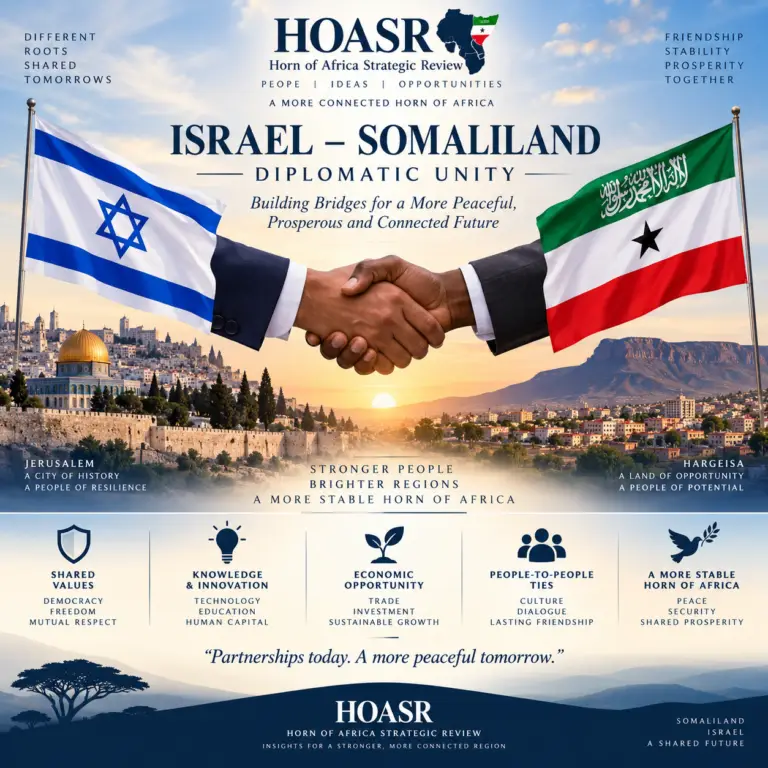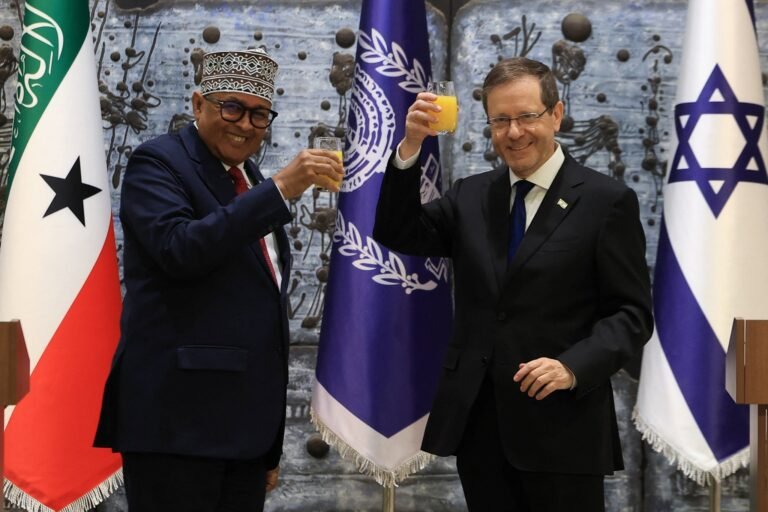
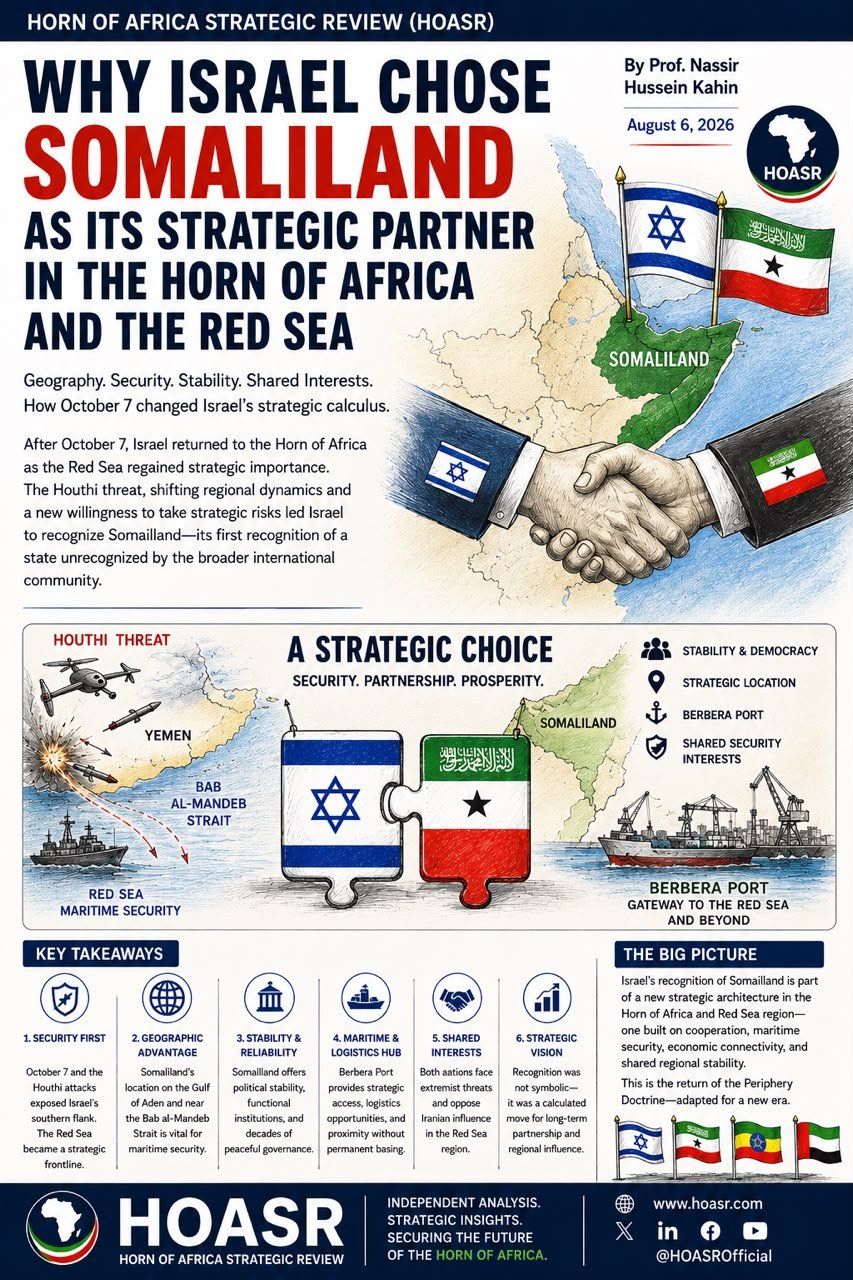
Israel’s recognition of Somaliland reflects a renewed strategy focused on Red Sea security, the Houthi threat and partnerships along the Horn of Africa.
By Prof. Nassir Hussein Kahin
The publication of Asher Lubotzky’s analysis on August 5, 2026 for the Italian Institute for International Political Studies (ISPI), “The Return of the Periphery? Israel, Somaliland and the Horn of Africa after October 7,” provides one of the clearest explanations yet of why Israel fundamentally recalibrated its policy toward Somaliland.
For years, many observers interpreted Israel’s recognition of Somaliland primarily through moral, historical or legal arguments. Those factors certainly mattered. Somaliland had previously existed as an independent state in 1960, Israel then being the first among 35 UN members to recognize it before it entered a voluntary union with Somalia, and later restored that sovereignty after the collapse of that union in 1991. It also built one of Africa’s most stable democratic systems despite remaining internationally unrecognized.
Yet Lubotzky correctly argues that those legal and historical realities alone cannot explain why recognition occurred in December 2025 rather than twenty or thirty years earlier.
The decisive factor was strategy.
October 7 Changed Israel’s Strategic Geography
The Hamas attacks of October 7, 2023 fundamentally transformed Israel’s security priorities.
Before October 7, Israeli planners viewed Yemen largely as a secondary theatre. Although the Houthis maintained close relations with Iran, they were generally considered a localized insurgency whose activities could largely be contained by Saudi Arabia, the Gulf states and Western naval coalitions.
That assumption collapsed almost immediately.
The Houthis rapidly became one of Iran’s most active regional partners, launching hundreds of drones and ballistic missiles toward Israel while simultaneously threatening international shipping throughout the Red Sea.
For the first time in decades, Israel discovered that its southern maritime flank had become an active war zone.
This forced Israeli policymakers to revisit a geopolitical reality that had largely disappeared after the Camp David Accords:
Israel is fundamentally a Red Sea power.
Its access to Asia, East Africa and the Indian Ocean depends upon freedom of navigation through the Bab al-Mandab Strait.
Once the Houthis demonstrated their ability to threaten that corridor, Israel required reliable partners positioned along the western side of the Red Sea.
That search inevitably led to Somaliland.
The Revival of the Periphery Doctrine
Lubotzky’s article places Israel’s policy within the historical framework of David Ben-Gurion’s famous Periphery Doctrine.
During the 1950s and 1960s, Israel deliberately built strategic partnerships with states located around the Arab world’s geographic periphery.
Ethiopia became one of Israel’s closest intelligence and military partners.
Israel supported southern Sudan.
It assisted anti-Egyptian forces in Yemen.
The objective was straightforward:
Rather than confronting hostile regional powers directly, Israel would cultivate stable partnerships with states sharing common security interests.
The collapse of the old regional order after 1979 reduced the importance of that strategy.
October 7 revived it.
Today’s Periphery Doctrine looks remarkably similar, but with new actors.
Instead of Imperial Ethiopia alone, Israel now sees Ethiopia and Somaliland as complementary pillars of its southern strategic architecture.
Why Somaliland?
Several factors distinguish Somaliland from every other political actor in the Horn of Africa.
Geography
Geography remains Somaliland’s greatest strategic asset.
Its coastline extends for approximately 850 kilometres along the Gulf of Aden, directly overlooking one of the world’s busiest maritime corridors.
Ships traveling between Europe and Asia pass only a short distance from Somaliland’s shores before entering the Bab al-Mandab Strait.
Any nation seeking long-term maritime security in the Red Sea must inevitably consider Somaliland’s geographic position.
Unlike many regional actors, Somaliland occupies this strategic location without being directly involved in the instability affecting southern Somalia.
Political Stability
Military partnerships require predictability.
For more than three decades Somaliland has maintained functioning institutions, conducted competitive elections, achieved peaceful transfers of power and preserved internal stability despite receiving little international assistance.
For Israeli planners accustomed to evaluating long-term security risks, political stability is as valuable as geography.
Shared Security Interests
Both Israel and Somaliland face threats from extremist organizations and regional instability.
Neither country seeks the militarization of the Red Sea by Iranian proxy groups.
Neither benefits from instability in the Bab al-Mandab.
Neither welcomes unrestricted expansion of hostile external actors into the Horn of Africa.
These overlapping interests create a durable strategic foundation extending well beyond diplomacy.
Berbera’s Strategic Potential
The Port of Berbera has increasingly become one of the most important strategic maritime facilities in the western Indian Ocean.
Its modernization, together with Berbera International Airport and expanding logistics infrastructure, creates opportunities extending beyond commercial trade.
For Israel, Berbera offers proximity to critical maritime routes without requiring permanent military deployment.
Even absent a formal military base, logistical access, intelligence cooperation and maritime coordination significantly enhance Israel’s strategic flexibility.
Intelligence and Maritime Domain Awareness
Modern security competition increasingly depends on information rather than territory.
Monitoring missile launches, drone activity, illicit arms trafficking and maritime movements requires trusted regional partners.
Somaliland occupies an ideal location for maritime surveillance across the Gulf of Aden and approaches to the Bab al-Mandab.
Intelligence cooperation therefore becomes mutually beneficial.
Beyond Recognition: Recognition as Strategy
One of Lubotzky’s most important observations is that Israel could have continued working quietly with Somaliland without formally recognizing it.
That raises an obvious question:
Why accept the diplomatic costs of recognition?
The answer appears to lie in Israel’s changing strategic culture after October 7.
The attacks convinced many Israeli policymakers that excessive diplomatic caution had failed to produce lasting security.
Instead of avoiding controversy, Israel increasingly demonstrated willingness to make bold strategic decisions when national security required them.
Recognition of Somaliland became one manifestation of that broader shift.
Recognition transformed an informal partnership into a formal alliance capable of supporting long-term diplomatic, economic, intelligence and security cooperation.
The Emerging Red Sea Architecture
Israel’s relationship with Somaliland should not be viewed in isolation.
Rather, it increasingly appears to form part of a wider regional network that includes:
* Israel
* Somaliland
* Ethiopia
* The United Arab Emirates
* Western maritime partners operating in the Red Sea
Each contributes different strategic capabilities:
Somaliland offers geography and stability.
Ethiopia provides demographic, economic and military weight.
The UAE contributes investment, logistics and port development.
Israel contributes technology, intelligence, cybersecurity, maritime security and defence innovation.
Together, these partnerships strengthen resilience along one of the world’s most important maritime corridors.
Implications for the Horn of Africa
Israel’s recognition of Somaliland represents more than a bilateral diplomatic decision.
It signals a broader geopolitical shift in how external powers increasingly view the Horn of Africa.
Rather than treating the region solely through the lens of Somali state-building, major strategic actors are beginning to assess political realities on the ground, maritime security requirements and dependable governance.
For Somaliland, recognition validated decades of democratic state-building.
For Israel, it secured a reliable strategic partner positioned at one of the world’s most important maritime chokepoints.
For the wider Red Sea region, it marked the beginning of a new geopolitical era in which maritime security, logistics, intelligence cooperation and strategic geography increasingly outweigh older diplomatic assumptions.
Conclusion
Asher Lubotzky’s ISPI analysis correctly identifies October 7 as the catalyst that accelerated Israel’s return to the Horn of Africa. Yet the deeper lesson is even more significant.
Israel did not choose Somaliland merely because Somaliland sought recognition.
Israel chose Somaliland because Somaliland offered what every serious strategic partner must ultimately provide: stability, geographic advantage, political reliability and shared security interests.
Recognition was therefore not an act of charity.
It was an act of strategic statecraft.
The Horn of Africa is once again becoming one of the world’s principal geopolitical theatres, and Somaliland now occupies a central position within that evolving security architecture.
For decades, Somaliland argued that its strategic value would eventually outweigh the politics of non-recognition.
Israel’s decision suggests that moment has already begun. For further insight read Asher Lubotzky’s artticle: The Return of the Periphery? Israel, Somaliland and the Horn of Africa after October 7

Prof. Nassir Hussein Kahin is a researcher, educator, journalist, and geopolitical analyst specializing in the Horn of Africa, the Red Sea, international law, diplomacy, and strategic affairs. To read Full Bio click on this link: ABOUT THE AUTHORProf. Nassir Hussein Kahin