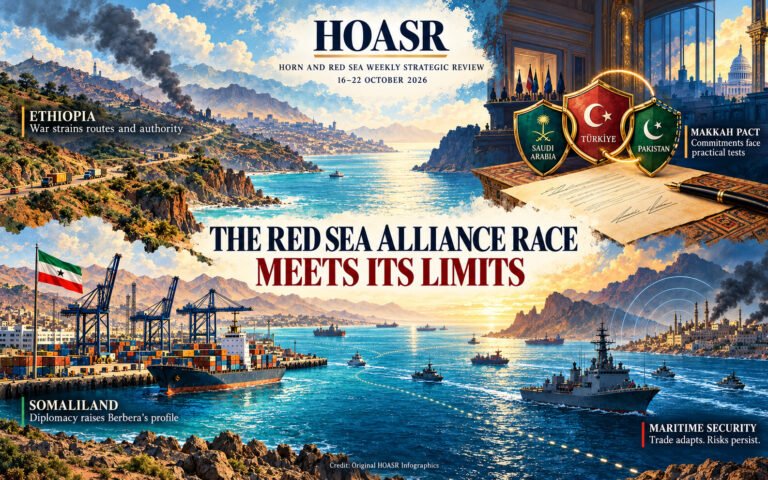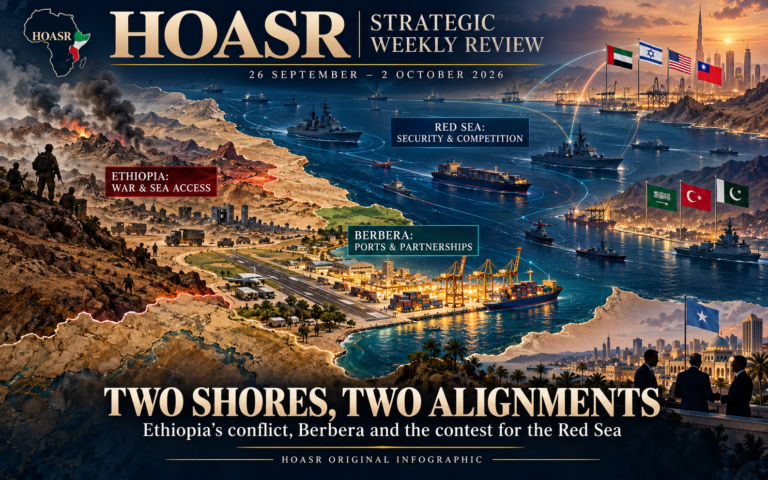
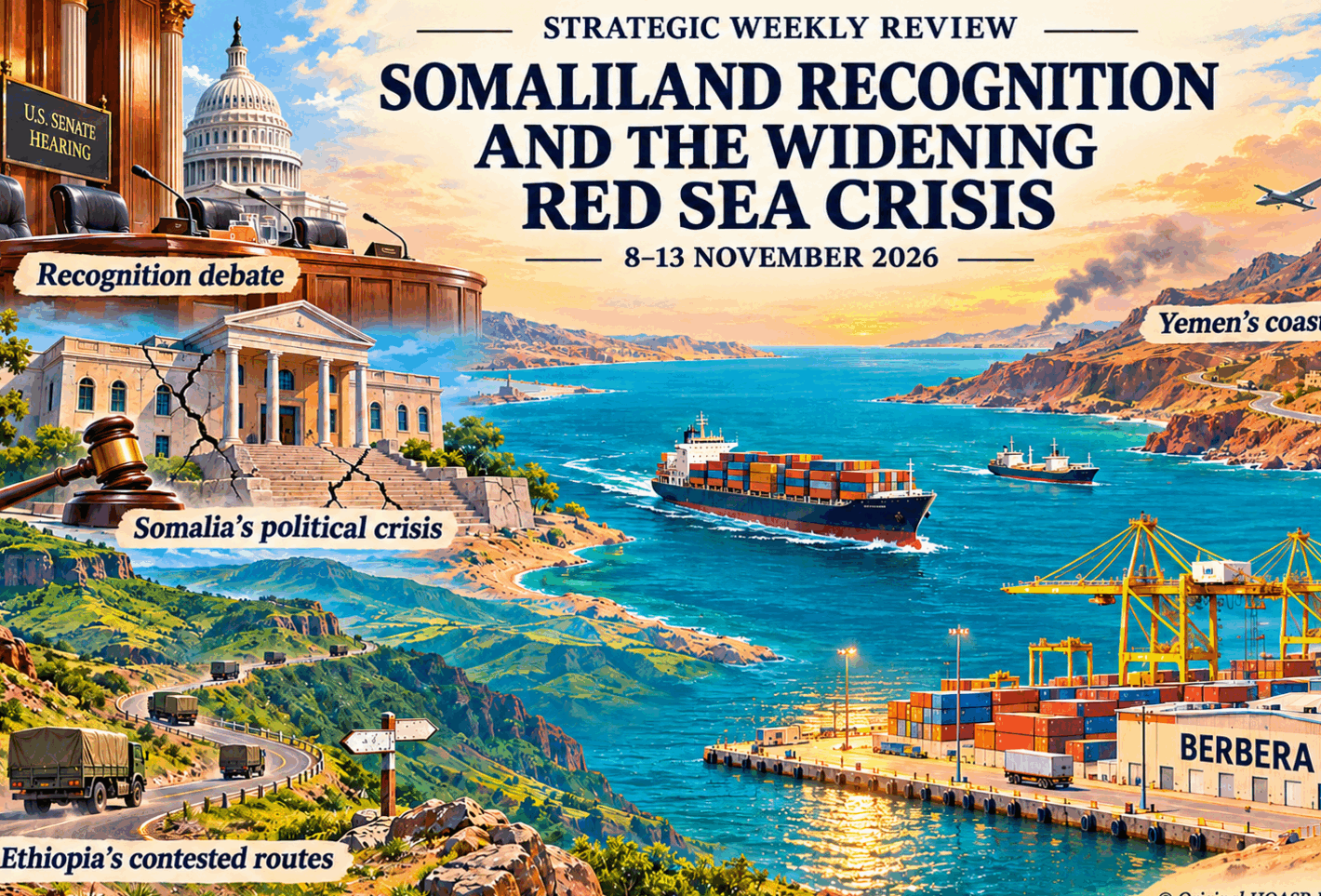
HOASR Strategic Weekly Review, 8–13 November 2026. © Original HOASR Infographics.
Washington debates recognition as conflicts test authority across the Horn and Red Sea
HOASR Strategic Weekly Review | 8–13 November 2026
Washington spent part of this week debating Somaliland while governments around the Red Sea struggled to defend their authority. A senator pressed an American ambassadorial nominee to explain the delay over recognition.
Somalia’s presidency faced a court ruling against its extended mandate. Ethiopia’s army fought to secure roads and border areas, while a Houthi offensive threatened the routes supplying Yemen’s coastal forces. Together, these developments expose the growing distance between diplomatic arrangements and the power actually exercised on the ground.
For Somaliland, that distance has long been familiar. Hargeisa has had to build foreign relationships while much of the international system processes its affairs through Mogadishu. The present security crisis gives outside governments practical reasons to reconsider that approach.
My argument is that postponement now carries strategic costs of its own, especially when reliable access to ports, intelligence and local partners becomes harder to secure.
Cruz brings recognition into the confirmation process
At the November 10 Senate hearing, Senator Ted Cruz questioned Devin Kennington, the nominee for ambassador to Somalia, about Somaliland recognition. According to hearing reporting, Kennington acknowledged Somaliland’s importance to Red Sea security, its favorable position towards the United States on China and opportunities for economic engagement. Cruz then tied his support for the nomination to State Department action. His intervention gave the recognition campaign a concrete point of pressure inside Washington.
The exchange follows the logic developed in HOASR’s earlier analysis, The Bureaucracy Says Wait. The Strategic Map Says Move. Officials can acknowledge Somaliland’s usefulness while leaving its political status indefinitely unresolved. Cruz asked why those two positions should continue together. One senator cannot settle the entire policy, but he can make its contradictions harder to avoid.
President Irro’s Washington campaign must therefore be judged partly by what continues after the visit. This hearing is evidence that Somaliland remains in the American policy debate, although it does not prove that the visit caused Cruz’s intervention. The issue now concerns the terms of America’s own regional presence. That gives the debate a wider audience than a diplomatic appeal from Hargeisa alone.
Somalia faces a struggle over who can set the rules
Somalia’s immediate crisis concerns the authority of institutions that international assistance was meant to strengthen. In a November 12 statement, UN independent experts condemned the dismissal of Chief Justice Bashe Yusuf Ahmed and the appointment of a replacement. They described the November 5 ruling against the presidential and parliamentary term extensions and the court’s order for elections within 90 days. Their criticism is an expert assessment, rather than a judgment issued by the United Nations itself.
There is a competing domestic account. The Somali Judges Forum, in a statement carried by state media, defended the removal process under Somalia’s transitional arrangements and urged investigation of intimidation claims. The disagreement cannot be reduced to a procedural detail. If the presidency and judiciary cannot agree on who has the authority to decide the limits of executive power, confidence in the wider political order weakens.
This is the central failure of state-building through outside support. Training soldiers, paying officials and protecting government compounds can keep an administration functioning. None of those measures creates an accepted rule for transferring power. When institutions become instruments in a contest over presidential tenure, foreign assistance may preserve the office while leaving the conflict beneath it unresolved.
The Africa File connects this confrontation with regional uprisings and the danger of security gaps that al-Shabaab could exploit. It also reports preliminary talks on November 10 and planned negotiations from November 14 to 18. Those talks deserve attention, but their value depends on an agreement that political rivals can accept and implement. A meeting cannot substitute for rules that still apply when a president loses an argument.
Abiy and Hassan Sheikh keep talking despite their differences
Against this background, Abiy Ahmed and Hassan Sheikh Mohamud met in Türkiye on November 11. The published account, citing the Somali presidency, described discussions about Somalia’s security and regional developments, stressing continued dialogue. It disclosed no new maritime agreement. The meeting shows that practical contact can continue even when the two governments have conflicting regional partnerships.
Mogadishu needs security cooperation while Addis Ababa has reasons to prevent another crisis on its eastern flank. Their contact therefore complicates any simple picture of fixed regional blocs. For Somaliland, it is a reminder to judge diplomacy by published commitments and implementation. A meeting between its neighbors neither settles its status nor explains what either government may eventually do about access to Berbera.
Ethiopia can retake roads without ending the war
Ethiopia’s latest military gains need to be read with care. The November 10 review by the Critical Threats Project reports federal advances along the Dessie–Woldia highway and continuing operations near the Eritrean frontier. It also records reported arrests of former Tigray People’s Liberation Front officials. Some battlefield accounts come from partisan sources, and the exact location of reported clashes involving Eritrean forces remains uncertain.
Roads determine whether an army can move reinforcements and supplies between fronts. Recovering towns along a major highway can improve the government’s military position without bringing political agreement to the surrounding region. The continued fighting illustrates that distinction. Control of a route is an operational gain; acceptance of the government by people living along it requires something more.
The same review records Egyptian opposition to Ethiopia’s approach to Nile usage and sea access. These disputes add external pressure to an already difficult domestic war. They also help explain why coastal access carries such weight in Ethiopian politics. But the desire for a port does not remove the need for agreements with neighboring governments and communities.
For Somaliland, Berbera’s importance is strengthened by the demand for alternative commercial routes. Yet a corridor must function beyond the harbor gate. Importers need dependable roads, workable customs arrangements and confidence that political disputes will not interrupt their cargo. The commercial case for Berbera rests on delivering those conditions over time, rather than treating geography as a guarantee of traffic.
Sudan adds another direction of pressure
The same regional assessment describes Sudanese army advances along the central east–west highway and Rapid Support Forces gains on a separate front in Blue Nile state. These are reported movements in a continuing war, rather than evidence of an approaching settlement. They show why a breakthrough on one front can be weakened by pressure elsewhere. Supply routes and the ability to hold them remain central to both sides’ campaigns.
The wider implication is that the Horn’s conflicts cannot be understood through capitals alone. Governments defend roads, borders and supply networks while seeking support abroad. Their opponents try to disrupt the same connections. For outside powers considering new partnerships, the useful test is whether those partnerships create dependable access and accountable local authority, or add another armed interest to an already crowded conflict.
The battle for the coast also depends on inland roads
Across the Gulf of Aden, the Houthis opened a new offensive in southeastern Lahij on November 11. The CTP–ISW assessment interprets reported gains around al-Shatt as an effort to threaten the Mokha–Aden supply route and isolate government-aligned coastal forces. Its account draws partly on partisan reporting. The possible isolation of those forces remains an assessment, not a completed outcome.
The military logic is straightforward. A force holding a coastal position still needs fuel, ammunition and reinforcements from the interior. An opponent that can threaten the road behind it may weaken that position without immediately capturing the port. This is why the Lahij fighting deserves attention alongside the familiar discussion of islands and shipping lanes. The land campaign helps determine how much power either side can sustain at sea.
Fewer reported attacks have not restored normal trade
The latest JMIC advisory, published on November 12, records about 23 daily cargo-vessel transits through Bab el-Mandeb during November 8–11, compared with about 32 in the preceding week. It reports no confirmed local shipping attacks or disruptions during that reporting period. These figures cover a defined category of cargo vessels and do not establish what caused the fall. They nevertheless show that the absence of reported attacks can coexist with reduced traffic.
The advisory also describes the Houthi-run voluntary safe-transit request service, while saying reported merchant use remains independently unconfirmed. A passage assurance is not the same as a lawful or dependable shipping regime. The commercial concern is uncertainty about who can threaten a voyage and what conditions might be imposed later. Shipowners must price that uncertainty even when their vessels complete the journey without incident.
The Scoop
This week’s developments strengthen the case for taking Somaliland seriously as a political and maritime partner. Washington is debating a country whose value its own nominee acknowledges, while Somalia struggles over the rules governing presidential power.
Ethiopia’s war and Yemen’s coastal fighting make dependable local relationships more valuable. The strategic cost of overlooking Hargeisa is therefore becoming easier to explain in plain terms.
Somaliland’s opportunity also comes with greater risk. A partnership becomes useful when it produces reliable services, functioning institutions and commitments that survive changes of government.
Recognition gives those relationships a stronger diplomatic foundation, but their strength will be measured through practice. The strongest argument for Somaliland is the record it can demonstrate while the region around it searches for arrangements that survive.

Prof. Nassir Hussein Kahin is a researcher, educator, Lecturer at (CSI), journalist, Director of Hussein Kahin Educational Foundation (HUKEF), Founder and Managing Editor of Horn of Africa Strategic Review (HOASR) and geopolitical analyst specializing in the Horn of Africa, the Red Sea, international law, diplomacy, and strategic affairs. To read Full Bio click on this link: Prof. Nassir Hussein KahinABOUT THE AUTHORNassir Hussein Kahin