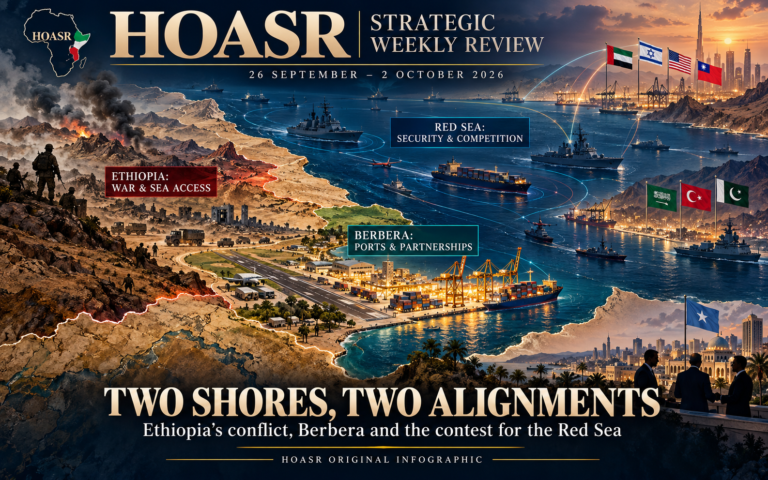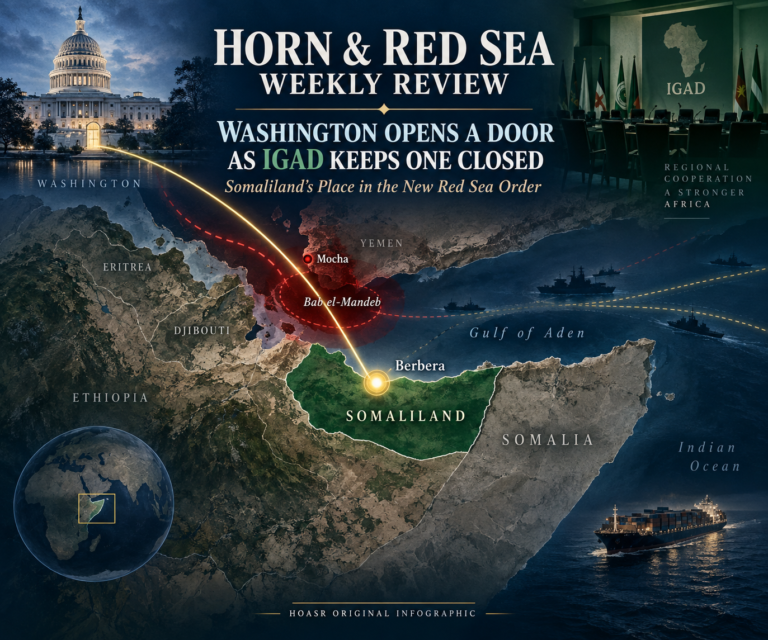
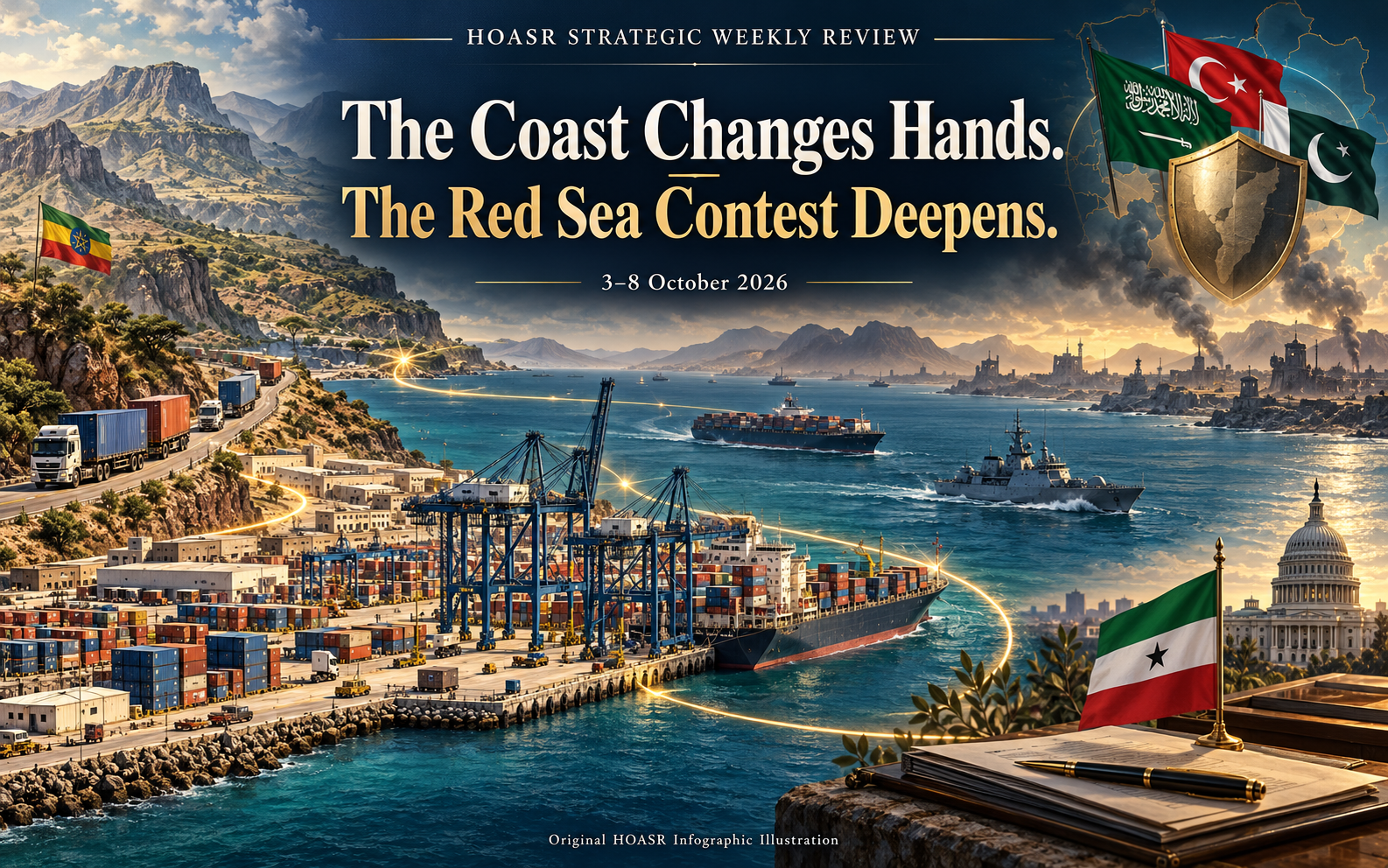
Yemen’s changing coastal front, the Makkah Pact and Ethiopia’s search for sea access reshape Somaliland’s strategic environment. Original HOASR infographic illustration.
Last month’s map of the Red Sea conflict has already changed. Saudi-backed forces have reportedly retaken Mocha, while the Houthis are responding with attacks on Saudi infrastructure. The Makkah Pact is now being tested in a real crisis. Across the water, Ethiopia’s war and the El-Alamein summit are adding pressure to the struggle over sea access. Somaliland is caught between these developments, while President Abdirahman Irro’s American visit continues to shape debate about the benefits of closer ties with Washington.
The fighting and diplomacy are coming together around the routes that connect the Horn to the rest of the world. Saudi Arabia needs safer waters along its southern shipping routes, while Ethiopia’s search for reliable ports has become tied to disputes with its neighbors. Somaliland wants the demand for sea access to bring lasting diplomatic and economic benefits. But success in one part of the region can lead governments to overlook the dangers still developing nearby.
The coastal reversal leaves a dangerous war behind
The Financial Times reported on 6 October that Saudi-led forces had retaken Mocha and that the Saudi navy had disrupted Houthi operations near Hodeida. It also reported the first activation of the Saudi–Türkiye–Pakistan defense agreement. These reported gains change the earlier perception of lasting Houthi control along the coast. They do not, however, mean that commercial ships can pass safely through Bab el-Mandeb.
Elsewhere, the fighting remains dangerous. The Guardian’s 7 October reporting described Houthi pressure toward Taiz and an attack at Aden airport, alongside continuing operations by forces aligned with the government. The front is moving in several directions. Retaking a port gives its defenders more options, but they must also hold the nearby roads, coastline and sea approaches. Control of one city tells us only part of the story.
Meanwhile, Associated Press reported on 8 October that the Houthis claimed another attack on Riyadh’s airport as Saudi authorities reported intercepting missiles. Air travel was disrupted, although the two sides disagreed about the attacks exact outcome. The Houthis can lose territory and still cause damage far from the fighting. For shipping companies and investors, that ability matters as much as the recovery of a coastal position.
Berbera’s importance extends far beyond its location near a coast controlled by the Houthis. Reliable ports, access during emergencies and maritime surveillance remain useful as the fighting in Yemen changes. Somaliland would still matter because the region needs dependable infrastructure and partners that can help keep commerce moving.
The Makkah Pact has reached the test of commitment
The pact now faces the practical test of every mutual-defense agreement: what will each member actually provide? Reuters reported on 8 October that Turkish Foreign Minister Hakan Fidan was considering air defense, electronic warfare and technical assistance for Saudi Arabia, while ruling out offensive operations or troop deployment. The agreement was still awaiting approval by Türkiye’s parliament. Ankara’s position puts the emphasis on defence and limits expectations of a joint war beyond the members’ borders.
Pakistan faces a different problem. Reuters’ examination of its expanding Gulf role describes additional military commitments without parliamentary participation, while details of the operations remain undisclosed. Decisions made quickly during a crisis can create commitments that are hard to change later. Saudi Arabia gains visible support, but its partners also take on responsibility for a conflict whose course they cannot fully control.
The pact’s success or failure will matter beyond Yemen. Effective assistance would strengthen Saudi Arabia’s role in organizing regional security and give Türkiye a larger part in protecting Saudi interests. If the disruption continues, it would expose the gap between a promise of mutual defence and the military capabilities needed to deliver it. Either way, American power remains deeply involved in the region’s security, so the pact cannot automatically replace Washington’s role.
For Somaliland, Türkiye’s relationship with Somalia is especially important. A growing Turkish role in Saudi defense could increase Ankara’s influence along the shipping routes around the Horn. But the pact’s current defensive commitments do not establish a mission against Hargeisa. Saudi Arabia’s interest in safe trade also offers room for practical cooperation despite political disagreements. Treating all of Mogadishu’s partners as one military coalition would hide both the opportunities and the risks.
Ethiopia fights at home while the coast becomes political
Ethiopia’s renewed war makes the dispute over sea access more urgent and harder to settle. Reuters reported on 5 October that airstrikes and artillery fire had hit northern towns, with aid sources reporting civilian deaths. Ethiopia accuses Eritrea, Egypt and Sudan of supporting its opponents, but those governments dispute the accusations. Civilians are suffering now, while the wider effects of the war threaten the trade routes and foreign relationships on which Ethiopia depends.
The 4 October El-Alamein declaration brought Egypt, Eritrea, Sudan and Somalia together around common positions on regional security. They opposed Somaliland recognition and said that countries bordering the Red Sea should govern it. Egypt, Eritrea and Somalia have different disputes with Ethiopia, but their diplomatic positions now strengthen one another. The summit shows more organized regional opposition, although it does not prove that the leaders share a war plan. Ethiopia could face pressure from the same group across several negotiations at once.
Abiy Ahmed still renewed his demand for a sea outlet on 5 October, according to Associated Press, calling for negotiation and arrangements that benefit both sides. His statement shows that access remains a priority despite the war. Yet a government under military pressure has less money for costly confrontation and long-term infrastructure projects. A negotiated trade corridor becomes more attractive under those conditions, even as delivering it becomes harder.
Hargeisa has kept the option open. Reporting on Somaliland’s renewed offer attributes support for sea-access agreements that benefit both countries. Mogadishu is also offering commercial access through Somali ports, as Somalia Today reported on 4 October. The competition is over who negotiates the agreement and what Ethiopia gets from it. For Berbera, a workable trade arrangement and Somaliland’s recognition campaign remain closely linked, although progress on one does not automatically deliver the other.
Irro’s visit continues in the American argument
The clearest new sign that Irro’s visit is still influencing debate appeared on 8 October. Peter Harris’s Washington Examiner opinion article, “Israel got it right: Somaliland is the strategic ally Trump needs now” brought the recognition argument to an American conservative audience and directly linked it to Irro’s meetings with policy institutions. This is an argument intended to influence policy, rather than an announcement from the administration. The visit has given American writers and analysts more material to discuss Somaliland’s value, the costs of engagement and Washington’s diplomatic choices.
The events themselves help explain why the debate continues. Hudson hosted Somaliland as a Strategic Partner in the Horn of Africa on 14 September. At the Council on Foreign Relations on 24 September, Irro discussed maritime cooperation and economic access alongside recognition, and described his meetings with American officials and legislators.
These appearances created a public record that analysts can examine and challenge. Hosting the president did not mean those institutions endorsed his position, but it gave his campaign a platform that lasted beyond the visit.
The CFR discussion also showed where Somaliland’s argument needs stronger answers. Irro viewed the silence of some governments as encouraging, but the moderator, Ebenezer Obadare, questioned whether silence meant agreement.
Questions about African support and barriers to economic participation took the discussion beyond Somaliland’s strategic location. Even audiences willing to listen will closely examine the case. Hargeisa can make its argument more persuasive by answering those questions with evidence and concrete action.
Access to banking is one practical issue raised by the visit. Horndiplomat’s reporting on the 15 September Treasury hearing recorded Representative John Rose asking Scott Bessent about it, with Bessent saying he would seek a briefing. This earlier development remains relevant, but it does not mean the proposed changes have become law or policy. It shows that Somaliland’s concerns can reach an American institution with a specific problem to examine. Removing banking barriers gives officials a clearer task than a general promise of friendship.
Irro’s campaign is now being discussed in several parts of the American policy debate. Supporters of recognition are arguing about Washington’s strategic choices, while proposals for practical cooperation give agencies and legislators specific issues to consider. These developments do not prove that the visit changed American policy. They do show that it remains part of the discussion. The next important sign will be official follow-up that identifies who is responsible and what has been achieved.
Berbera sits between competing security projects
The rivalry between Türkiye and Israel adds to these pressures. The Jerusalem Post’s 6 October account quoted a senior Somaliland adviser asking for Israeli defense support against Türkiye’s growing role in Somalia. The statement shows Hargeisa’s security concerns, but it does not establish an Israeli promise to defend Somaliland. Israel and the UAE are both important to Somaliland’s foreign relationships, although their interests are not necessarily the same. Commercial investment, diplomatic ties and military commitments each create different responsibilities.
Those differences matter as Saudi Arabia organizes its response to the Houthis. Somaliland benefits from safer seas even when governments with which it disagrees help provide that security. At the same time, deeper Turkish involvement may increase Hargeisa’s concern about the regional balance of power. Berbera can attract several partners because it serves trade across a wider region. Tying it exclusively to one partner could make that partner’s operations easier while discouraging others from using the port.
The Scoop: battlefield gains will not settle the political contest
This week has challenged two assumptions. Houthi gains along the coast can be reversed, and Somaliland’s American campaign can remain influential after a visit ends without recognition. Neither development settles the wider dispute. Retaken territory must stay secure, while attention in Washington must lead to action by government institutions before it changes relations.
The bigger contest is over who will control access and provide security once the immediate crisis passes. Saudi Arabia is testing a new defence partnership, Ethiopia is seeking room to negotiate, and the El-Alamein governments are trying to set the terms of regional cooperation. Somaliland’s location gives it a part in that contest. Its importance grows when partners see Berbera as serving their long-term interests, beyond its usefulness during an emergency.
For Hargeisa, the strongest result would bring together a workable Ethiopian trade corridor, wider international engagement and partnerships that leave Somaliland free to make its own choices. War makes that goal more urgent and harder to achieve. Lasting influence will come from keeping trade and cooperation working when the next coastal town changes hands. That is how Somaliland’s geography can become a source of real political weight.
HOASR Strategic Weekly Review 26 September to 2 October 2026: Two Shores Two Alignments

Prof. Nassir Hussein Kahin is a researcher, educator, journalist, and geopolitical analyst specializing in the Horn of Africa, the Red Sea, international law, diplomacy, and strategic affairs. To read Full Bio click on this link: ABOUT THE AUTHORProf. Nassir Hussein Kahin