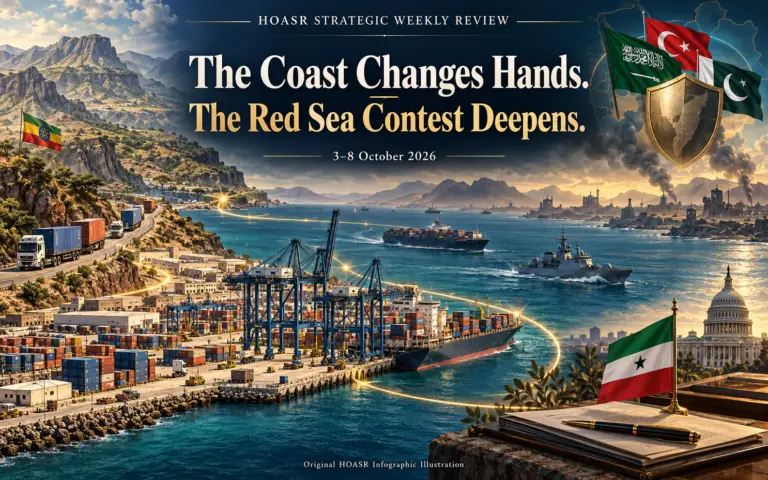
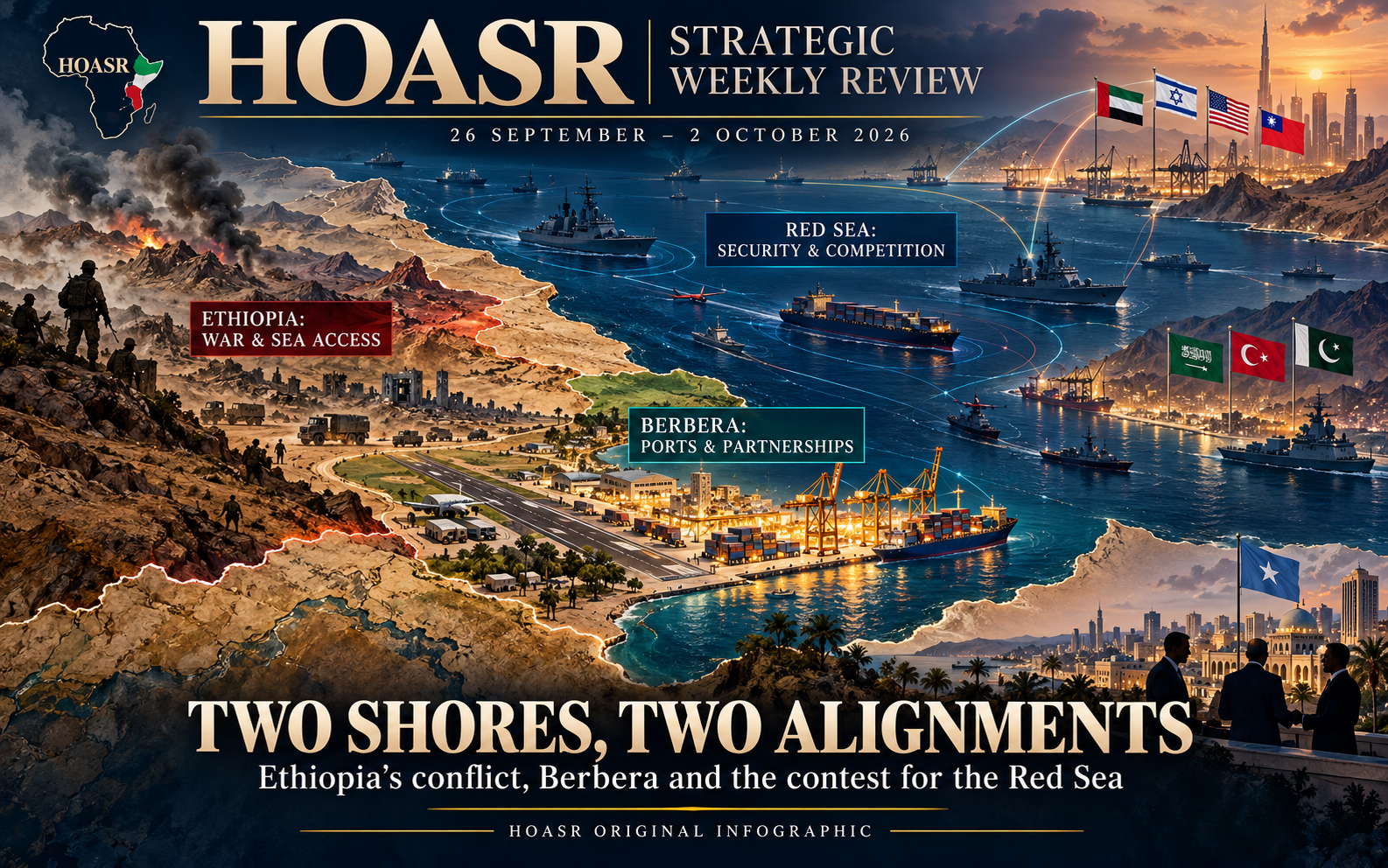
Two Shores, Two Alignments: Ethiopia, Berbera and regional maritime competition, 26 September–2 October 2026. HOASR original infographic.
How Ethiopia’s new war, the UAE Israel partnership and the Mecca Pact are redrawing the Horn and Red Sea

This week in one sentence
The Horn is being absorbed into a wider contest between Gulf power, Israeli security strategy, Turkish reach and American hesitation, Fighting in Northern Ethiopia with Somaliland and Somalia increasingly positioned on opposite sides of an emerging regional map.
The week the regional map became harder to ignore
The Horn of Africa is no longer a neighbouring theatre to the Red Sea crisis. It has become part of the same strategic system. Fighting in northern Ethiopia, the rupture between Addis Ababa and Asmara, Houthi control along Yemen’s western coast and growing concern over Houthi links with Al-Shabaab now reinforce one another.
At the same time, the United Arab Emirates, Israel, Saudi Arabia, Türkiye, Pakistan and the United States are building or testing relationships that reach across both shores. Somaliland and Somalia are not simply watching this realignment; they are being drawn into it.
The sharpest change this week came from Ethiopia. Reuters described a conflict in which the old alignments have reversed: Eritrea, once an ally of Prime Minister Abiy Ahmed against the Tigray People’s Liberation Front, now stands accused of helping forces fighting Addis Ababa.
Egypt and Sudan’s army have their own reasons to resist Ethiopian power, while the UAE remains an important partner of Ethiopia and a major actor in Somaliland, Puntland and Sudan.
The result is not a clean division into two camps, but a crowded contest in which every local war changes the calculations of outside states.
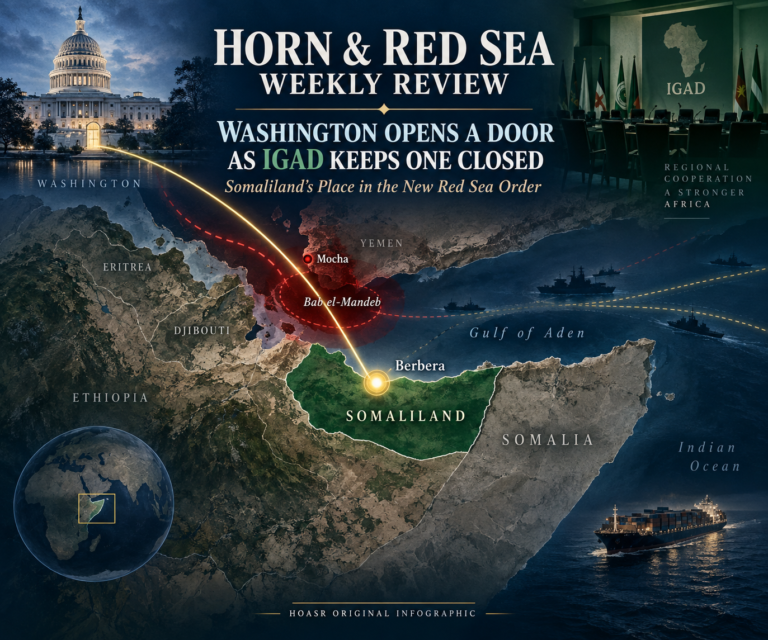
This matters to Somaliland because Berbera sits inside the contest rather than outside it. The port and airfield are valuable not only as national assets but as elements in a wider network of shipping, surveillance, logistics and access.
Yet strategic value brings exposure. A Somaliland that is seen exclusively through its relationships with the UAE, Israel and Ethiopia may find itself treated by Saudi Arabia, Türkiye and Egypt as part of a hostile alignment, even when Hargeisa has no interest in joining a regional confrontation.
Ethiopia’s new war is not a replay of 2020
The fighting that began on 22 September is broader than another round between Addis Ababa and the Tigray People’s Liberation Front. Two days earlier, seven armed organizations announced the Coalition of Ethiopian Popular Forces for Survival with the declared objective of removing Prime Minister Abby Ahmed’s government.
The TPLF supplies the coalition’s most experienced military organization, but the alliance also draws together forces rooted in Amhara, Oromia and other regions. These groups share an enemy more readily than they share a political settlement for Ethiopia.
The coalition contains serious internal contradictions. Fano forces in Amhara fought beside the federal army and Eritrea during the 2020 to 2022 Tigray war, then turned against Addis Ababa after feeling excluded from the Pretoria settlement and resisting the dismantling of regional forces.
The Oromo Liberation Army has fought the federal government since 2018, but it also clashes with Fano over territory and communal boundaries.
The TPLF and Fano remain divided over western Tigray, where Amhara forces consolidated control during the last war.
Cooperation on the battlefield therefore does not amount to agreement over borders, federal power or the future of the state.
The opening phase nevertheless demonstrated that the rebellion has reach. Tigrayan forces captured Erebti in Afar, threatening routes that connect northern Ethiopia with the Djibouti corridor, while federal and allied forces retook Alamata and advanced northward.
Explosions in Addis Ababa, accompanied by opposition claims of drone attacks, suggested that the conflict may no longer remain confined to the northern front, although attribution and damage were not independently established.
Ethiopia’s military advantage in drones and aircraft remains substantial, but the opposition is trying to stretch federal forces across several regions rather than defeat them in one conventional campaign.
The humanitarian indicators are already severe. Associated Press reporting cited about 150,000 displaced people, while hospitals supported by Médecins Sans Frontières recorded sharp increases in war casualties within days.
The earlier Tigray war destroyed health systems, interrupted agriculture and left a legacy of mass displacement and unresolved territorial claims. A new campaign begins before those wounds have healed and as the country faces serious economic pressure.
Even a federal battlefield victory could leave Ethiopia weaker, more indebted and less capable of carrying out large regional infrastructure commitments.
The outside actors are fighting over more than Tigray
Eritrea is the most consequential reversal. President Isaias Afwerki supplied troops to Abiy during the previous Tigray war; Addis Ababa now accuses Asmara of financing and supplying the TPLF-led coalition.
Eritrea denies the charge, but its interests have plainly changed. Abiy’s language about sovereign sea access and the port of Assab has transformed Ethiopia from a former partner into a possible territorial threat.
Cooperation between Asmara and its former Tigrayan enemies is best understood as a defensive convergence against Addis Ababa rather than reconciliation over the atrocities of the last war.
Egypt enters through another front. Cairo’s dispute with Ethiopia over the Grand Ethiopian Renaissance Dam has made any weakening of Abiy’s government strategically useful, although Egyptian support for the rebels remains an Ethiopian allegation rather than an independently established fact.
Sudan’s military leadership also rejects Addis Ababa’s accusations, while accusing Ethiopia of assisting the Rapid Support Forces.
The Sudan war has therefore become part of Ethiopia’s war: Eritrea, Egypt and Sudan’s army share overlapping concerns, while Ethiopia and the UAE are accused of helping the RSF. The governments concerned dispute important parts of that account.
The Gulf rivalry sits behind these alignments. The UAE has invested heavily in Ethiopia and built commercial and security relationships with Somaliland and Puntland. Saudi Arabia maintains close ties with Egypt, Eritrea and Sudan’s army and is increasingly suspicious of Emirati activity across Yemen and the Horn.
Riyadh’s new defence relationship with Türkiye and Pakistan adds another layer because Türkiye is also Somalia’s most important external security partner. None of this creates two perfectly disciplined blocs, but it gives local belligerents more external options and makes compromise harder.
Sea access has become part of the war itself
Ethiopia’s search for the sea is often presented as an economic necessity. More than ninety percent of its external trade has moved through Djibouti, imposing high transport and port costs on a population of more than 130 million.
Diversifying access is a rational national objective. The danger came when economic diversification was joined to language about sovereign access, a natural boundary on the Red Sea and the historic loss of Assab.
Eritrea heard a territorial claim; Somalia interpreted the Somaliland memorandum as an attack on its sovereignty; Egypt saw another attempt by Ethiopia to alter the regional balance.
The January 2024 memorandum with Somaliland offered Ethiopia a different route. It connected access near Berbera with an Ethiopian commitment to make an assessment toward recognition, avoiding any need to challenge Eritrea’s internationally recognized border.
The agreement also promised to diversify Ethiopia away from Djibouti and deepen the Berbera corridor. Yet its ambiguity created vulnerabilities.
The commercial terms, security component and timetable for recognition were never made sufficiently transparent, allowing Somalia and its partners to depict the memorandum as a naval annexation project rather than a negotiated partnership.
Türkiye’s Ankara process attempted to move Ethiopia’s maritime access into an arrangement controlled by Somalia. Mogadishu now argues that this framework made the Somaliland memorandum irrelevant, but Ethiopia has never publicly completed a formal cancellation.
The renewed war makes Addis Ababa’s choices more urgent and more difficult. Assab is becoming inseparable from a potential war with Eritrea, while Djibouti remains commercially indispensable but strategically concentrated.
Berbera consequently becomes more attractive as an alternative corridor at the same moment that Ethiopia becomes a less predictable partner.
What Ethiopia’s war changes for Somaliland
The immediate temptation is to conclude that Ethiopia’s vulnerability strengthens Somaliland’s leverage. In one sense it does. Addis Ababa needs a secure outlet that does not depend on coercing Eritrea, and the Berbera corridor offers an existing port, a road connection and a government willing to negotiate.
Israeli recognition and Emirati investment have also made Somaliland harder to treat as an empty space on someone else’s map. A functioning Berbera option could give Ethiopia strategic redundancy while allowing Somaliland to advance recognition, transit revenue and regional relevance.
The opposite risk is just as real. A government fighting on several fronts may lack the money, bureaucratic attention and political stability needed to implement the corridor. If Abiy’s position deteriorates, agreements identified too closely with his administration could be reopened by a successor or attacked by the opposition.
Somaliland would then carry the diplomatic costs of the memorandum without receiving recognition or the promised economic return. The lesson is not to abandon Ethiopia, but to move the relationship from presidential understanding to institutional agreement with published commercial obligations, dispute mechanisms and a realistic implementation timetable.
Somaliland must also keep Berbera from becoming a proxy asset in the UAE–Saudi contest. Emirati investment remains indispensable, and Israeli recognition has changed the diplomatic landscape, but neither partnership should close the door to Riyadh, Washington, Europe or additional commercial users.
The port will be more valuable if it serves as an open, professionally regulated corridor than if it is viewed as the exclusive platform of one alignment. Diversified investment and transparent access rules would protect Somaliland if regional alliances shift again.
The war therefore increases both Somaliland’s value and its exposure. Ethiopia needs alternatives, but Somaliland needs assurance that recognition and corridor development will survive political change in Addis Ababa.
The strongest arrangement would separate three questions that have too often been blurred together: Ethiopia’s commercial transit needs, any security access it requests and Somaliland’s recognition. Each requires its own legal terms, parliamentary scrutiny and enforcement. Strategic urgency should accelerate serious negotiation, not replace it.
A serious new report and a familiar European instinct
The most substantial publication of the week is the Polish Institute of International Affairs report New Flags in the Red Sea Region. Across eighty pages, it compares Somaliland with southern Yemen and the Rapid Support Forces’ parallel administration in Sudan.
Its central claim is that separatist and quasi-state projects have become instruments through which outside powers, above all the UAE and Israel, are reshaping authority around the Red Sea. Saudi Arabia, in this account, has answered by defending recognized governments and strengthening relationships with actors opposed to Emirati expansion.
The report deserves attention because it may indicate how sections of the European policy establishment will interpret Somaliland after Israeli recognition. Its framework is also its principal weakness.
Somaliland’s state institutions, constitutional order and long period of civilian self-government are not comparable to administrations created by armed organizations during active wars.
Putting them under the same conceptual heading allows the authors to discuss external sponsorship while flattening the historical and institutional differences that define Somaliland’s case.
The treatment of Las Anod is particularly severe. The authors present the crisis as proof that Somaliland’s democratic reputation was partly illusory and argue that Hargeisa lost legitimacy among important eastern communities.
Those claims cannot be dismissed, but they are judgments rather than neutral findings.
A useful HOASR response would acknowledge the political damage caused by Las Anod while challenging the report’s tendency to treat territorial reversals as a complete answer to the legal, historical and democratic case for Somaliland statehood.
There are also factual reasons to read the document carefully. It states that Somaliland established diplomatic relations with Taiwan in 2009, whereas Taiwan’s Ministry of Foreign Affairs records that the agreement to establish reciprocal representative offices was signed in February 2020 and implemented later that year.
The error does not invalidate the whole report, but it illustrates why its conclusions should be tested rather than imported wholesale.
The document is most valuable as evidence of an emerging European narrative and as a map of the arguments Somaliland will increasingly have to answer.
The UAE Israel relationship is an alignment not a command structure
The UAE and Israel now share important interests in the Red Sea, but the relationship should not be described as a formal military bloc.
Abu Dhabi has built influence through ports, logistics, investment and security relationships.
Israel’s priorities are narrower and more immediate: monitoring Iran and the Houthis, protecting maritime access and securing partners on the African side of the Gulf of Aden.
Somaliland offers both countries a stable point of entry, but each approaches it through a different strategic lens.
For the UAE, Berbera forms part of a commercial and political network extending from the Gulf to the western Indian Ocean.
DP World’s investment, the corridor toward Ethiopia and Emirati relationships with authorities outside Mogadishu give Abu Dhabi options that do not depend on a single central government.
For Israel, Somaliland’s importance rose sharply as the Houthi threat moved closer to Bab el-Mandeb.
Recognition converted an informal relationship into a political commitment, but the practical security architecture remains far less transparent than the rhetoric surrounding it.
This week’s reporting adds a further layer. Reuters places the UAE alongside Ethiopia and notes its relationships with Somaliland and Puntland, while Saudi Arabia appears closer to Egypt, Eritrea and Sudan’s army.
Those connections are fluid and sometimes contradictory. The UAE and Saudi Arabia still cooperate where their interests converge, and Israel and Türkiye retain channels despite sharp competition.
The more accurate picture is a set of overlapping networks, not two disciplined alliances waiting for orders from rival capitals.
The Mecca Pact faces the difference between promise and power
The Mecca Joint Defence Agreement has entered its first real test. Pakistan’s defence minister said Islamabad would use whatever means were available to defend Saudi Arabia against Houthi attacks. Military chiefs from Pakistan, Türkiye and Saudi Arabia have met, while work continues on a secretariat and an operational framework.
That is more than ceremonial diplomacy, but it is still short of an integrated military alliance.
The pact brings together three complementary strengths: Saudi finance and political weight, Turkish defence production and regional reach, and Pakistani military capacity.
On paper, that combination could reshape security from the Gulf to the Horn.
In practice, the agreement’s text has not been published, its triggers remain unclear and none of its members has demonstrated that an attack will produce an automatic joint response.
Pakistan’s desire to preserve channels with Iran and Türkiye’s multiple regional commitments will constrain how far collective defence can move from signalling to war.
For Somalia, however, even a partly implemented pact matters. Türkiye already possesses a deep military and political relationship with Mogadishu.
Saudi Arabia has increasingly defended Somalia’s territorial claim, and Pakistan adds weight to a network that could eventually include training, intelligence, air defence, naval cooperation and arms production.
Somaliland therefore faces a strategic challenge that cannot be answered by assuming Israeli recognition alone has permanently changed the balance.
The correct response is neither panic nor bloc politics. Somaliland needs room to maintain relations with the UAE and Israel while opening a more serious channel to Riyadh and avoiding unnecessary confrontation with Türkiye.
Saudi Arabia’s Red Sea concerns are not identical to Somalia’s sovereignty claims.
Hargeisa can still present itself as a functional maritime partner if it separates practical cooperation from ideological alignment and demonstrates that Berbera can contribute to regional security without threatening Saudi interests.
Washington remains indispensable and strategically undecided
The United States remains the actor with the greatest capacity to connect the region’s separate security files, yet its policy still moves at different speeds.
American officials warn that Houthi cooperation with Al-Shabaab could threaten trade from both shores of the Gulf of Aden.
Washington also understands the vulnerability of concentrated bases and the need for distributed access, surveillance and logistics.
Those conditions strengthen the practical case for a separate relationship with Somaliland even if the White House is not ready to grant recognition.
President Irro’s recent appearances in Washington and New York were therefore important less for any single announcement than for the questions they revealed.
American policy audiences wanted clarity on military access, Israel, Taiwan, China, critical minerals and the terms of investment.
President Irro confirmed that Somaliland wants to be regarded as a security and economic partner, but the visit also showed that sympathy for recognition is not a substitute for a negotiated offer.
Washington will ask what access Somaliland can provide, under what legal framework, at what political cost and with what protection against escalation.
The Mecca Pact does not replace the American security role in Saudi Arabia. US weapons, intelligence and air-defence systems remain embedded in the kingdom’s military structure.
The pact instead reflects Riyadh’s determination to gain additional options after repeated doubts about American reliability.
This is important for Somaliland: Washington may cooperate with Saudi Arabia, the UAE, Israel and Türkiye simultaneously, even as those states compete with one another.
Hargeisa’s strongest position is to offer a useful node within that wider American network rather than demand that Washington choose one regional camp.
Taiwan is the quiet strategic constant
Taiwan generated no major Somaliland-specific publication during this briefing period, but its absence from the week’s headlines should not be confused with declining importance.
The relationship with Taipei remains Somaliland’s most durable example of sustained governmental cooperation outside the conventional recognition system.
Health, agriculture, education, information technology, energy and mineral cooperation give the relationship practical depth that newer partnerships have not yet matched.
Taiwan also places Somaliland inside the wider competition between the United States and China.
That brings diplomatic value, but it can encourage outsiders to reduce the relationship to anti-Chinese symbolism.
The stronger case is that two governments with limited formal recognition have built institutions that deliver measurable cooperation.
Somaliland gains more by showing what the relationship produces than by presenting Taiwan only as a geopolitical badge.
Somalia has diplomatic backing but not strategic control
Mogadishu enters this realignment with an advantage in formal diplomacy. Saudi Arabia, Türkiye, Egypt and most multilateral institutions continue to support Somalia’s territorial claim.
That support can raise the political cost of additional recognitions and help Somalia frame Somaliland’s partnerships as foreign interference.
Yet diplomatic backing does not give Mogadishu control over Berbera, Hargeisa or the security environment along Somaliland’s coast.
The reported Houthi–Al-Shabaab relationship sharpens this contradiction. American officials describe exchanges involving weapons, training, explosives and drone knowledge, though the public evidence does not yet establish a single integrated command.
Even limited cooperation would turn Somalia’s internal security weakness into a direct Red Sea problem.
Mogadishu can invoke territorial integrity, but international partners will also judge which authorities can monitor coastlines, interdict trafficking and protect commercial infrastructure.
Somalia’s strongest card remains international legitimacy. Somaliland’s strongest card remains effective administration and strategic geography.
The next phase will be decided by which side converts its advantage into usable relationships.
If Somalia’s allies provide functioning security and maritime capacity, Mogadishu’s position will strengthen.
If Somaliland can demonstrate reliability, legal clarity and operational value, practical engagement may continue to grow even before another formal recognition.
The strategic map
The UAE now operates through a broad network of ports, investments and flexible relationships extending across Ethiopia, Somaliland, Puntland and Sudan.
For Somaliland, Abu Dhabi remains a vital commercial and strategic partner.
The risk lies in allowing that partnership to be interpreted entirely through the UAE’s rivalry with Saudi Arabia.
Berbera’s value is strongest when it serves several markets and security relationships rather than becoming identified as the exclusive outpost of one Gulf power.
Israel occupies a different but increasingly important position.
Its recognition of Somaliland and its growing concern with intelligence, maritime security and the Houthi theatre have increased Hargeisa’s strategic value.
They have also increased Somaliland’s exposure to actors that view any Israeli presence near Bab el-Mandeb as a direct threat.
The relationship gives Somaliland new diplomatic and security possibilities, but it must be developed with a clear understanding of the regional reaction it can provoke.
The United States remains cautious on recognition even as its practical interests move closer to Somaliland.
American concern about the two-shore militant threat, resilient logistics and maritime surveillance creates space for security cooperation that may advance faster than formal diplomatic change.
Washington does not have to abandon Mogadishu to work directly with Hargeisa.
Its real test is whether it can build separate, functional relationships with both without allowing Somalia’s objections to block every practical initiative.
Taiwan remains the quiet institutional partner in this landscape.
Its work with Somaliland demonstrates that durable governmental cooperation can grow without universal diplomatic recognition.
The partnership also connects Hargeisa to the wider competition between the United States and China, although its greatest value lies in the institutions and technical capacity it has helped build.
That record gives Somaliland a model for turning political friendship into practical results.
Saudi Arabia is building additional security options through Türkiye and Pakistan while resisting what it sees as excessive Emirati reach.
Hargeisa cannot afford to let Mogadishu define Somaliland’s relationship with Riyadh by default.
Direct communication on trade, pilgrimage routes, livestock, shipping and maritime security could create a separate channel even while Saudi Arabia continues to support Somalia’s territorial claim.
Engagement would not remove the political disagreement, but it could prevent the disagreement from hardening into permanent strategic hostility.
Somalia retains strong formal backing from regional states and international institutions, but its control over territory and maritime security remains limited.
Its diplomatic advantage is formidable with diminishing trust and confidence; its operational weakness is equally visible.
Mogadishu will try to convert Saudi, Turkish and Egyptian support into a containment strategy against Somaliland.
Hargeisa’s answer will depend on whether it can translate stability, geography and effective administration into partnerships that foreign governments find more useful than diplomatic caution.
What to watch next
First, watch whether the Mecca Pact produces an operational act rather than another declaration.
A confirmed Pakistani or Turkish deployment, integrated air-defense arrangement or joint maritime mission would change the assessment.
Until then, the pact is an emerging institution with real political weight but uncertain military force.
Second, watch how Saudi Arabia treats Somaliland directly. Public support for Somalia’s unity does not preclude quiet communication on maritime safety, trade, pilgrimage routes or investment.
A complete absence of engagement would leave Mogadishu and Ankara free to define Somaliland for Riyadh.
Third, watch whether Washington converts its concern about Houthi–Al-Shabaab cooperation into a two-shore security policy.
If American planning begins to include Somaliland’s coastline, Berbera’s logistics or intelligence-sharing arrangements, practical differentiation from Somalia will have moved further than formal diplomatic language suggests.
The Scoop
The Red Sea is producing alignments faster than institutions can explain them. The UAE and Israel are strengthening relationships that favor access, local partners and strategic flexibility.
Saudi Arabia, Türkiye and Pakistan are building a defense framework whose reach may extend toward Somalia and the African shore.
Washington remains central to every major actor but has yet to translate its interests into a coherent Horn strategy.
Somaliland stands closer to the center of this map than at any time in its modern history. That is not the same as being secure. Recognition by Israel, Emirati investment, Taiwanese cooperation and American interest provide openings, but they also place Somaliland inside rivalries it does not control.
The most effective diplomacy will widen the circle of relationships rather than turn today’s partners into tomorrow’s permanent camp.
Somalia retains international legitimacy and powerful friends. Somaliland retains control, location and a record of separate government.
The contest between them will increasingly be judged through the needs of the Red Sea: who can provide security, protect commerce, manage partnerships and remain useful without becoming a proxy. This week’s developments made that test impossible to ignore.

Prof. Nassir Hussein Kahin is a researcher, educator, journalist, and geopolitical analyst specializing in the Horn of Africa, the Red Sea, international law, diplomacy, and strategic affairs. To read Full Bio click on this link: ABOUT THE AUTHORProf. Nassir Hussein Kahin