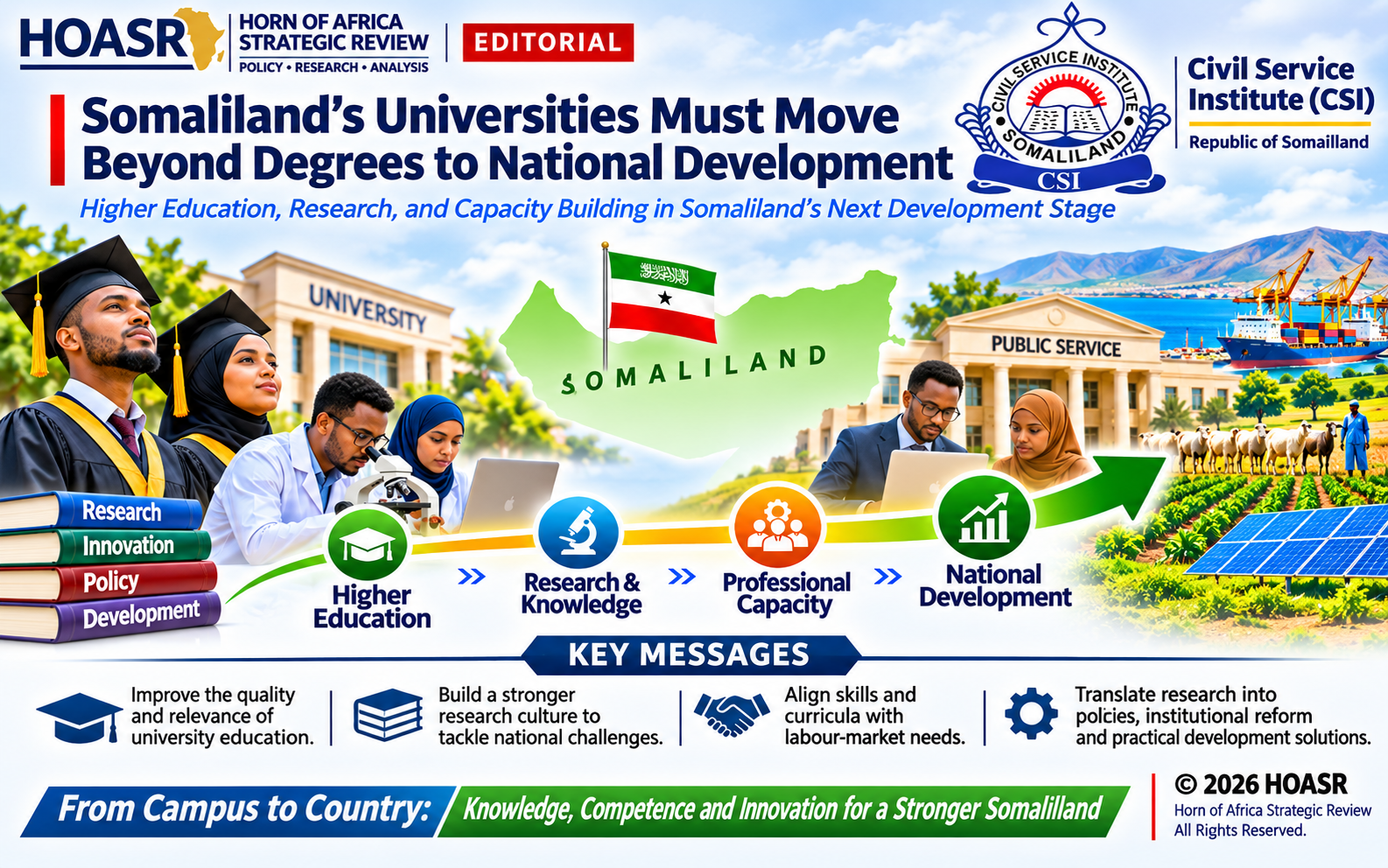
From Campus to Country: Higher education, research and professional capacity building for Somaliland's development. © 2026 HOASR
Somaliland’s Universities Must Move Beyond Degrees to National Development
Somaliland has made remarkable progress in rebuilding its education system since 1991. From a country emerging from war, destruction and the collapse of public institutions, it has developed universities, professional colleges and training institutions across its major cities. Thousands of young men and women have gained access to higher education that previous generations could scarcely imagine.
Yet another question now demands attention. Are Somaliland’s universities producing the knowledge, skills and research needed to develop the country, improve public institutions and create employment? Or have too many institutions become primarily concerned with awarding degrees rather than preparing graduates for the responsibilities awaiting them?
This question deserves serious attention as the Civil Service Institute (CSI) prepares to host the Somaliland Public Administration Conference on Excellence and Research (SPACER 2026) on 18–19 November at the Ambassador Hotel in Hargeisa. Among its activities is a thematic discussion examining how higher education, research and professional capacity building can contribute to Somaliland’s national development.
The conference arrives at an important time. Somaliland is seeking to strengthen its institutions, diversify its economy and expand international economic and academic relationships. Its universities must be capable of supporting those ambitions. The country’s future cannot depend indefinitely on imported expertise, externally financed studies and an education system whose graduates are not always adequately prepared for professional employment.
From Reconstruction to Educational Expansion
The development of higher education is one of Somaliland’s important achievements since the restoration of its independence in 1991. Universities such as Amoud University, the University of Hargeisa and the University of Burao, alongside other public, community-supported and private institutions, helped create educational opportunities during decades when resources were limited and outside assistance was uncertain.
Much of this progress came through community initiative, private investment, diaspora contributions and the determination of Somaliland families to educate their children. The emergence of local universities also helped reduce the need for students to travel abroad to pursue university qualifications.
These achievements deserve recognition. However, the conditions under which universities originally developed have changed. Institutions created to meet an urgent educational need are now expected to prepare engineers, teachers, accountants, researchers, health professionals, public administrators and business leaders for an increasingly demanding economy.
In its 2024 Higher Education Conference Report, Somaliland’s Commission for Higher Education acknowledged that the expansion of university education had created significant challenges involving quality assurance, infrastructure, institutional governance, research and labor-market relevance.
This is where Somaliland must begin its next stage of educational reform. The priority is not simply increasing the number of universities or the graduates they produce. It is improving what students learn, how they learn it and what they can accomplish after graduation.
When a University Degree Is Not Enough
For many Somaliland families, university education represents years of financial sacrifice and the hope of a better future. Parents invest their savings, students devote years to their studies, and graduates naturally expect their qualifications to improve their employment prospects.
But obtaining a degree and possessing professional competence are not necessarily the same thing.
A graduate may complete four years of university education yet still struggle to prepare a professional report, conduct independent research, analyze financial information, communicate effectively in English or apply theoretical knowledge to real workplace problems.
These weaknesses should not be treated as failures of individual students alone. They also raise questions about curriculum design, teaching methods, practical instruction, academic supervision and the relationship between universities and employers.
A 2026 study published in Frontiers in Education examined curriculum governance and perceived educational quality among 358 students and academic staff at six Somaliland universities. Its exploratory findings suggested that formal academic coordination was rated more positively than the institutional capacity and practical support needed to sustain curriculum development. The authors cautioned that their results were not nationally representative, but the study raises a relevant concern: administrative structures alone do not guarantee educational quality.
Therefore, it is imperative that colleges and universities fully examine whether their teaching programs genuinely prepares students to perform professional tasks.
For instance, Accounting graduates should be able to prepare financial statements and understand auditing practices. Public administration graduates should know how to analyze policies, draft official correspondence and evaluate institutional performance. Engineering graduates need practical experience, while education graduates must possess the skills required to teach effectively.
Critical thinking, academic writing, digital literacy, research methods and professional communication should become major essential components of university education, rather than minor subjects that students merely complete to satisfy graduation requirements.
Graduate Unemployment Is Also an Educational Challenge
Somaliland’s graduate employment problem cannot be separated from the wider structure of its economy. Even well-qualified graduates will struggle if businesses are not expanding, investment remains limited and the public sector cannot absorb increasing numbers of jobseekers.
Nevertheless, universities have a responsibility to understand the labor market into which they are sending their graduates.
A 2026 study examining youth unemployment in Somaliland identified educational and labor-market mismatches among the obstacles to employment. It also pointed to the importance of digital competence, access to financial services and vocational training. Such findings strengthen the case for closer cooperation between educational institutions, government and employers.
Somaliland cannot afford an educational system in which academic programs expand without sufficient consideration of employment opportunities or the country’s development priorities.
The livestock industry needs veterinary professionals, agricultural specialists and food-processing expertise. Berbera’s port and expanding commercial activities require specialists in logistics, maritime services, customs administration and international trade. Financial institutions need graduates trained in accounting, banking regulation, risk management and financial technology.
At the same time, agriculture, renewable energy, water management, information technology and public health offer opportunities for more specialized professional education.
Universities should maintain regular consultations with employers; establish meaningful internship programs and track graduates after they leave campus. Employment outcomes should become one measure of academic performance, although they cannot be the only measure of educational quality.
It is not necessary that every graduate must become an employee. Higher education should also encourage entrepreneurship, creativity, innovation and the ability to establish enterprises that create employment for others.
Research Must Become Part of National Decision-Making
One of the most serious weaknesses facing Somaliland’s higher education system is the limited institutional support available for research.
Universities exist not only to teach established knowledge but also to produce new knowledge. Their research should help society understand its problems, evaluate possible solutions and make better decisions.
Somaliland faces development challenges that require its own evidence and expertise. Drought, water shortages, livestock diseases, rural poverty, urban growth, unemployment, environmental degradation and weaknesses in public administration cannot be addressed effectively without reliable information based local research methodology.
In most cases, research often depends on individual academic initiatives, temporary external funding or projects undertaken to meet degree requirements. Valuable studies may remain unpublished, inaccessible or unused by the institutions that could benefit from their findings.
The Commission for Higher Education’s 2024 conference report identified inadequate research financing, limited infrastructure, shortages of trained researchers and the absence of a sufficiently coordinated national research framework as major problems.
Somaliland’s own priorities require a new national research agenda to begin with, for example:
Research undertaken in Togdheer could examine livestock production, water scarcity and the economic conditions facing pastoral communities. Universities in Awdal and Gabiley could expand practical studies on agriculture, irrigation and food security. Researchers in Berbera could investigate port development, maritime trade and employment opportunities, while institutions in Hargeisa could contribute to studies of urban planning, financial regulation and public-sector reform.
These are not merely academic subjects. They involve decisions affecting livelihoods, public expenditure and national development.
Somaliland should encourage stronger research partnerships between universities, ministries, municipalities, businesses and professional organizations. Research findings should be made accessible to policymakers and accompanied by recommendations that can be evaluated and implemented.
The Civil Service Institute Has a Strategic Role
The Civil Service Institute (CSI) occupies an important position in this discussion because the quality of public administration depends heavily on the knowledge and skills of the people working within government.
Public-sector reform requires more than changing organizational structures or introducing new administrative procedures. It requires civil servants who can manage public resources, communicate professionally, interpret legislation, collect reliable information and make decisions based on evidence.
CSI can help establish a stronger connection between academic learning and the practical demands of government employment.
Training programs should address identifiable weaknesses within ministries and public institutions. Their effectiveness should be measured not simply by the number of participants receiving certificates but by improvements in administrative performance, service delivery and professional competence.
The Institute’s Department of Research and Knowledge Management can also play a greater role in connecting academic researchers with government institutions seeking solutions to specific problems.
This is especially important for Somaliland, where limited financial resources make effective administration and the proper use of professional expertise essential.
The value of SPACER 2026 will ultimately depend on whether its discussions lead to stronger institutional cooperation, practical research programs and measurable improvements in public service.
Quality Assurance Must Mean More Than Accreditation
The rapid development of private and community-supported universities has created an equally important responsibility for Somaliland’s educational authorities: ensuring that institutions maintain credible academic standards.
Accreditation should not become a one-time administrative exercise. It must involve continuing evaluation of teaching quality, academic qualifications, research activities, student assessment, institutional governance and facilities.
The research of Tadesse Melesse and Fuad A. Obsiye, published in Cogent Education, identified weaknesses in curriculum standardization, educational resources, teacher preparation and the implementation of education policies in Somaliland. Their study emphasized that educational progress requires stronger quality assurance and more reliable information for decision-making.
Universities should be encouraged to improve through transparent and consistent standards rather than compete merely through enrollment figures, tuition fees or graduation ceremonies.
Stronger accreditation must also be accompanied by support for academic development. Lecturers need opportunities for professional training, postgraduate education, research collaboration and access to scholarly publications.
A university cannot expect sustained academic excellence from lecturers who lack sufficient teaching resources, research opportunities or institutional support.
International Partnerships Must Strengthen Local Institutions
Somaliland’s expanding international relationships also create opportunities for educational development.
Academic cooperation with universities and research institutions abroad could help strengthen professional training, postgraduate education, digital learning and applied research.
Partnerships with institutions in Taiwan, Israel, Ethiopia, Kenya, Europe, North America and elsewhere could be explored according to Somaliland’s educational priorities and the expertise each partner can provide.
Such cooperation should not be limited to ceremonial agreements or exchange visits. Its value should be measured through joint research, laboratory development, faculty training, scholarships, professional certification and the transfer of practical knowledge.
Somaliland also possesses an important resource in its educated diaspora. Professionals working in universities, hospitals, engineering firms, financial institutions and government agencies abroad could contribute through visiting lectureships, online teaching, research mentorship and institutional partnerships.
However, international cooperation should strengthen local institutions rather than create permanent dependence on external specialists.
The objective must be to develop Somaliland’s own researchers, educators and professionals so that the country can increasingly identify and address its development challenges using locally available expertise.
Education Is Also a Question of Equal Opportunity
Any serious discussion about higher education must recognize that many Somaliland children still face barriers long before they reach university.
For families experiencing poverty, displacement or rural isolation, the immediate challenge may be obtaining school supplies, paying educational expenses or finding accessible schools.
Girls, children with disabilities and students from underserved communities may face additional obstacles.
The Somaliland Education Sector Strategic Plan 2022–2026 recognizes the importance of equitable access, educational quality and the development of competencies needed for economic and social progress.
Higher education reform must therefore form part of a broader effort to improve the entire educational system, beginning with primary and secondary schools.
A student who arrives at university without strong foundations in language reading, writing, mathematics and analytical thinking faces disadvantages that cannot always be corrected at the level of university teaching alone.
Government, educational institutions, charitable foundations and community organizations all have a role in ensuring that talented students are not excluded from education because of their family’s economic circumstances.
From Conference Discussions to Institutional Reform
SPACER 2026 offers the Civil Service Institute and Somaliland’s academic community an opportunity to move the education debate beyond familiar speeches about the importance of knowledge.
The issues are already reasonably clear. What is needed is a practical programme linking higher education to national priorities.
Somaliland should consider establishing a coordinated national research framework supported by universities, the Commission for Higher Education and relevant government ministries. A modest but dependable research fund could support competitive projects addressing priority national challenges.
Universities should review academic programs in consultation with employers, strengthen internships and practical learning, and publish regular information about graduate employment and academic outcomes.
CSI could coordinate applied public-administration research and encourage ministries to identify problems suitable for investigation by local researchers. The findings of these studies should feed into policy discussions and institutional improvement.
An annual assessment of progress could help determine whether conference commitments have produced results. Such a review should identify completed projects, research adopted by government institutions, improvements in training programs and areas where further action remains necessary.
These measures would require coordination, funding and political commitment. But they would also provide a more meaningful way of judging educational progress than the number of conferences organized or certificates awarded.
The Scoop: Somaliland’s Next Development Frontier Is Knowledge
Somaliland has already demonstrated its ability to rebuild institutions under difficult circumstances. Its universities are themselves evidence of what communities can accomplish through determination, collective effort and investment in education.
But the next stage of national development demands more than the continued expansion of higher education.
A country seeking to strengthen public administration, attract international investment, modernize agriculture, develop its ports and improve public services must also develop the professional skills and research institutions capable of supporting those ambitions.
SPACER 2026 provides an opportunity to begin a more serious national conversation about this responsibility. The challenge is not simply to persuade universities to produce more research or to encourage students to pursue additional qualifications. It is to ensure that education becomes directly connected to the problems Somaliland needs to solve.
The true measure of a university is not the number of graduates standing on a stage in academic gowns. It is the contribution those graduates make to the institutions, businesses and communities around them.
Somaliland has spent more than three decades rebuilding its educational foundations. It is now time to ensure that those foundations produce the knowledge, innovation and professional capacity on which the country’s future development will depend.
The next generation of Somaliland graduates should leave university with more than a degree. They should leave with the ability to help build their country.
© 2026 Horn of Africa Strategic Review (HOASR). All rights reserved.

Prof. Nassir Hussein Kahin is a researcher, educator, Lecturer at (CSI), journalist, Director of Hussein Kahin Educational Foundation (HUKEF), Founder and Managing Editor of Horn of Africa Strategic Review (HOASR) and geopolitical analyst specializing in the Horn of Africa, the Red Sea, international law, diplomacy, and strategic affairs. To read Full Bio click on this link: Prof. Nassir Hussein KahinABOUT THE AUTHORNassir Hussein Kahin