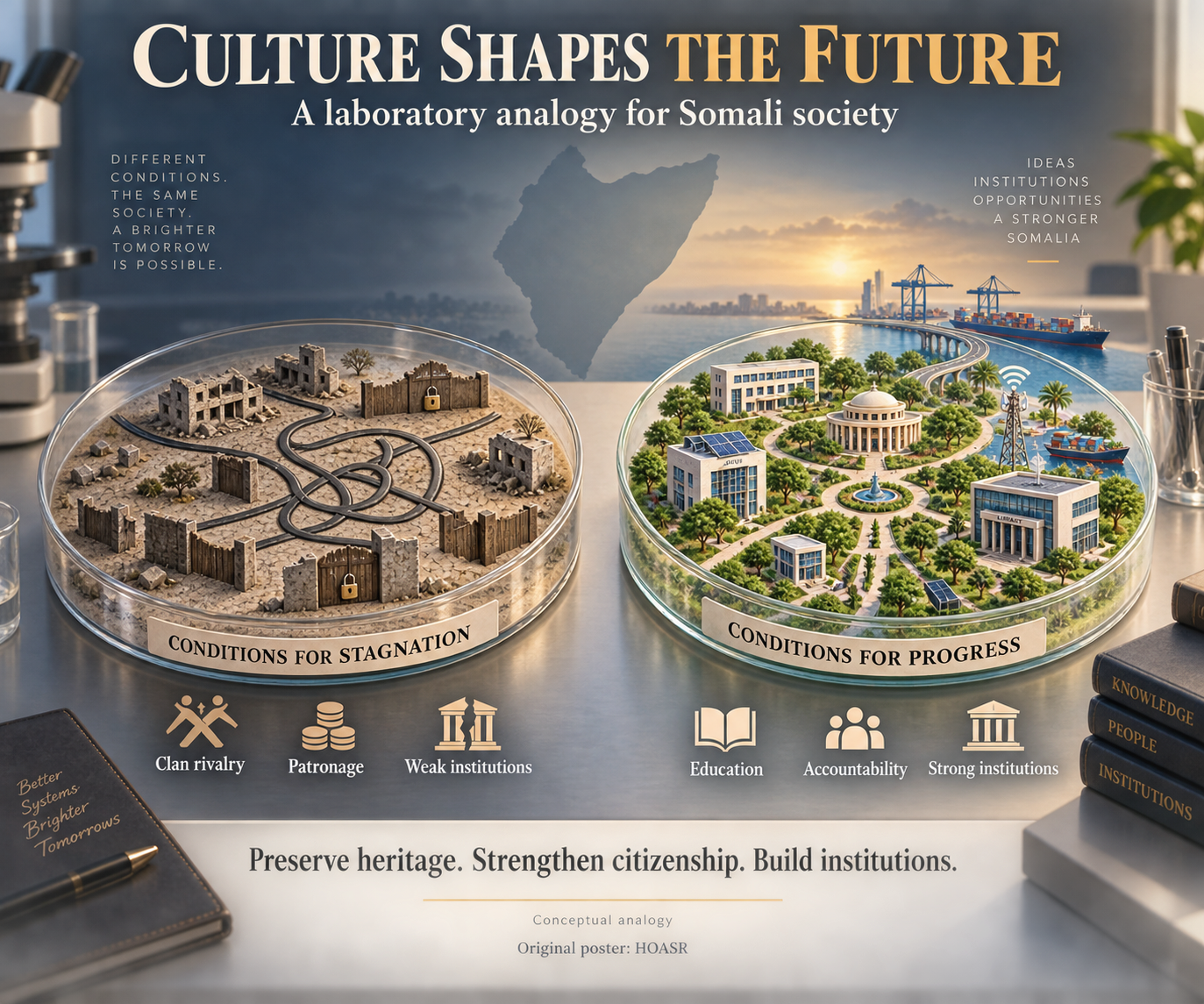
Different conditions, different outcomes: a laboratory analogy illustrates how political and institutional choices shape Somali society’s future. Original poster: HOASR.
A Cultural Analogy That Explains Somali Stagnation in the Modern Era
A friend of mine recently introduced me to a compelling book concept that uses a clear analogy between laboratory culture and societal culture. The idea is simple but powerful. In a laboratory, a culture grows when conditions are healthy and collapses when conditions are toxic.
Societies behave in the same way. Some adapt, learn, and progress, while others remain trapped in cycles of stagnation even when they possess favorable geography, resources, or historical opportunity. This analogy provides an important lens through which to understand the current cultural and political challenges facing Somali communities.
Somali society has many advantages that should support modernization. It has a strategic location, a long history of trade, a strong oral tradition, and a global diaspora with access to education and technology. These are the equivalent of favorable laboratory conditions.
Yet instead of using these advantages to build modern institutions, Somali culture often mutates backward toward older patterns of tribal hostility. At a time when the world is entering a brave digital era, Somali communities continue to circle back to centuries-old clan divisions that weaken their ability to participate in global progress.
This cultural regression is not caused by external forces alone. It is shaped by internal choices. Somali communities frequently place their trust in tribal chiefs and lineage elders when making decisions that require modern political leadership.
These elders play an important cultural role, but they are not equipped to guide society through the demands of state-building, economic planning, or digital transformation. Their authority comes from tradition, not from the professional responsibilities of national governance. When society relies on them for political direction, it creates conditions that prevent institutional growth.
This pattern is visible across Somali territories, whether in Somalia, Djibouti, Somaliland, or the Somali regions of Ethiopia and Kenya. These communities have access to education, trade routes, and global networks. They have the potential to join the digital economy and to shape regional development.
Yet their political choices often reflect a fear of losing clan protection rather than a desire to build strong national institutions. This fear keeps society in a defensive posture and prevents it from embracing the responsibilities of modern citizenship.
Diplomatically speaking, the issue is not the existence of clan elders. Every society preserves elements of its heritage. The problem arises when traditional authority replaces modern leadership. No nation can progress when its political decisions are shaped by lineage calculations instead of national priorities. No society can modernize when its leaders must negotiate every reform through tribal structures that prioritize local advantage over collective progress.
Somali communities must therefore make a deliberate cultural decision. They must choose whether they will continue to rely on tribal chiefs for political guidance or whether they will empower leaders who understand the realities of the twenty-first century. Modernization requires courage. It requires accepting that tradition cannot solve every national challenge. It requires trusting institutions, supporting professional leadership, and recognizing that citizenship is stronger than clan loyalty.
This is not a call to abandon cultural heritage. It is a call to place heritage in its proper place. Tribal elders can continue to serve as custodians of tradition and guardians of cultural identity. But the responsibility for national development must rest with leaders who are prepared to guide society into the digital age. Somalis have the talent, the diaspora, and the strategic position to succeed. What they need now is the cultural decision to move forward.
The future of Somali societies will depend on whether they choose modern leadership over traditional authority. This choice will determine whether the next generation inherits a nation ready for global participation or a society still negotiating its future through the logic of clan identity. The world is moving quickly. Somalis must decide whether they are ready to move with it.

Ambassador Egal is a regular contributing writer for HOASR and the founder of Horn of Africa Herald, an independent digital newspaper