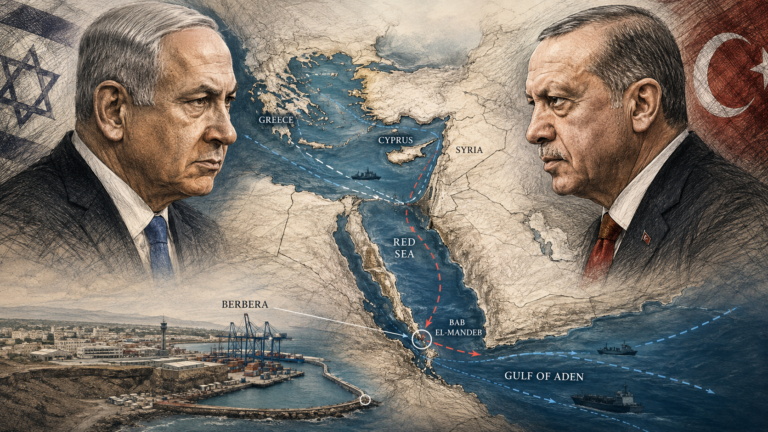
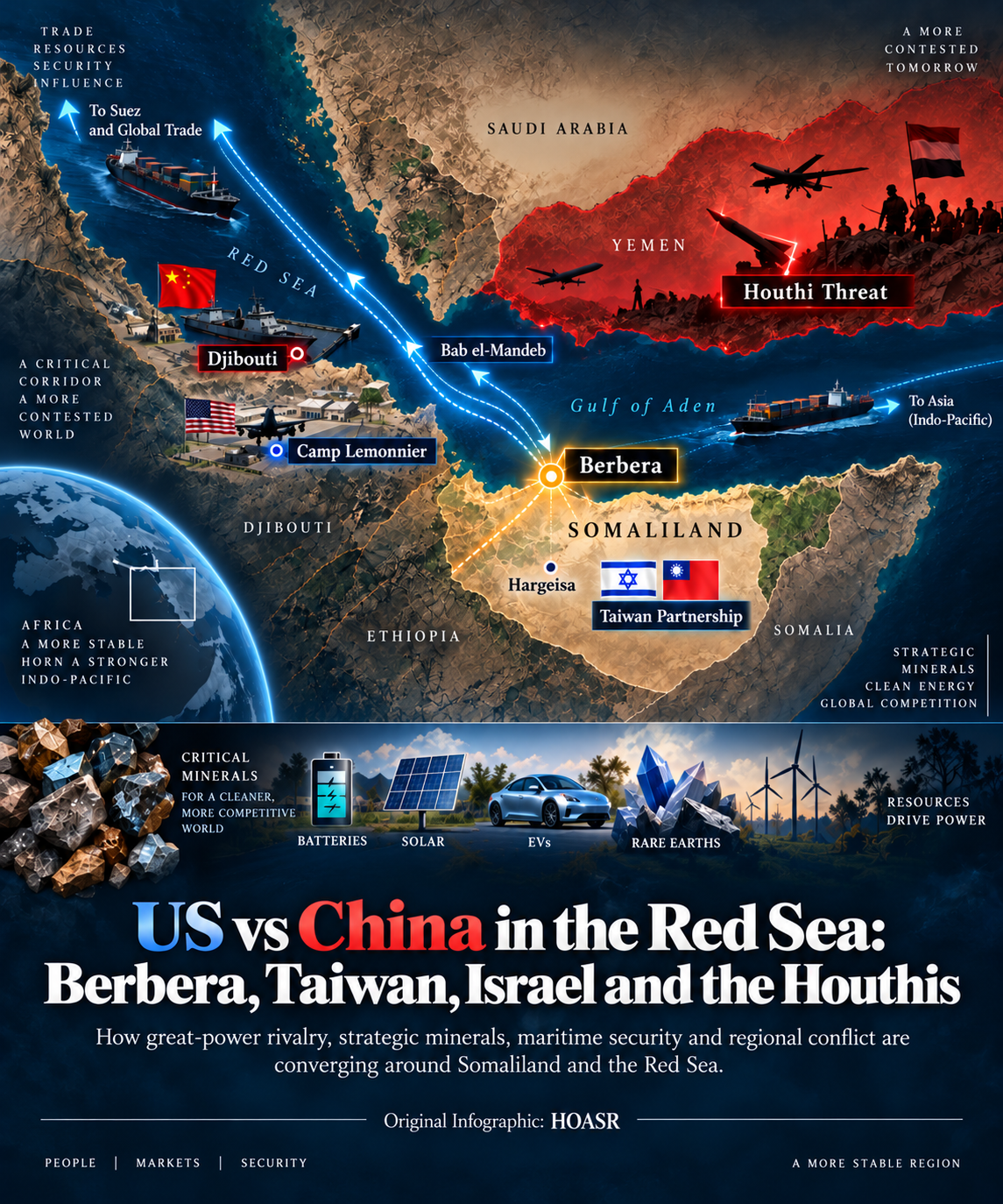
Berbera has become an important point of intersection between US–China competition, Somaliland’s Taiwan partnership, Israel’s Red Sea security interests and Houthi pressure on maritime trade.
Berbera, Taiwan, Israel and the contest over Somaliland are increasingly connected to a wider struggle over the political and security order of the Red Sea and the Horn of Africa.
For decades, international diplomacy treated Somaliland primarily as an unresolved question left by the collapse of the Somali state. That description has become inadequate. By September 2026, Somaliland had entered a much wider strategic contest involving the United States, China, Taiwan, Israel, Turkey, the Gulf states and several African powers. Its significance now extends beyond diplomatic recognition as geography, maritime security, commercial infrastructure, military access and competing political alignments turn it into one of the Horn of Africa’s most closely watched geopolitical spaces.
Beijing supplied the clearest recent indication. On 16 September, China’s embassy in Somalia issued an unusually direct statement criticizing President Abdirahman Mohamed Abdullahi Irro after his remarks concerning Taiwan during a visit to the United States. Beijing accused Somaliland’s leadership of violating the one China principle, warned of serious consequences and reaffirmed its position that Somaliland forms part of Somalia. (Chinese Embassy in Somalia)
The warning followed President Irro’s appearance at the Hudson Institute on 14 September, where the discussion placed Somaliland within the context of great power competition, Red Sea security, Taiwan, China, Iran and the Houthis. Hudson described Somaliland as strategically significant because of Chinese influence across Africa, instability around the Red Sea and Hargeisa’s alignment with Taiwan and Israel. The Washington appearance and Beijing’s reaction show how far the Somaliland question has moved beyond its former diplomatic confines. (Hudson Institute)
Berbera Changes the Strategic Geography
The foundation of Somaliland’s growing importance remains physical geography. Berbera lies on the Gulf of Aden, opposite Yemen and close to the approaches to the Bab el Mandeb, the narrow maritime gateway connecting the Indian Ocean with the Red Sea and the Suez Canal.
Commercial investment has strengthened that geographical advantage. DP World describes Berbera as a major gateway to East Africa. Its expansion plans envisage substantial growth in container capacity, while the adjoining Berbera Economic Zone is intended to connect maritime transport with inland trade and logistics. (DP World Berbera)
The implications extend beyond container throughput. Durable security, intelligence or logistical access on the Gulf of Aden gives a state proximity to one of the world’s most sensitive maritime corridors. The Red Sea connects European and Asian trade, Gulf energy flows, the Mediterranean and the western Indian Ocean. Disruption around Yemen has shown how quickly instability near the Bab el Mandeb can raise insurance costs, redirect naval deployments and shipping routes, and disrupt global supply chains. Berbera is close enough to Yemen to be operationally relevant while sitting on the comparatively more stable southern shore of the Gulf of Aden.
Reports of expansion at Berbera Airport have intensified international interest. Le Monde reported in July that construction underway there was associated with plans involving the UAE, United States and Israel. Such reporting should be distinguished from a publicly confirmed basing agreement, but the physical expansion reinforces perceptions that Berbera may eventually serve functions beyond commercial aviation. In this setting, Somaliland intersects directly with US China competition. (Le Monde)
China Sees Somaliland Through Taiwan
Beijing does not view Somaliland only through its support for Somalia’s territorial claim. It increasingly reads Hargeisa through the Taiwan question. Somaliland and Taiwan established representative offices in 2020 and continue to maintain reciprocal missions. (Taiwan Ministry of Foreign Affairs)
For Beijing, the relationship violates its one China position and makes Somaliland one of the few places in Africa where competition between Beijing and Taipei is unusually visible. China’s 16 September statement linked the two sovereignty disputes by asserting both that Taiwan belongs to China and that Somaliland belongs to Somalia. Somaliland, by contrast, treats its Taiwan relationship as evidence that it can pursue an autonomous foreign policy despite its limited international recognition. (Chinese Embassy in Somalia)
Taiwan has therefore become more than a bilateral relationship. It is a strategic marker that helps explain Somaliland’s growing place in American discussions about China. Senator Ted Cruz urged President Donald Trump in 2025 to recognize Somaliland, citing its ties with Taiwan and arguing that Beijing was applying economic and diplomatic pressure on Hargeisa because of that relationship. (Office of Senator Ted Cruz)
The Republic of Somaliland Independence Act, H R 3992, was introduced in the House in June 2025 and referred to the House Foreign Affairs Committee. Its stated purpose is to authorize recognition of Somaliland as an independent country. These initiatives do not establish that Washington has changed formal policy, but they show that Somaliland has gained supporters in American political circles who connect its status to strategic competition with China. (US Government Publishing Office)
Israel Adds a Red Sea Security Layer
Israel’s recognition of Somaliland in December 2025 altered the diplomatic environment. Before recognition, Somaliland could still be treated mainly as an African territorial dispute with occasional external involvement. Israel’s formal relationship with Hargeisa connected Somaliland more directly to Middle Eastern security calculations.
The geography helps explain the logic. Yemen lies across the Gulf of Aden from Somaliland. Houthi military capabilities, Iranian regional networks and repeated attacks on commercial shipping have increased the value of maritime intelligence and early warning for Israel and its partners. Berbera, the Bab el Mandeb, Yemen and Eilat now form part of the same strategic discussion.
Israel’s decision also generated immediate resistance. The African Union Commission rejected recognition of Somaliland in December 2025 and subsequently condemned Israel’s diplomatic engagement with Hargeisa. The AU maintains that Somaliland remains part of Somalia and argues that recognition could weaken the territorial principles that underpin African borders. Washington must therefore weigh strategic opportunity against potential damage to relations with Somalia, the African Union and other regional partners. (African Union)
The Washington Debate Has Changed
Recognition has not been decided in Washington. The important development is the change in the argument. Earlier discussions focused heavily on legal status, Somali sovereignty and whether Somaliland represented a special case arising from the former British Somaliland protectorate. The newer debate also includes Berbera, China, Taiwan, Israel, Houthi activity, counterterrorism, critical infrastructure and competition over maritime access.
President Irro’s Hudson Institute appearance illustrates the shift. The event, titled Somaliland as a Strategic Partner in the Horn of Africa, connected Somaliland with China’s influence in Africa, Iranian and Russian activity in East Africa, the Houthis and the regional consequences of Israel’s recognition. The question is increasingly whether Berbera and Hargeisa can contribute to American strategy in the Red Sea and western Indian Ocean, even before Washington resolves the recognition issue. (Hudson Institute)
China already operates a permanent military facility in neighboring Djibouti and maintains extensive political, infrastructure and commercial relationships across Africa. The United States faces an asymmetric position: Beijing has built durable footholds while Washington continues debating how Somaliland fits within a Somalia centered diplomatic framework.
Taiwan Strengthens the Case but Cannot Carry It Alone
US Taiwan relations add another layer of uncertainty. Reuters reported on 17 September that American allies in Asia were concerned about how President Trump might handle Taiwan in future negotiations with Chinese leader Xi Jinping. Some regional governments feared that Taiwan related questions could become entangled with broader US China economic negotiations. (Reuters)
Hargeisa presents its relationship with Taiwan as evidence of political reliability under Chinese pressure. Yet Somaliland’s value to the United States cannot rest entirely on Washington’s Taiwan policy, which can fluctuate with wider negotiations. A durable American assessment would examine several concrete interests: maritime infrastructure, counterterrorism, intelligence cooperation, Red Sea surveillance, commercial logistics, critical minerals, Gulf security and political stability. Taiwan strengthens Somaliland’s geopolitical relevance but cannot determine American policy by itself.
Somalia Turkey and the Wider Regional Contest
The Horn cannot be reduced to a simple contest between Washington and Beijing. Turkey has developed extensive political, economic and security relations with Somalia. Egypt has strengthened cooperation with Mogadishu. The UAE has invested heavily in Somaliland’s Berbera infrastructure while maintaining relationships elsewhere in the region.
These overlapping partnerships create a competitive environment rather than two rigid blocs. Somaliland may gravitate toward Taiwan, Israel, the UAE and advocates of closer American engagement, while Somalia maintains strong relations with Turkey, China, Egypt and other governments. States in the Horn also maintain partnerships with rival powers at the same time, making the region fluid and potentially unstable.
Competition can bring infrastructure investment, security cooperation and diplomatic opportunity. It can also encourage external actors to reinforce opposing local partners. Somaliland’s higher strategic profile therefore creates both leverage and exposure.
Recognition Is One of Several American Options
American policy is often presented as a choice between recognizing Somaliland and preserving the status quo. In practice, Washington has several intermediate options. It could increase direct diplomatic engagement with Hargeisa, establish a representative office, separate travel and security guidance, expand maritime and intelligence cooperation, develop commercial ties, or negotiate limited access arrangements without immediately deciding recognition.
Formal recognition would carry wider consequences. Mogadishu would object, the African Union has already stated its opposition, and other African governments would examine the precedent. Somaliland answers that concern by pointing to its distinct history: the former British Somaliland gained independence in June 1960 before entering a union with the former Italian administered territory. Those competing legal and political interpretations will remain central to any decision.
A phased policy could combine deeper practical engagement with clear standards for governance, security cooperation and regional stability. Washington could also consult the African Union and neighboring states to manage the diplomatic consequences. Such steps would test the value of partnership while preserving room for a later decision on recognition.
Beijing’s Warning Reveals Its Strategic Assessment
China’s 16 September warning is important because governments rarely issue explicit threats over issues they consider marginal. By rebuking President Irro during his US visit, Beijing acknowledged the strategic weight of Somaliland’s Taiwan relationship and widening international engagement.
China prefers Somaliland to remain diplomatically constrained within Somalia. That position protects Beijing’s relationship with Mogadishu, reinforces its one China policy and restricts Taiwan’s international space. Washington’s calculation is more complex because it must balance relations with Somalia and the African Union against Somaliland’s possible strategic value as Red Sea insecurity grows and China consolidates influence across Africa.
Berbera Is Where the Rival Calculations Meet
Somaliland is moving from the margins of African diplomacy into the strategic geography connecting the Mediterranean, Red Sea, Gulf of Aden and Indo Pacific. Berbera supplies the physical anchor. Taiwan brings the China dimension, Israel adds a Middle Eastern security connection, and Houthi activity creates immediate maritime pressure. Washington’s debate over Somaliland is where these questions increasingly converge.
American recognition is neither predetermined nor necessarily imminent. The policy costs and benefits are now being judged in a different environment from the one that shaped Washington’s approach during most of the past three decades. The contest concerns access, geography, trade routes, security partnerships and influence across one of the world’s most heavily contested maritime regions.
China appears to understand the stakes. Washington is still deciding how to respond, and Berbera is increasingly where their rival calculations meet.

Prof. Nassir Hussein Kahin is a researcher, educator, journalist, and geopolitical analyst specializing in the Horn of Africa, the Red Sea, international law, diplomacy, and strategic affairs. To read Full Bio click on this link: ABOUT THE AUTHORProf. Nassir Hussein Kahin