Washington’s engagement, IGAD’s exclusion and Houthi advances near Bab el-Mandeb are reshaping Somaliland’s place in the Red Sea security order.
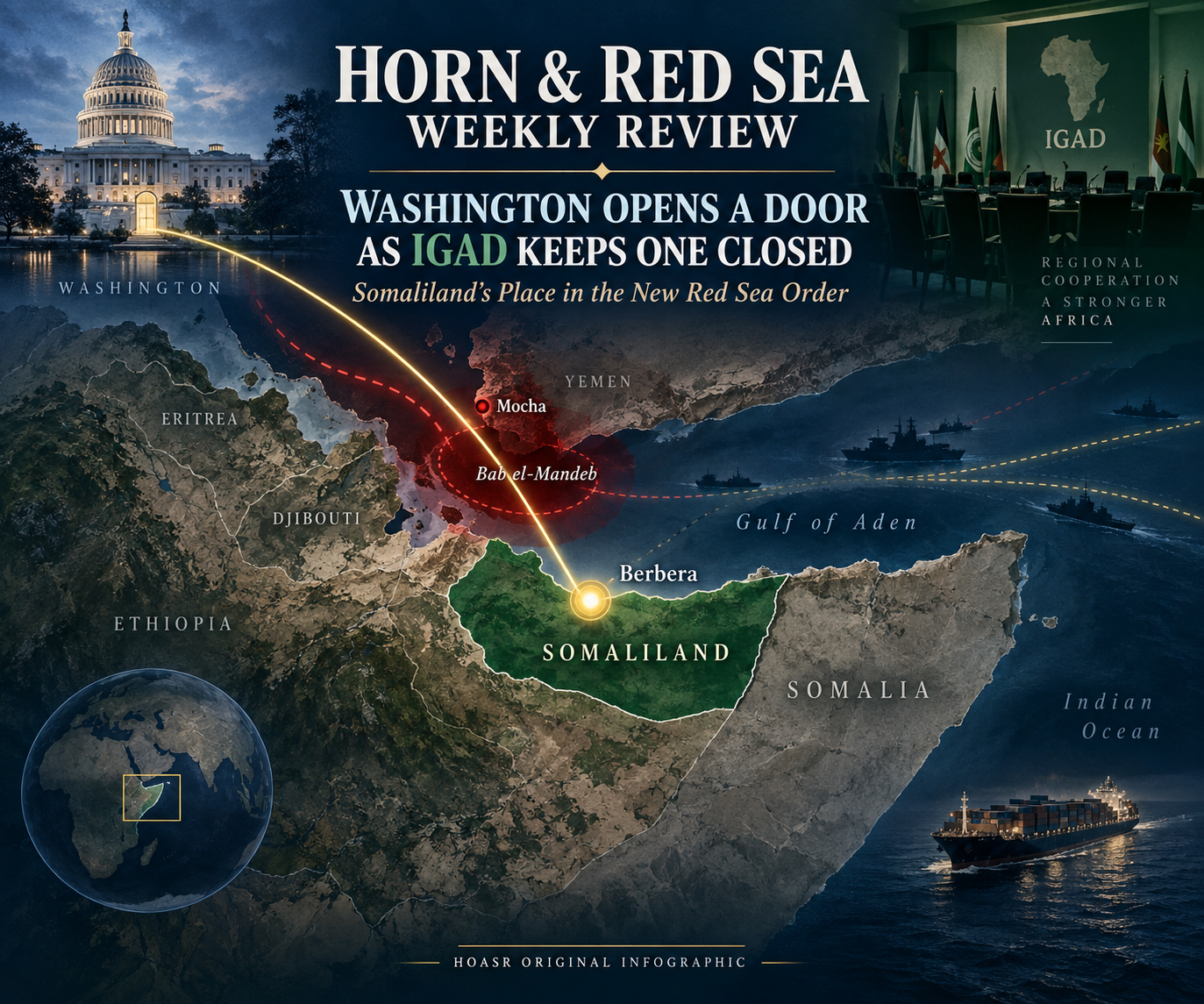
This week brought a rare convergence: Somaliland’s campaign reached deeper into Washington’s policy machinery while the Houthi advance made the African shore of Bab el-Mandeb more strategically urgent. Yet IGAD’s response still places Somaliland outside the room where regional maritime security is being designed.
| THE WEEK’S JUDGMENT
|
A Week When Diplomacy Met the Map
President Abdirahman Mohamed Abdullahi Irro’s Hudson Institute address and Representative John Rose’s intervention before the House Financial Services Committee were different events, but they pointed in the same direction. Somaliland’s case is moving beyond history and moral entitlement. It is entering the language Washington uses when it decides whether a relationship serves American interests: maritime security, financial compliance, trade, intelligence, logistics and competition with hostile powers.Irro Puts Somaliland on Washington’s Financial Map
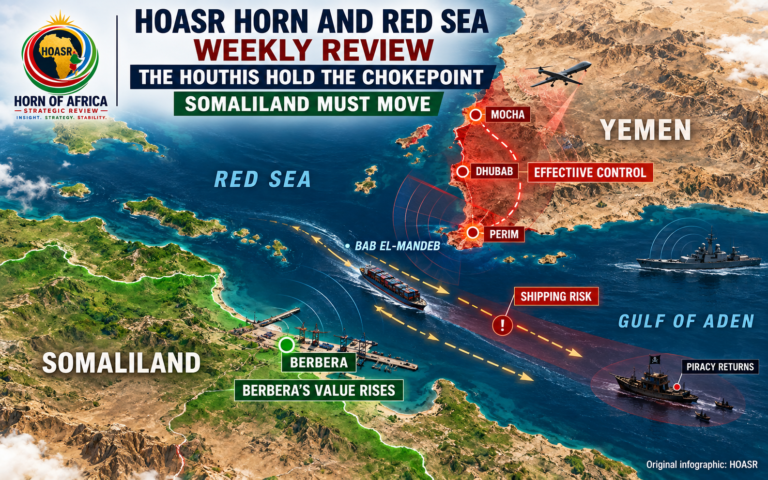
At the same time, events across the water made that argument harder to dismiss. The Houthis’ capture of Mocha, Dhubab and Perim Island has altered the military geography around Bab el-Mandeb. The movement now controls nearly all of Yemen’s Red Sea coast and occupies positions close to Djibouti, where American, Chinese, French, Italian and Japanese forces operate. The threat is not confined to shipping. It reaches ports, undersea cables, insurance markets, energy routes and the security calculations of every government on the African shore.
The central question is therefore no longer whether Somaliland is strategically located. The question is whether Hargeisa can convert that location into a disciplined national offer—and whether international institutions can continue designing maritime policy while excluding the authority that actually governs much of the opposite coastline.
Washington: From Recognition Appeal to Strategic Offer
Irro’s appearance at Hudson was the most visible moment of his Washington visit. His task was not simply to repeat Somaliland’s legal and historical case. American officials and specialists already know the outline: Somaliland was independent in June 1960, entered an unsuccessful union, restored its sovereignty in 1991 and has since built a separate political order. The harder task was to explain what the United States gains by acting now.
The president presented Somaliland as a dependable partner anchored by Berbera, relative domestic stability, democratic competition and a consistent pro-Western orientation. This was the correct frame. Recognition becomes more plausible when it is connected to concrete American interests rather than presented as an act of sympathy. Berbera’s port and airfield, proximity to the Yemen theatre, relations with Taiwan and Israel, and potential role in distributed logistics create a policy package Washington can evaluate.
Still, strategic language must be matched by detail. A successful follow-up requires written proposals covering access arrangements, investment protections, coast-guard cooperation, intelligence sharing, port and runway standards, financial transparency and the limits of any foreign military presence. Geography opens a conversation; institutional readiness decides whether the conversation produces an agreement.
The Treasury Exchange May Prove More Practical Than It Looked
Representative John Rose’s exchange with Treasury Secretary Scott Bessent gave the visit a second track. Rose raised the Somaliland Economic Access and Opportunity Act, and Bessent agreed to receive a briefing from Treasury’s international-affairs team and engage with Rose’s office. The commitment was narrow. It was not recognition, endorsement of the bill or a promise of financial access. But it placed Somaliland before the department that shapes sanctions, correspondent banking, engagement with international financial institutions and many of the compliance rules that determine whether a territory can participate in the global economy.
H.R. 7993 targets the machinery of isolation. It calls for an examination of recognition-related barriers, remittance flows, anti-money-laundering standards, counter-terrorism financing safeguards, World Bank and IMF treatment, and the steps required for access to SWIFT. These issues rarely attract the symbolism of recognition, but they determine whether businesses can receive investment, families can transfer money efficiently and Somaliland’s institutions can demonstrate credible financial governance.
For Hargeisa, this is a test of preparation. Treasury will respond to verified regulations, audited systems, enforcement records and credible counterpart institutions—not slogans. The Central Bank, finance ministry and foreign ministry should assemble a joint technical file covering KYC rules, beneficial ownership, transaction monitoring, licensing, remittance supervision and sanctions compliance. The opening created by the House hearing will be useful only if Somaliland can meet it with evidence.
IGAD’s Maritime Turn—and Its Somaliland Contradiction
The 74th Extraordinary Session of the IGAD Council of Ministers formally identified freedom of navigation in the Red Sea and Gulf of Aden as a core regional peace, security and development priority. The communiqué directed the IGAD Secretariat to strengthen maritime governance, cooperation and coordination, while recognising the interaction among piracy, external military involvement, strategic competition and threats to commercial shipping.
This is a meaningful institutional step. IGAD is moving from general concern to a ministerial mandate that requires follow-up. Yet the same document reaffirmed Somalia’s territorial integrity and placed the entire regional framework within a system of recognised member states. Somaliland’s coastline, port infrastructure and security institutions are therefore strategically relevant but politically absent.
That contradiction is becoming difficult to defend on operational grounds. Mogadishu does not administer Berbera, patrol Somaliland’s territorial waters or command Somaliland’s coast guard. A regional maritime system that refuses direct technical engagement with Hargeisa will either leave a gap or depend on informal arrangements that obscure responsibility and slow coordination.
Somaliland should not respond by rejecting IGAD outright. It should propose functional participation: liaison arrangements, information sharing, joint exercises, anti-piracy coordination, search and rescue, port-state control and communication protocols for incidents near Bab el-Mandeb. The aim should be to make exclusion visibly impractical while avoiding unnecessary confrontation with states whose positions may evolve.
The Houthis Have Rewritten the Immediate Security Map
Farea Al-Muslimi’s Chatham House assessment describes the capture of Mocha as the most consequential territorial change in Yemen for years. With Perim Island reportedly under Houthi control, an armed movement possessing missiles, drones and maritime capabilities now sits close to the shipping channel and roughly 20 kilometres from Djibouti.
Reuters’ investigation into the Houthi breakthrough adds important operational detail. Sources attributed the collapse to an intelligence failure, fragmentation among Saudi-backed Yemeni forces, weak coordination and a concealed Houthi mobilisation reportedly involving about 100,000 fighters. Retreating forces also left behind American- and Saudi-supplied equipment that may improve Houthi capabilities and reveal information about their opponents’ systems.
The exact troop figure and scale of captured weaponry remain source-based assessments rather than independently verified totals. The broad strategic result is clearer: the Houthis gained terrain, equipment and leverage while Saudi Arabia discovered the limits of its local command structure and external partnerships. Western governments have shown little appetite for a direct counteroffensive, leaving Riyadh to seek regional support while weighing the dangers of escalation against the costs of accepting a hostile presence near the strait.
What the Houthi Position Means for Somaliland
Somaliland now faces a more capable and geographically closer threat. Hargeisa should avoid exaggerating the immediacy of an attack, but it cannot treat Yemen as a distant conflict. Drone and missile ranges, maritime smuggling, intelligence collection and relationships between armed networks operate across the Gulf of Aden. Commercial vessels, port facilities, aviation infrastructure and communications cables can all be pressured without a conventional invasion.Mocha Falls: The Strategic Map Noves Again
- A permanent maritime-domain awareness centre integrating radar, AIS data, satellite reporting and liaison channels with trusted partners.
- A professional coast guard able to conduct interception, search and rescue, evidence collection and port-security operations under clear law.
- Drone detection, airfield protection and emergency procedures for Berbera’s port, airport, fuel storage and communications infrastructure.
- A transparent framework governing foreign security cooperation so that partnerships strengthen deterrence without surrendering national decision-making.
- Civil-defence and commercial-continuity planning that accounts for insurance costs, shipping disruption and possible attacks on regional supply chains.
China Is Being Asked to Prove It Can Protect the Order It Uses
A separate Reuters report found that Saudi Arabia appealed to China following the Houthi advance and that Beijing privately urged Tehran to restrain the movement. China is Iran’s largest oil customer, but its wider economic interests are heavily tied to Gulf energy producers and commercial routes through the Red Sea. Beijing therefore faces a conflict between its strategic relationship with Tehran and its dependence on regional stability.
This pressure reaches the Horn directly. China’s base in Djibouti was designed to support long-range naval activity and protect overseas interests. It now sits close to territory controlled by an Iranian-aligned force whose actions can threaten the trade routes China relies upon. Beijing may possess economic leverage over Tehran, but whether it is willing to use that leverage remains uncertain.
For Somaliland, the episode reinforces the connection among Taiwan, Berbera and US–China competition. Hargeisa’s relationship with Taiwan places it outside Beijing’s preferred political order. Its partnership with Israel and outreach to Washington deepen that divide. Somaliland should present itself as a reliable security and commercial partner, but it must also prepare for diplomatic, economic and information pressure intended to prevent Berbera from becoming a durable Western-aligned node.
US vs China in the Red Sea: Why Somaliland has moved into the center of great power competition
The Strategic Opportunity—and the Required Discipline
The week strengthened Somaliland’s argument, but it did not complete it. A presidential address at Hudson created visibility. A congressional exchange opened a Treasury channel. The Houthi advance raised the value of the African shore. None of these developments guarantees American recognition or a formal security agreement.
The opportunity lies in connecting them. Somaliland should offer Washington and regional partners a practical programme built around secure logistics, financial compliance, maritime awareness, counter-smuggling, investment protection and crisis resilience. Each component should have an identified Somaliland institution, a legal basis, a cost estimate and a proposed foreign counterpart. This would turn the recognition campaign from a series of persuasive events into an executable policy agenda.
Domestic credibility is equally important. Foreign partners will scrutinise political inclusion, eastern territorial disputes, procurement, public finance and the treatment of opposition and media. Strategic geography cannot compensate indefinitely for weak governance. Somaliland’s most persuasive advantage remains the claim that it is both useful and governable. Hargeisa must protect both sides of that proposition.
What HOASR Is Watching Next
| Indicator | Why it matters |
| Treasury follow-through | Whether Bessent receives the promised briefing, whether Rose’s office reports further engagement and whether H.R. 7993 gains additional sponsors or committee movement. |
| The Irro visit after the headlines | Whether meetings produce named working groups, technical proposals, congressional letters, investment discussions or executive-branch contacts. |
| IGAD implementation | Whether the secretariat establishes a maritime mechanism and whether Somaliland is engaged directly, indirectly or excluded entirely. |
| Houthi consolidation | Deployment of missiles, drones, coastal surveillance, boats or logistics systems around Mocha, Dhubab and Perim; pressure on shipping; and links with armed networks in the Horn. |
| China’s response | Whether Beijing applies measurable pressure on Tehran or limits itself to public appeals for restraint while protecting its relationship with Iran. |
| Saudi and Egyptian decisions | Whether Egypt enters Red Sea operations, whether the new Saudi-led coalition becomes operational and how Riyadh responds to continued Houthi pressure. |
Conclusion: The Door Is Open, but the Work Has Just Begun
Somaliland ended the week in a stronger position than it began. Its president placed a strategic offer before an influential Washington audience. A member of Congress carried a practical financial-access proposal directly to the Treasury secretary. Across the Gulf of Aden, the Houthi advance supplied fresh evidence that Bab el-Mandeb security cannot be managed from the Arabian shore alone.
The institutional picture remains difficult. IGAD is building a stronger maritime mandate while reaffirming a political formula that excludes Somaliland. Washington is showing interest without yet committing itself. China is being asked to restrain an Iranian partner’s ally while defending its own interests in Djibouti and the Gulf.
Somaliland’s best response is neither triumphalism nor frustration. It is preparation. Hargeisa must present partners with laws, capabilities, projects and accountable institutions that make cooperation possible before recognition—and make recognition easier to defend when the political moment arrives.The Hudson Backlash

Prof. Nassir Hussein Kahin is a researcher, educator, journalist, and geopolitical analyst specializing in the Horn of Africa, the Red Sea, international law, diplomacy, and strategic affairs. To read Full Bio click on this link: ABOUT THE AUTHORProf. Nassir Hussein Kahin