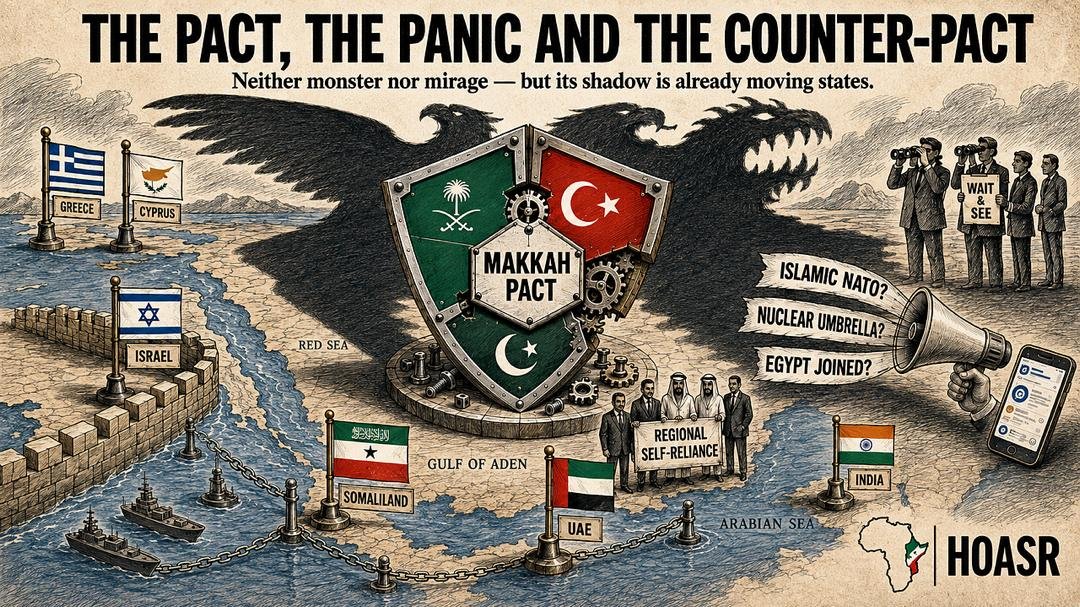
The Makkah Pact remains unfinished, but its expanding geopolitical shadow is already provoking counterbalancing, strategic caution and online speculation.
By Prof. Nassir Hussein Kahin
Editorial note: This analysis is based on public material available through 12 August 2026. The signatories have published a joint declaration, but not a detailed treaty text, operational plan or nuclear protocol. That distinction matters throughout this article.
An alliance begins to exercise power before its armies move.
It exercises power when a rival changes its deployments, when a small state looks for a new patron, when diplomats begin testing counter-coalitions, and when markets and publics start imagining what the alliance might become. In that sense, the Makkah Pact signed by Saudi Arabia, Türkiye and Pakistan on 7 August is already consequential. It has altered expectations even though its institutions, procedures and military credibility remain largely untested.
The official joint statement, also published by the Saudi Press Agency, contains the sentence that generated the present furor: an armed attack on any one of the three states will be regarded as an attack on all. The declaration also promises broader defence cooperation. It does not publicly describe an integrated command, permanently assigned forces, an automatic war plan, a common nuclear doctrine or the precise decision-making process that would follow an attack.
That gap between a dramatic commitment and missing operational detail is where sober analysis, strategic anxiety and opportunistic rumor now compete.
The correct conclusion is not that the pact is already an “Islamic NATO.” Nor is it that the agreement is meaningless until the first missile is fired. The more defensible conclusion is that Makkah is an option-generating framework. It gives three important states a mechanism through which political consultation, intelligence sharing, arms production, maritime coordination, missile defence and – if they choose – combined military planning can become easier. Its existence also gives each member leverage in bargaining with Washington, Beijing, Moscow, Tehran, New Delhi, Jerusalem and the Gulf capitals.
That is why some countries and political figures are not waiting to discover whether the pact eventually becomes the powerful, difficult-to-control bloc they fear. They are beginning to think about the counter-pact now.
The agreement that was signed – and the agreement people imagine
The three signatories describe the arrangement as defensive and non-directed. Türkiye’s foreign minister, Hakan Fidan, said the collective-defence language is technically comparable to NATO’s Article 5, while stressing that the pact is not aimed at a specific country. He also said that the arrangement had been under development for nearly three years and would include a ministerial committee and a Saudi-based secretariat, according to Reuters.
Those details make the agreement more than a ceremonial photograph. They still do not make it NATO.
NATO’s effectiveness rests on decades of integrated planning, standardisation, exercises, command structures, common political procedures and a vast record of interoperability. Even NATO’s own explanation of Article 5 notes that each ally takes the action it “deems necessary”; the article is not a mechanical switch that sends every member into identical combat. Türkiye’s NATO membership also does not extend NATO protection to Saudi Arabia or Pakistan. NATO says explicitly: partner countries are not covered by Article 5.
The nuclear claim requires equal care. Pakistan is a nuclear-armed state, but the public Makkah declaration contains no nuclear-guarantee clause. The Belfer Center’s Rabia Akhtar argues that the pact should not be read as a Pakistani nuclear umbrella over Saudi Arabia or Türkiye. A CSIS analysis of nuclear ambiguity likewise warns against converting suggestive language into a doctrine that Islamabad has not announced. Pakistan’s nuclear posture has historically been centred on India. Expanding it across the Middle East would require decisions about command, thresholds, basing and escalation that cannot be wished into existence by a viral post.
Egypt supplies a third example of projection. Turkish officials have spoken about the possibility of Egyptian participation after technical matters are addressed. That is not the same as Egyptian accession. Reporting by Alhurra describes Cairo’s participation in earlier four-country consultations but finds no public evidence that Egypt signed the pact. Until Cairo and the three signatories say otherwise, “Egypt may join” is analysis; “Egypt has joined” is misinformation.
A security agreement can become more dangerous when governments act upon an imaginary version of it. In 1914, assumptions about what allies would do narrowed leaders’ perceived choices. In a nuclear and missile-saturated age, an invented guarantee can be almost as destabilising as a real one if adversaries believe it.
A map of the first reactions
Supporters present the pact as regional self-reliance. The Financial Times placed the agreement within a wider search for security as confidence in the durability and sufficiency of American guarantees weakens. An Al Jazeera analysis calls it the possible emergence of a “third pole”: not necessarily a coalition built to defeat one enemy, but one intended to deny any existing power a monopoly over regional order.
Somalia welcomed the agreement as a historic step toward collective security and stronger defence cooperation. The Palestinian presidency and the Muslim World League also welcomed it in statements carried by the Saudi Press Agency and SPA’s separate account of the League’s reaction. These reactions see coordination among the three Muslim-majority powers as potential protection in a region repeatedly exposed to external intervention and internal fragmentation.
Iran’s response was more interesting than a simple endorsement or rejection. Foreign Ministry spokesperson Esmaeil Baghaei said Tehran had no reason to fear an agreement that promoted regional self-reliance, provided it was inclusive and identified the source of threats correctly. He suggested it might help restrain Israel, according to Reuters. This is conditional approval: Iran welcomes reduced dependence on the United States, but it also wants to influence the answer to the decisive question – security against whom?
India is examining implications for national security and regional stability rather than issuing a premature verdict, the Ministry of External Affairs said in remarks reported by the Economic Times. New Delhi has reason to distinguish Saudi and Turkish relations from its central problem with Pakistan. It will watch for changes in technology transfers, financing, nuclear signalling and the diplomatic treatment of disputes involving India.
Israel has produced the clearest language of counterbalancing. Israeli Diaspora Affairs Minister Amichai Chikli called the Saudi-Turkish-Pakistani alignment “very dangerous and very troubling” and urged deeper Israeli ties with Greece, Cyprus, the United Arab Emirates and Somaliland, as reported by i24NEWS and reproduced by Horn Diplomat. The notable point is not only the criticism. It is the map Chikli drew: an Eastern Mediterranean and Red Sea network intended to balance Türkiye and its partners before their coordination hardens.
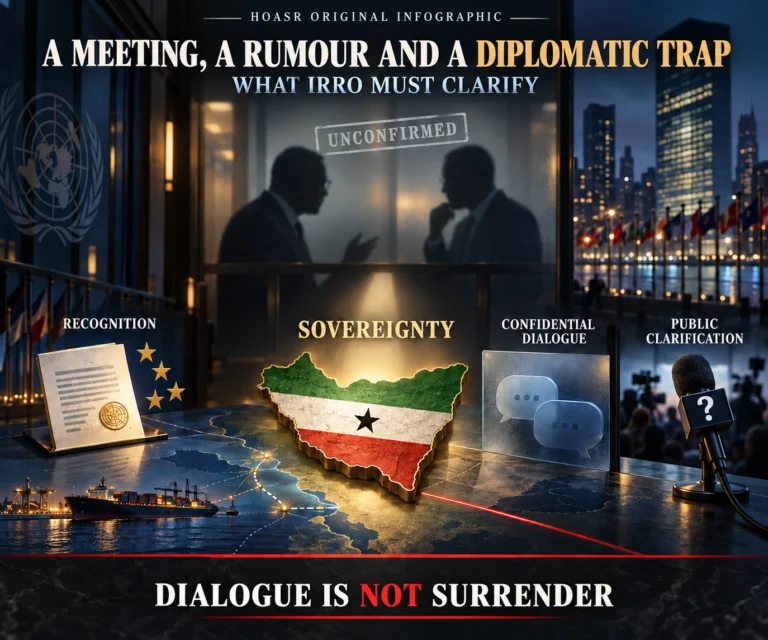
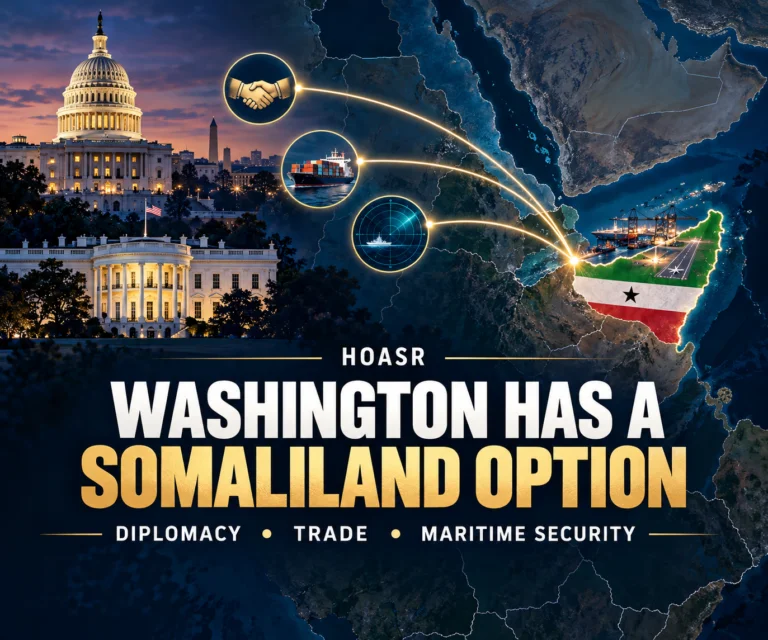
Somaliland presidential spokesperson Hussein Deyr’s public commentary on X approached the pact from the other side of that proposed network. He described an emerging Muslim-Sunni axis seeking strategic and economic influence across the Gulf of Aden, Bab al-Mandab and Red Sea, then asked how the United States, Israel and Europe should respond. He suggested recognition of Somaliland as a possible counterweight. This was an original strategic commentary by a senior official, not a formal cabinet communiqué. Yet it shows how quickly a pact signed in Makkah can enter recognition politics in Hargeisa.
Silence elsewhere should be reported as silence, not converted into support. As of the date of this editorial, no comparably substantive public position had been located from the United States, European Union, United Arab Emirates or NATO, and Cairo had not announced accession. An Al Jazeera review of the implications for Washington noted the absence of a formal American response at that point. Governments may be supportive, wary, divided or simply studying an incomplete text. “No public statement” is a fact. “Secret approval” is a guess.
Why some states will not wait for the monster
The fear expressed by critics is easy to reconstruct.
Türkiye brings a large military, combat experience, an expanding defence industry, naval ambition and a geographic position connecting the Black Sea, Mediterranean and Middle East. Pakistan brings a large armed force, nuclear status, long defence ties with Saudi Arabia and access to the Indian Ocean. Saudi Arabia brings capital, religious and diplomatic influence, energy weight and a central position on the Arabian Peninsula. Their capabilities are complementary even when their interests are not identical.
That combination can look more formidable in anticipation than it is in practice. The danger perceived in Israel, parts of India and some Horn of Africa circles is that waiting for full integration would surrender the time needed to balance it. If Türkiye’s drones, ships and military-industrial networks are joined to Saudi finance and Pakistani personnel, training and strategic weight, the pact might eventually become harder to contain. The logical response of an anxious state is therefore to build relationships, access agreements, intelligence links and political recognition before that possibility matures.
This is classic counterbalancing. It does not require a declaration of enmity. Israel can tighten coordination with Greece and Cyprus in the Eastern Mediterranean, reinforce its relationship with the UAE and seek Red Sea access. India can deepen security relationships with Gulf partners while pressing them privately about Pakistan. Iran can publicly welcome regional autonomy while quietly testing whether the pact is inclusive or directed against it. Egypt can negotiate the price and conditions of membership without committing. Washington can seek visibility and influence inside the members’ planning rather than denounce the arrangement.
The problem is that counterbalancing easily becomes a self-fulfilling cycle. If every defensive move is interpreted as offensive preparation, each side produces evidence for the other’s fear. The pact’s members may then institutionalise faster because rival states are organising against them; the rivals, seeing faster institutionalisation, organise still more.
The 1914-1918 Online Encyclopedia’s account of Europe’s alliance system offers the relevant warning. Alliances could deter attack, but they also damaged crisis management when leaders assumed they had little time and few independent choices. The lesson is not that alliances always cause war. It is that opaque commitments, rigid mobilisation assumptions and fear of being late can convert a local crisis into a systemic one.
Before 1914: protection becomes entrapment
Modern alliance politics did not begin with NATO. European rulers had long made and broken coalitions, often to prevent a single power from dominating the continent. The balance of power was less a permanent moral camp than a moving calculation. Britain could fight France in one era and align with it in another when Germany appeared the greater danger.
By the early twentieth century, the Triple Alliance and Triple Entente divided Europe into armed groupings. The alliances were not identical, and the Entente was not originally a single automatic war treaty. Yet military timetables, public expectations and private assurances made the system increasingly rigid.
Germany’s “blank cheque” to Austria-Hungary after the assassination of Archduke Franz Ferdinand is a textbook example of alliance reassurance becoming moral hazard. The same scholarly encyclopediaexplains how unconditional German support strengthened the advocates of war in Vienna. An ally intended to provide security can also encourage risk-taking if leaders believe someone else will absorb the consequences.
The Makkah Pact is nowhere near the mobilisation machinery of 1914 Europe. But the historical test is already applicable: does the collective-defence promise restrain members by making consultation obligatory, or embolden them by making rescue appear guaranteed? The answer will depend on procedures that the public has not yet seen.
Media also played a role before 1914, though not the caricatured role of single-handedly causing the war. Research on media responsibility in imperial crises emphasises framing, agenda-setting and long-term formation of public expectations. Today’s version moves at the speed of X, TikTok, YouTube and encrypted messaging. The “nuclear umbrella” can become conventional wisdom in hours, long before a defence ministry has designed one.
Between the wars and during the Second World War: paper, power and survival
The interwar period teaches a different lesson. The League of Nations offered collective security without sufficient power or consistent political will. Aggressors learned that a legal promise was not the same as an enforceable response. The United Nations’ history of the multilateral system describes how the League failed to prevent another world war, leading states after 1945 to construct stronger institutions.
But the Second World War also destroys the myth of permanent camps. Italy entered the conflict as an Axis power, surrendered in 1943 and then fought alongside the Allies; Romania changed sides in 1944, as summarised by the United States Holocaust Memorial Museum. National survival, battlefield reality and regime change overrode yesterday’s ideological declarations.
This matters because commentary on Makkah too often treats “Muslim,” “Sunni,” “NATO member” or “Chinese partner” as if each label dictates behaviour. It does not. Saudi Arabia, Türkiye and Pakistan share interests, but they also have different threat perceptions, economic dependencies and relationships with the United States, China, Iran, India and Israel. An identity label can help legitimate cooperation. It cannot erase national interest.
The Cold War: when institutions mattered – and motives diverged
NATO, created in 1949, and the Warsaw Pact, created in 1955 after West Germany joined NATO, were not merely promises. They built commands, plans, bases and habits of consultation. NATO’s official short history shows why institutional depth distinguishes a durable alliance from a communiqué.
The Middle East and South Asia also produced pacts, but their histories were less tidy. The Baghdad Pact, later CENTO, linked Türkiye, Iran, Iraq, Pakistan and Britain in an anti-Soviet security arrangement. American documents described the region’s oil, communications and geography as central to containing Soviet power. Yet the members did not all join for the same reason.
Pakistan’s primary security concern was India. Washington viewed the alliances mainly through anti-communist containment. A U.S. State Department history of the 1965 India-Pakistan war explains this divergence. Pakistan expected security and material assistance relevant to India; the United States wanted a partner against Soviet expansion. The same treaty could therefore mean different things in Islamabad and Washington.
That history has a striking contemporary echo. Türkiye and Pakistan were already members of CENTO, alongside pre-revolutionary Iran. Saudi Arabia was outside it but tied closely to the United States. Today’s Makkah alignment is not a revival of CENTO: it is a hedge against the uncertainty of a world in which no single patron is considered sufficient. Still, the old lesson survives. An alliance can fail not because its members lack cordial relations, but because they expect it to solve different wars.
Cold War alignments also shifted dramatically. The Sino-Soviet split opened the way for U.S.-China rapprochement, with Pakistan serving as an intermediary, as the U.S. Office of the Historian recounts. Egypt under Anwar Sadat expelled Soviet advisers, opened a channel to Washington and eventually signed the Camp David accords, developments traced in official histories of the 1973 Arab-Israeli warand Camp David.
The general rule is uncomfortable but clear: states do not marry alliances. They lease strategic advantage while circumstances remain favourable.
The Middle East after the Arab-Israeli wars
The Arab-Israeli conflict once appeared to provide the region’s master alignment: Arab states against Israel, with the superpowers competing behind them. Even then, the reality was fractured. Rival Arab republics and monarchies contested leadership. Egypt and Syria coordinated in war but developed different strategies. Jordan pursued its own survival. Gulf monarchies used oil and finance but remained dependent on outside security.
Egypt’s peace with Israel removed the largest Arab army from the conventional Arab-Israeli front. Iran’s 1979 revolution created a new axis of conflict. The Iran-Iraq war, Iraq’s invasion of Kuwait and the expanding American military role shifted Gulf threat perceptions away from a single organising conflict.
After the Cold War, states built overlapping relationships rather than one clean bloc. Türkiye remained in NATO while increasing regional autonomy. Pakistan developed deep ties with China while retaining an episodic security relationship with Washington and longstanding military links to Saudi Arabia. Gulf states relied on the United States while buying Chinese technology, coordinating oil policy with Russia, restoring relations with Iran and diversifying their arms suppliers.
The 2011 uprisings produced another cycle of camps. Türkiye and Qatar often supported political Islamist movements; Saudi Arabia, the UAE and Egypt resisted them. The 2017 blockade of Qatar exposed divisions within the Gulf Cooperation Council itself. Subsequent reconciliation demonstrated again that today’s existential rhetoric can become tomorrow’s negotiation.
The Abraham Accords then normalised relations between Israel and several Arab states without resolving the Palestinian question. The Gaza war and the wider regional confrontation complicated that process. Simultaneously, maritime attacks, drone warfare and conflict around Iran convinced many governments that airspace, ports, sea lanes and supply chains are part of national defence.
That expanded concept of the frontier is particularly important for Makkah. A Carnegie study of Gulf security beyond land bordersdescribes how Gulf states increasingly treat surrounding waters, trade routes and ports as extensions of their security environment. The pact therefore cannot be understood only as a promise to defend three homelands. It must also be watched in the Red Sea, Gulf of Aden, Arabian Sea and the defence-industrial networks connecting them.
Three schools of interpretation
The first school sees a new pole. On this reading, the pact localises security and gives middle powers room to resist dependence on the United States, the pressure of Israel or Iran, and the constraints of a great-power rivalry. The Al Jazeera “third pole” argument is the clearest expression. A Le Monde editorial analysis similarly stresses the political signal created by the members’ complementary strengths.
The second school sees a hedge. Experts assembled by Harvard’s Belfer Center disagree on ultimate effectiveness but converge on diversification. Moeed Yusuf sees middle powers formalising partnerships without necessarily turning against Washington. Karen Elliott House reads the agreement more skeptically as hedging and public relations, arguing that Saudi Arabia still depends heavily on U.S. protection. Edward Djerejian asks whether the pact will remain ink on paper or become part of a multipolar regional architecture.
The Atlantic Council also cautions against treating Makkah as a discrete NATO-style bloc. It fits Saudi Arabia’s wider web of partnerships and may generate more diplomatic leverage than immediate military capability. An IFIMES assessment calls the logic “strategic redundancy”: members are adding an insurance policy rather than abandoning their other partners.
The third school offers a conditional verdict. Rabia Akhtar calls the combination “asymmetric complementarity”: each member supplies something different. If cooperation produces shared early warning, missile and drone defence, maritime security, intelligence, exercises and arms production, it can provide useful regional security. If it is organised around sectarian or adversarial identity, it can deepen bloc politics.
That conditional approach is closest to the method of the International Crisis Group. ICG had already examined the informal Egypt-Pakistan-Saudi-Türkiye consultations and asked whether they could help the Gulf escape an increasingly dangerous U.S.-Israel-Iran trap in its analysis of the new initiative. Its longer work on collective security and collective breakdown favours inclusive dialogue because exclusive regional coalitions have repeatedly struggled to produce common positions and often intensify the security dilemma.
As of this writing, ICG has not published a full stand-alone report on the final Makkah declaration. That should not produce analytical silence. Its established method suggests the right questions: What conflict does the pact help prevent? Whose threat perception defines its action? What communication channels will connect it to Iran, Israel, India, the United States and non-member Arab states? How does it manage escalation? What happens when one member’s crisis is not shared by the other two?
What responsible geopolitical analysis does before the official answers arrive
A serious analyst does not wait passively for governments to reveal every secret, because official clarity may arrive only after the structure has shaped events. But the analyst also does not fill missing pages with fantasy.
The first task is to separate interests from slogans. Saudi Arabia wants deterrence, regime and infrastructure security, defence-industrial diversification and freedom of manoeuvre. Türkiye wants strategic autonomy, markets for its defence sector and wider influence across connected regions. Pakistan wants investment, diplomatic room, defence cooperation and recognition of its strategic weight. These interests overlap, but not completely.
The second is to separate capability from commitment. The three countries collectively possess impressive resources. Whether those resources can be deployed for one another depends on planning, logistics, political permission, rules of engagement and domestic legitimacy.
The third is to inspect institutions. The Saudi-based secretariat, ministerial committee and any future military staffs matter more than adjectives used at the signing ceremony. Watch whether the pact produces joint threat assessments, secure communications, common exercises, interoperability standards, contingency plans, procurement projects and mechanisms for resolving disputes among members.
The fourth is to build scenarios, not prophecies. How would the pact respond to a drone attack on Saudi oil infrastructure, a maritime attack in the Red Sea, a confrontation involving Türkiye in the Eastern Mediterranean, or an India-Pakistan crisis? The answer may differ in every case. A pact that is credible against one contingency may be irrelevant or dangerous in another.
The fifth is to watch counter-reactions. Chikli’s proposed network and Deyr’s recognition argument are not side stories. They are early evidence that the agreement is redistributing diplomatic attention. An alliance’s strategic effect includes the alliances it provokes.
Finally, analysts must label uncertainty. “The agreement may enable” is different from “the agreement guarantees.” “A minister said Egypt could join” is different from “Egypt is a member.” “Pakistan has nuclear weapons” is different from “Pakistan has extended nuclear deterrence.” Silence is not strategy, but noise is not evidence.
The Red Sea and Somaliland cannot be a footnote
For Somaliland and the wider Horn of Africa, the Makkah Pact is not a remote argument among Middle Eastern capitals. The Bab al-Mandab links the Red Sea to the Gulf of Aden. Ports, bases, recognition policy, shipping security and conflicts in Yemen and Somalia already connect the two shores.
International Crisis Group warned before this pact that intra-Gulf competition in the Horn can export rivalries into fragile political systems and undermine Red Sea security. Its work on calming the Red Sea similarly shows how maritime insecurity interacts with regional conflict. A Brookings study of a Red Sea forum argues for an inclusive architecture involving states on both shores rather than a contest conducted only through ports, bases and client relationships.
Somaliland should therefore analyse the pact early. Hussein Deyr is right that a new strategic arrangement involving Türkiye, Pakistan and Saudi Arabia may affect the Gulf of Aden and Red Sea. He is also right that Somaliland’s location gives it relevance to actors considering a counterweight.
But relevance is not the same as safety. Somaliland should avoid becoming a forward piece in someone else’s confrontation. Recognition by a powerful state would be a historic diplomatic gain, yet a recognition strategy built exclusively as an anti-Türkiye or anti-Saudi instrument could narrow Hargeisa’s future options.
Türkiye is deeply engaged in Somalia; Saudi Arabia is a central Red Sea and Gulf power; Pakistan carries weight across the Muslim world. Somaliland’s interest is to diversify relationships, protect its coast and ports, deepen professional maritime cooperation and insist on a voice in any Red Sea security architecture – while maintaining channels to all three pact members and to those considering a counter-coalition.
Somalia’s welcome for the pact and Somaliland’s counterbalancing discussion show how an external alignment can enter an unresolved local dispute. That creates both diplomatic opportunity and danger. Responsible partners should not use the Makkah Pact to militarise competition between Hargeisa and Mogadishu.
The tests that will reveal what Makkah becomes
The pact’s name and signing place carry symbolism. Its future will be decided by behaviour.
Watch the secretariat. Does it become a diplomatic office, or does it acquire operational planners and secure links to national commands?
Watch the exercises. Do the three conduct routine drills, or practise specific scenarios involving air defence, anti-drone operations, naval protection and reinforcement?
Watch procurement and industry. Do Saudi finance, Turkish production and Pakistani expertise generate shared systems, maintenance chains and dependence that make cooperation difficult to reverse?
Watch Egypt. Accession would expand the arrangement into the Arab world’s largest population and a state controlling the Suez Canal, but Cairo’s own interests and constitutional constraints could also moderate the pact.
Watch the nuclear language. Any move from ambiguity to an explicit guarantee would transform Indian, Iranian, Israeli and American calculations.
Above all, watch the first crisis. Alliances become credible when members accept costs for one another. The first request for consultation, basing, intelligence, interception or military support will reveal more than the summit prose.
Neither monster nor mirage
The Makkah Pact may develop into a meaningful security institution. It may remain a flexible political framework. It may fracture when the members face a crisis that exposes incompatible priorities. No honest analyst can yet know which path will prevail.
But waiting for perfect official information is not neutrality. By the time commands, bases and deployments are publicly visible, the region’s political choices may already have narrowed. HOASR and other institutions concerned with the Horn and Red Sea should analyse the incentives, fears and possible counter-blocs now.
The analysis must nevertheless be disciplined. Some governments are balancing early because they fear a future combination of Turkish military-industrial ambition, Saudi resources and Pakistani strategic power. Others support the pact as long-delayed regional self-reliance. Some are reserving judgment. Others are projecting what they want to see – an Islamic NATO, an automatic nuclear umbrella, an Egyptian accession or a borrowed NATO guarantee – and spreading it as fact.
History’s warning is not that every pact becomes a monster. It is that unexamined commitments, unanswered fears and invented certainties can help create one.
The wisest response is therefore neither panic nor silence. It is early, evidence-led analysis; open channels among rival blocs; and a regional security design broad enough that states do not have to choose between permanent vulnerability and permanent confrontation. Related posts: The Geography Riyadh Ignored: How Saudi Arabia’s Somaliland Blind Spot Deepened Its Red Sea Vulnerability

Prof. Nassir Hussein Kahin is a researcher, educator, journalist, and geopolitical analyst specializing in the Horn of Africa, the Red Sea, international law, diplomacy, and strategic affairs. To read Full Bio click on this link: ABOUT THE AUTHORProf. Nassir Hussein Kahin