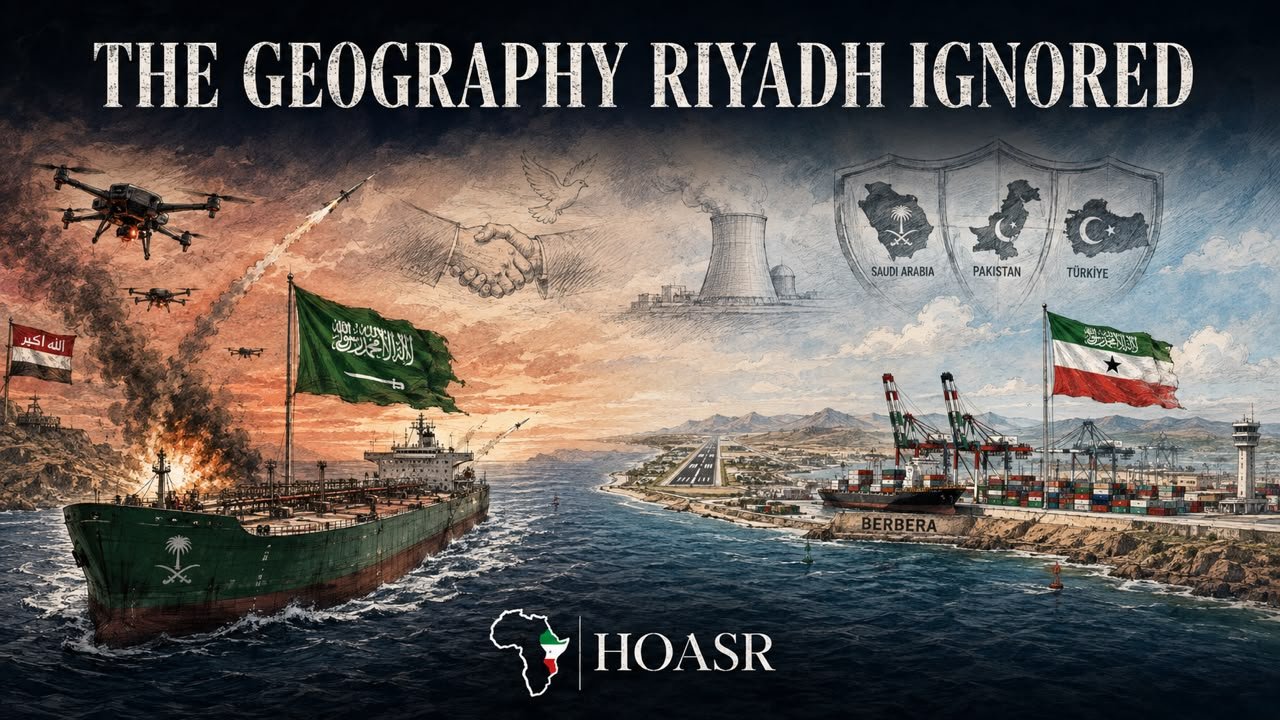
Saudi Arabia is confronting the cost of neglecting Somaliland while the UAE converted its early investment in Berbera into lasting strategic influence.
By Prof. Nassir Hussein Kahin
Saudi Arabia’s present predicament is not simply the product of Iranian hostility, Houthi aggression or American inconsistency. It is also the cumulative result of strategic opportunities Riyadh postponed, relationships it allowed to deteriorate and geography it treated as secondary until geography became an emergency.
That is the essential force of Steven A. Cook’s recent Foreign Policy argument, “The Saudis Are the Architects of Their Own Misfortune.” Cook’s criticism is deliberately severe: Saudi leaders are not merely victims of an unstable region; through indecision and strategic miscalculation, they helped create the conditions in which the kingdom now finds itself exposed.
Cook’s thesis becomes even more compelling when viewed from the Horn of Africa. For years, Riyadh gave decisive diplomatic preference to Somalia’s internationally recognized government while keeping Somaliland—the stable authority that actually governs the southern shore of the Gulf of Aden opposite Yemen—at political arm’s length. The United Arab Emirates made a different calculation. Through DP World, Abu Dhabi invested in Berbera, developed long-term commercial access and converted an early partnership with Somaliland into strategic depth.
Now the Houthis are threatening Saudi-linked shipping in the Red Sea and Gulf of Aden. The Strait of Hormuz has proved vulnerable during the Iran war, forcing greater reliance on Saudi Arabia’s western export infrastructure. The kingdom is rushing to assemble new maritime and military coalitions, reconsider ties with Israel and repair relationships that it once believed it could afford to neglect.
Saudi Arabia has not run out of options. But it has run out of the luxury of pretending that formal diplomatic orthodoxy is a substitute for control of territory, ports, airfields and coastlines.
The Strategic Mistake Across the Water
The Saudi error concerning Somaliland was not the absence of every relationship. Somaliland and Saudi Arabia have long been connected through religion, pilgrimage, livestock commerce, family networks and movement across the Red Sea. The mistake was Riyadh’s failure to transform these natural ties into an institutional strategic partnership.
Saudi policy remained anchored to Somalia’s formal sovereignty claim. Riyadh backed Mogadishu’s territorial position and, in February 2026, signed a military-cooperation agreement with the Somali federal government. That policy offered diplomatic conformity and a partnership with a recognized state. It did not, however, give Saudi Arabia meaningful political access to the authorities governing Berbera or Somaliland’s approximately 850-kilometre Gulf of Aden coastline.
This distinction matters. International recognition answers a legal question. Maritime security answers an operational one: who administers the coast, controls the port, polices the territorial approaches, shares intelligence, maintains the airfield and can implement an agreement on the ground?
On the Somaliland coast, the answer is Hargeisa—not Mogadishu.
The UAE understood this earlier than Saudi Arabia. DP World secured its Berbera concession in 2016 and began operations the following year. Its phased investment—reported at up to $442 million—expanded the port, added modern container-handling capacity and connected Berbera to a broader Emirati logistics network. DP World describes Berbera as a deep-water gateway with a 17-metre draft, a substantially expanded quay and a post-expansion annual capacity of 500,000 containers, with further expansion envisaged.
Abu Dhabi did more than purchase access to a terminal. It accumulated relationships, local knowledge, infrastructure, commercial credibility and strategic optionality. When crises erupted in Yemen, the Red Sea or the Horn, the UAE already possessed an operating platform. Saudi Arabia possessed statements affirming Somalia’s territorial integrity.
Legal recognition and territorial control should not be confused. Riyadh allowed its commitment to the first to obscure the strategic importance of the second.
The Cost of Choosing Mogadishu Exclusively
Saudi Arabia’s closer alignment with Somalia was not irrational. Riyadh wanted to reinforce the conventional state system, counter Emirati influence and prevent what it regarded as destabilizing fragmentation. A 2026 analysis by John Calabrese described the kingdom’s “Somalia gambit” as an effort to shape the Red Sea order, constrain Abu Dhabi and protect maritime and economic interests.
But a policy can be understandable and still be strategically inadequate.
Mogadishu cannot provide Saudi Arabia with access that it does not itself exercise in Somaliland. Nor can Somalia’s federal government erase the infrastructure, security forces, institutions and political authority that have operated in Somaliland for more than three decades. By treating engagement with Hargeisa as if it necessarily meant hostility toward Mogadishu, Riyadh created a false choice.
A more sophisticated Saudi policy could have retained formal relations with Somalia while building functional relations with Somaliland in maritime surveillance, coast-guard development, livestock health certification, fisheries, port logistics, counter-smuggling, disaster response and investment. Such an arrangement would not initially have required recognition. It would merely have required strategic realism.
Instead, Saudi Arabia’s recent embrace of Mogadishu has increasingly appeared tied to its competition with the UAE. That rivalry has sharpened since the breakdown of Saudi-Emirati cooperation in Yemen. The Washington Post reported in January that Riyadh was trying to counter the network of influence Abu Dhabi had built around the Red Sea and Horn, including its footholds in Berbera and Bosaso. Yet trying to dislodge the UAE by supporting Mogadishu does not automatically produce an equivalent Saudi network. Influence cannot be declared into existence. It must be built through capital, presence, trust and time.
Saudi Arabia therefore risks making a second mistake in response to the first: instead of developing its own constructive partnership with Somaliland, it may define the Somaliland question primarily through its rivalry with Abu Dhabi. That would turn a potentially valuable partner into a theatre of Gulf competition.
The Houthis Expose the Difference Between Maps and Power
The Houthi campaign has transformed Saudi Arabia’s Somaliland omission from a missed commercial opportunity into a national-security liability.
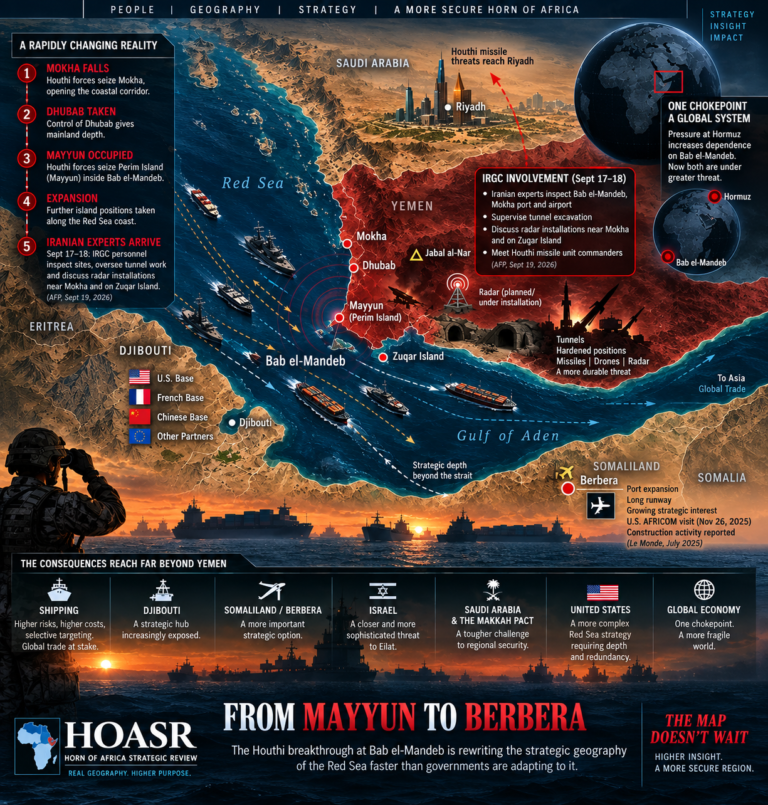
In July, the Houthis announced a blockade of Saudi-linked shipping and claimed attacks on Saudi tankers. Subsequent assaults and threats sharply reduced traffic through both Bab al-Mandab and the Strait of Hormuz. Reuters reported that Bab al-Mandab traffic fell to a single vessel on one observed day, while Saudi Arabia had not confirmed some of the specific Houthi claims. Even allowing for propaganda and uncertainty surrounding individual attacks, the strategic effect is unmistakable: shipowners, insurers and energy traders respond to credible risk, not only to confirmed damage.
Saudi vulnerability is intensified by the interaction of two chokepoints. Disruption at Hormuz makes the kingdom more dependent on pipelines and terminals facing the Red Sea. Houthi pressure at Bab al-Mandab then threatens the alternative route. This is a form of maritime compression: pressure in the east pushes Saudi exports westward, where another Iranian-aligned force can threaten them.
Somaliland cannot by itself neutralize Houthi missiles and drones launched from Yemen. Berbera is not a magical solution to a complex war. But Somaliland offers assets that become increasingly valuable in a layered maritime-security system:
* a long, comparatively stable coastline facing the Gulf of Aden;
* proximity to the sea approaches east of Bab al-Mandab;
* Berbera’s deep-water port and logistics facilities;
* one of Africa’s longest runways at Berbera;
* a government willing to deepen security and economic partnerships;
* potential sites for radar, maritime-domain awareness, search and rescue, refuelling, repair, intelligence fusion and coast-guard cooperation.
The central lesson is not that Saudi Arabia should “use Somaliland against Yemen.” It is that a state seeking to secure the Red Sea cannot afford to exclude from its security architecture the functioning authority governing one of the most important stretches of the opposite shore.
The Abraham Accords: A Delayed Strategic Choice
Saudi Arabia’s hesitation over normalization with Israel forms part of the same pattern: postponing a difficult strategic decision while assuming that its benefits will remain available later on similar terms.
Riyadh’s insistence on a credible pathway to Palestinian statehood has political and moral logic. Saudi Arabia has custodial responsibilities toward Islam’s holiest sites, a leadership role in the Arab and Muslim worlds and a domestic audience that cannot be ignored. Normalization was never a cost-free decision.
But delay also carried costs. The UAE and Bahrain joined the Abraham Accords in 2020, creating channels for security cooperation, technology transfer, investment and diplomatic influence with both Israel and the United States. Saudi Arabia remained outside while depending on informal coordination and Washington’s continuing willingness to offer strategic benefits without formal normalization.
That assumption has now been tested. On July 23, President Donald Trump stated that a proposed American civilian nuclear agreement with Saudi Arabia would proceed only if Riyadh joined the Abraham Accords. The White House said that without normalization, “the deal is off.” The proposed arrangement still requires congressional review, and important non-proliferation questions remain, including uranium enrichment and reprocessing. Nevertheless, the linkage is now explicit.
Saudi Arabia is therefore negotiating under greater pressure than it might have faced earlier. It wants nuclear power for energy diversification, technical prestige and strategic hedging. It also wants stronger security guarantees and advanced American weapons. Washington and Israel now understand that these objectives give them leverage.
The lesson is not that Riyadh should have abandoned the Palestinian issue. It is that it should have converted its willingness to normalize into a structured bargaining process earlier—when it possessed more freedom to define the price, timetable, Palestinian provisions and security package. Strategic leverage depreciates when every alternative has become more dangerous.
The Unnecessary Rupture With the UAE
Saudi Arabia’s deteriorating relationship with the UAE compounded these problems. Riyadh and Abu Dhabi have genuine disagreements: over Yemen’s political future, relations with Islamist movements, oil-production policy, regional commercial competition and the UAE’s partnerships with sub-state or separatist actors.
These are not cosmetic disputes. But transforming competition into estrangement weakened both states at precisely the moment Iran and its partners were demonstrating the ability to strike infrastructure and disrupt maritime trade.
The two Gulf powers possess complementary strengths. Saudi Arabia offers demographic, religious, financial and territorial weight. The UAE offers agile diplomacy, sophisticated logistics, commercial ports, technology partnerships and expeditionary networks. Their earlier cooperation contained serious flaws, especially in Yemen, but their rupture fragmented the anti-Houthi camp and turned the African shore of the Red Sea into an arena for intra-Gulf competition.
The strategic objective should not be a return to unquestioning Saudi-Emirati alignment. It should be a disciplined accommodation: defined red lines, a deconfliction mechanism, intelligence exchange against common threats, protection of commercial infrastructure and an understanding that competition in the Horn must not undermine maritime security.
Berbera could become part of that accommodation. Saudi investment need not displace DP World. Riyadh could participate in complementary projects—energy storage, food-security facilities, livestock quarantine and processing, fisheries, ship services, coastal surveillance and the Berbera Corridor—while establishing its own direct relationship with Hargeisa. Strategic access does not require exclusive ownership.
The Mecca Pact: Deterrence or Evidence of Delay?
On August 7, Saudi Arabia, Pakistan and Türkiye signed a mutual-defense agreement in Mecca under which an attack on one would be treated as an attack on all. The pact brings together Saudi financial and energy power, Türkiye’s NATO experience and rapidly expanding defence industry, and Pakistan’s large armed forces and nuclear status.
It is a consequential development. It may strengthen deterrence, diversify Saudi Arabia’s security partnerships beyond the United States and provide new frameworks for air defence, training, intelligence and weapons production. It also signals that Riyadh no longer believes bilateral understandings and American protection alone are sufficient.
Yet the pact should not be mistaken for an instant shield. Collective-defence language does not automatically produce interoperable command systems, integrated missile defence, pre-positioned forces or a common definition of aggression. Pakistan and Türkiye maintain their own relations with Iran. Türkiye is also a NATO member with independent ambitions in Syria, Somalia and the wider Red Sea. Each party will interpret the agreement through its national interests.
The treaty also creates complications for Somaliland. Türkiye is Somalia’s most influential external security partner and remains a strong defender of Mogadishu’s territorial claims. Pakistan has traditionally supported Somalia’s position as well. A Saudi-led security framework heavily dependent on Ankara and Islamabad could reinforce Riyadh’s existing bias toward Mogadishu—unless Saudi leaders recognize that effective Red Sea defence requires engaging both the internationally recognized government and the authorities that actually administer Somaliland’s coast.
The pact is therefore both an instrument of recovery and evidence of earlier strategic delay. Saudi Arabia is assembling a security architecture under fire. Such architectures are strongest when built before a crisis, not during one.
A New Alignment Is Taking Shape
The emerging regional order cannot be reduced to two clean blocs, but several tendencies are becoming visible.
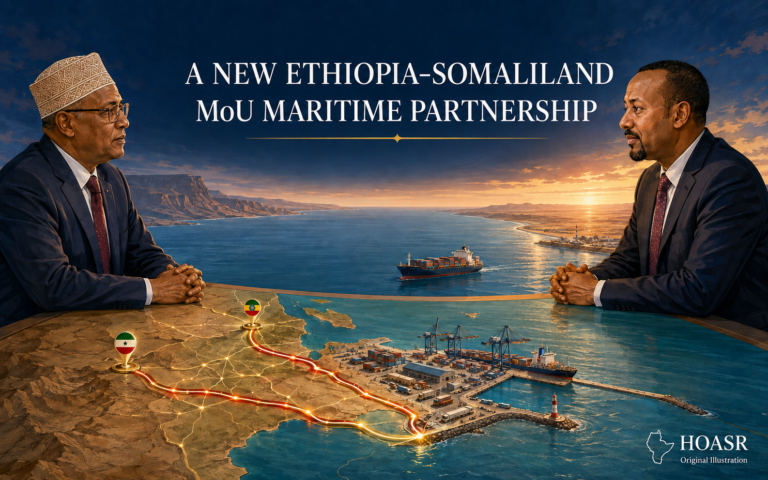
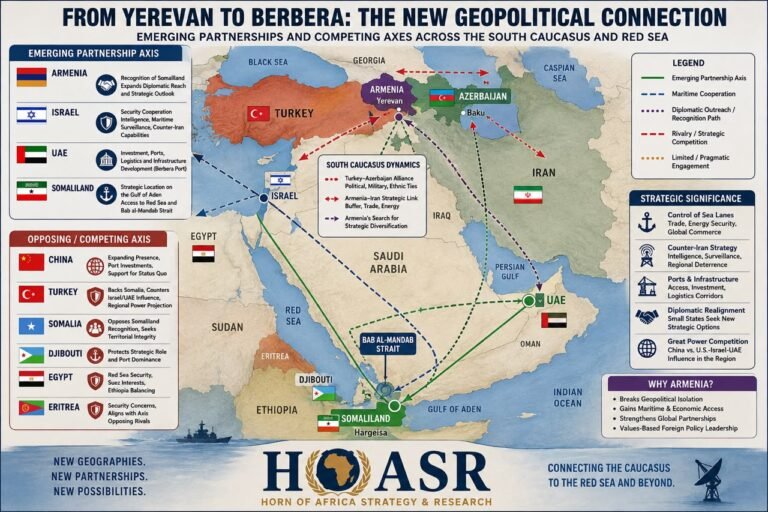
One network links Israel, the UAE and increasingly Somaliland through recognition, port infrastructure, intelligence interests and concern over Iranian power. India has strong relations with Israel and the UAE, deep hostility toward Pakistan and a growing interest in western Indian Ocean security. Ethiopia sees Berbera as a route toward diversified maritime access. Together, these relationships suggest an emerging Indo-Abrahamic maritime geometry, even if no formal alliance unites all its members.
A second grouping brings Saudi Arabia closer to Türkiye and Pakistan, while Riyadh simultaneously strengthens cooperation with Somalia and seeks broader leadership of a Red Sea maritime coalition. This network has greater military weight but also greater internal contradiction. Türkiye competes with Israel and the UAE, supports Somalia’s territorial position and maintains channels with Iran. Pakistan must balance Saudi expectations, its partnership with Türkiye, its rivalry with India and its need to avoid an uncontrolled confrontation with Tehran.
Saudi Arabia’s danger is that its new defence alignment could improve military deterrence while worsening its access to the most strategically useful geography. If Riyadh allows Ankara’s Somalia policy or its rivalry with Abu Dhabi to dictate its approach to Somaliland, it will reproduce the same error within a new alliance.
What Riyadh Should Do Now
Saudi strategy can still be corrected without forcing every decision into a binary choice.
First, Riyadh should open direct, senior-level dialogue with Hargeisa. This should begin with practical cooperation and remain insulated from its disputes with Abu Dhabi. Maritime security cannot depend on communicating with Somaliland only through Mogadishu.
Second, Saudi Arabia should establish a Red Sea maritime-security compact with Somaliland covering radar data, coast-guard training, search and rescue, counter-smuggling, fisheries protection, port security and emergency access. Recognition need not be the entry price for functional cooperation, although Riyadh should keep its ultimate diplomatic position under review.
Third, it should pursue commercial participation in Berbera and the wider Somaliland economy without attempting to undermine DP World. Saudi strengths in energy, logistics, livestock, food processing, Islamic finance and infrastructure could complement the Emirati platform.
Fourth, Riyadh should seek a structured détente with Abu Dhabi. Neither side benefits if rivalry destroys the interoperability and political coordination required to defend Gulf and Red Sea trade.
Fifth, Saudi Arabia should negotiate normalization with Israel as part of a comprehensive package—not as a hurried transaction for nuclear technology alone. Any agreement should integrate nuclear safeguards, American security commitments, Palestinian political provisions, missile defence, technology cooperation and a wider Red Sea strategy.
Sixth, the Saudi–Pakistan–Türkiye pact should develop a maritime component that reflects territorial realities. Somaliland’s coast cannot be effectively secured from conference rooms in Riyadh, Ankara, Islamabad or Mogadishu.
Somaliland’s Opportunity—and Its Caution
For Somaliland, Saudi Arabia’s reassessment represents an important opening. Hargeisa can present itself not as an instrument against Somalia or an exclusive base for any single coalition, but as a reliable provider of maritime stability.
Somaliland should offer Riyadh a formal strategic dialogue, investment protections, transparent port and airfield access arrangements, livestock and food-security partnerships, and coast-guard cooperation. It should also avoid allowing competition among Saudi Arabia, the UAE, Israel and Türkiye to turn its territory into a proxy arena.
The most persuasive Somaliland policy is one of multi-alignment: cooperate with the UAE without becoming dependent on Abu Dhabi; deepen ties with Israel without importing every Israeli conflict; welcome Saudi investment without surrendering political autonomy; and maintain channels with Türkiye where interests permit.
Recognition remains Somaliland’s central diplomatic objective, but strategic relevance must be converted into durable national capability—not merely rented geography.
Conclusion: Geography Collects Its Debts
Saudi Arabia is confronting the accumulated cost of deferred strategy. It postponed normalization with Israel and now finds nuclear cooperation tied to it. It allowed relations with the UAE to decay and now confronts regional threats without the cohesion that once amplified Gulf power. It prioritized Somalia’s diplomatic claims while neglecting a functional partnership with Somaliland, only to discover that the coast opposite Yemen cannot be secured through Mogadishu.
The UAE’s advantage in Berbera did not arise from superior geography. Saudi Arabia faces the same sea. It arose from earlier recognition that ports, runways, local partnerships and commercial networks create influence long before a crisis makes their value obvious.
Riyadh’s emerging pact with Pakistan and Türkiye may strengthen deterrence. A reconciliation with Abu Dhabi could restore Gulf coordination. An Abraham Accords agreement could unlock nuclear and security cooperation. Engagement with Somaliland could provide strategic depth on the African shore of the Gulf of Aden.
But these initiatives will succeed only if Saudi Arabia draws the correct lesson from its present misfortune: power is not preserved by defending old assumptions after the strategic environment has changed. It is preserved by seeing the change early, investing in real relationships and treating geography as a partner rather than an afterthought.
Somaliland has been across the water all along. Riyadh is only now discovering how costly it was not to look.
────────
Principal sources
- Steven A. Cook, “The Saudis Are the Architects of Their Own Misfortune,” Foreign Policy, August 5, 2026.
- Reuters, “US says Saudi nuclear deal off without Israel recognition,” July 23, 2026.
- Reuters, “Gulf shipping traffic down after Houthis say they attacked Saudi tanker,” August 6, 2026.
- Reuters, “Dubai’s DP World says operations at Somaliland’s Berbera port unaffected by UAE-Somalia dispute,” January 13, 2026.
- John Calabrese, “Saudi Arabia’s Somalia Gambit,” Gulf International Forum, April 6, 2026.
- DP World, “Berbera Port — Your Strategic Gateway to East Africa.”

Prof. Nassir Hussein Kahin is a researcher, educator, journalist, and geopolitical analyst specializing in the Horn of Africa, the Red Sea, international law, diplomacy, and strategic affairs. To read Full Bio click on this link: ABOUT THE AUTHORProf. Nassir Hussein Kahin