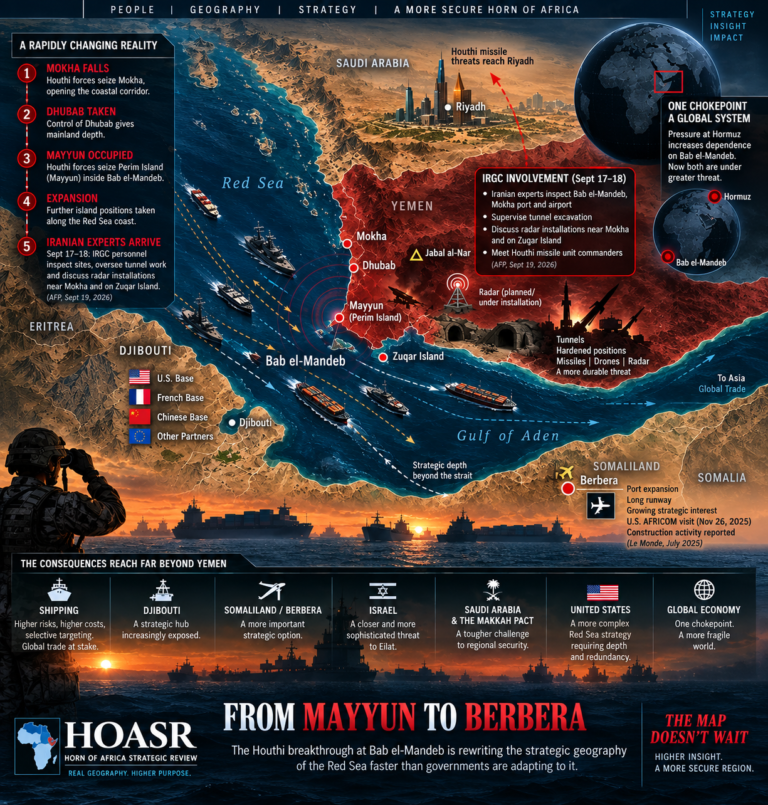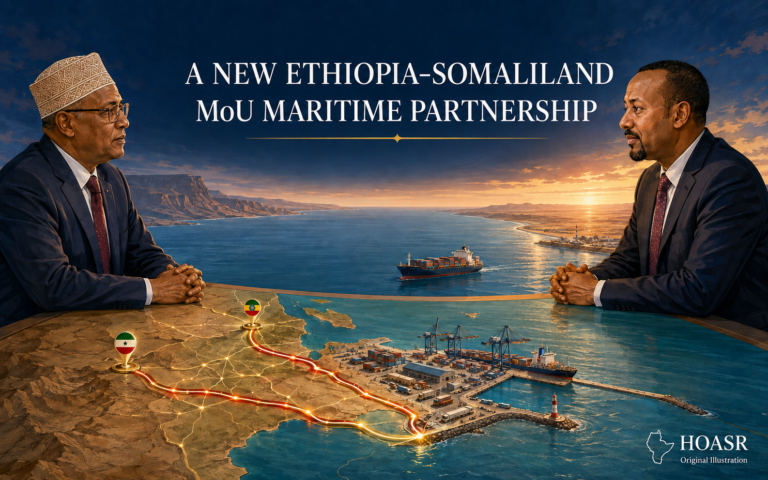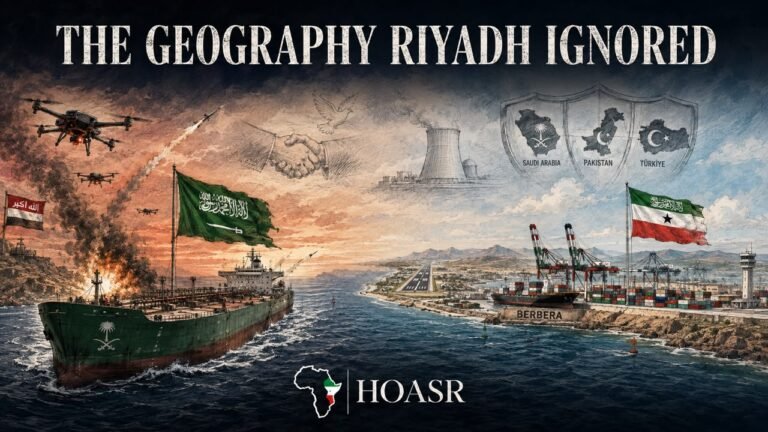
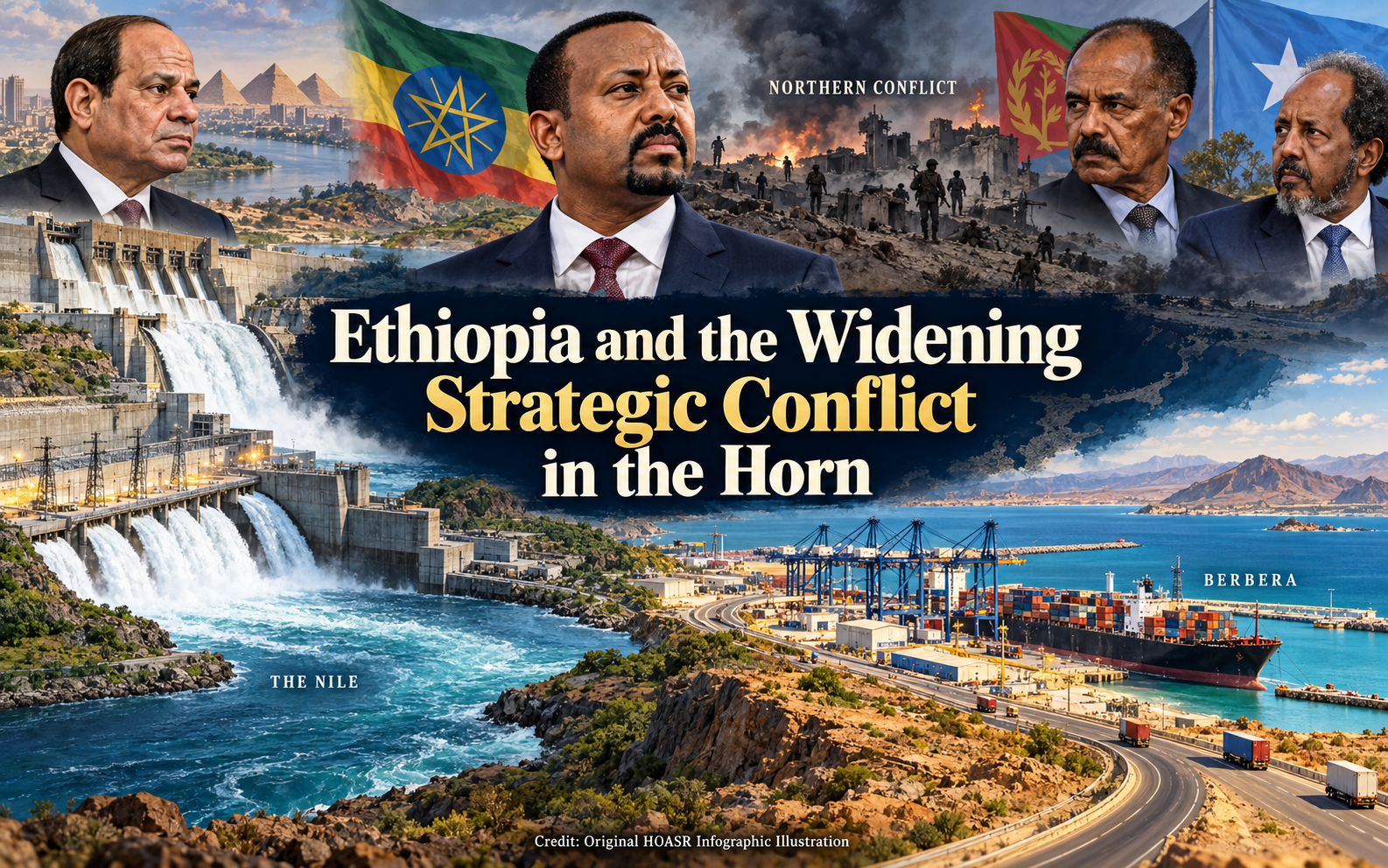
Ethiopia’s Nile and maritime ambitions intersect with regional rivalries, northern fighting and the Berbera option. Credit: HOASR infographics.
The Nile dispute and the search for maritime access are drawing neighboring states into a confrontation that reaches from northern Ethiopia to Berbera and the Red Sea
The renewed fighting in northern Ethiopia is unfolding within a regional struggle that has been developing for years. Ethiopia’s pursuit of greater control over its economic future, through the Nile and a more secure route to the sea, has unsettled neighbors with different interests.
Their responses are increasingly bringing separate disputes into the same diplomatic confrontation. The danger grows when those external rivalries intersect with Ethiopia’s unfinished internal political settlements.
HOASR’s earlier Nile analysis connected Ethiopia’s water and maritime ambitions through a common outlook: overcoming inherited constraints and strengthening national independence. The Grand Ethiopian Renaissance Dam became central to that outlook because Addis Ababa saw its upstream resources as a foundation for development.
Earlier water arrangements, particularly the 1959 agreement between Egypt and Sudan, allocated Nile waters without Ethiopia as a party. The dam consequently acquired political significance far beyond electricity generation.
Egypt approaches the river through its dependence on downstream water supplies. Ethiopia approaches it through its demand for greater use of resources originating within its territory. Sudan’s position includes possible benefits from regulated flows and electricity alongside concerns about dam operations and water security.
These different priorities explain the persistence of the dispute and why confidence, information sharing and drought management remain central to any settlement. Agreements over the Nile must accommodate both upstream development and downstream vulnerability.
Ethiopia’s maritime problem developed along a different historical path. Eritrea’s independence in 1993 left Ethiopia without a sovereign coastline, and its subsequent dependence on Djibouti made port access a lasting strategic concern.
Ethiopia continues to trade through foreign ports; its ambition is to secure greater reliability, diversify routes and, in some formulations, obtain a stronger strategic presence at the coast.
Those objectives carry different consequences. Commercial transit and control over coastal territory cannot be treated as interchangeable demands.
International maritime arrangements can provide access while preserving the sovereignty of the coastal and transit states involved. The law of the sea provides for negotiated transit arrangements and protection of transit states’ legitimate interests. Ethiopia can therefore pursue a dependable outlet without acquiring sovereign coastal territory.
The political danger arises when neighbors believe an economic requirement is being expanded into a territorial claim. Ambiguity over that boundary makes even proposals for cooperation harder to trust.
Somaliland offers a negotiated route into this problem. As HOASR’s Berbera analysis explained, Ethiopia seeks alternatives to dependence on one maritime gateway, while Somaliland seeks investment and a larger role in regional trade.
Berbera sits on the Gulf of Aden, connected to the wider Red Sea trading system through Bab el-Mandeb. Its value depends on the port and the corridor reaching into Ethiopia, together with reliable customs, transport and security arrangements. Geography creates the opportunity; functioning agreements and sustained cargo movement determine the return.
This economic relationship has a practical foundation. DP World’s corridor agreement with Ethiopia’s transport ministry in 2021 sought to develop the Ethiopian side of the Berbera route. The company subsequently opened the Berbera Economic Zone with Somaliland’s government.
Such investment brings external commercial interests into a corridor whose security depends on regional stability. Fighting in Ethiopia could reduce the trade and investment that make the route attractive, even as diplomatic confrontation increases interest in alternative access.
Each neighbour consequently reads Ethiopia’s ambitions differently. Eritrea’s concern centres on coastal sovereignty and the history of its separation from Ethiopia. Djibouti has an economic interest in retaining its importance as Ethiopia’s principal maritime gateway.
Somalia opposes agreements that strengthen Somaliland’s separate international standing, while Egypt and Sudan approach Ethiopian power through the Nile dispute as well as regional security. These interests can encourage coordination, although they do not amount to identical objectives or prove a common military strategy.
The Alamein declaration of 4 October 2026 made that coordination more visible. Egypt, Eritrea, Sudan and Somalia brought Red Sea governance, downstream Nile interests and opposition to Somaliland recognition into the same diplomatic framework.
The analytical significance lies in the connection among these positions. Pressure on Ethiopia’s maritime ambitions can now reinforce pressure over the Nile, while Somaliland’s external relationships become part of the same argument over regional authority.
The northern escalation gives these disputes an immediate security dimension. On 9 October, Reuters reported Ethiopia’s accusation of an Eritrean invasion and Eritrea’s counterclaim that Addis Ababa was pursuing aggression for sea access. Reported Eritrean troop movements inside Tigray have brought the confrontation closer to direct interstate warfare.
The opposing accounts show how border security and maritime ambition now enter the justification for military action. They also increase the risk that each government will interpret the other’s movements as preparation for a wider campaign.
The conflict still has substantial domestic causes. The Pretoria agreement of 2 November 2022 sought to end the federal government’s war with the Tigray People’s Liberation Front. Subsequent reporting describes renewed alliances among opposition movements with different grievances and territorial disputes.
A maritime settlement would leave those political conflicts to be resolved within Ethiopia. Regional rivals may find opportunities in domestic fragmentation, but Ethiopian accusations that Egypt, Eritrea and Sudan support the rebels remain contested allegations; all three have denied such support.
Somaliland’s position is complicated by the competing diplomatic routes Ethiopia has pursued. The January 2024 memorandum linked proposed long-term coastal access with Somaliland’s expectation of Ethiopian recognition, according to public accounts discussed in HOASR’s earlier work. The Ankara Declaration of December 2024 subsequently imagined commercial access under Somalia’s sovereign authority. It did not name Berbera.
Negotiations concerning a port administered by Mogadishu therefore need to be distinguished from any proposal involving Somaliland’s coast, where practical implementation requires Hargeisa’s participation.
Türkiye’s mediation places it directly within this diplomacy, while investment at Berbera gives Gulf commercial actors a stake in the outcome. The wider relevance was examined in HOASR’s recognition analysis.
The IFA publication it discussed described operational recognition: practical integration into international networks through trade, infrastructure, diplomacy and security cooperation.
This helps explain why Somaliland can become more important to external partners while their formal diplomatic positions remain cautious. The publication reflects a contributor’s analysis and does not establish an Ethiopian government commitment to recognition.
Growing practical engagement also presents Somaliland with a difficult bargaining problem. HOASR’s maritime doctrine editorial argued that access must deliver reciprocal political and economic benefits while preserving Somaliland’s authority over its territory.
The application depends on the agreement being negotiated. Ordinary commercial trade and a long-term coastal or naval lease carry different sovereign and security consequences.
Where recognition forms part of an explicit strategic bargain, implementation needs clear detailed diplomatic commitment; an undefined promise leaves Hargeisa carrying risks without assurance of the agreed return.
According to Kaab TV’s report, Somaliland’s foreign ministry reaffirmed on 3 October its support for negotiated Ethiopian maritime access based on mutual benefit and rejected outside interference in its agreements. That position preserves an opening for deescalation of hostilities and an urgent cooperation amid the wider confrontation.
However, increased Ethiopian need does not automatically strengthen Somaliland’s position: war could disrupt corridor traffic, discourage investors and heighten pressure on the coast. Somaliland leadership must translate strategic demand into a workable partnership without surrendering control over the terms.
The struggle is over how regional power is exercised. Ethiopia wants its economic needs and demographic weight reflected in the arrangements governing water and maritime access. Its neighbors want those arrangements to protect their sovereignty and security. Somaliland offers a possible negotiated outlet, but a durable agreement requires benefits and obligations that both sides can defend.
The Horn’s present danger is that domestic warfare and regional competition are beginning to reinforce each other. Berbera’s promise depends on whether diplomacy can contain that process before the corridor becomes another front in the confrontation. For further insight read my analysis published in the Times of Israel Blogs:my analysis

Prof. Nassir Hussein Kahin is a researcher, educator, journalist, and geopolitical analyst specializing in the Horn of Africa, the Red Sea, international law, diplomacy, and strategic affairs. To read Full Bio click on this link: ABOUT THE AUTHORProf. Nassir Hussein Kahin