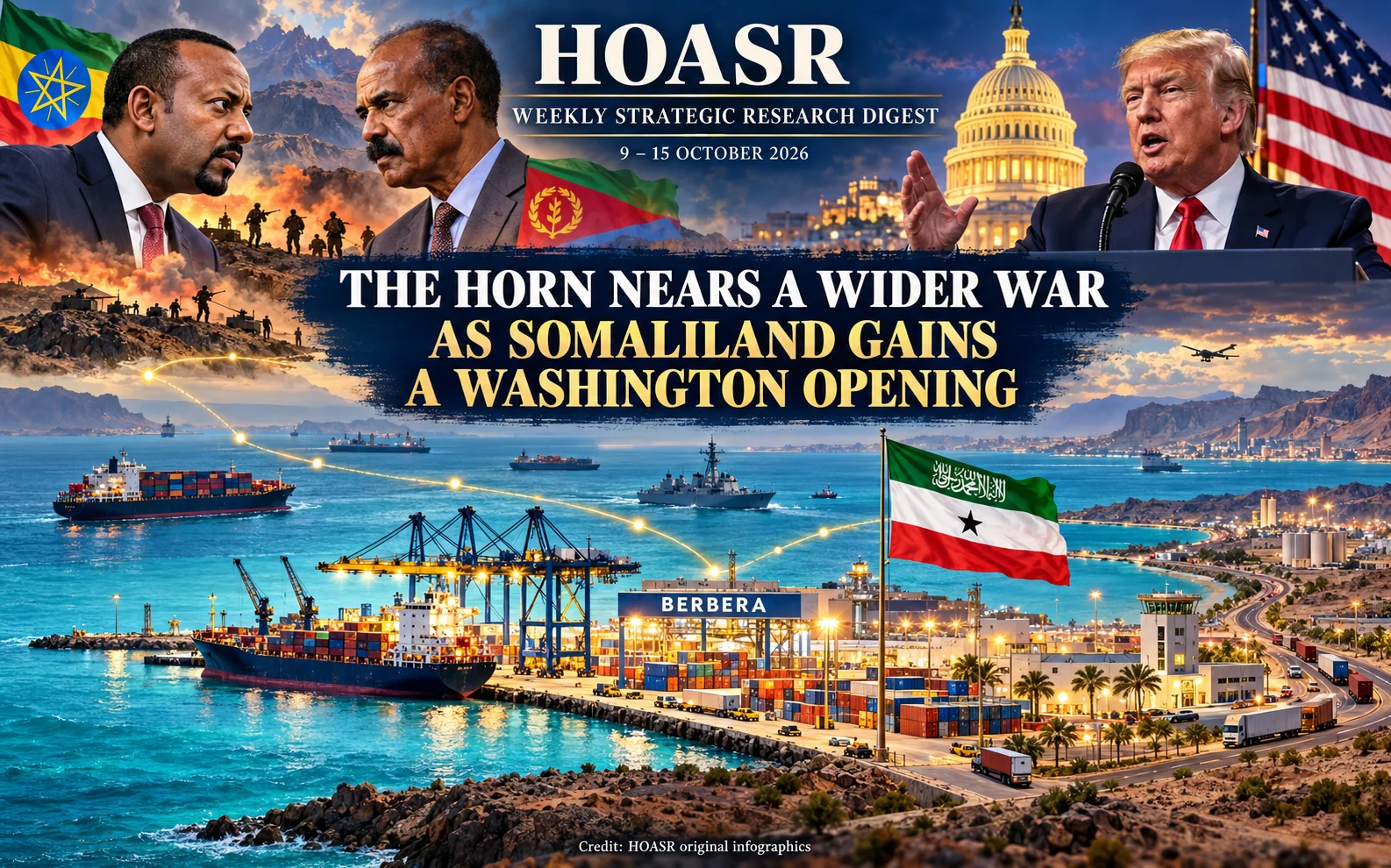
Berbera at the intersection of Ethiopia–Eritrea tensions, Red Sea shipping insecurity and Somaliland’s diplomatic opening in Washington. Credit: HOASR original infographics.
Week reviewed 9 to 15 October 2026
Ethiopia’s northern war has reached the Eritrean frontier while Somaliland has gained a new opening in Washington. Fighting and maritime insecurity are giving governments stronger reasons to reconsider regional access.
President Donald Trump’s public distinction between Somaliland and Somalia adds political attention to that strategic debate. The opportunity for Hargeisa is to connect those developments through a credible case for negotiated access and regional stability.
This week’s selected research, policy material and reporting show how quickly the military and diplomatic calculations are changing. Federal advances in Tigray bring the danger of interstate escalation closer.
Reported Houthi territorial reversals offer a different picture from September, yet the ability to threaten shipping survives changes on the ground. The region needs arrangements that reduce current escalations to war while keeping trade moving.
Berbera enters this debate as an available coastal option whose wider role still requires agreement. Its relevance extends beyond relieving dependence on a single gateway. Negotiated access through Somaliland could help separate Ethiopia’s maritime needs from confrontation over a neighbors coastline.
That is HOASR’s assessment of the opportunity emerging from the evidence below, rather than an agreement already concluded.
The Northern Front Has Reached the Eritrean Border
The Critical Threats review dated 13 October records federal advances to Zalambessa on the Eritrean border, alongside gains at Adwa and Axum. Its reporting period ends on 13 October. The battlefield has therefore moved beyond the earlier contest over Mekelle toward positions where retreat, pursuit and border defense can collide. That proximity raises the consequences of a miscalculation.
The review also separates stronger reporting from isolated claims about an Ethiopian advance toward Assab. Some alleged cross-border movements were contradicted by local accounts: an advance through Tigray does not establish that a campaign to seize an Eritrean port has begun.
The immediate evidence supports concern about escalation, with no end in sight of its next direction.
For Somaliland, the implication is a stronger regional case for access negotiated by consent. A coastal arrangement can serve commercial and security interests without requiring a territorial confrontation.
Berbera does not resolve Ethiopia’s northern conflict, but it offers a separate channel through which part of the maritime dispute could be addressed. Whether that channel becomes usable depends on the terms governments are prepared to negotiate.
A Federal Advance Does Not End the Ethiopian Crisis
Lesley Anne Warner’s 14 October Just Security analysis explains why the renewed war cannot be treated as a repetition of 2020–2022. Tigray is divided into a pro-government Tigray Peace Force that has fought alongside federal troops, and former partners of Addis Ababa have now turned hostile. The balance within Tigray has changed, while Ethiopia faces pressures across several fronts. Military advantage and political authority consequently remain different problems.
Warner’s analysis is strongest on these changed alignments and the challenges of governing recovered territory. It is an interpretation supported by reporting, rather than proof of how the campaign will end.
A government can retake towns while facing an enduring contest over legitimacy and administration. The population’s willingness to accept the resulting order will shape the durability of federal gains.
This has consequences for maritime diplomacy. Internal strain can make alternative access more attractive while reducing the resources available to implement it.
Washington Is Trying to Contain the Border Crisis
The State Department issued a readout of Secretary Marco Rubio’s 14 October call with Prime Minister Abiy Ahmed. Associated Press reported on 15 October that Rubio urged de-escalation, dialogue and respect for neighboring states’ sovereignty. The intervention shows Washington’s immediate concern about further regional conflict. It does not establish an American endorsement of a particular maritime agreement.
The political significance is that access and restraint can be discussed within the same diplomatic effort. Ethiopia has an economic and strategic interest in reliable routes to the sea. Coastal governments have an equally direct interest in protecting their territorial authority.
An agreement reached by consent would allow those interests to be addressed without making a military results the starting point.
Berbera can play a potential role in regional diplomacy rather than just a port transaction. Trade access, investment and carefully defined cooperation could provide benefits to more than one government.
That possibility remains a proposition to negotiate. Its attraction grows when the alternative is a prolonged confrontation that disrupts commerce and draws in additional powers.
A Territorial Reversal Does Not Reopen the Sea by Itself
The Red Team analysis published on 8 October was updated on 10 October to report Houthi losses on Perim Island and around Bab el-Mandeb on 9 October, following earlier reported setbacks near Dhubab. It explicitly describes the situation as fluid.
This updates the September picture of expanding Houthi territorial leverage. It should not be turned into a fixed map of control for the rest of October.
The study’s important value is its explanation of shipping behavior. It connects attacks and uncertainty with routing decisions, transit volumes and the pace at which carriers return. Its use of shipping data makes it useful for examining commercial responses. Its territorial references still depend on the underlying reporting and their dates.
The strategic conclusion: recovering a position on land and restoring commercial confidence are separate achievements. Ships remain exposed to weapons that can be launched from beyond the immediate shoreline.
Carriers need confidence that a route will remain usable and safe over repeated voyages. In this case, Berbera’s relevance would be in securing investments for reliable logistics and additional access.
The Threat Can Travel to the African Shore
Peter Fabricius’s 9 October ISS analysis examines reported connections between the Houthis and al-Shabaab. It discusses arms transfers, training and the possibility that technology could strengthen militant capabilities in Somalia. The article also includes expert uncertainty about sophisticated missile transfers and whether al-Shabaab intends to pursue a wider maritime campaign. Contacts and smuggling ties do not establish a unified military strategy.
The study places coastal security, weapons trafficking and insurgency within the same assessment. The African shore cannot be treated simply as a platform from which outsiders respond to threats in Yemen. Local armed groups can exploit maritime networks for purposes connected to their own wars and suggests surveillance and interdiction alongside naval escorts.
For Somaliland, this increases the practical meaning of a security partnership. Port protection, intelligence cooperation and coastal monitoring can support commerce as well as national defense. Berbera’s strategic role becomes more durable when it contributes to everyday security and the movement of lawful trade.
Shipping Confidence Remains a Separate Front
On 15 October, Le Monde reported a French frigate’s interception of a drone threatening a CMA CGM vessel on 1 October. It also described crew anxiety about the route. The incident predates the reported territorial reversals, while the article’s broad description of Houthi control differs from the updated territorial accounts. It establishes neither the present front line nor the removal of maritime risk.
The commercial test is sustained confidence. A port corridor can add options, but cargo traveling from Berbera toward Suez must still pass through Bab el-Mandeb. Therefore, diversification and passage security remain complementary tasks.
Trump Has Given the Somaliland Argument a Wider Hearing
The diplomatic development comes from Trump’s remarks at an Ohio rally on 12 October. Business Insider reported his description of Somaliland as a “totally different country” from Somalia. Somaliland’s Foreign Ministry welcomed the acknowledgement in its 13 October statement. The remarks brought the distinction directly into presidential language, although they did not announce formal US recognition.
For Hargeisa, the political value is the wider hearing given to an argument it has made for decades. Somaliland’s separate institutions and its case for international recognition have reached an audience beyond specialist policy circles.
The Foreign Ministry’s response connects that position with Berbera, regional trade and constructive engagement; its argument is also set out in the Horn Tribune. As a government statement, it establishes Hargeisa’s position rather than Washington’s commitments.
The strategic opening is to connect that attention with identifiable areas of cooperation. Recognition, investment and security engagement each require decisions of their own. Presidential language can change the political atmosphere in which those decisions are considered. This week has made Somaliland harder to overlook without completing the diplomatic work ahead. Read HOASR’s editorial analysis in the Times of Israel Blogs Presidential Words Matter
The Scoop
The week’s evidence brings two developments into the same strategic frame. Ethiopia’s war is closer to an international border, increasing the value of arrangements that keep maritime access separate from territorial confrontation. Somaliland has gained presidential attention in Washington while regional insecurity continues to expose the limits of existing access and protection. Berbera offers a practical subject around which those interests could meet.
The important distinction is between a geographic opportunity and a functioning agreement. A negotiated corridor could support Ethiopian commerce and Somaliland’s economy while reducing one source of regional pressure. Reliable security cooperation could protect that activity and strengthen confidence in the route. Neither requires pretending that a port agreement can settle Ethiopia’s internal wars or end the threat from Yemen.
The strongest case for Berbera is now its contribution to a more workable regional order. It offers a place where trade, access and cooperation can be negotiated without deciding the outcome of a border war. Somaliland’s diplomatic opportunity will carry greater weight when attached to those concrete benefits. The region has ample experience of access becoming a cause of confrontation; an agreement through Berbera could make access part of the effort to prevent another one.

Prof. Nassir Hussein Kahin is a researcher, educator, journalist, and geopolitical analyst specializing in the Horn of Africa, the Red Sea, international law, diplomacy, and strategic affairs. To read Full Bio click on this link: ABOUT THE AUTHORProf. Nassir Hussein Kahin