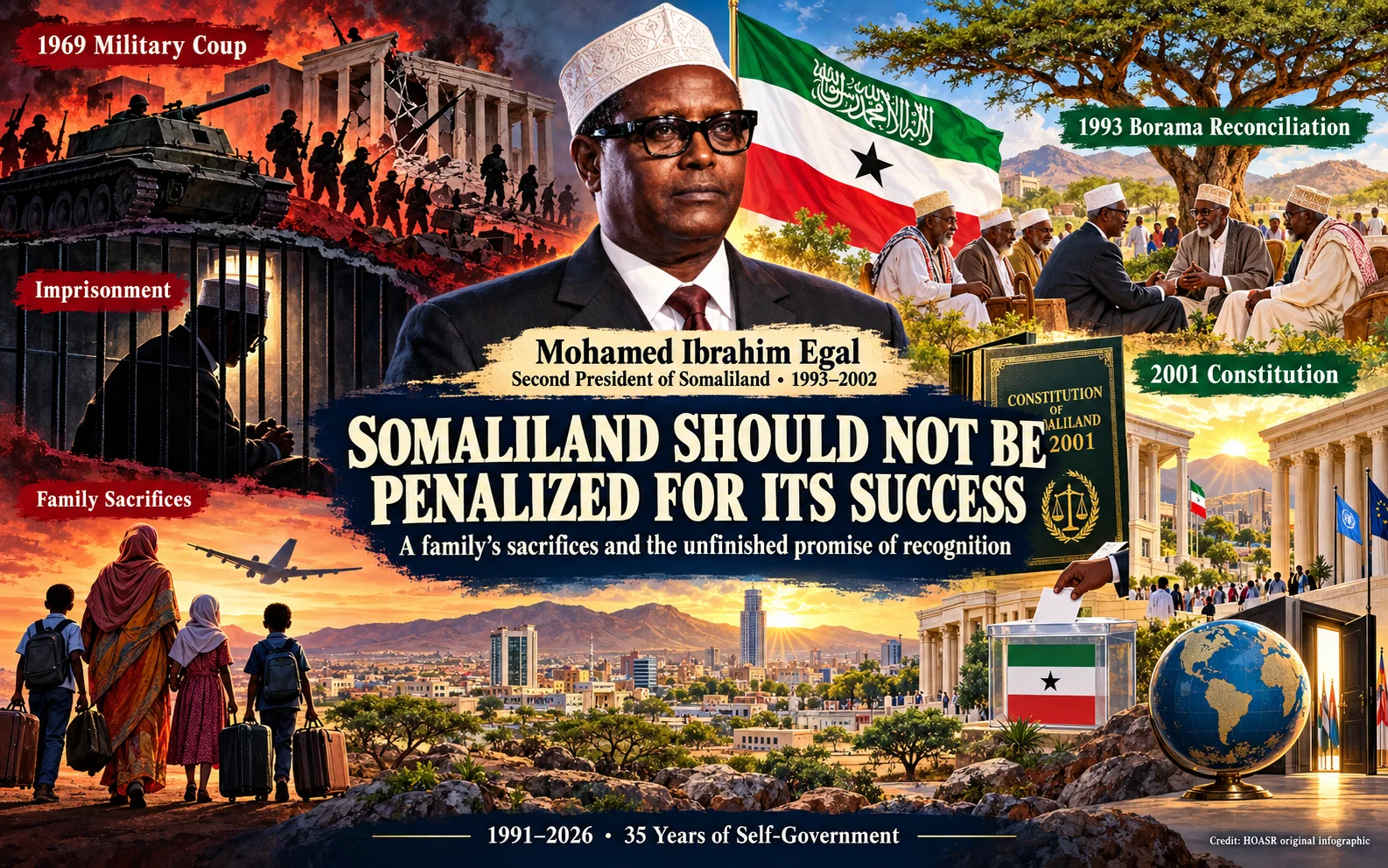
Mohamed Ibrahim Egal’s journey through civilian leadership, imprisonment and Somaliland’s presidency
It is almost nine months since Israel recognized Somaliland on 26 December 2025. For those who have spent their lives defending our nation’s sovereignty, that moment felt like vindication decades in the making. As the first anniversary approaches, Somalilanders ask: was that milestone the beginning of our rightful global integration, or merely a fleeting diplomatic headline?
Recognition must become functioning diplomatic relations and practical cooperation. The wave of Western and regional recognition has not materialised. Investment has not fulfilled our hopes; much economic potential remains unrealised.
This delay hurts because Somaliland’s pursuit of self-determination was never an academic exercise. The world cannot afford to ignore us. It was not imported from Western capitals or granted through foreign charity. It was paid for in blood, forged through traditional consensus and sustained by the private sacrifices of generations.
For my family, Somaliland’s story has been our daily reality for generations, not a textbook chapter.
A heritage forged in defiance
Before our status was debated at international summits, my grandfather, Ibrahim Egal, was a prominent merchant trading across the Gulf of Aden. Our family remembers his imprisonment by Italian forces during the Second World War and his seven months behind bars before the British returned. That recollection belongs to the Italian occupation of British Somaliland in 1940–1941.
Two decades later, the price of freedom struck closer still. My mother’s brother, a Sandhurst-trained officer according to our family’s account, returned to a Somaliland in an ill-fated union with Somalia. The original union arrangements and subsequent retrospective legislation left enduring disputes over its legal foundations.
Disillusioned by the treatment of the north, he joined young officers who attempted to restore Somaliland’s independence in December 1961. He was killed during that attempt. His death shaped our family’s understanding of the union’s cost.
By 1967, my father, Mohamed Ibrahim Egal, had become prime minister of the Somali Republic. I was ten years old. I watched him practise international statesmanship: strengthening relations with Britain, meeting President Lyndon B. Johnson during his Washington visit in March 1968, and working to strengthen civilian government and regional peace.
The dream collapsed in October 1969 with the military coup led by Major General Mohamed Siad Barre. Overnight, our lives fractured. My father was imprisoned and, in my recollection, endured long periods in isolation. My siblings, Ahmed and Amina, and I were separated from him and sent to boarding schools in Switzerland and the United Kingdom. We found refuge abroad while he remained detained.
While the children of European diplomats studied beside me, I spent my youth wondering whether my father was dead or alive.
Following his release in the mid-1970s, he was appointed ambassador to India. To our family, the posting felt like exile from the Somali public. Our emotional reunion in New Delhi felt like a resurrection.
In our family’s recollections of the Non-Aligned Movement summit in Colombo in August 1976, African leaders were astonished to see him. They embraced a man some had feared Barre had eliminated. Returning to public life did not protect him from another arrest.
A summons arrived: my father was ordered back to Mogadishu for “consultations.” My mother pleaded with him to delay his return until after Ramadan, fearing a trap. He refused to cower. I will never forget standing at the foot of the aircraft stairs and watching him turn back towards us before boarding: “I am ready if he wants to lock me up.”
Days later, we learned that he had been arrested and returned to detention. My mother looked at me and said, “Go straight to the embassy, enter his office, and take every single one of his papers home.”
I remember offers of citizenship and sanctuary from foreign representatives in Delhi, including the United Arab Emirates. My mother refused foreign passports. She insisted that we retain our identity and move to Abu Dhabi because flights from Mogadishu landed there. That tenuous lifeline offered hope of news about my father. He would remain imprisoned for several more years.
The foundation we built
When civil war finally brought down Barre’s dictatorship in 1991, Somaliland began a difficult process of reconciliation and reconstruction. Despite subsequent internal conflict, our communities repeatedly negotiated towards a political settlement.
In 1993, clan elders, intellectuals and political and military leaders gathered in Borama for months of national reconciliation. Drawing on traditions of deliberation and consensus, delegates selected my father to lead the republic as its second president.
Working from the devastation of war, with overwhelmingly local support and limited external assistance, his administration helped establish the central bank, introduced the Somaliland shilling, developed the army and police, and strengthened public administration. It also helped lay the constitutional foundations for multiparty democracy and issued Somaliland passports.
This national achievement involved elders, business-people, political leaders and ordinary citizens. My father helped turn negotiated peace into institutions sustaining government.
The constitution was approved in a referendum in May 2001, providing a framework for the competitive elections that followed. Amid regional authoritarianism and conflict, Somaliland established an order where authority could pass through constitutional rules and, subsequently, the ballot box.
My father’s death in a South African military hospital in May 2002 brought national grief. Vice-President Dahir Riyale Kahin succeeded him under the constitution.
After his burial, senior political figures urged me to accept the vice-presidency. I refused without hesitation.
I refused because Somaliland is not a kingdom. My father did not endure long years of imprisonment to establish a monarchy. His constitutional legacy required earning office through legitimate political participation rather than inheritance.
The second act: beyond mere symbols
Today, our country stands at a difficult threshold. Somaliland has survived atrocities, rebuilt institutions and sustained self-government for thirty-five years. Its democratic system developed through reconciliation, constitutional arrangements and successive elections. The unfinished foundation my father helped establish must be strengthened.
For decades, outsiders associated Somaliland mainly with pastoral life and the herds of camels, sheep and goats that supplied markets across the Arabian Peninsula. Today, our development ambitions extend to ports, agriculture, services and mineral exploration. Geological assessment must establish commercially viable mineral resources before expectations become promises.
Recognition from Israel—or any other state—cannot remain an abstract trophy on a diplomatic mantelpiece. Symbols do not pave roads, power clinics or create jobs. Strategic partnerships must become practical: functioning diplomatic representation, accountable security cooperation in the Gulf of Aden and approaches to Bab el-Mandeb, and investment in our young people and productive economy.
To Jerusalem, Washington, London and the Gulf: Somaliland has demonstrated its capacity to govern itself. We are not asking for permission to exist. We have sustained self-government for thirty-five years and developed a democratic system through our own political experience.
My grandfather’s imprisonment, my uncle’s death and my father’s years in detention remain part of our family’s memory. They recall the sacrifices behind a country too often reduced to a diplomatic dispute.
Somaliland is not asking foreign powers to build the state we have already built. We are asking the international community to align policy with reality, take seriously our claim to the sovereign boundaries of 1960, and engage Somaliland as the reliable, democratic partner it has worked to become.
*Ali Mohamed Ibrahim Egal is a Somaliland diplomat and businessman, and the son of the late President Mohamed Ibrahim Egal.
Ali Mohamed Ibrahim Egal
Ali Mohamed Ibrahim Egal is a Somaliland Diplomat, businessman, and is the son of the late 2nd President of Somaliland (1993-2002)