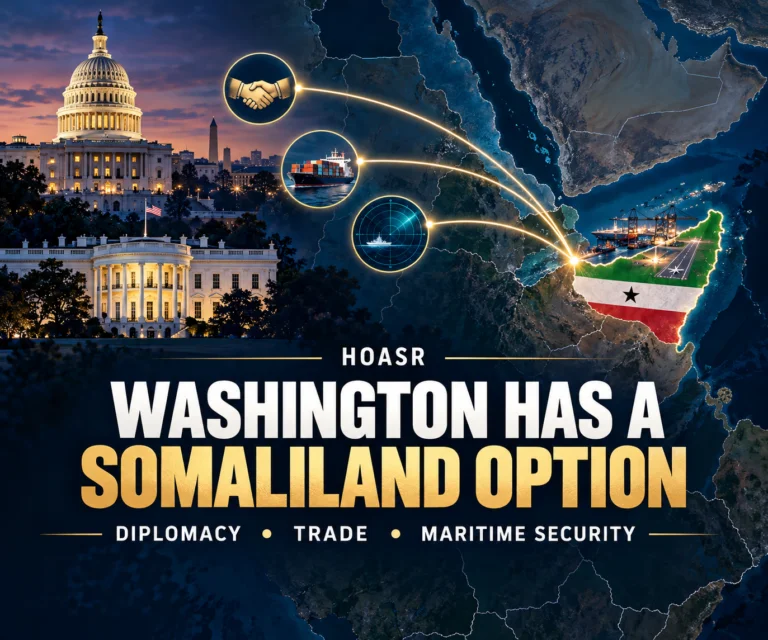
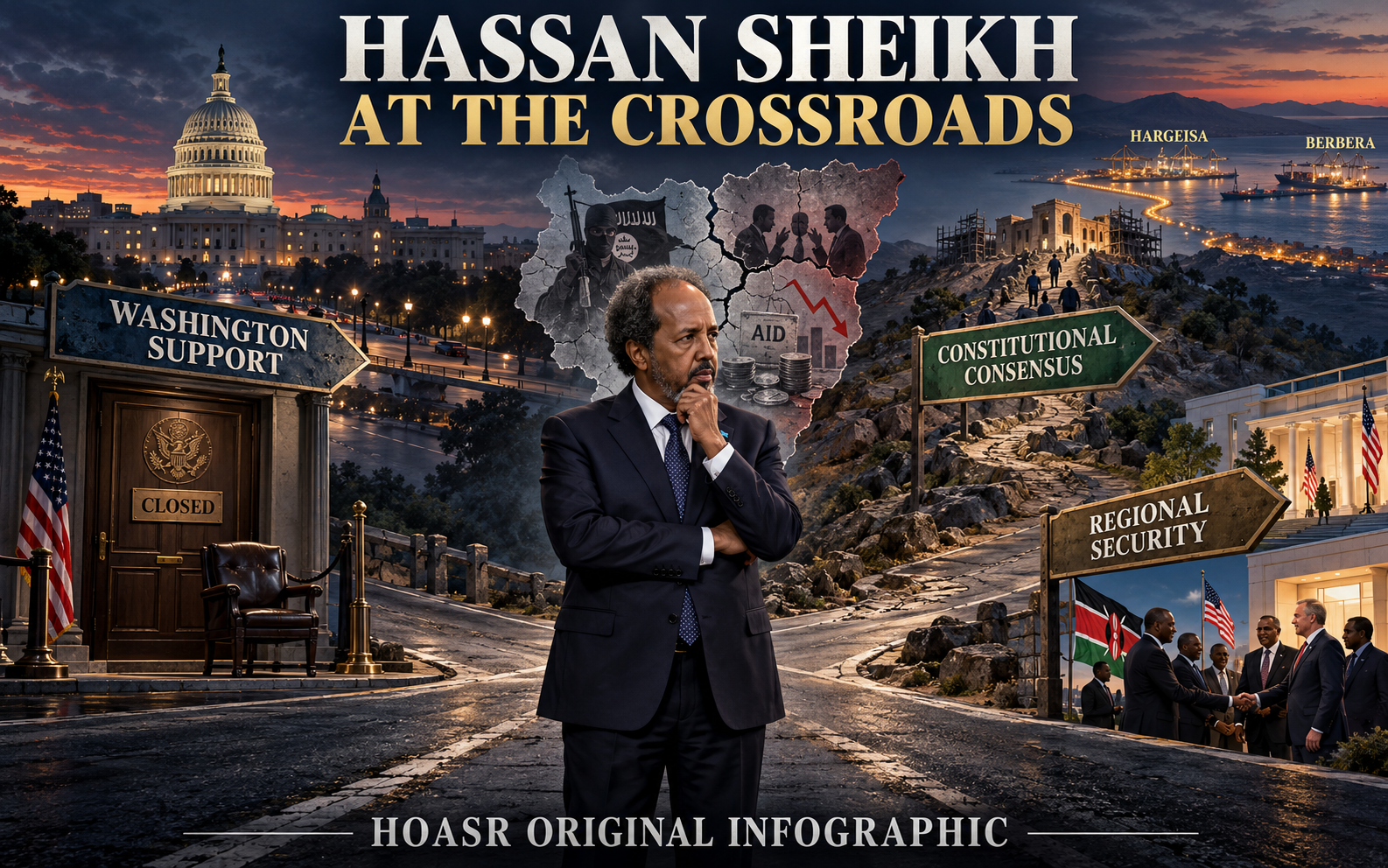
Hassan Sheikh at the crossroads: Somalia retains international recognition, but Washington’s confidence in Mogadishu is declining. HOASR original infographic.
Somalia’s president defended territorial integrity at the United Nations, but returned without the high-level American access, durable security financing or political endorsement his government needed.
President Hassan Sheikh Mohamud travelled to the United States with two connected objectives. He sought to defend Somalia’s sovereignty and territorial integrity after Israel’s recognition of Somaliland, and he sought to preserve the external security system on which his government still depends. At the UN General Assembly, he insisted that Somalia’s borders could not be altered by unilateral action and appealed for predictable support for the country’s security transition. [1] [16]
The language was confident, but the practical results were modest. Hassan Sheikh met several foreign leaders and secured one lower-level meeting with the US Assistant Secretary of State for African Affairs. He did not meet President Donald Trump, Secretary of State Marco Rubio, the defense secretary or another Cabinet-level American official. He also left without a permanent financing arrangement for the African Union mission, a reversal of Washington’s plan to end support for the UN Support Office in Somalia, or a new American measure limiting Somaliland’s expanding contacts in Washington. [2] [3] [5]
The visit exposed a widening gap between Somalia’s legal position and its political performance. Most governments still recognize Somalia’s internationally accepted borders. Yet that diplomatic formula no longer guarantees Mogadishu a veto over every practical relationship that the United States may develop with Hargeisa or Berbera.
A sovereignty campaign that preserved language, not leverage
Hassan Sheikh devoted a central passage of his UNGA address to sovereignty, unity and territorial integrity. Although he did not repeatedly name Somaliland or Israel, the intended message was evident. Somalia, he said, rejected unilateral actions that undermine its internationally recognized borders and maintained that disagreements must be resolved through dialogue and international law. [1]
Somalia received support from familiar partners. Egypt reiterated its commitment to Somali territorial integrity, while meetings with Kuwait, Pakistan, Serbia and Senegal preserved Mogadishu’s diplomatic visibility. The foreign minister met counterparts from Egypt, Algeria, Morocco, Costa Rica and the Dominican Republic. The clearest formal outcome was an agreement establishing diplomatic relations with the Dominican Republic. [2]
Those were legitimate diplomatic gains, but none altered Somaliland’s new position. Israel did not withdraw its recognition. Washington did not announce punitive measures against Somaliland, close the channels opened to its delegation or promise that Mogadishu would determine the limits of future American contact with Hargeisa. Hassan Sheikh preserved the traditional wording of Somali sovereignty without reversing the strategic movement occurring around it.
Rubio, Ruto and the politics of trust
Washington’s confidence and trust in Hassan Sheikh appears to be declining. The diplomatic contrast was embarrassing for Mogadishu: while Somalia’s president was physically present in New York, Secretary of State Marco Rubio chose the more trusted leader next door, Kenyan President William Ruto, for a senior discussion that included the future of security operations inside Somalia. Somali commentators and media voices described it as humiliating that matters affecting the daily security of Somalis were discussed with a neighboring president rather than their own. Hassan Sheikh received only a lower-level meeting with the Assistant Secretary of State for African Affairs—an unusually cold reception that revealed how far his standing in Washington has fallen. [4] [3]
Kenya contributes troops, faces al-Shabaab directly, shares a border with Somalia and has become a dependable American security partner. Nairobi can also engage regional crises beyond Somalia. Washington appears to judge Kenya by what it can deliver, while increasingly judging Mogadishu by the distance between repeated promises and measurable results.
For Somalia, this is more than a diplomatic embarrassment. Decisions about the African mission affect the daily security of Somali communities. A sovereign government would expect to be central to any senior discussion concerning an international force deployed on its territory. Mogadishu’s absence from the Rubio-level conversation suggests that US trust in Villa Somalia is shrinking.
Why Washington has lost confidence
The American frustration did not begin at UNGA. International humanitarian and political engagement followed the collapse of Somalia’s central state in 1991. The current sequence of African Union military missions began with AMISOM in 2007 and continued through ATMIS and AUSSOM. The United States financed relief, stabilization, troop training and equipment, Somali security forces, counterterrorism programmes and UN logistical support. [10]
By 2008, Washington was already Somalia’s largest bilateral donor. US government reporting documented hundreds of millions of dollars in American assistance and at least $1 billion in international humanitarian support between 2001 and 2007. Later investments included support for African peacekeepers, the Danab Brigade, intelligence cooperation and American operations against al-Shabaab and ISIS-Somalia. [10]
Yet al-Shabaab remains militarily capable, financially influential and embedded in parts of southern and central Somalia. It taxes communities, coerces businesses, carries out attacks and exploits disputes between Mogadishu and the federal member states. Military offensives have often cleared territory without creating the political agreements and local institutions required to hold it.
Washington’s July 2026 assessment was unusually direct. The United States said Somalia had not assumed responsibility for most of its security functions despite nearly $2 billion in American assessed contributions to UNSOS and its predecessor. It argued that political infighting and internal rivalries continued to weaken operations against al-Shabaab and ISIS. This was not simply criticism of battlefield performance; it was an indictment of the governing model surrounding the war. [6]
Donor fatigue is more than exhaustion
Donor fatigue is sometimes described as if foreign governments have merely become tired of Somalia. The deeper problem is a loss of confidence in repetition without transformation. Each cycle brings another security transition, stabilization plan and promise that Somali institutions will shortly assume full responsibility. Timelines move, mission names change and foreign troops remain indispensable.
Donors also face wars and humanitarian emergencies in Sudan, Ukraine, the Middle East and the Sahel. Governments in Europe and North America are under pressure to show that assistance produces measurable results. Somalia competes for shrinking resources while presenting a record of political fragmentation, insecure access, weak monitoring and recurring allegations of diversion.
The US Government Accountability Office has warned that conflict limits direct oversight of assistance. It also cited a UN assessment that found widespread and systemic diversion of aid in Somalia, especially cash assistance. These findings do not justify abandoning civilians, but they make long-term funding harder to defend before taxpayers and legislatures. [11] [12]
The human cost of the retreat is already visible. Reuters reported that funding for Somalia’s malnutrition response fell by more than 80 percent in 2026, while total humanitarian resources declined from roughly $2.2 billion in 2022 to about $300 million. Somali civilians remain deserving of help; the tragedy is that humanitarian need is increasing while donor confidence in the political and delivery system is falling. [9]
The constitutional crisis traveled with the president
Hassan Sheikh’s standing in Washington cannot be separated from Somalia’s constitutional crisis. His original presidential term expired on 15 May 2026. Parliamentary changes potentially extended the term and delayed the election, but opposition leaders dispute the legitimacy of the process. Earlier efforts to advance amendments produced disorder inside parliament and accusations that the leadership was attempting to extend mandates without proper consensus. [7] [8]
The dispute extends beyond parliamentary procedure. Puntland and Jubaland reject important parts of the president’s constitutional and electoral programme. Opposition leaders accuse Villa Somalia of using the promise of direct elections to centralize power and weaken federalism. Violence involving government forces, regional authorities and opposition-aligned groups has made the political crisis a security problem.
Direct elections could be a historic democratic advance. The difficulty lies in attempting a major constitutional transformation without agreement among federal member states, opposition leaders and other national stakeholders. Washington is unlikely to finance an open-ended security transition with confidence while Somalia’s political leadership is creating new internal fronts.
At UNGA, Hassan Sheikh said his government had engaged all Somali political leaders, federal member states, civil society, women, youth and the diaspora. Puntland’s estrangement, Jubaland’s resistance and the opposition’s rejection of the extension make that claim vulnerable. The speech presented constitutional reform as consensus when the political record shows deep contestation. [1]
A speech caught between ownership and dependence
The UNGA address did identify accomplishments. Hassan Sheikh cited the National Transformation Plan, stronger public financial management, growing domestic revenue, preparations for direct elections and stronger security institutions. He reported real GDP growth of 3.1 percent and highlighted Somalia’s membership in the East African Community, ratification of the African Continental Free Trade Area agreement and efforts to join the World Trade Organization. [1]
The weakness was not the absence of achievements; it was their limited connection to the conflicts confronting the country. The president said Somalia possessed capable institutions and asked the UN to channel assistance through national systems rather than parallel structures. In the same address, however, he requested sustained international financing for AUSSOM and continued external support for security, climate and humanitarian needs.
He emphasized that Somalia was not asking the United Nations to leave. Instead, he wanted a partnership in which Somali institutions led implementation. The formulation was meant to assert ownership, but it also confirmed that the state still cannot finance or manage its central security responsibilities without external help. [1]
His disclosure that disruption around the Strait of Hormuz had contributed to an estimated 40 percent fall in customs-based revenue added to the picture of vulnerability. The speech therefore sounded less like an account of a state completing its transition and more like an appeal to keep a weakening international support structure intact. [1]
AUSSOM received a countdown, not a rescue
Washington did give the mission limited breathing space. It agreed to allow another year for the United Nations to wind down logistical support to African peacekeepers. Mogadishu can describe this as an extension, but the more accurate description is a drawdown window. [5]
The United States did not reverse its decision. The 12-month period is expected to begin in January 2027 and be followed by liquidation of the UN Support Office in Somalia, whose annual budget is about $500 million. Hassan Sheikh did not secure a permanent financing mechanism, a replacement logistics arrangement or an American commitment to preserve the existing model. [5]
This was not renewed confidence in Villa Somalia. It was an attempt to avoid an abrupt collapse while Somalia, the African Union and other partners seek other alternatives during this one year grace period. The political message was clear: Washington is prepared to reduce the structure that has protected Mogadishu unless Somalia assumes greater responsibility and resolves the political divisions weakening its security institutions.
Somaliland’s practical advance
As Washington reassesses the costs of its Somalia policy, it is gradually widening practical engagement with Somaliland. This has not produced American recognition, and the formal US position still supports Somalia’s territorial integrity. But policy is also expressed through visits, institutional contacts and the subjects governments are willing to discuss.
AFRICOM commanders have visited Hargeisa and Berbera, met President Abdirahman Irro and senior Somaliland defence officials, and inspected the port and airfield. AFRICOM said its November 2025 visit assessed the security environment and Berbera’s operational capacity as part of America’s regional counterterrorism approach. [13]
During Irro’s September 2026 visit, the Somaliland delegation reportedly engaged officials or specialists across the State Department, Pentagon, Treasury and Department of Energy. Irro met members of Congress and appeared at the Hudson Institute and Council on Foreign Relations. The agenda included maritime security, Berbera, counterterrorism, critical minerals, energy and financial access. [14]
The Treasury track was particularly important. Representative John Rose raised Somaliland’s exclusion from the American financial system and the Somaliland Economic Access and Opportunity Act during a hearing with Treasury Secretary Scott Bessent. Bessent agreed to receive a briefing and engage further. This was not recognition, but it moved Somaliland’s case into a practical administrative process. [15]
The contrast is increasingly sharp. Mogadishu approaches Washington as a recognized state asking partners to preserve funding and defend its territorial claim. Hargeisa approaches Washington as an unrecognized but comparatively stable partner offering geographic access, maritime cooperation and strategic value. The United States can continue selective counterterrorism cooperation with Mogadishu while developing a separate, practical relationship with Somaliland without making recognition its first decision.
What was accomplished – and what failed
Hassan Sheikh’s delegation achieved limited but real objectives. It kept Somalia’s sovereignty claim before the General Assembly, collected supportive language from established partners, conducted bilateral meetings, established relations with the Dominican Republic and obtained access to the State Department’s senior Africa official. Somalia’s Security Council seat also ensured visibility.
The failures were more consequential. The delegation obtained no top-level American meeting, no durable AUSSOM or UNSOS financing, no reversal of Washington’s withdrawal timetable and no new American restriction on engagement with Somaliland. It offered no evidence that the constitutional crisis had been resolved or that the president’s continued tenure rested on a broad national agreement.
The trip preserved Somalia’s diplomatic position without strengthening its operational one. Hassan Sheikh defended the principle of sovereignty but could not demonstrate that his government possessed the confidence, political cohesion or security performance required to convert that principle into influence in Washington.
The Scoop: US is Not Abandoning Somalia; But Trust and Confidence is Declining
The United States is not abandoning Somalia. Washington retains counterterrorism interests and cannot ignore the danger of an al-Shabaab advance or a sudden collapse of international support. Selective security operations and humanitarian programmes are likely to continue even as the wider assistance model contracts.
But the terms are changing. The UNSOS wind-down, humanitarian reductions, American criticism of political infighting and Rubio’s decision to discuss Somalia’s security future with Ruto all point toward a more conditional policy. After decades of assistance, Washington is demanding political agreement, institutional ownership and measurable security results.
Hassan Sheikh traveled to New York to defend Somalia’s sovereignty. He returned having demonstrated that legal recognition carries diminishing weight when a government cannot build internal consensus, protect its population or assume responsibility after prolonged external support including boots on the ground.
President Irro did not obtain US recognition, but Somaliland’s relationship with Washington moved further into practical areas: security, ports, finance, energy and strategic access. Hassan Sheikh retained the language of international legitimacy; Irro expanded the field of engagement. The contrast does not mean Washington has chosen Somaliland over Somalia. It means Mogadishu can no longer assume that sovereignty alone will prevent Washington from building a separate relationship with Hargeisa.
Hassan Sheikh’s American mission was therefore not empty, but it failed at the level that counted most. It preserved diplomatic ceremony while revealing the erosion of political confidence and trust. Somalia remains internationally recognized. But, its president returned with far less evidence that he is trusted.
Selected Sources:
- [1] Hassan Sheikh Mohamud, UNGA81 address transcript, 24 September 2026
- [2] SONNA: Ten meetings and one new relationship, 24 September 2026
- [3] SONNA: Hassan Sheikh meets the US Assistant Secretary of State for African Affairs, 23 September 2026
- [4] The Star: Ruto and Rubio discuss regional security and the Somalia mission, 22 September 2026
- [5] Reuters: US gives UN more time to end support for Somalia peacekeepers, 18 September 2026
- [6] Reuters: Somalia mission at risk as US blocks UN support, 2 July 2026
- [7] Reuters: Somalia government says it restored order after Mogadishu fighting, 5 June 2026
- [8] Associated Press: Disorder in parliament over constitutional amendments, 28 January 2026
- [9] Reuters: Somalia malnutrition response hit by an 80 percent funding fall, 11 August 2026
- [10] US GAO: Challenges limiting US and international stabilization in Somalia
- [11] US GAO: Foreign assistance risk management in conflict zones
- [12] US GAO: Fraud, waste and abuse risks in foreign assistance
- [13] US AFRICOM: Commander visits Somaliland and Berbera, 1 December 2025
- [14] The EastAfrican: Somalia and Somaliland leaders seek US attention at UNGA, 26 September 2026
- [15] US House Financial Services Committee hearing, 15 September 2026
- [16] Reuters: Israel recognizes Somaliland, 26 December 2025
Prof. Nassir Hussein Kahin is a researcher, educator, journalist, and geopolitical analyst specializing in the Horn of Africa, the Red Sea, international law, diplomacy, and strategic affairs. To read Full Bio click on this link: ABOUT THE AUTHORProf. Nassir Hussein Kahin