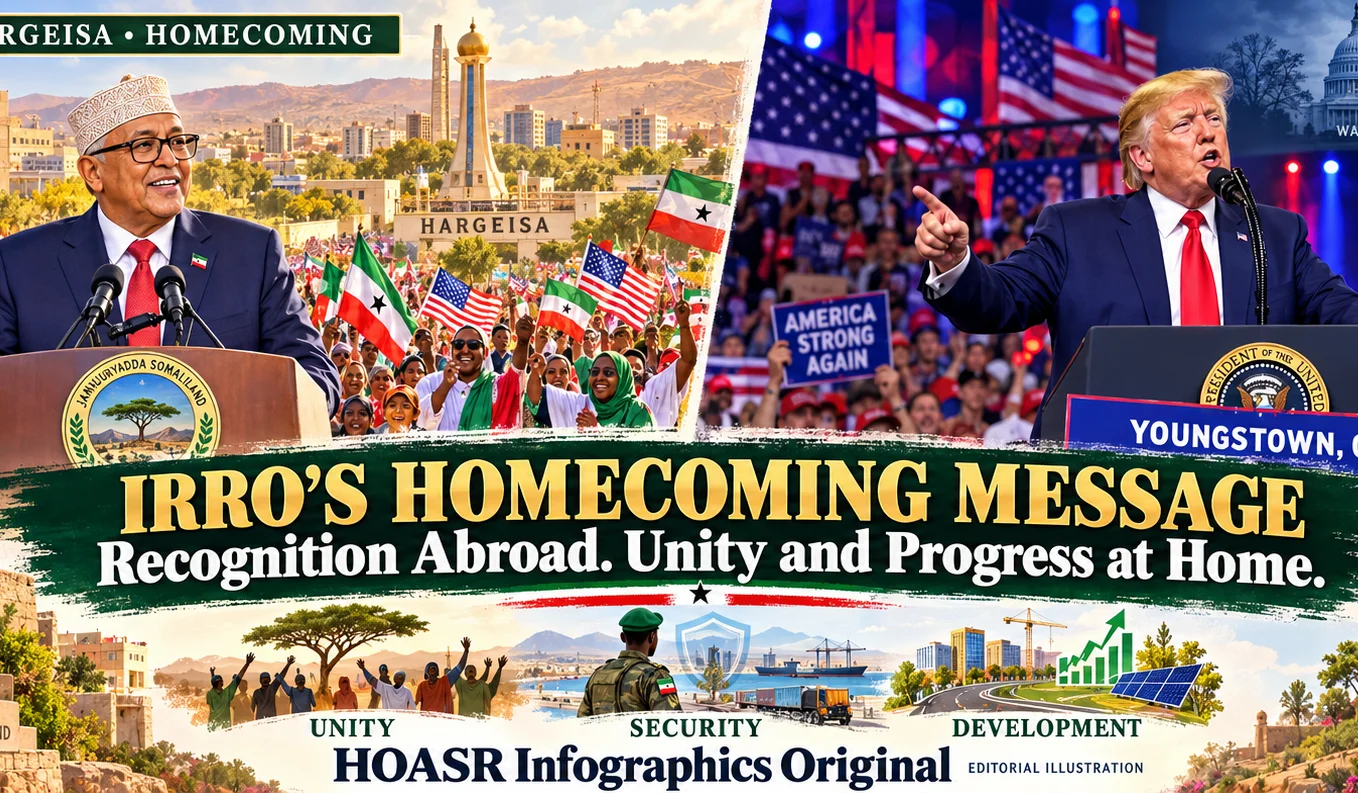
Recognition abroad, unity and progress at home: an original HOASR editorial illustration connecting Irro’s homecoming message with Trump’s distinction between Somaliland and Somalia.
HOASR Front Page Editorial
President Abdirahman Mohamed Abdullahi Irro’s homecoming speech gave Somalilanders a substantive answer to the questions surrounding his weeks abroad. He described diplomatic work, important channels of communication and commitments affecting the country’s security and development.
In HOASR’s assessment, the speech provided credible grounds to reject the sweeping claim that the journey amounted to a prolonged holiday and a collection of photographs.
The public was entitled to ask what its president was doing. His account deserved a fair hearing in return. Engagement with the White House, the American defense establishment, both houses of Congress and influential policy institutions represents meaningful work in a recognition campaign.
These relationships take time to develop, but their value cannot reasonably be dismissed simply because recognition did not arrive with the returning delegation.
Irro’s appreciation of President Donald Trump’s distinction between Somaliland and Somalia captured the political importance of the moment. Somalilanders have spent decades explaining that difference.
Hearing it acknowledged by an American president strengthens their confidence that the argument is reaching further. Irro’s tribute to Senator Ted Cruz also recognized the sustained advocacy behind this opening.
Somalilanders welcomed Trump’s rally remarks with celebrations in the streets of Hargeisa. Trump’s remarks were a significant political encouragement; formal American recognition remains an objective. Irro returned with an account of stronger access and opportunities for cooperation. That itself is progress worth acknowledging on its own merits.
The deeper importance of the speech was its connection between recognition abroad and national strength at home. Somaliland’s diplomatic case rests partly on what Somalilanders have built and continue to preserve: functioning institutions, peaceful political competition and the capacity to manage their own affairs.
In fact, the recognition campaign runs through the country’s daily life as well as through foreign capitals.
That connection gave weight to Irro’s warning against governments undermining Somaliland’s independence and sovereignty. His affirmation that Somaliland would defend itself and its citizens expressed a responsibility the public expects its president to uphold.
His commitments to modern equipment, improved salaries and benefits for the army and police brought that responsibility into the domestic national agenda.
The UAE commitments gave the homecoming another practical dimension. Four technical schools and renewed movement towards the Burao hospital speak directly to families concerned about employment, skills and healthcare.
Irro acknowledged that he had requested six schools and secured four: the public heard what he said had been obtained and what remained unfinished.
These are commitments whose fulfillment lies ahead. Their inclusion nevertheless gave Somalilanders a clearer explanation of how foreign relationships can serve their communities.
Recognition gains public strength when diplomacy also creates opportunities for young people, improves essential services and supports the institutions protecting the country.
Irro’s acknowledgment of rising prices was equally necessary. Families can care deeply about sovereignty while struggling to afford basic needs. National ambition does not suspend household hardship.
His promise to address those pressures placed public welfare within the same national discussion as diplomacy and defense.
The president’s appeal for peace and unity deserves support. So does his commitment to consultation with opposition parties and other sections of society.
Somalilanders can share an unwavering defense of their country while disagreeing over government decisions or policies. Open debate strengthens the national cause when political leaders conduct it responsibly and citizens remain free to demand answers.
Somalilanders understand the central message of the homecoming address. The recognition campaign and the domestic agenda depend on each other. Diplomatic openings gain lasting value when the country behind them remains peaceful, united, secure and confident.
Public confidence grows when citizens understand the work being done in their name and see its benefits taking shape.
The Scoop
HOASR’s reading of Irro’s homecoming is positive. His speech gave a credible account of work undertaken for Somaliland and connected that effort to the country’s domestic concerns. The sweeping claim that the trip was merely a holiday and a photo opportunity became harder to sustain.
President Irro returned with an account that gave Somalilanders reason for encouragement. The speech clarified the purpose of his absence and brought recognition, defense, development and household welfare into one national argument.
The blanket dismissal of the trip as a holiday no longer offers a fair account of the work he described.
The next chapter belongs at home as much as abroad. Somaliland’s pursuit of recognition draws strength from its people, their institutions and their determination to preserve their country.
Irro’s homecoming message recognized that connection. It deserves support—and a public record measured by the progress that follows.
Prof. Nassir Hussein Kahin is a researcher, educator, journalist, and geopolitical analyst specializing in the Horn of Africa, the Red Sea, international law, diplomacy, and strategic affairs. To read Full Bio click on this link: ABOUT THE AUTHORProf. Nassir Hussein Kahin