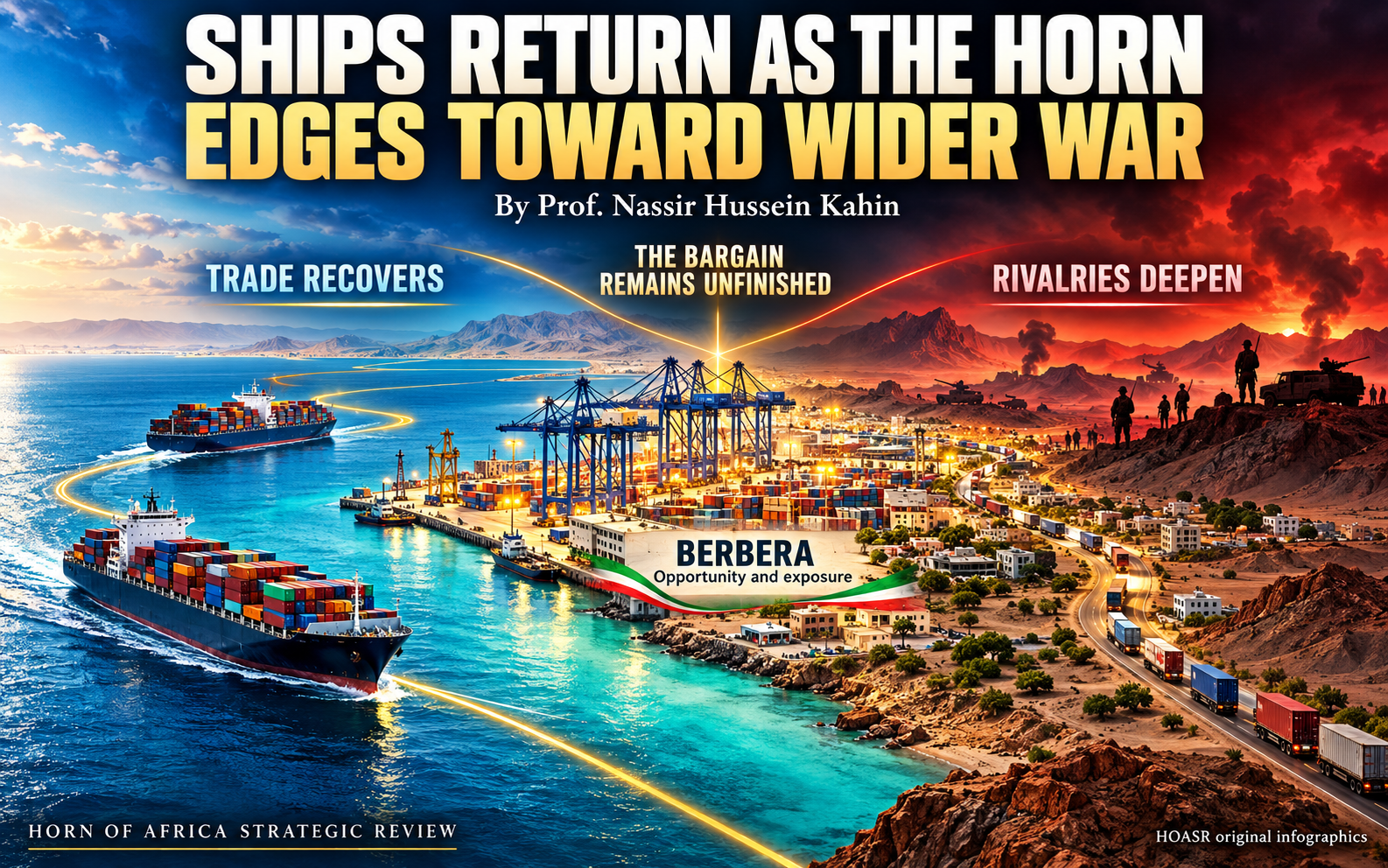
Trade recovers as rivalries deepen. Berbera’s growing strategic importance brings both opportunity and exposure. Credit: HOASR original infographics
Recovering shipping traffic and deepening regional rivalries are drawing Somaliland into a larger contest over Ethiopian access
The Red Sea is recovering some of its shipping traffic just as the African shore is becoming more dangerous. Cargo is returning to a corridor whose surrounding governments are moving deeper into confrontation. Ethiopia’s northern war, Egypt’s widening security commitments and Somaliland’s closer exchanges with Addis Ababa now intersect around the same maritime economy. The commercial recovery has given the region more to lose.
Berbera sits inside that contradiction. Its value rises as Ethiopia looks for additional gateways and outside powers compete for influence. Yet the conflicts increasing its strategic importance also threaten the trade on which its commercial promise rests. A port can become more desirable on the diplomatic map while becoming harder to reach from its intended market.
Ships are returning to an unsettled corridor
Lloyd’s List Intelligence reported on 15 October that September transits through Suez were 21 per cent above the same month a year earlier, while Bab el-Mandeb transits were up 16 per cent. Both remained well below levels before the Houthi shipping crisis. Container services accounted for part of the recovery, while bulk-carrier momentum weakened. The figures describe September traffic, before the latest October escalation had fully unfolded. Lloyd’s List Intelligence, 15 October
That uneven recovery complicates the familiar picture of a Red Sea simply closing down. Some businesses have judged that a return makes commercial sense despite continuing danger. Their calculations remain exposed to attacks, insurance costs and another sudden deterioration. An improving traffic count can coexist with a worsening strategic outlook.
For Egypt, movement through Suez carries direct economic importance. For Ethiopia, dependable access affects the cost and security of international trade. For Somaliland, greater activity brings the prospect of more business through Berbera. These interests overlap, but the governments pursuing them increasingly disagree over who controls access and who has authority to negotiate it.
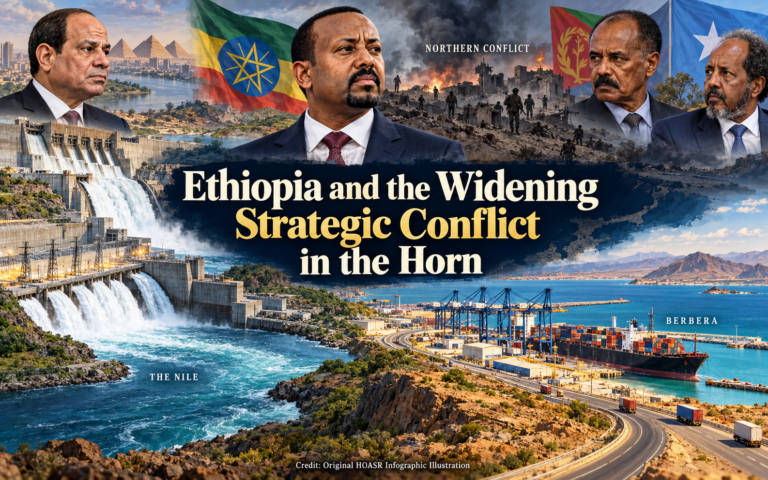
The northern war is changing the meaning of sea access
Reuters reported on 13 October that Ethiopian government forces had reached Zalambessa on the Eritrean border. Addis Ababa accused Eritrea of incursions, while Asmara denied the allegations and sought action at the United Nations. The northern campaign was already entering a diplomatic confrontation between states. Ethiopia’s maritime ambitions give that confrontation an additional source of suspicion. Reuters, 13 October
Critical Threats’ 15 October assessment examines the risk of further border conflict and the constraints on a larger Ethiopian operation. Its forecast remains an analytical judgement. The importance of the assessment lies in how it connects military movements with the political arguments surrounding them. Advances inside Tigray can acquire a different meaning when Eritrea reads them against Ethiopia’s declared interest in access to the sea. Critical Threats, 15 October
Lesley Anne Warner’s Just Security analysis explains why this conflict differs from 2020–2022. Tigray is divided, former partners have changed sides, and opposition groups bring different grievances into their struggle against Abiy Ahmed. Domestic fragmentation creates openings for regional rivals. The result is a war whose consequences can spread beyond the territory where its battles are being fought. Just Security, 14 October
Egypt is engaged on both sides of the water
Egypt’s National Defense Council pledged support for Saudi Arabia on 18 October and linked Saudi security with Egyptian and Arab security. It also called for diplomatic efforts to reduce regional tensions. The statement places Cairo more visibly inside the response to the Saudi–Houthi confrontation. It leaves the form and extent of any resulting military involvement unresolved. Egyptian Presidency, 18 October
Two weeks earlier, Cairo joined Eritrea, Somalia and Sudan in the El Alamein declaration. Their statement combined opposition to Somaliland’s recognition with positions on Nile waters and Red Sea governance. Egypt is therefore operating across connected disputes: supporting a Gulf partner facing attacks while strengthening coordination with African governments concerned about Ethiopian power and Somaliland’s diplomatic standing. El Alamein Joint Declaration, 4 October
These relationships do not carry identical obligations. Their political effect can nevertheless accumulate. Ethiopia encounters pressure over the Nile, suspicion over maritime access and a hostile interpretation of its northern campaign. Somaliland encounters opposition to recognition within the same regional conversation. Cairo’s diplomacy has made the two countries’ separate disputes easier to understand as parts of a wider struggle over influence.
Hargeisa and Addis Ababa are drawing closer under pressure
Against that background, Somaliland’s foreign minister said in an interview reported on 12 October that Hargeisa was ready to discuss Ethiopian coastal access and greater use of Berbera. He described Ethiopia and the UAE as close partners. No implementation timetable accompanied the remarks. The offer nevertheless kept a Somaliland route publicly available while Ethiopia’s relations with Eritrea deteriorated. Horn Diplomat, 12 October
Military contacts gave the relationship another dimension. Horn Diplomat’s 14 October report, citing Somaliland’s army, described talks between its commander and Ethiopian diplomatic and defence representatives. Irro then publicly opposed interference threatening Ethiopia’s stability. The sequence placed an existing security relationship beside a presidential declaration of political solidarity. Defence talks, 14 October | Irro’s remarks, 15 October
The significance lies in the timing. El Alamein gathered opposition to Somaliland’s recognition into a framework that also touched Ethiopian interests. Hargeisa’s subsequent exchanges with Addis Ababa showed that the countries facing that pressure retained their own channels of cooperation. In HOASR’s reading, the summit increased the political value of a relationship that already had practical foundations.
Irro defends Abby
Ethiopia is still weighing two security relationships
The exchange between Ethiopia’s ambassador to Israel and Somaliland’s envoy reveals how far this convergence still falls short of a common policy. Reports published on 16 October described the Ethiopian ambassador warning that recognition could prompt Mogadishu to demand Ethiopian troop withdrawal and create security risks. Mohamed Hagi disputed that assessment, arguing that recognition would strengthen Ethiopia’s position. The disagreement exposed an unresolved Ethiopian calculation. Somalilandpost, 16 October
Addis Ababa is weighing two relationships with different immediate returns. Its military presence in Somalia forms part of its current security position. Somaliland offers the prospect of an additional maritime partnership and a closer political alignment. A recognition decision would change the balance between those relationships, with consequences extending beyond the port question.
This helps explain why visible warmth can coexist with hesitation. Somaliland’s strategic usefulness does not automatically settle Ethiopia’s concerns about Mogadishu. Nor does the pressure of the northern war necessarily make a large diplomatic decision easier. Crisis can increase a government’s interest in an alternative while reducing its freedom to pursue it.
Israel and the UAE bring different stakes to Berbera
The Emirati connection has a commercial foundation. DP World’s account of the Berbera Economic Zone places the port and its facilities within a corridor toward Ethiopia. That infrastructure predates the October confrontation. Its presence means the debate concerns an existing investment whose wider return depends partly on the movement of Ethiopian trade. DP World on the Berbera Economic Zone
Israel approaches the relationship through a different combination of interests. During Irro’s June state visit, President Isaac Herzog publicly connected the partnership with maritime freedom and regional stability. Recognition has given the relationship a diplomatic standing that Ethiopia has not yet extended. The partners around Somaliland consequently occupy different positions even where their interests overlap. Israeli Presidency, 14 June
That difference makes the emerging network more complicated than a single camp confronting another camp. A port investor, a recognising state and a neighbouring government considering its maritime options are engaged for different reasons. Their connections can reinforce one another without producing a shared timetable or a common defence obligation. The strategic alignment remains a process shaped by separate national decisions.
The Scoop the recovery and the rivalry are moving together
The developing story is that commerce and regional politics are moving at different speeds. Ships have returned to parts of the Red Sea trading system, while governments around it have become more suspicious of one another. The recovery has increased the economic stake in stability. The struggle over access has made that stability harder to secure.
Somaliland’s place in this contest is becoming clearer. Berbera links Ethiopia’s search for alternatives with Emirati investment and Israel’s interest in a dependable regional partner. Hargeisa also carries its own unresolved claim to wider recognition. Those interests meet at the same port, but they have yet to become the same bargain.
That is the tension beneath the latest meetings and declarations. The pressure intended to limit Somaliland’s choices is also increasing the value of its Ethiopian connection. Yet a wider war could damage the commercial relationship that makes that connection attractive. Berbera’s growing importance is therefore both an opportunity and an exposure.
The shipping recovery shows what the region stands to regain. The northern battlefield shows how quickly it could lose it. Between them sits Somaliland, more central to the regional calculation than before, while the political decisions surrounding its coast remain unfinished.

Prof. Nassir Hussein Kahin is a researcher, educator, journalist, and geopolitical analyst specializing in the Horn of Africa, the Red Sea, international law, diplomacy, and strategic affairs. To read Full Bio click on this link: ABOUT THE AUTHORProf. Nassir Hussein Kahin