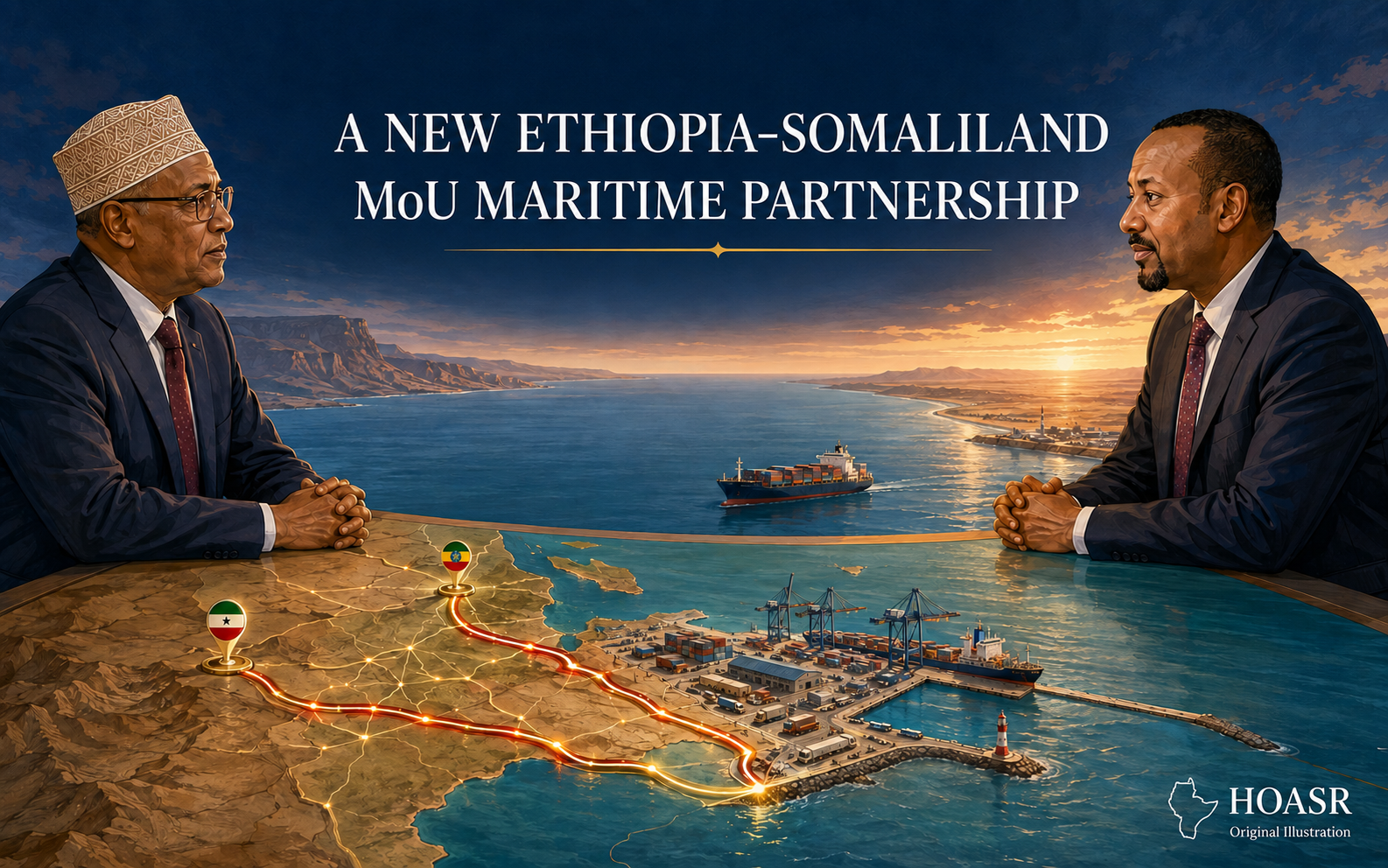
President Irro and Prime Minister Abiy Ahmed face each other over Berbera, where Ethiopia’s search for maritime access meets Somaliland’s stronger case for recognition.
The Ethiopia–Somaliland MoU should remain alive. But its future lies in a practical Berbera corridor, open commitments and Somaliland’s recognition—not in brinkmanship, secret clauses or a new contest over military base.
A new paper by the Middle East Media Research Institute (MEMRI) argues that Ethiopia and Somaliland need strategy, not an ultimatum. MEMRI is a Washington-based research institute that monitors and translates media and political discourse from the Middle East and surrounding regions. Its president, Yigal Carmon, writes from a clear regional-security perspective: he sees Somaliland and Ethiopia as potentially useful partners in a Red Sea order increasingly shaped by conflict, maritime insecurity and great-power rivalry. Readers should bear that perspective in mind. It does not invalidate his argument, but it explains why his paper gives priority to strategic alignment and recognition.
His central point is still worth taking seriously. The January 2024 Ethiopia–Somaliland MoU should not be buried simply because it provoked Mogadishu, worried neighboring states and later became entangled in Ethiopia’s talks with Somalia. It opened a direct conversation between a landlocked regional power seeking more maritime options and a self-governing country seeking recognition, investment and a larger international role.
The MoU’s problem was not its purpose
Ethiopia’s maritime ambition is neither new nor irrational. Its dependence on Djibouti for most seaborne trade is a strategic vulnerability. Addis Ababa has every reason to seek commercial alternatives through a policy of corridor pluralism: Djibouti, Berbera, Lamu, Port Sudan when conditions permit, and other routes where they make economic sense. That is not a threat to Somalia or any other neighbor. It becomes dangerous only when access is presented as an entitlement to another country’s territory or when it is pursued through pressure rather than agreement.
HOASR has consistently made this distinction. Berbera should be one link in a wider network, not a replacement for every port or waterway. Its strength lies in what it can do: serve as a logistics and distribution center, provide an entry route to eastern Ethiopia, support warehousing and cold-chain investment, and strengthen Somaliland’s role in a Red Sea–Gulf commercial corridor. In 2021, DP World and Ethiopia signed a cooperation agreement envisaging investment in Berbera Corridor logistics and supply-chain infrastructure. That commercial record matters more than dramatic, but unverified claims about railway projects or immediate military transformation.
The original MoU was weakened by uncertainty. Its full text was never published. Public reporting referred to a coastal lease, commercial access, possible naval facilities and prospective recognition, but the obligations and timetable were not openly settled. Contemporary reporting reflected that lack of clarity. It allowed opponents to define the agreement before the two signatories did. Somalia declared it invalid; Ethiopia left the recognition question unclear; and Somalilanders were entitled to ask what, precisely, had been promised and when.
Somaliland is negotiating from a different position now
The political setting is no longer the same as it was in January 2024. Since then, Israel’s recognition of Somaliland has changed the diplomatic atmosphere. It does not automatically deliver broad international recognition, nor does it remove the need for patient diplomacy. But it ends with the old assumption that Somaliland must accept vague strategic promises because no state will take the recognition step. A state that has secured recognition from Israel enters future discussions with greater confidence, wider diplomatic reach and a stronger case that its status can no longer be postponed indefinitely.
That should shape Somaliland’s approach to Ethiopia. Hargeisa has no reason to abandon the MoU or diminish Ethiopia’s legitimate commercial interest in Berbera. But it also has no reason to accept an agreement whose political return remains permanently deferred. The next negotiation should be firmer and more balanced: Ethiopia receives defined and secure commercial access; Somaliland receives a clear pathway toward recognition, investment and normal state-to-state relations.
This is not the case for an ultimatum. It is a case for maturity. Somaliland’s best leverage is not to threaten Ethiopia, but to demonstrate that Berbera is a dependable, commercially useful and politically serious partner. Ethiopia’s best response is to show that it does not view Somaliland merely as a bargaining instrument in its relationship with Mogadishu.
A commercial-first Berbera
Berbera must remain on a commercial and civilian project first. Somaliland should not turn its coast into an opaque foreign base because outside powers are competing in the Red Sea. Any security cooperation should be narrow, public, and subject to Somaliland’s law. It should state duration, jurisdiction, environmental obligations, jobs, training, and concrete public benefits. Recognition must not be exchanged for indefinite military dependence or unpublished land commitments.
The same standard should apply to Ethiopia. A productive Berbera partnership would start with the less glamorous but more important work: customs systems, roads, dry ports, cargo handling, storage, insurance, freight links and predictable border rules. These are the building blocks that make a corridor real. They also create jobs and give Somaliland a durable stake in regional commerce instead of leaving it exposed to the politics of foreign basing.
An agreement needs a public road map
The way forward is straightforward. Ethiopia and Somaliland should preserve the MoU but issue a joint implementation road map. It should separate commercial access, corridor investment, port operations, maritime safety, and diplomatic recognition into clear workstreams. Each should have dates, responsible institutions, and a means of public verification.
Recognition requires particular clarity. Somaliland should insist that any Ethiopian commitment be written, specific and time bound. Ethiopia, equally, needs transparency on the commercial terms of access and on the protections available to its investments. That is how a memorandum becomes a functioning partnership rather than a source of permanent suspicion.
The Ankara Declaration helped lower tensions between Ethiopia and Somalia. That was welcome. No one in Somaliland should want another Horn crisis. Yet Ankara did not erase Somaliland’s separate political reality, nor did it settle Ethiopia’s need for diversified sea access. Ethiopia’s dialogue with Mogadishu should continue; it should not require Hargeisa to disappear from the region’s political map.
The real test
MEMRI is right that a broader campaign for Somaliland’s recognition matters. But international advocacy will be more credible when it is tied to a disciplined bilateral relationship: open agreements, commercial viability, civilian benefit, sovereign control and mutual obligations. Somaliland should welcome partnerships, but it must not become a proxy, or a piece of territory others discuss without it.
The MoU remains valuable because it recognized a real convergence of interest between Ethiopia and Somaliland. Its next version should reflect a changed Somaliland: one with a stronger diplomatic position, a clearer understanding of the risks of secret strategic bargains, and a growing role in Red Sea commerce. Ethiopia can gain a trusted route to the sea. Somaliland can gain investment, connectivity, and recognition. But neither outcome will come from ambiguity. For further insight read my related post: Ethiopia’s Maritime Doctrine and the Somaliland Test: Cooperation, Recognition or Regional Hegemony?

Founder, publisher& Managing Editor of HOASR