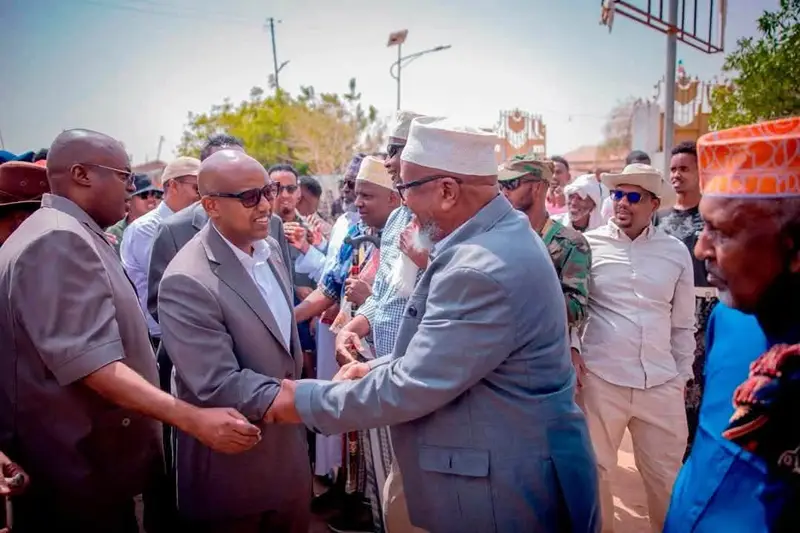
Odweine welcomes the Minister of the Presidency, H.E. Khadar Jama and his entourage
The recent regional tour led by the Minister of the Presidency, H.E. Khadar Jama, has drawn public attention not for its achievements, but for what it reveals about the current state of Somaliland’s governance.
A minister whose legal mandate is fundamentally administrative, overseeing staff management, logistical coordination, financial expenditures, and the scheduling of presidential appointments, appeared in the regions performing duties that traditionally and constitutionally belong to the Head of State.
His speeches in Berbera, Sheikh, Burao, and Odweine carried the tone, posture, and authority of presidential communication, yet he offered no indication that he was conveying an official message from the President.
In any constitutional system, such ambiguity is more than a procedural misstep; it is a blurring of institutional boundaries that should remain clearly defined.
Compounding public concern was the scale of the delegation accompanying him. Nearly eighty individuals, including the full security detail typically reserved for the presidency, traveled with the minister.
In a country where public resources are limited, where development projects often stall due to funding constraints, and where citizens are asked to shoulder economic hardship, such an expansive entourage raises legitimate questions about fiscal discipline and administrative judgment.
Every vehicle, guard, hotel room, and per diem represents public expenditure. For a minister whose role is not executive but supportive, this level of expenditure is difficult to justify.
Citizens across the regions noticed the symbolism. They saw a minister moving, speaking, and presenting himself in a manner indistinguishable from the presidency, while the actual President remained absent from the public stage. Somaliland’s political stability relies on clarity of roles and respect for constitutional limits.
When ministers begin to occupy spaces reserved for the Head of State, even unintentionally, it signals a drift in institutional discipline.
It suggests either a presidency that is not fully engaged or an administrative environment in which proximity to power allows individuals to operate beyond their formal mandate.
For the people of Odweine, the visit carried an additional layer of frustration.
Since 1960, they have witnessed a long succession of delegations arriving with speeches, lay ceremonial foundation stones, and promises that fade as soon as the convoy departs.
They have heard the same assurances for more than half a century —declarations of
development, commitments to progress, and pledges of government attention, yet tangible results remain scarce.
Understandably, they have grown weary of being treated as a backdrop for political performance rather than as a community deserving sustained investment and follow-through.
Minister Khadar’s large delegation and presidential-style address fit neatly into this historical pattern.
To many, it appeared less like governance and more like political theatre, costly, unnecessary, and lacking substantive outcomes.
It reinforced the perception that the government is increasingly focused on appearances rather than
delivery, on tours rather than implementation, and on symbolic gestures rather than constitutional adherence.
Somaliland cannot afford such institutional drift. It cannot afford a political environment in which ministers assume presidential roles, nor can it sustain the wasteful spending of public funds on delegations that produce little more than speeches.
The people deserve leadership that communicates with them directly, respects
constitutional responsibilities, and delivers measurable results.
Until that standard is restored, delegations will continue to travel, speeches will continue to echo, and Odweine will continue to wait as it has waited for more than sixty year.
Opinion & Analysis
Opinion & Analysis features expert commentary, thought-provoking perspectives, and in-depth analysis of the political, economic, diplomatic, security, and strategic issues shaping Somaliland, the Horn of Africa, Africa, and the wider world. Articles in this section present informed opinions, interpret current events, assess policy developments, and explore emerging regional and global trends. While grounded in facts and evidence, the views expressed are those of the individual authors and contributors, encouraging informed debate and a deeper understanding of complex issues.
Ambassador Egal is a regular contributing writer for HOASR and the founder of Horn of Africa Herald, an independent digital newspaper