By Prof. Nassir Hussein Kahin
One of the most encouraging developments in geopolitical research is the moment when independent analysts, working separately and from different institutional perspectives, arrive at remarkably similar conclusions. Such convergence does not prove influence. Instead, it strengthens confidence that the underlying strategic trends are real.
The recent publication by Ethiopia’s Institute of Foreign Affairs (IFA), Operational Recognition: Somaliland and the Emerging Geopolitical Order, is one such example.
As one of Ethiopia’s leading foreign policy research institutions, the IFA has produced a thoughtful analysis of Somaliland’s evolving role in the Horn of Africa and the Red Sea region. While the paper does not represent official Ethiopian government policy, it reflects a growing recognition among regional strategic thinkers that Somaliland can no longer be understood solely through the traditional legal lens of recognition versus non-recognition.
Instead, the IFA introduces a compelling concept: operational recognition.
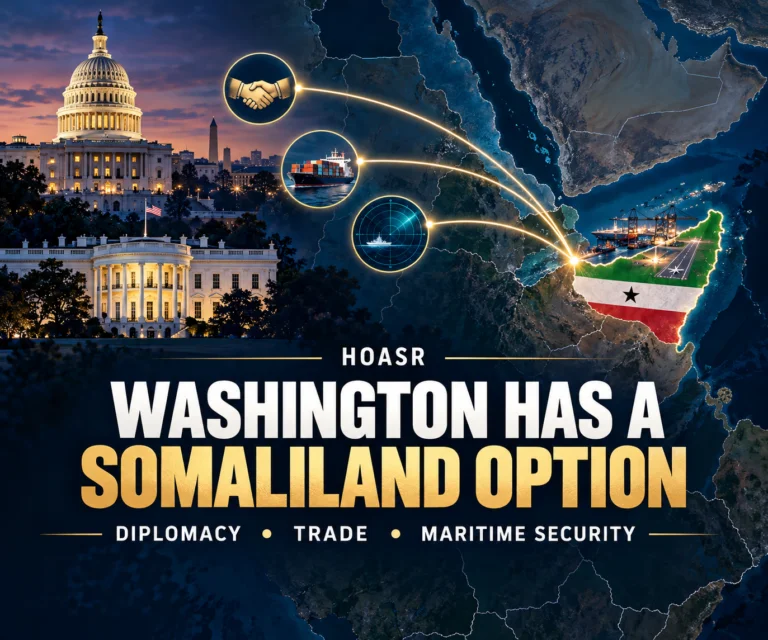
This describes a reality in which states increasingly engage Somaliland as a functioning strategic partner through diplomacy, security cooperation, trade, maritime affairs, infrastructure development, and investment—even in the absence of formal diplomatic recognition.
For readers of Horn of Africa Strategic Review, this argument will sound familiar.
Over the past several months, this publication has consistently argued that Somaliland’s geopolitical significance has begun to outpace the international legal debate surrounding its status. We have maintained that the strategic realities of the twenty-first century—particularly in the Red Sea, the Gulf of Aden, and the Bab el-Mandeb Strait—are steadily reshaping international engagement with Somaliland.
The IFA’s analysis independently reinforces that assessment.
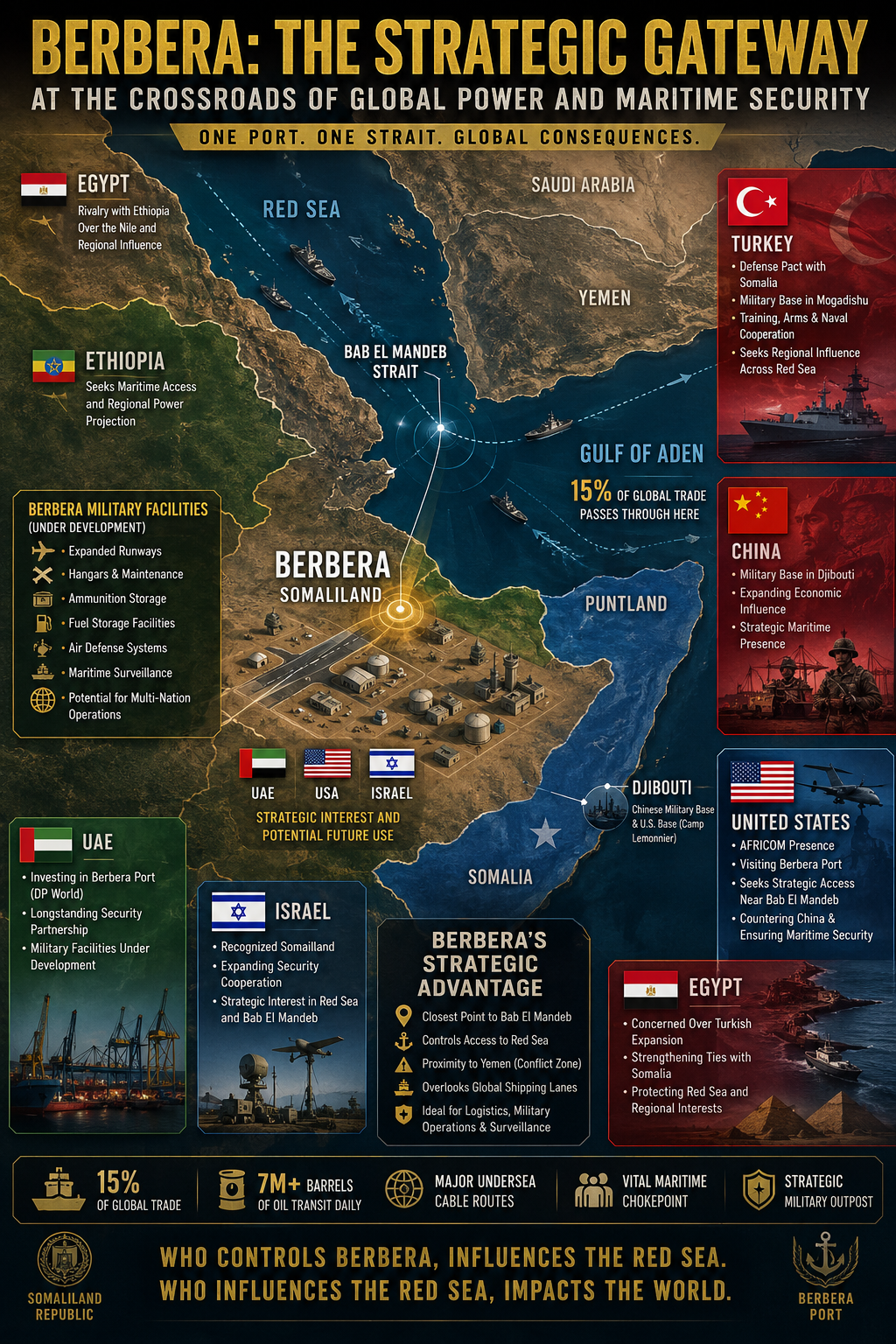
Perhaps the paper’s greatest contribution is its recognition that Berbera has evolved far beyond the role of a commercial port. Increasingly, Berbera represents strategic infrastructure with implications for Maritime Security, regional logistics, energy routes, humanitarian operations, and international trade. Geography, rather than diplomacy alone, is making Somaliland indispensable.
This has long been one of the central themes of our own geopolitical analysis.
In numerous articles, we have argued that Somaliland’s location at one of the world’s most strategically important maritime chokepoints naturally attracts the interests of regional and global powers. Whether the issue is maritime security, commercial shipping, counter-piracy, naval logistics, or supply-chain resilience, Somaliland occupies a position that cannot be ignored indefinitely.
The IFA arrives at essentially the same conclusion from its own analytical perspective.
The institute also correctly places Somaliland within the broader context of intensifying geopolitical competition involving Ethiopia, Somalia, Turkey, Egypt, Gulf states, and other international actors. This reflects another argument consistently advanced in these pages: that Somaliland is no longer simply part of a bilateral dispute with Somalia. It has become an increasingly important variable in the wider strategic competition shaping the future of the Horn of Africa and the Red Sea.
As international competition intensifies, Somaliland’s stability, democratic governance, and strategic geography become assets of growing importance.
Another important area of convergence concerns the nature of recognition itself.
For years, discussions about Somaliland have focused almost exclusively on formal diplomatic recognition. The IFA challenges this narrow approach by demonstrating that practical cooperation often develops before legal recognition. Security partnerships, commercial agreements, infrastructure investment, diplomatic exchanges, and institutional engagement can create a form of functional acceptance long before embassies are formally exchanged.
This closely mirrors an argument we have repeatedly made: recognition is increasingly a process rather than a single event.
International relations are filled with examples where strategic cooperation precedes formal diplomatic acknowledgment. Somaliland appears to be following a similar trajectory, as governments and institutions increasingly engage with it because doing so serves practical regional interests.
Where our analysis extends beyond the IFA paper is in considering the logical implications of this trend.
If operational recognition continues to expand, formal diplomatic recognition becomes less a question of principle than of timing and political decision-making. Once governments routinely cooperate with Somaliland across multiple sectors, the gap between geopolitical reality and official policy becomes increasingly difficult to sustain.
That does not mean recognition is inevitable or imminent. International diplomacy remains shaped by complex political calculations. However, it does suggest that the international conversation has evolved. The debate is no longer confined to historical legal arguments. It increasingly revolves around security, trade, regional stability, maritime strategy, infrastructure, and great-power competition.
The significance of the IFA paper therefore extends beyond Ethiopia.
It reflects a broader intellectual shift taking place across the region. Strategic institutions are beginning to evaluate Somaliland through the realities of geography, governance, and regional security rather than relying exclusively on inherited diplomatic assumptions.
This is precisely the direction in which serious geopolitical analysis should move.
Independent scholarship is most valuable when different analysts, working independently, identify the same emerging trends. The convergence between the IFA’s recent publication and many of the themes previously explored by Horn of Africa Strategic Review should therefore be welcomed—not as a matter of personal validation, but as evidence that Somaliland’s strategic transformation is increasingly being recognized by respected policy researchers across the region.
As the geopolitical landscape of the Horn of Africa continues to evolve, the concept of operational recognition may well become one of the defining frameworks for understanding Somaliland’s place in regional and international affairs.
The question facing policymakers is no longer whether Somaliland matters.
The evidence increasingly suggests that it already does.
The more pressing question is how long international diplomacy can continue to lag behind geopolitical reality.

Prof. Nassir Hussein Kahin is a researcher, educator, journalist, and geopolitical analyst specializing in the Horn of Africa, the Red Sea, international law, diplomacy, and strategic affairs. To read Full Bio click on this link: ABOUT THE AUTHORProf. Nassir Hussein Kahin