By Prof. Nassir Hussein Kahin
For nearly three decades, Al Jazeera established itself as one of the world’s most influential international news organizations. It earned a reputation for reporting stories often overlooked by Western media and for challenging dominant narratives in global affairs. Millions of viewers came to regard the network as an alternative voice willing to question power rather than merely echo it.
That reputation, however, carries an equally important responsibility.
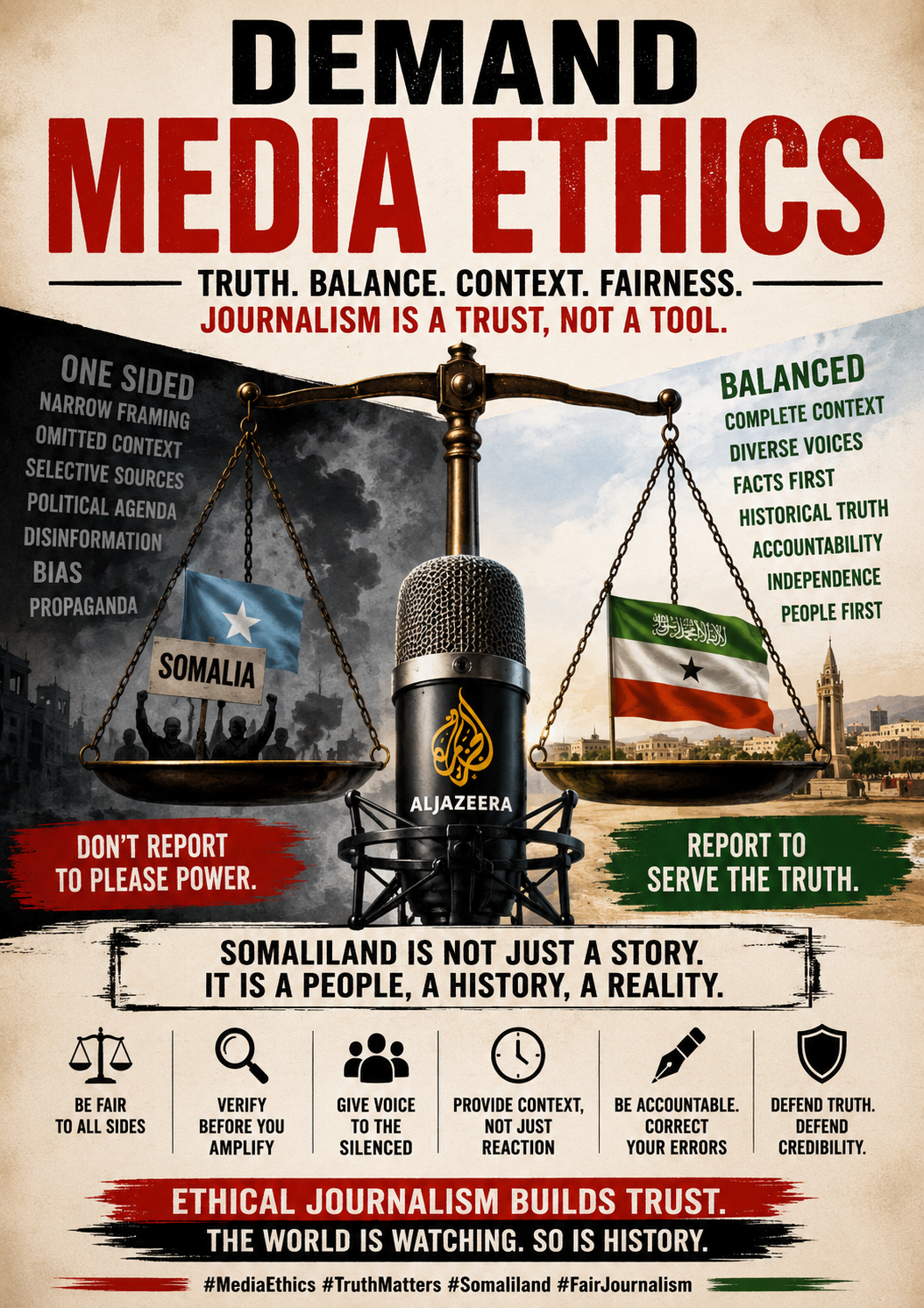
When reporting on politically sensitive conflicts involving disputed territories, competing historical claims, and international diplomacy, journalism must do more than report official statements. It must provide audiences with sufficient historical context, fairly represent competing legal and political arguments, and avoid allowing one narrative to become the default framework through which every subsequent event is interpreted.
It is against that standard that Al Jazeera’s recent coverage of Somaliland deserves careful scrutiny.
Over the past six months, particularly following Israel’s recognition of Somaliland and the subsequent diplomatic developments in the Horn of Africa, a discernible editorial pattern has emerged. While individual reports remain factually grounded, their cumulative framing consistently emphasizes Somalia’s sovereignty claims, Israel’s geopolitical ambitions, and the risks of regional instability, while giving comparatively limited attention to Somaliland’s historical, constitutional, and democratic case for restored sovereignty.
The question is therefore not whether Al Jazeera has reported inaccurate facts.
The question is whether its editorial framing has remained balanced.
When Headlines Shape the Narrative
Readers often absorb a story’s central message before reading the first paragraph.
Recent Al Jazeera headlines illustrate this phenomenon:
- “Israel fetes Somaliland’s leader as it seeks to expand Red Sea influence.”
- “What does Israel’s recognition of Somaliland mean for the region?”
- “Why Israel’s recognition of Somaliland backfired.”
Collectively, these headlines direct readers toward a particular interpretation of events. The dominant themes are Israeli strategy, geopolitical competition, and Somalia’s objections. Missing from these headlines is Somaliland’s own narrative: that it was an independent state in June 1960, entered a voluntary union with Somalia, experienced the collapse of that union through dictatorship and conflict, and restored its sovereignty in 1991.
The omission matters because framing determines how audiences understand political legitimacy.
If Somaliland is introduced primarily as “a breakaway region,” readers begin with the assumption that secession is the central issue. If it is introduced as a territory claiming the restoration of a previously sovereign state, readers are invited to consider a different historical and legal question.
Journalistic fairness requires presenting both frameworks.
The Power of Language
Language is never neutral.
Throughout its reporting, Al Jazeera consistently refers to Somaliland as a “breakaway region” or “self-declared republic.”
These descriptions are widely used by many international organizations and media outlets. Yet they represent only one perspective.
Rarely does Al Jazeera devote equivalent space to explaining that Somaliland was recognized by more than thirty states following its independence from Britain on 26 June 1960 before voluntarily entering union with the former Italian-administered Trust Territory of Somalia on 1 July 1960.
Likewise, comparatively little attention is given to the political collapse of that union, the atrocities committed under the military regime of Mohamed Siad Barre, or Somaliland’s restoration of its own governing institutions in 1991.
Without this context, audiences receive an incomplete picture of why Somaliland’s claim differs from many contemporary separatist movements.
Whose Voices Define the Story?
Balanced journalism depends not only on facts but also on whose voices are heard.
Across multiple reports, Somali government officials, African Union representatives, regional diplomats, and critics of Israel’s recognition receive extensive coverage.
Somaliland officials are quoted, but their constitutional and historical arguments often receive far less analytical treatment than Somalia’s position on territorial integrity.
The imbalance becomes even more evident in opinion coverage.
Al Jazeera published an opinion article by former Somali minister Abdi Aynte entitled Why Israel’s Recognition of Somaliland Backfired. The article presents a robust defence of Somalia’s position and argues that recognition has strengthened rather than weakened Mogadishu’s diplomatic standing.
Opinion journalism has every right to publish strongly argued viewpoints.
The question, however, is whether readers were offered an equivalent opinion from a Somaliland constitutional scholar, historian, diplomat, or former government official explaining Somaliland’s own legal and historical case.
A marketplace of ideas functions best when competing arguments receive comparable opportunities to be heard.
Geopolitics and Editorial Framing
No international broadcaster operates in a geopolitical vacuum.
Al Jazeera is funded by the State of Qatar while maintaining that its newsroom operates with editorial independence. Those two facts are not mutually exclusive.
Nevertheless, Qatar’s close strategic partnership with Turkey, combined with both countries’ longstanding political and security support for Somalia’s Federal Government, inevitably raises legitimate questions about whether regional foreign-policy priorities influence editorial emphasis.
Such questions are not unique to Al Jazeera.
Chinese state media frequently reflect Beijing’s positions on Taiwan and territorial sovereignty.
Turkish public broadcasters naturally reflect Ankara’s strategic interests.
Israeli media often frame developments through the lens of national security.
Western media may prioritize liberal democratic norms or great-power competition.
Recognizing these influences is not an accusation of propaganda. Rather, it is an acknowledgment that editorial framing often reflects institutional perspectives and national priorities.
The appropriate response is therefore not to demand identical reporting from every outlet but to encourage greater transparency, broader sourcing, and deeper historical context.
Why Somaliland Deserves More Than Simplified Narratives
For thirty-five years, Somaliland has maintained functioning institutions, conducted multiple elections, preserved relative stability, and developed one of the Horn of Africa’s most durable democratic systems.
Whether one supports or opposes its recognition, these realities deserve careful examination.
Reducing Somaliland primarily to an extension of Israel’s strategic ambitions or Somalia’s sovereignty dispute risks overlooking the agency of Somaliland’s own people and institutions.
Its political development cannot be understood solely through the foreign policies of Israel, Turkey, Qatar, Ethiopia, or Somalia.
Somaliland’s story predates all of those contemporary geopolitical rivalries.
Journalism Must Inform, Not Predetermine
Media organizations wield enormous influence over international understanding.
The words chosen in headlines, the sequence in which facts are presented, the experts selected for interviews, and the historical context included—or omitted—shape public opinion long before policymakers debate the issues.
This is precisely why balance remains journalism’s most valuable currency.
Fair reporting does not require accepting Somaliland’s claims uncritically.
Nor does it require rejecting Somalia’s arguments regarding territorial integrity.
It requires presenting both with equal intellectual seriousness.
As one of the world’s leading international broadcasters, Al Jazeera occupies a uniquely influential position in shaping global perceptions of the Horn of Africa.
With that influence comes an equally significant responsibility.
The Somaliland question is too important to be viewed through a single geopolitical lens.
Readers deserve reporting that explores history as thoroughly as current events, constitutional arguments as carefully as diplomatic protests, and Somaliland’s own voice as prominently as those who oppose its aspirations.
Only then can journalism fulfil its highest purpose—not to reinforce competing narratives, but to help audiences understand them.
In an era increasingly defined by geopolitical competition and information warfare, credibility is earned not through advocacy but through fairness.
For Al Jazeera, and indeed for every international news organization, balance is not merely a professional ideal.
It is the foundation upon which public trust is built.

Prof. Nassir Hussein Kahin is a researcher, educator, journalist, and geopolitical analyst specializing in the Horn of Africa, the Red Sea, international law, diplomacy, and strategic affairs. To read Full Bio click on this link: ABOUT THE AUTHORProf. Nassir Hussein Kahin