U.S. Aircraft Carriers on the Red Sea
By prof. Nassir Hussein Kahin political Analyst, International Affairs Writer and Managing Editor of hornofafricastrategicreview.com
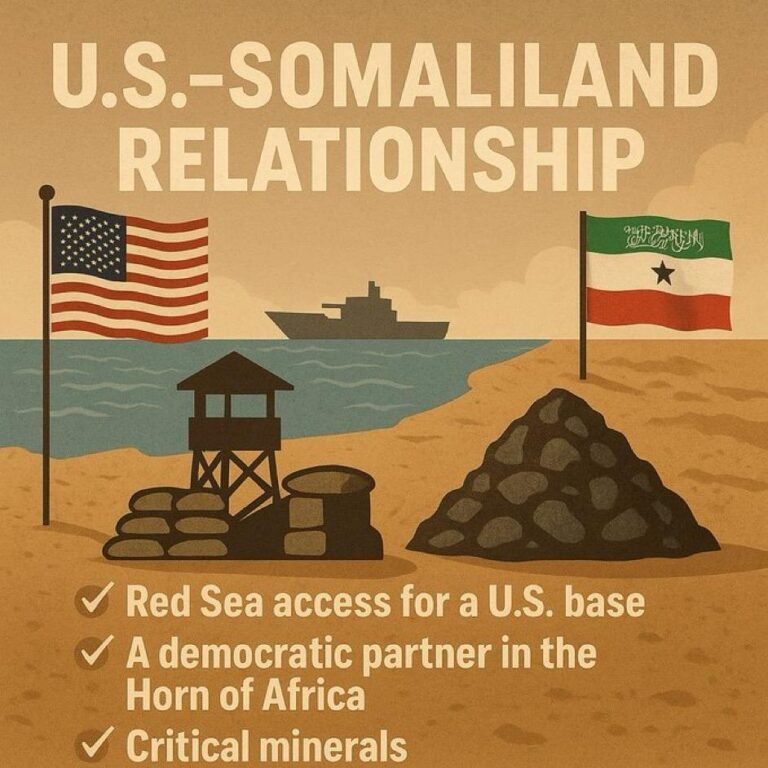
In a region beset by volatility and geopolitical power plays, Somaliland is making its most calculated and confident move yet. In a late July interview with Bloomberg News, President Abdirahman Mohamed Abdillahi “Cirro” reiterated a long-standing offer to the United States: a military base on Somaliland’s Red Sea coast. But this time, he added something new—and powerful—to the table: exclusive access to Somaliland’s critical mineral reserves.
Unlike past overtures, this latest offer does not demand U.S. diplomatic recognition of Somaliland’s 1991 declaration of independence. Instead, the government seeks security guarantees, economic and technical assistance, and support for institutional development. This pragmatic, high-stakes move aligns with global trends, where countries from Pakistan to Ukraine to the DRC have increasingly leveraged their real or claimed critical mineral wealth to secure Western backing.
As U.S. lawmakers consider including Somaliland in the 2026 foreign defense and security budget, this mineral-military offer—and the broader geopolitical context surrounding it—may prove too strategically significant to ignore.
A Region in Flux: Why Timing Matters
Somaliland’s bold offer comes amid growing doubts about the viability of U.S. policy in Somalia. Despite U.S. support, Somalia’s state-building project is unraveling. A recent Economist report described the central government’s collapse as terrorist groups regain territory and regional forces pull away from Mogadishu’s authority.
In this context, Somaliland’s stability, democratic governance, and geostrategic location present a compelling contrast. The U.S. State Department continues to endorse the “One Somalia” policy, as Bloomberg noted—but policies shift when realities do. A second Trump administration, should it materialize, may well see Somaliland as a more reliable long-term ally, especially compared to the fragile, divided Somalia.
Minerals, Military, and Maritime Leverage
Somaliland’s untapped mineral resources—including kaolin, feldspar, silica sand, granite, and dolomite—are vital for the global clean energy transition, semiconductor production, and military technologies. Somaliland has taken serious steps to prepare its sector for foreign investment, including:
- Developing a digitized Geological and Mineral Information Management System (GMIMS);
- Launching phased mineral mapping and exploration;
- Modernizing its mining laws and environmental standards;
- Training local communities, especially women and artisanal miners.
This isn’t speculation—it’s infrastructure. And it’s paired with military basing rights at one of the world’s most strategically vital maritime chokepoints: the Bab El-Mandeb Strait.
Such a deal gives the U.S. logistical access to the Red Sea, a secure mineral corridor, and a new outpost for counterterrorism and naval power projection—all from a stable, democratic partner.
The Egypt-Ethiopia Rift and the Somali-Ethiopia-Turkey Triangle
Yet, the geopolitics go deeper.
Somalia has relied heavily on Egypt and Eritrea over the past year to push back against Ethiopia’s unfulfilled MoU with Somaliland, which proposes partial recognition in exchange for port access and potential stakes in state companies. Egypt—one of the U.S.’s “Major Non-NATO Allies”—opposed this move strongly, fearing it would undermine Somalia’s sovereignty and weaken its own Red Sea influence.
However, Egypt’s recent rejection of a reported U.S. “Gaza–GERD quid pro quo” (wherein Egypt might host Gazan refugees in exchange for U.S. support over the Ethiopian dam dispute) has offended key players in Washington. In contrast, Ethiopia has left the door open to cooperation, including the possibility of supporting the Gaza plan if it comes with funding and broader multilateral buy-in.
This shift creates a rare diplomatic opening for Ethiopia and Somaliland. If managed strategically, the two could present a coordinated case to Washington—backed by their shared Emirati ally and an emerging partner: India.
A Multilateral Pathway to Recognition and Realignment
Instead of unilateral U.S. recognition of Somaliland—which remains politically delicate—the U.S. could coordinate a multilateral framework akin to the Abraham Accords. This could involve:
- Somaliland, Ethiopia, the UAE, India, and eventually others, like Kenya or Taiwan;
- Joint recognition or diplomatic normalization;
- A coordinated critical minerals and security corridor linking East Africa to global democracies.
India’s potential involvement would be particularly symbolic. With its interest in a naval base in the region and growing Indo-Pacific ambitions, India could join the U.S. in recognizing the world’s newest Democracy, alongside the world’s oldest and largest democracies.
Ethiopia could sweeten the deal further by offering its own critical minerals partnership with the U.S., creating a regional minerals hub that reduces dependence on Chinese sources.
Somaliland’s Diplomatic Pivot: A Realpolitik Masterstroke
President Cirro’s no-recognition-required offer puts the U.S. in a favorable position to act without overstepping diplomatic precedent. It provides:
- A military base at a critical maritime junction;
- A reliable minerals corridor with transparent data systems;
- A democratic ally aligned with Western interests;
- A pathway to reshape regional partnerships in a way that balances U.S. values and realpolitik.
Should Trump 2.0 return to the White House, and if Ethiopia and Somaliland coordinate their message carefully, Washington may be ready to shift course—from a failing Somalia to a rising Somaliland, and from an increasingly transactional Egypt to a more cooperative Ethiopia.
Conclusion: Somaliland Is Not Waiting—It’s Leading
At a time when the Horn of Africa is under intense global scrutiny, Somaliland is offering the United States a clear choice: continue investing in failing state projects and unreliable allies—or pivot to a partner that is stable, sovereign in practice, resource-rich, strategically located, and willing to cooperate without demanding too much, too soon.
This is no longer just about recognition. It’s about relevance, readiness, and realignment.
Editor’s Note: This article is part of our special series on the evolving balance of power in the Red Sea region. Upcoming features will explore Ethiopia’s diplomacy, the role of Taiwan in Somaliland’s rise, and the fate of the “One Somalia” policy.
Submit your comments below:
[user-submitted-posts]

Prof. Nassir Hussein Kahin is a researcher, educator, journalist, and geopolitical analyst specializing in the Horn of Africa, the Red Sea, international law, diplomacy, and strategic affairs. To read Full Bio click on this link: ABOUT THE AUTHORProf. Nassir Hussein Kahin