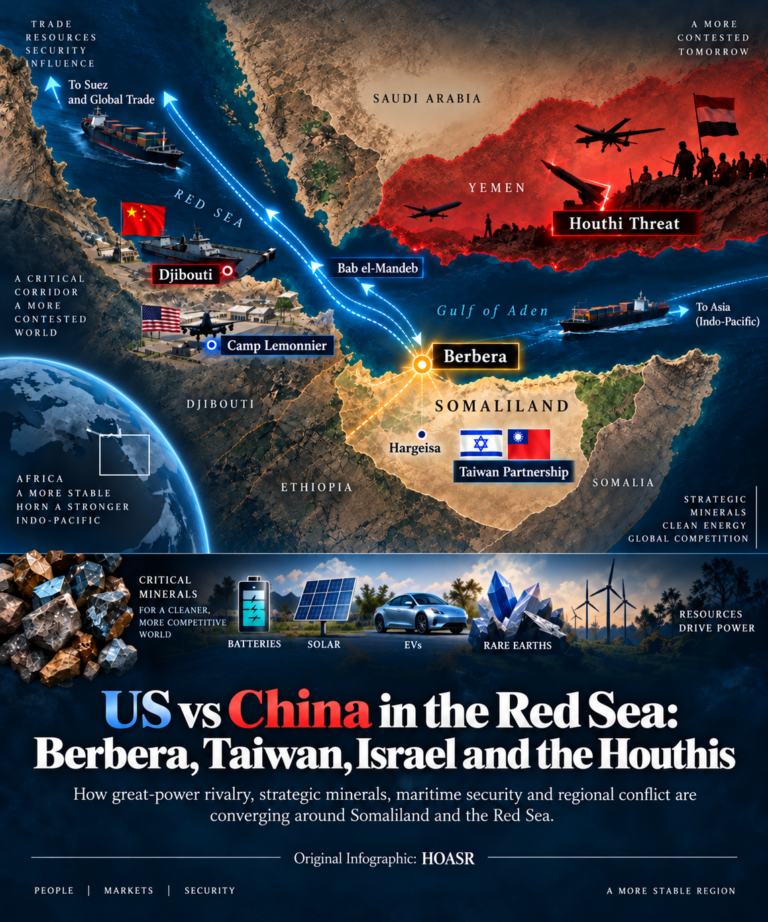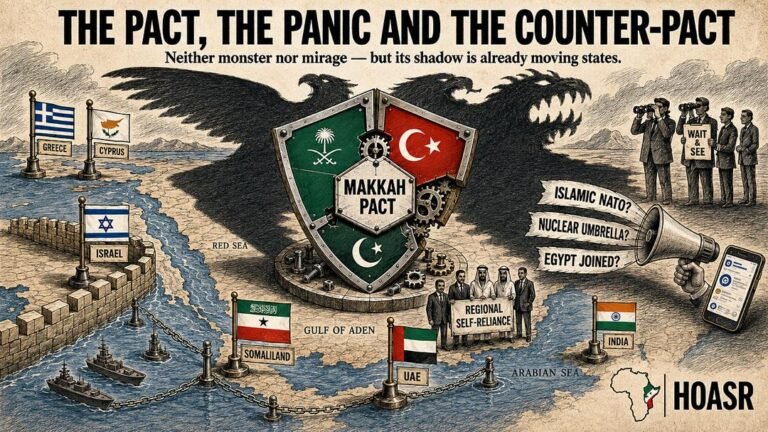
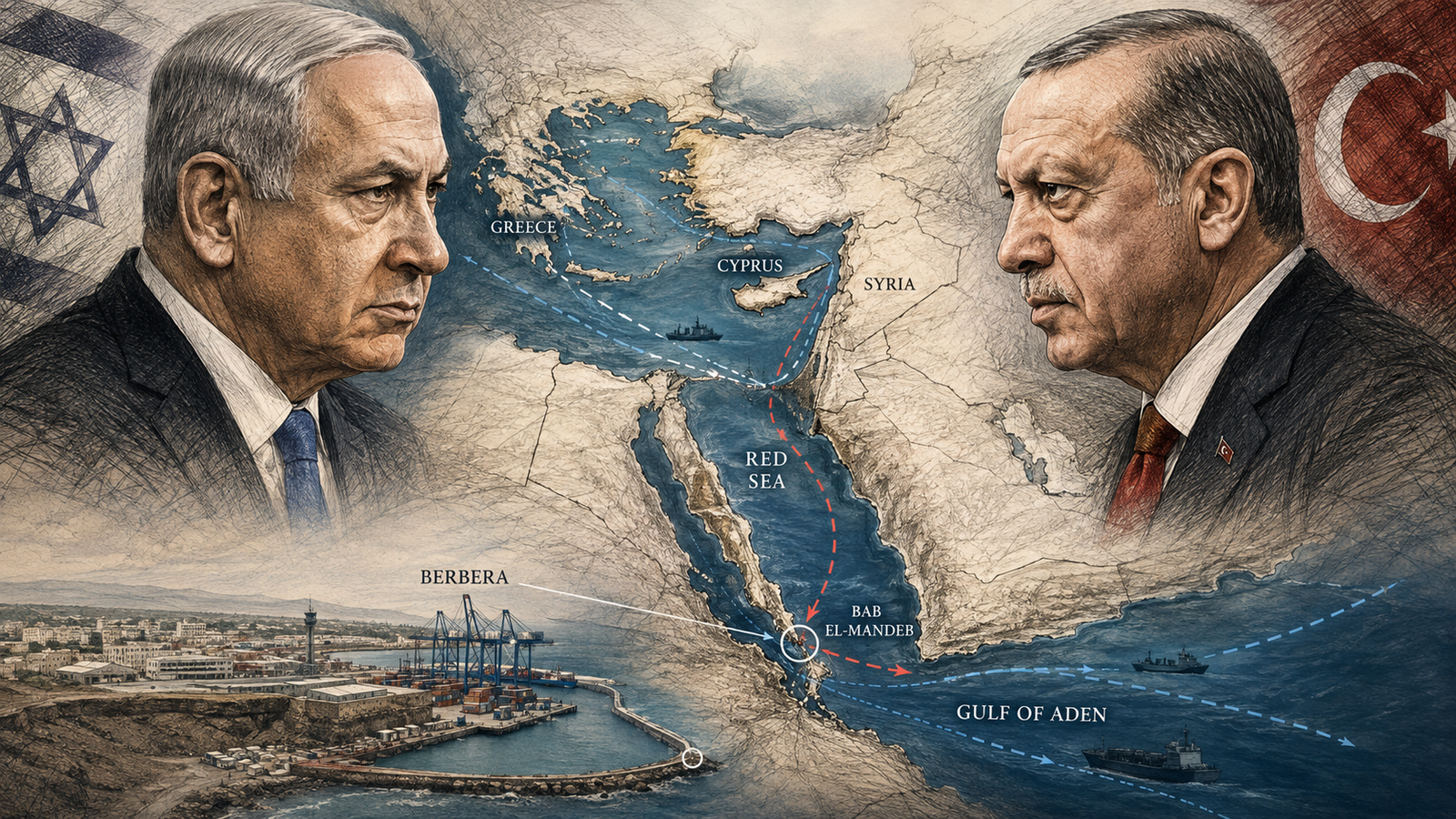
From the Eastern Mediterranean to the Horn of Africa, Israel and Türkiye are increasingly operating across interconnected strategic theatres stretching from Cyprus to Berbera and the Red Sea. HOASR original Infographic Art Work
Syria is now the immediate military fault line. The Makkah Agreement gives Ankara new collective-security depth, while Israel is strengthening a separate network through Greece, Cyprus, India, the UAE and Somaliland.The Israel-Türkiye rivalry is becoming harder to describe as a bilateral diplomatic quarrel. The map now runs from the Aegean and Eastern Mediterranean through Syria, the Red Sea and Bab el-Mandeb to Somalia and Somaliland.
This is not a clean division into rival camps. Greece and Türkiye remain NATO allies. Saudi Arabia is not a Turkish proxy. Israel’s ties with Greece and Cyprus do not create an automatic mutual-defence treaty. Yet a growing number of military, diplomatic and maritime arrangements are beginning to form one strategic picture.
Türkiye is adding strategic weight through Syria and Somalia, while the Makkah Agreement with Saudi Arabia and Pakistan is acquiring an institutional form. Israel, meanwhile, is deepening defence links with Greece and Cyprus, extending its strategic conversation toward India and the UAE, and turning recognition of Somaliland into a practical relationship. Syria is the immediate point of danger, but Berbera is increasingly part of the larger argument.
Syria is the most dangerous point of contact
On 18 August, Israeli strikes hit Syria’s Abu al-Duhur airbase. Reuters reported that Israel said Damascus was close to allowing a Turkish troop deployment there, while Ankara and Damascus rejected that interpretation. The public record does not establish that a permanent Turkish base was being created. It does establish that a possible Turkish military presence at the site had become strategically explosive.
A follow-up Reuters report said Washington was seeking to prevent an escalation and cited U.S. envoy Tom Barrack’s criticism of the strike as an unnecessary escalation. That is the core risk: Turkish personnel or infrastructure cannot be treated as interchangeable with the Iranian-linked militia targets Israel has confronted in Syria for years.
A sustained Turkish military role could constrain Israeli operational freedom even without a formal Israel-Türkiye war. Syria may therefore be where a competition over regional architecture first turns into direct deterrence.
Greece and Cyprus give Israel new western depth
On 31 August, Israel and Greece signed the approximately EUR3 billion Achilles Shield agreement. The Israeli Ministry of Defense says Israel will build a multilayered Greek air-defence architecture incorporating David’s Sling, SPYDER, BARAK MX and a national command-and-control system. It is the largest defence-export deal in the history of Israel-Greece relations.
The agreement is more than a sale. It embeds Israeli systems, training and industrial cooperation in the defence modernization of a state whose security relationship with Türkiye remains exceptionally sensitive. That does not make Israel a treaty guarantor of Greece, but it makes the bilateral relationship more operational.
Cyprus adds another layer. The Hellenic National Defence General Staff says the 2026 Greece-Cyprus-Israel Joint Action Plan includes joint operational activities, special-operations training, staff-level meetings and consultations. It is a dense defence partnership, not a public equivalent of NATO Article 5. That distinction matters, but so does the direction of travel.
The Makkah Agreement moves beyond symbolism
The first Strategic Political and Defence Committee meeting under the Makkah Agreement took place in Istanbul on 31 August. In their joint statement, Türkiye, Saudi Arabia and Pakistan agreed to establish a secretariat in Saudi Arabia, initially led by a Pakistani secretary-general for three years. They are also committed to joint activities, defence-industry cooperation, technology development and joint production.
The public statement did not announce a standing multinational force, a supreme commander or an integrated air-defence command. Nor does it say that every clash involving one member will automatically produce a military response by the others. But it does create a framework for interoperability and routine coordination. Those routines, rather than a dramatic treaty label, may be the agreement’s most consequential effect.
Saudi interests remain distinct from Türkiye’s. The communiqué does not name Israel, and Riyadh continues to balance concerns about Iran, the Houthis, Gulf infrastructure and Red Sea stability. Pakistan adds strategic weight, but it does not erase the members’ different priorities. The prudent reading is not an automatic anti-Israel axis; it is an emerging security mechanism whose future operational content remains to be seen.
The Recognition Front: Amichai Chikli’s Makkah Pact Warning Places Somaliland at the Centre of Israel’s Emerging Counter-Alignment
Somalia gives Türkiye entrenched depth in the Gulf of Aden
Türkiye’s Somalia position is not confined to a training mission. On 21 July, the Turkish parliament extended the Turkish Armed Forces’ Somalia mandate for a further two years. The official parliamentary account points to longstanding military training, advisory and security cooperation under bilateral agreements.
At sea, the footprint is visible. Anadolu Agency reported that TCG Goksu, TCG Gelibolu and TCG Bartin, assigned to the Somalia Naval Task Group, were escorting the Cagri Bey drilling ship and its support vessels off Somalia. Training, naval deployment, energy activity, commercial interests and political access give Ankara a deep institutional foothold on the southern approaches to the Red Sea.
That context is directly relevant to Somaliland. In a December statement, Türkiye’s Foreign Ministry rejected Israel’s recognition of Somaliland and reaffirmed its support for Somalia’s territorial integrity. The Somaliland question is therefore already part of the wider Israel-Türkiye competition, whether or not Hargeisa seeks that role.
Somaliland offers a different model: a node, not a fortress
Israel’s relationship with Somaliland has moved quickly since recognition. During President Abdirahman Mohamed Abdillahi’s June state visit, President Isaac Herzog linked the relationship to countering extremism, security in the Horn of Africa and protecting maritime freedom.
The defence dimension nevertheless needs precision. Reuters reported that Somaliland’s defence minister said Israel was providing training to police and military forces, while denying that talks on an Israeli military base were under way. The distinction is central to responsible policy.
HOASR’s assessment is that Israel does not need a large, conspicuous permanent base in Berbera to gain strategic value from the relationship. A stronger model would be distributed access and Somaliland-led capacity: maritime-domain awareness, radar and information-sharing, coast-guard training, counter-drone capability, logistics, emergency access and the protection of commercial shipping. Such cooperation should remain transparent, civilian-aware and based on Somaliland’s consent and interests.
Somaliland’s value is not in becoming an Israeli fortress. It lies in becoming a reliable security, logistics and economic node near Bab el-Mandeb – useful to Somaliland first, and useful to partners that want safer maritime routes.
Somaliland eyes Djibouti model of leasing out bases in bid to gain recognition
Two maritime arcs are taking shape – but they are not fixed blocs
Israel’s own defence establishment has articulated part of the wider idea. In June, Defence Ministry Director-General Amir Baram called for a broader regional alignment from India through the UAE to Greece and Cyprus. Somaliland was not named in that formulation, but geographically it could become a southern connector between the Gulf, Bab el-Mandeb and the eastern Mediterranean.
HOASR’s analytical map is therefore not an announced alliance but a set of overlapping maritime arcs. One runs from India through the UAE toward Somaliland, Israel, Cyprus, Greece and Europe. Another runs from Türkiye through Syria and the Makkah framework toward Somalia and the Gulf of Aden. The UAE works with both Israel and Türkiye; Saudi Arabia retains relationships across the region; Greece and Türkiye remain NATO allies. The overlaps are precisely why the competition should not be reduced to a civilizational or religious bloc narrative.
The real contest is between security architecture. Türkiye is building depth through entrenched state partnerships, military missions and institutional links. Israel is building a network around technology, defence industry, maritime connectivity and selective security cooperation. The practical question is who can protect routes, chokepoints and commercial infrastructure without turning every partner into a front-line participant.
What changes for Israel and Somaliland
For Israel, the Makkah Agreement increases uncertainty around a future confrontation with Türkiye; it does not predetermine a Saudi or Pakistani military response. The prudent answer is not to imitate the agreement or force partners into an anti-Türkiye coalition. It is to build flexible, interoperable arrangements for maritime awareness, shipping protection, resilient logistics and information-sharing.
For Somaliland, the opportunity is real but requires discipline. Recognition must become useful capacity: safer waters, stronger coast-guard institutions, better port and airport resilience, commercial investment, and a clear national framework for any foreign security cooperation. The more the relationship delivers public goods rather than headlines, the harder it will be to portray Berbera as a foreign military outpost.
Ultimately, Syria is the immediate military fault line. Greece and Cyprus give Israel strategic advantage to Türkiye’s west. Somalia gives Türkiye strategic weight on the Gulf of Aden. The Makkah Agreement adds a new collective framework. Somaliland sits near the southern entrance of the Red Sea system at exactly the moment these connections are becoming more visible.
Berbera should now be discussed in the same strategic conversation as Cyprus, Syria and the eastern Mediterranean. Berbera is at the connecting center of who will shape the security architecture connecting the Mediterranean, Suez, the Red Sea, Bab el-Mandeb and the Indian Ocean.https://blogs.timesofisrael.com/the-red-sea-opening-israel-cannot-afford-to-lose/

Prof. Nassir Hussein Kahin is a researcher, educator, journalist, and geopolitical analyst specializing in the Horn of Africa, the Red Sea, international law, diplomacy, and strategic affairs. To read Full Bio click on this link: ABOUT THE AUTHORProf. Nassir Hussein Kahin