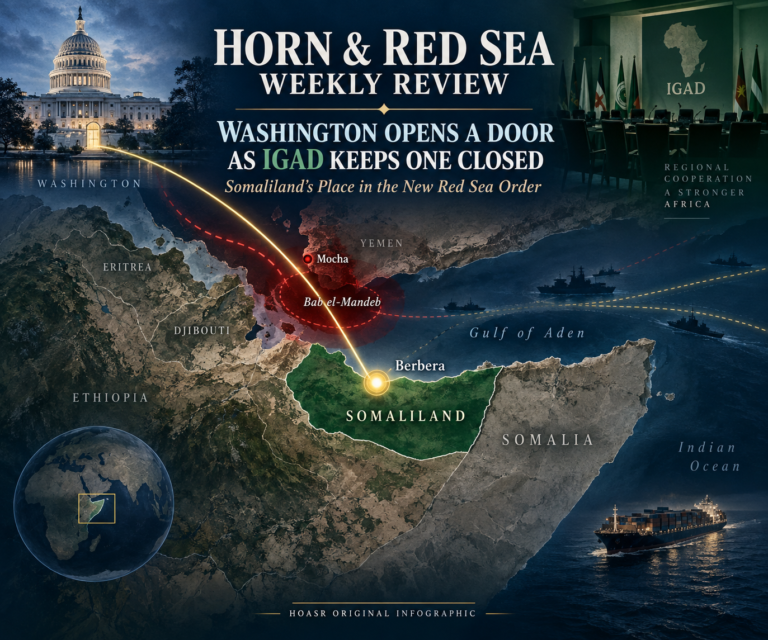
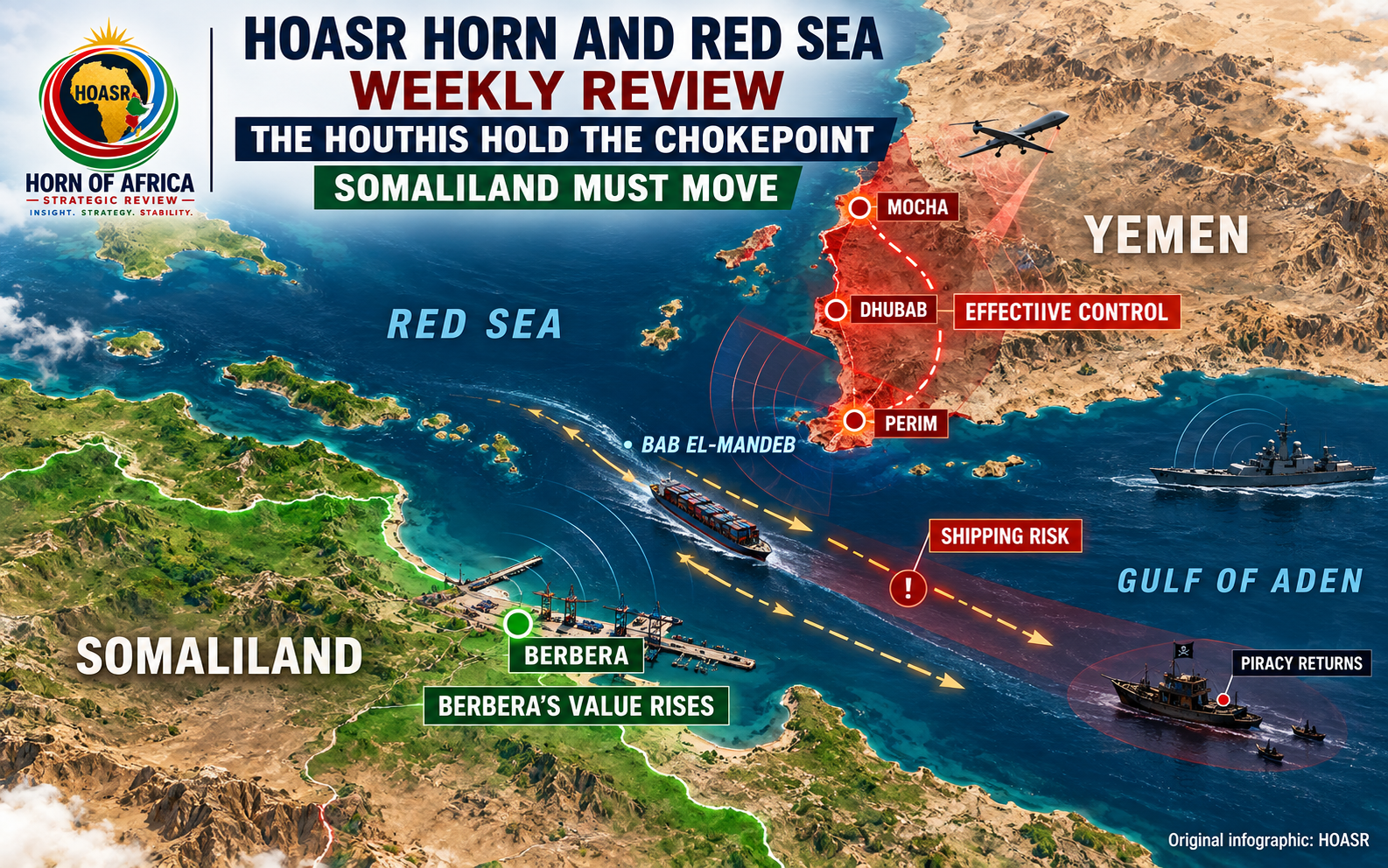
Houthi-held positions at Mocha, Dhubab and Perim give the movement a dominant coercive position on the Yemeni side of Bab el-Mandeb, increasing Somaliland’s strategic value and risk exposure.
HOASR HORN AND RED SEA WEEKLY REVIEW
REGIONAL SECURITY ASSESSMENT:| 5–11 September 2026
Regional diplomacy is still speaking the language of concern. The strategic map is speaking more clearly. The Houthis now hold the decisive Yemeni positions around Bab el Mandeb, and Somaliland can no longer treat the Yemen war as a distant crisis.
The map changed before the policy did
The Houthis did not simply capture another Yemeni port this week. They changed the strategic map around Bab el Mandeb. Mocha fell on 10 September. Within twenty four hours, government forces had withdrawn from Perim Island and the Houthis had taken Dhubab on the adjacent mainland.
Four Yemeni government sources confirmed the new positions to Reuters. With the Hanish islands already under Houthi control, the movement now holds the decisive Yemeni ground around the southern entrance to the Red Sea. The Houthi power has now reached the chokepoint.
The Wall Street Journal called this “effective control” of Bab el Mandeb. That judgment is strategically sound. Perim divides the strait into two shipping channels. Dhubab and Mocha provide advantage, observation points and potential missile launch areas. Together, these positions allow the Houthis to watch traffic, threaten selected vessels and raise the price of passage without closing the waterway completely.
“Effective control” is not absolute control
The Houthis do not possess legal sovereignty over the strait. They cannot prevent powerful naval and air forces from contesting their operations, and commercial traffic has not stopped. Yemen’s internationally recognized government has also announced a counteroffensive.
But absolute control is the wrong test. A movement that can identify ships, launch drones and missiles, place mines or force insurers to recalculate risk already possesses coercive power. The Houthis do not need to sink every vessel. They need only to persuade captains, owners, insurance companies and governments that safe passage depends on Houthi permission.
Their assurance that non Saudi shipping will remain safe should therefore be treated as a political message, not a security guarantee. A selective blockade is still a blockade in practice. The list of protected ships can shrink as quickly as the political objectives of the movement expand.
Hormuz made Bab el Mandeb more valuable
The timing makes the advance more dangerous. Saudi Arabia has become more dependent on its Red Sea route after disruption in the Strait of Hormuz. Reuters, citing the International Energy Agency, reported Saudi crude supply at roughly six million barrels a day in August. That was 2.3 million barrels below July and the lowest level in more than three decades. The Associated Press also cited maritime intelligence showing traffic through Bab el Mandeb about 60 percent below late 2023 levels.
This is the real strategic shift. The Red Sea was supposed to provide redundancy when Hormuz became dangerous. It is now becoming a second point of pressure. Oil was moving above $100 a barrel as the week closed, and every additional threat at Bab el Mandeb increases costs far beyond Yemen.
Reuters also reviewed satellite imagery showing smoke near Saudi Arabia’s East West pipeline, although Riyadh had not confirmed an attack.The confirmed map is serious enough without exaggeration.
The human cost is strategic
The Associated Press, citing the International Organization for Migration, reported more than 46,000 people displaced during the week. The Guardian reported more than 500 deaths and warned that the remaining 2022 truce was at risk. Displacement, port disruption and rising food and fuel costs weaken local government and enlarge the space in which armed groups and smuggling networks operate. Civilian protection is not separate from Red Sea security. It is part of it.
A Coalition Announced and a Coastline Lost
The speed of the Houthi advance exposed more than a battlefield failure. It exposed the distance between the security architecture announced by regional governments and the force they could actually organize when the map began to move.
Government aligned forces did not lose every position in a prolonged conventional battle. In several places they withdrew, allowing the Houthis to occupy strategic ground with remarkable speed. An anonymous Yemeni official told the Associated Press that the Saudi response was slow and coordination poor. That account should not be treated as the whole explanation, but it fits the larger pattern.
Yemen’s anti Houthi camp remains divided among forces with different local interests and foreign sponsors. The United Arab Emirates had developed facilities on Perim before ending its active military involvement earlier this year. Saudi air strikes were reported over Mocha only after the city fell. The Guardian’s September 11 account described the new fourteen country Saudi led maritime coalition as largely invisible during the crisis.
That is the central failure. The coalition existed on paper while the coastline changed hands. Membership lists, joint statements and future exercises are not a command structure. They do not assign targets, move aircraft, share intelligence or decide who acts when a strategic island is abandoned.
Washington Delegated and the Threat Moved
A senior United States administration official, speaking on background, told Fox News that Washington remained focused on freedom of navigation while empowering regional partners. That is a defensible policy only when the partners are capable of acting together. Bab el Mandeb has now become the test.
The United States does not need to own every regional conflict. It does need to know when delegation has become strategic drift. If partners cannot coordinate surveillance, escort, interdiction, air defence and crisis command, then a policy of regional burden sharing becomes a policy of watching armed movements fill the gap.
A counteroffensive may still recover some territory. But time favours the force already in place. Radar, drones, anti ship weapons, mines and hardened positions can turn a rapid takeover into a much more expensive military problem. Prevention was the cheaper option. Delay now carries its own price.
Somaliland Is No Longer Outside the Theatre
For Somaliland, Mocha and Perim are no longer names on the far side of the Gulf of Aden. They are forward positions opposite Berbera’s port, airport, fuel facilities and trade corridor. The strategic distance between Yemen and Somaliland has narrowed, even if the physical distance has not changed.
This does not prove that a Houthi attack on Somaliland is imminent. It does prove that Hargeisa must plan for threats it could once treat as remote: missile and drone surveillance, sabotage, cyberattack, covert logistics, dark shipping, weapons smuggling and sudden disruption to commercial traffic.
The first pressure may be financial rather than military. Insurers and shipping companies do not wait for a formal blockade. They price uncertainty. Higher premiums, diverted routes and tighter compliance rules can weaken Berbera without a single strike. The opposite is also true. Reliable surveillance, transparent regulation and credible emergency procedures can make Berbera more valuable precisely because the surrounding region is becoming less predictable.
Piracy Is the Warning from the African Shore
The Guardian reported on September 8 that eight hijackings had occurred since late April. Pirate groups are again using captured ships as motherships and satellite communications to identify targets. Some ransom and tactical details remain locally attributed, but the direction is clear. Naval attention drawn toward Iran and the Houthis is creating openings for criminal networks off the Somali coast.
There is no established evidence that the Houthis and Somali pirates are operating as one force. They do not need to be. Both benefit from the same overstretched security system. Yemen supplies organized coercion from the north. Piracy supplies opportunistic predation from the south. Somaliland now sits between them, and it must think like a maritime state.
Somaliland Must Convert Exposure into Leverage
Irro Now Needs a Sharper Washington Argument
President Abdirahman Mohamed Abdillahi Irro arrived in Washington to argue that Somaliland is a reliable strategic partner.The Houthi advance strengthens that case but makes every security offer more consequential. In an interview with The Times of Israel he said Somaliland could contribute up to 2,000 personnel to a proposed Gaza stabilization force. He stressed that no request had been made and no Israeli troops were deployed in Somaliland.
The offer presents Somaliland as a security provider, not an applicant for sympathy. But Irro’s stronger case is closer to home. Somaliland can help secure the African side of the Gulf of Aden and protect a major commercial corridor. Hargeisa should link that contribution to written commitments on recognition, investment and long term security cooperation, not praise or undefined promises.
Israel Sees One Maritime Theatre
Israeli Navy commander Vice Admiral Eyal Harel said on 8 September that there was no longer any distant maritime front. He treated the Mediterranean and Red Sea as one theatre. His statement did not mention Somaliland or Berbera and does not prove a basing decision. It does explain why Perim, Mocha and Berbera belong in the same strategic conversation. Israel needs warning and redundancy; Somaliland needs technology and training.Those interests should be placed inside a transparent framework.
Ethiopia Is Part of the Same Map
Israel’s ambassador to Ethiopia, Avraham Neguise, told Ethiopian state media that support for Ethiopia’s sea access was clear Israeli policy. He did not name Somaliland, Berbera, Assab or the 2024 MoU memorandum, and no trilateral agreement is confirmed. Yet the interests overlap: Ethiopia wants dependable access, Israel wants Red Sea resilience and Somaliland controls the Berbera corridor. Any revived corridor strategy must recognize Somaliland’s sovereignty and produce visible economic benefits. Geography is leverage, not a substitute for recognition.
What Somaliland Should Demand
First, Hargeisa needs an immediate threat review covering Berbera port and airport, fuel storage, coastal radar, cyber systems and emergency continuity. Somaliland must plan against the map that exists now, not last month’s map.
Second, intelligence sharing, training and access require written, reciprocal agreements. Each arrangement should strengthen Somaliland’s institutions and advance a diplomatic and investment pathway. Access without reciprocity would reproduce the imbalance recognition is meant to end.
Third, Somaliland must build coast guard readiness, radar and AIS coverage, secure communications, port state control and enforceable shipping law. It should also engage insurers and shipping companies directly. A flag on a foreign ship will not secure Berbera. Institutions will.
Berbera’s advantage is not only its location. It is the possibility that it can remain dependable when other routes are not. Predictable regulation and rapid incident response are therefore economic assets as well as security capabilities.
What Matters Next
The next evidence will come from action. Watch for Houthi radar, anti ship weapons, mines or fortifications on Perim, Dhubab and Mocha; the scale of any Saudi backed counteroffensive; and changes in insurance premiums and port calls. Somaliland’s test is equally concrete. Did Irro’s mission produce written commitments, official channels, maritime cooperation or investment? Do Israel and the United States move beyond strategic compliments?
The Strategic Map Says Move
The bureaucracy will continue debating whether the Houthis truly control Bab el Mandeb, whether Somaliland is formally recognized and whether Berbera can be discussed before larger questions are settled. The map will not wait. The Houthis are at the chokepoint. Shipping risk is rising. Somaliland’s exposure is real. Hargeisa should move now, but it should move as a state: deliberately, lawfully and with a clear demand that strategic partnership produce strategic reciprocity.

Prof. Nassir Hussein Kahin is a researcher, educator, journalist, and geopolitical analyst specializing in the Horn of Africa, the Red Sea, international law, diplomacy, and strategic affairs. To read Full Bio click on this link: ABOUT THE AUTHORProf. Nassir Hussein Kahin