Official logo of HOASR’s Horn & Red Sea Weekly Review.
7 September 2026 | Updated before publication
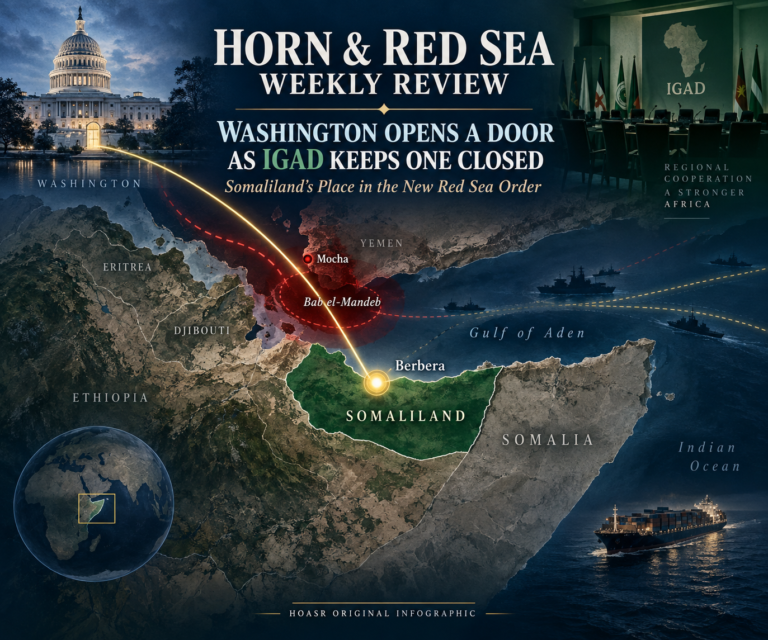
President Abdirahman Mohamed Abdullahi Irro’s visit to Washington is the main Somaliland story of the week. It is also an important test of his presidency.
Irro did not travel simply to improve relations with the United States. He travelled with a larger political purpose: to convince American decision-makers that recognising Somaliland would serve U.S. interests in the Horn of Africa and the Red Sea.
That is a difficult argument, but the timing gives him an opening. Somaliland has already secured recognition from Israel. Shipping routes around the Red Sea and the Gulf remain exposed to conflict. Berbera offers a port, an airport and a stable position on the Gulf of Aden. Washington is also looking for dependable partners while China, Türkiye, Egypt, the Gulf states and other powers deepen their roles across the region.
These conditions make Somaliland more relevant. They do not make American recognition automatic. The political meaning of the visit lies in the space between those two points. Irro has reached Washington at an unusually favourable moment. He must now turn access into a result.
Why the visit matters
Somaliland’s recognition campaign has often relied on a familiar case: it restored the sovereignty it briefly held in 1960, built its own institutions after the collapse of the Somali state, maintained relative peace and held competitive elections. These arguments remain central. Yet they have not been enough to overcome the international preference for Somalia’s territorial unity.
Irro is trying to add a second argument. Somaliland is not only asking Washington to recognise a political and historical reality; it is offering a practical partnership.
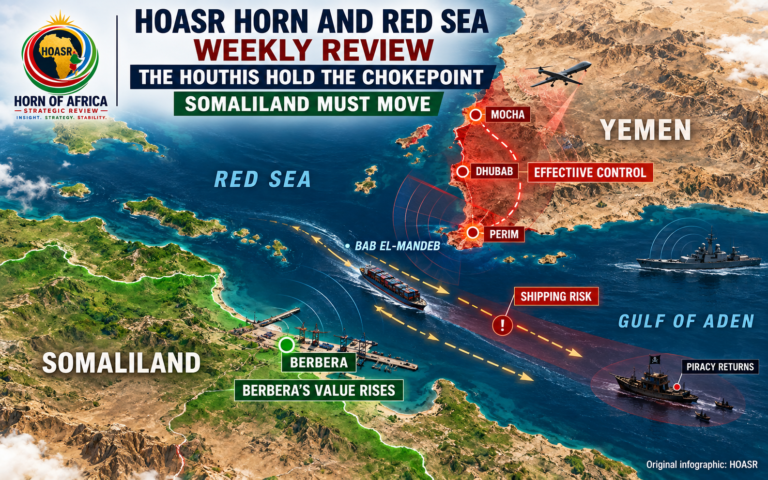
Berbera is at the centre of that offer. Its port faces the Gulf of Aden, close to the shipping lanes leading to Bab el-Mandeb. Its airport and coastline could support maritime monitoring, emergency logistics and security cooperation. Somaliland also presents itself as democratic, friendly to the West and willing to work with Taiwan and Israel at a time of sharper competition with China and Iran.
This gives American officials several reasons to listen. Congress may view Somaliland through democracy, Taiwan and competition with China. Defence officials may be interested in access, intelligence and maritime security. Investors will look at Berbera, minerals, energy and links to the Ethiopian market.
But interest is not the same as recognition. Washington may decide that it can gain many of these benefits through informal cooperation while continuing to recognise Somalia’s sovereignty. That is the central danger for Irro’s campaign.
Somaliland can offer access before it is recognised. The United States can hold talks with Hargeisa, support maritime projects or encourage private investment without changing diplomatic policy. From Washington’s point of view, this may appear less costly than a formal break with Mogadishu.
Irro therefore needs to explain why recognition is not merely Somaliland’s reward. He must show why it would make the partnership more reliable for the United States. His strongest point is that long-term security and investment agreements are easier when there is no dispute about which government has the authority to sign and enforce them.
The visit will be successful if it produces a path forward: named officials responsible for follow-up, a timetable for further talks, a serious congressional process, an agreement on representation, or a clearly defined security and investment programme. A photograph, a friendly statement or an impressive guest list will not be enough.
The mood in Washington is more favourable – but still divided
On 4 September, Foreign Policy published an article titled “Why the United States Should Recognize Somaliland”. Its appearance during Irro’s visit helps place the issue before an influential American policy audience.
This is useful for Somaliland, but it must be described accurately. The article is an argument for recognition, not evidence that the U.S. government has decided to recognise Somaliland. It shows that the campaign has supporters with access to Washington’s foreign-policy debate. It does not show that those supporters have carried the administration.
Israel’s recognition of Somaliland on 26 December 2025 changed the atmosphere around the question. A step once discussed only as a future possibility has now been taken by one state. The recognition decision documented by Reuters gave Hargeisa a diplomatic opening and strengthened its belief that other governments could follow.
It also created new resistance. Somalia, the African Union and several regional governments oppose the decision. Türkiye, Egypt and China have strong reasons to support Mogadishu’s claim to the whole territory of the former Somali Republic. Some Arab and Muslim governments may also view Somaliland’s close relationship with Israel through the wider Middle East conflict.
Irro must therefore avoid presenting recognition as one side of a regional military struggle. Somaliland can explain its willingness to cooperate with Israel and the United States without allowing its case to become dependent on conflict with Iran, the Houthis or any other actor. A country seeking lasting acceptance should be useful in a crisis, but not defined by the crisis.
The first problem is managing expectations
The greatest immediate risk may come from the expectations created at home. Many Somalilanders understandably see the visit as historic. Years of diplomatic isolation have made high-level access in Washington feel like proof that recognition is near.
The government should be careful. If officials suggest that a breakthrough is certain and no announcement follows, an important diplomatic step could be remembered as a disappointment. Recognition decisions are rarely made through one meeting or one visit. They usually require agreement across several parts of government and a willingness to manage the consequences.
This is why the absence of an official American readout matters. It does not mean the visit has failed. Private meetings often come before public policy. It does mean that analysts and officials should not fill the silence with claims they cannot verify.
The delegation’s size and focus have also become part of the debate. In a 4 September commentary, former Pentagon official Michael Rubin argued that Somaliland risked weakening its message by bringing what he described as an unusually large delegation. His concern was that Washington rewards small teams, clear priorities and officials who can negotiate specific agreements. Somaliland Chronicle published Rubin’s criticism.
That commentary is an opinion, and its reported delegation count has not been independently established here. Still, the warning deserves attention. Somaliland has a limited window in Washington. Every official should have a clear role, and every meeting should support the same central message.
Irro does not need to ask every American audience for the same thing. He does need to connect every request to the recognition strategy. Security talks should establish why recognised sovereignty would improve cooperation. Investment talks should show how political clarity would reduce risk. Congressional meetings should build support for a formal policy review rather than produce only general statements of friendship.
Mogadishu is preparing to push back
Somalia will not treat Irro’s visit as ordinary diplomacy. For Mogadishu, American recognition of Somaliland would be a major defeat and could encourage other governments to reconsider their positions.
One Somali news outlet reported on 3 September that the Federal Government was expanding a planned Washington delegation and placing it under Deputy Prime Minister Salah Ahmed Jama. The same report said the team was expected to travel on 9 September, partly in response to Irro’s visit. FTL Somalia described the reported counter-mission.
If the mission goes ahead, Mogadishu is likely to make three arguments. First, recognition would violate Somalia’s territorial integrity. Second, it could complicate cooperation against al-Shabaab. Third, Washington can obtain access to ports and security partners through the Federal Government without redrawing borders.
Irro needs answers that do not depend on insulting or dismissing Somalia. Somaliland’s case is stronger when it explains its own legal history, record of government and value as a partner. It is weaker when recognition is presented simply as punishment for Mogadishu’s failures.
The reported Somali response also shows why timing matters. Somaliland may have a temporary advantage while Irro is the focus of attention. Mogadishu will use its recognised embassies, its relations with the State Department and its regional partners to slow any policy change. Hargeisa needs permanent diplomatic capacity in Washington, not only presidential visits.
How the regional setting helps – and complicates – Irro’s case
The Red Sea crisis strengthens one part of Irro’s message. Attacks, military tension and uncertain shipping have made governments more interested in secure ports, maritime information and reliable partners. Berbera’s location now receives attention that would have been harder to attract in a calmer period.
Yet geography can be oversold. Berbera cannot replace the Suez Canal, and ships using it still face Bab el-Mandeb if they sail into the Red Sea. Its real value is as a secure Gulf of Aden port, a possible support and monitoring point, and an alternative commercial route into Ethiopia.
That practical description is more convincing than exaggerated claims. It also helps Somaliland argue that recognition would strengthen a functioning partner rather than create a new state from nothing.
Competition among outside powers cuts both ways. American concern about China’s base in Djibouti and close relationship with Mogadishu may make Somaliland more attractive. Ties with Taiwan give Hargeisa supporters in Washington another reason to pay attention. Türkiye’s military and political role in Somalia may also encourage some American officials to seek additional options.
At the same time, these rivalries raise the cost of recognition. China is likely to oppose a government that maintains relations with Taiwan. Türkiye and Egypt support Somalia’s territorial position. Regional states may warn that recognition could open new disputes or deepen the military contest around the Red Sea.
Irro’s best response is to present Somaliland as a stabilising partner, not a platform to be used against everyone else’s enemies. The argument should be simple: Somaliland controls its territory, protects its coast, holds elections and can make agreements that last. Recognition would bring an existing political reality into a clearer and more accountable international framework.
What a real success would look like
Recognition itself would be the clearest result, but it is not the only measure of progress. The visit could still be important if it produces steps that make a later decision more likely.
A formal review of U.S. policy would matter. So would a regular channel between American and Somaliland officials, upgraded representation in Hargeisa or Washington, a maritime-security agreement, direct development support, or congressional legislation requiring closer engagement.
Investment commitments would also help, especially if they move beyond promises. Somaliland needs bankable projects, clear rules and companies prepared to put money into Berbera, energy, telecommunications or mineral development. Commercial ties create American interests that can support a political relationship over time.
The strongest result would combine politics, security and economics. Recognition without a plan for cooperation could remain symbolic. Cooperation without movement on status could leave Somaliland in the same diplomatic position. Irro’s task is to prevent Washington from separating the benefits Somaliland offers from the political commitment Somaliland seeks.
What to watch in the coming days
First, the official American record. Watch for a White House, State Department, Pentagon or congressional statement naming the people Irro met and describing what comes next. The level of the meetings matters, but the follow-up matters more.
Second, the wording used by Somaliland’s government. A careful statement that identifies practical gains will strengthen confidence. Claims of imminent recognition without American confirmation would raise expectations the government may not be able to meet.
Third, Mogadishu’s counter-campaign. Confirmation of the reported Somali delegation, its meetings and its message will show how seriously the Federal Government views Irro’s progress. Regional support from Türkiye, Egypt, China or the African Union would increase the pressure on Washington to preserve its existing policy.
Irro has succeeded in bringing Somaliland’s recognition case into a serious American conversation. That is an achievement, but it is not yet the decision Somaliland wants.
The real test begins after the first meetings. Can the president leave behind an organised campaign, clear American partners and a timetable for action? If he can, the Washington visit may become a turning point. If the visit ends with warm words but no process, it will show that Somaliland is welcome as a useful partner while recognition remains unfinished business.
Somaliland’s president has brought the recognition campaign to Washington. The visit has created attention and raised expectations, but its success will depend on what the United States is prepared to put in writing before he returns home. For further insight read my last week’s full analysis published at The Times of Israel:
Somaliland: The US Recognition Window Has Openedp

Prof. Nassir Hussein Kahin is a researcher, educator, journalist, and geopolitical analyst specializing in the Horn of Africa, the Red Sea, international law, diplomacy, and strategic affairs. To read Full Bio click on this link: ABOUT THE AUTHORProf. Nassir Hussein Kahin