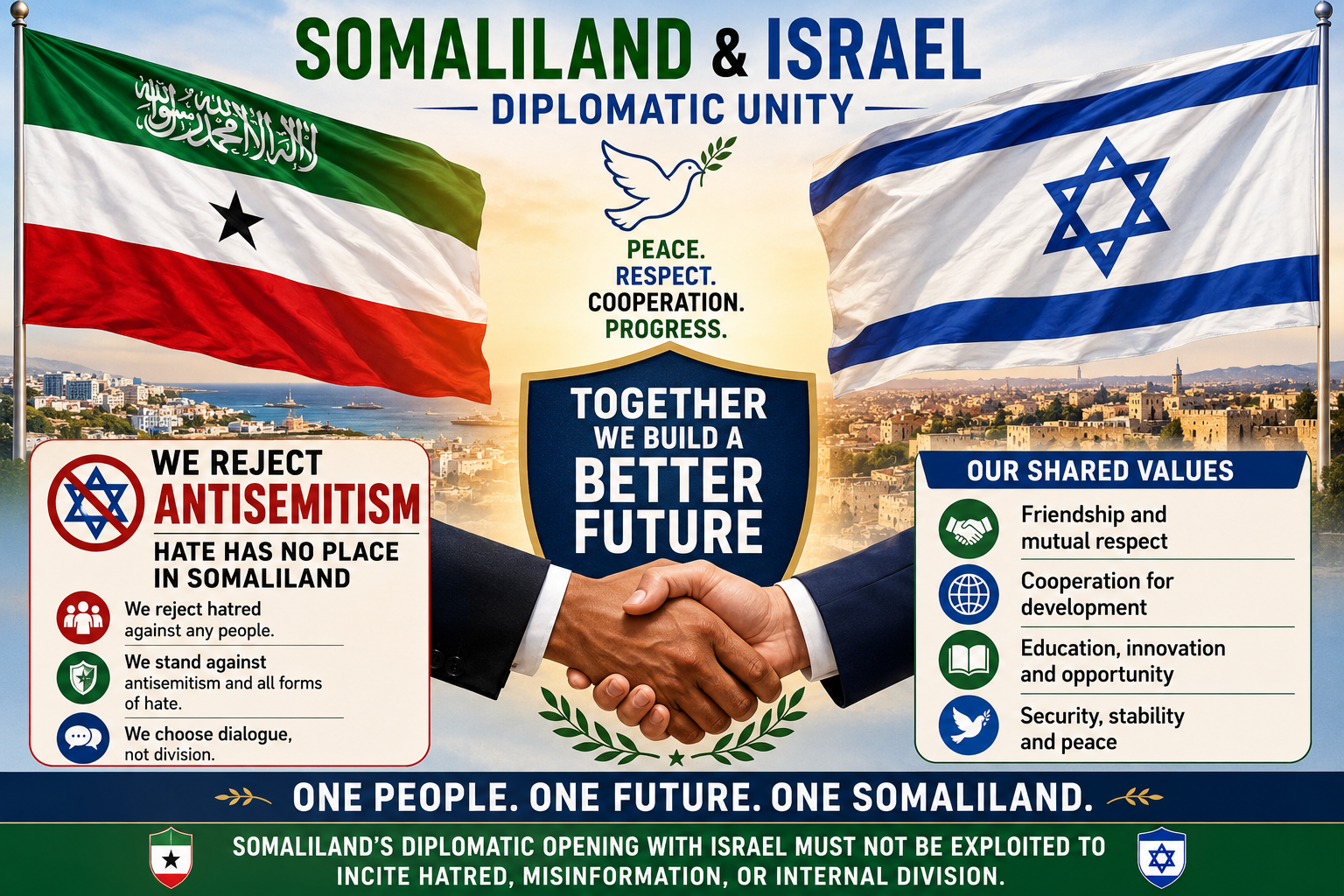
Antisemitism Propaganda
The New Battle Is Not at the Border—It Is for Somaliland’s Social Cohesion
By Prof. Nassir Hussein Kahin
For thirty-five years, Somaliland endured the burden of non-recognition while building peace, elections, institutions, security forces, and a functioning democratic order from the ruins of war.
It did so despite isolation, despite regional pressure, and despite repeated attempts to reduce its national cause to a dispute that could be settled in Mogadishu without the consent of Somaliland’s people.
That era is now changing.
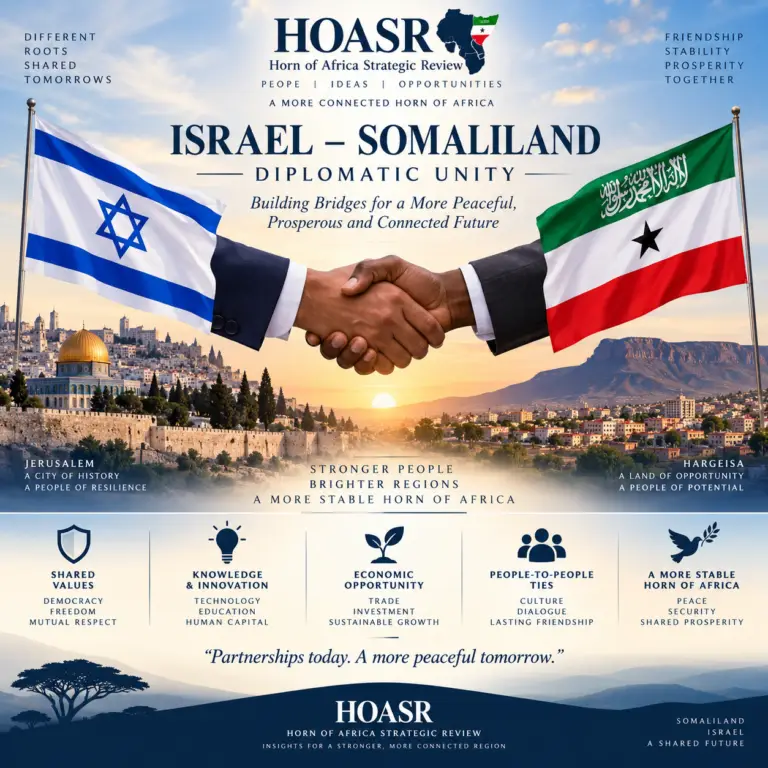
President Abdirahman Mohamed Abdullahi Irro’s historic visit to Israel, his meetings with senior Israeli leaders, the opening of Somaliland’s embassy in Jerusalem, and his receipt of the Friends of Zion Award have pushed Somaliland into a new diplomatic and strategic environment.
The Friends of Zion ceremony followed the embassy inauguration, and FOZ founder Mike Evans publicly said he would advocate for formal United States recognition of Somaliland. (Israel & Jewish News – JNS)
These developments are consequential. They have created diplomatic visibility, access to new networks, and the possibility of deeper cooperation in technology, agriculture, water management, investment, Maritime Security, intelligence, education, health, and defense. They have also made Somaliland more difficult to ignore.
But every strategic breakthrough produces a counter-strategy.
The immediate danger is not merely external diplomatic opposition. It is the attempt to transform foreign-policy disagreement into internal hostility: to weaponize religion, circulate inflammatory slogans, target Jews as a people, portray Somalilanders who support diplomatic engagement as enemies of Islam, and create an atmosphere in which anger replaces national judgment.
That is not principled debate. It is propaganda warfare.
Criticism Is a Right; Incitement Is Not
Somaliland’s Constitution protects freedom of expression, peaceful assembly, and independent media. Every citizen has the right, within the law, to express political views orally, visually, artistically, or in writing.
That constitutional protection must be respected. A confident state does not criminalize every critic. Somalilanders are entitled to ask difficult questions about foreign policy, diplomatic priorities, Jerusalem, security agreements, economic arrangements, and the implications of any partnership with Israel.
However, constitutional liberty is not a license to advocate hatred against an ethnic or religious people, issue threats, circulate fabricated allegations, call for violence, or deliberately provoke unrest.
There is a clear distinction:
- Political criticism: “I disagree with the government’s Israel policy.”
- Religious or moral disagreement: “I oppose the embassy decision on religious or political grounds.”
- Democratic advocacy: “I want Parliament to debate and scrutinize the agreement.”
- Incitement and Hate Propaganda: “Jews are enemies,” “Somalilanders who support this must be attacked,” or claims designed to make violence, intimidation, or communal hostility appear legitimate.
The first three belong in a democratic society. The fourth is a threat to that society.
This distinction matters because hate speech and coordinated misinformation are not harmless online noise. Research on the Somali information environment has warned that social-media misinformation, hate speech, and tribal propaganda can damage social cohesion and political stability; recent analysis specifically recommends monitoring systems, legal safeguards, media literacy, and grassroots peacebuilding.
The “Israel of Africa” Phrase Is Being Deliberately Weaponized
Mike Evans’s phrase, “Somaliland is the Israel of Africa,” is plainly an analogy—not a declaration that Somaliland is Israel, that Somalilanders are Jews, or that Somaliland has abandoned Islam.
Analogies are common in international political writing. Somaliland has also been described as “the Taiwan of Africa” because of its democratic resilience, diplomatic isolation, strategic geography, and capacity to build institutions without universal recognition.
Neither analogy erases Somaliland’s history, faith, culture, sovereignty, or national identity.
The purpose of such comparisons is to identify similarities in political circumstance: survival under pressure, self-reliance, democratic aspiration, strategic vulnerability, and the determination to preserve a distinct national identity.
Those now presenting the phrase as proof that Somaliland has become “un-Islamic” are not engaging in serious interpretation. They are converting a diplomatic metaphor into a weapon of emotional mobilization.
The question Somalilanders should ask is simple: why were comparisons to Taiwan treated as ordinary geopolitical analysis, while a comparison to Israel is suddenly turned into a reason to spread hostility toward Jews or to delegitimize the elected government?
The answer is that the controversy is useful to actors who cannot defeat Somaliland’s diplomatic momentum through facts, institutions, or public confidence. They therefore seek to create fear, religious polarization, and internal distrust.
The Old Strategy: Isolate Somaliland, Then Exploit Its Vulnerability
For decades, Somaliland’s greatest strategic weakness was isolation. Without broad recognition, it was vulnerable to pressure from actors who denied its political reality while benefiting from its diplomatic exclusion.
The objective was never only to prevent a flag from entering the United Nations. It was to keep Somaliland strategically constrained: unable to secure strong defense partnerships, unable to access international finance on equal terms, unable to attract sufficient investment, and unable to build the diplomatic alliances necessary to protect its hard-won peace.
The new relationship with Israel changes part of that equation. It does not eliminate Somaliland’s challenges, and it should not be exaggerated into a guarantee of security. But it creates new diplomatic space and potential practical cooperation. Israel’s recognition in December 2025, the June 2026 presidential visit, the Jerusalem embassy opening, and the FOZ award all signal that Somaliland is no longer as isolated as it was. (Al Jazeera)
That is precisely why opponents will try to shift the contest inward.
If Somaliland cannot be kept isolated from outside, the alternative is to weaken it from within: revive the language of division, inflame religious anxiety, manufacture a false conflict between Islam and national interest, and encourage Somalilanders to see one another as traitors rather than citizens with different opinions.
This is the dangerous road back toward the instability Somaliland escaped before and after 1991.
Somaliland’s Islamic Identity Does Not Require Hatred of Jews
Somaliland is a Muslim society. Its constitutional and cultural identity must be respected. But Islam does not require Somalilanders to hate Jews as a people, nor does it require the country to reject diplomacy, trade, education, technology, or security cooperation with a Jewish state.
A state can maintain its religious identity while conducting diplomacy according to national interest. Muslim-majority countries across the world maintain formal or informal relations with states whose policies they may criticize. Diplomacy is not theological surrender. An embassy is not conversion. A security agreement is not an abandonment of faith.
Somaliland’s national interest requires sober judgment: What protects peace? What expands opportunity? What strengthens institutions? What gives Somaliland greater agency in the Red Sea and Horn of Africa? What reduces the ability of hostile actors to threaten its sovereignty?
These are legitimate national questions. They must be answered through evidence, parliamentary oversight, public communication, and constitutional process—not through antisemitic rhetoric or conspiracy theories.
What the Irro Government Should Do Now
The government must respond firmly, but constitutionally. It should not confuse dissent with sedition, nor use the current controversy as an excuse to suppress independent journalists, religious leaders, opposition parties, or peaceful protesters.
Such a response would damage Somaliland’s democratic credibility and hand propagandists a victory.
Instead, the government should adopt a measured national resilience strategy.
First, establish a clear public standard: criticism of government policy is protected; incitement to violence, threats against people, collective hatred of Jews, fabricated security allegations, and calls for communal disorder are not.
Second, create a rapid-response public information unit involving the Presidency, Ministry of Information, Ministry of Religious Affairs, Ministry of Interior, police cybercrime capacity, and civil-society representatives.
Its task should be to identify major falsehoods, publish factual corrections quickly, and distinguish misinformation from legitimate opinion.
Third, invite respected Somaliland scholars, elders, women’s organizations, youth leaders, academics, and religious figures to issue a joint national statement: Somaliland’s Islamic identity, constitutional order, and peaceful civic culture reject hatred against any people. Such a statement should also affirm that citizens retain the right to debate foreign policy peacefully.
Fourth, require transparency around any major agreements. The government should brief Parliament and publish non-sensitive summaries of cooperation in areas such as investment, education, agriculture, water, technology, health, and security. Transparency deprives rumor networks of oxygen.
Fifth, investigate credible threats and coordinated disinformation through lawful procedures, with judicial oversight and clear evidentiary standards. The target must be criminal conduct—not political identity or criticism.
Sixth, launch a national civic-information campaign explaining the difference between diplomacy, recognition, defense cooperation, religious identity, and constitutional citizenship. The public must not be left to learn foreign policy from anonymous social-media accounts, edited clips, and hostile propaganda channels.
The Choice Before Somaliland
Somalilanders should not be asked to choose between Islam and national survival, between faith and diplomacy, or between constitutional freedom and public order.
These are false choices designed to divide a people who have already paid too high a price for division.
The real choice is between mature national debate and destructive incitement.
Somaliland has reached this point because it refused to surrender its identity during thirty-five years of diplomatic exclusion.
It should not now surrender its unity to those who seek to turn a foreign-policy disagreement into a domestic fire.
The opening of an embassy in Jerusalem, the FOZ award, and the Israel relationship can be debated. They should be debated seriously.
But Somaliland must reject every effort to use these developments as an excuse for Antisemitism, political violence, religious manipulation, or a return to the instability of the past.
The future belongs to a Somaliland that is secure enough to debate, wise enough to distinguish criticism from hate, and united enough to turn new diplomatic openings into national opportunity.

Prof. Nassir Hussein Kahin is a researcher, educator, journalist, and geopolitical analyst specializing in the Horn of Africa, the Red Sea, international law, diplomacy, and strategic affairs. To read Full Bio click on this link: ABOUT THE AUTHORProf. Nassir Hussein Kahin