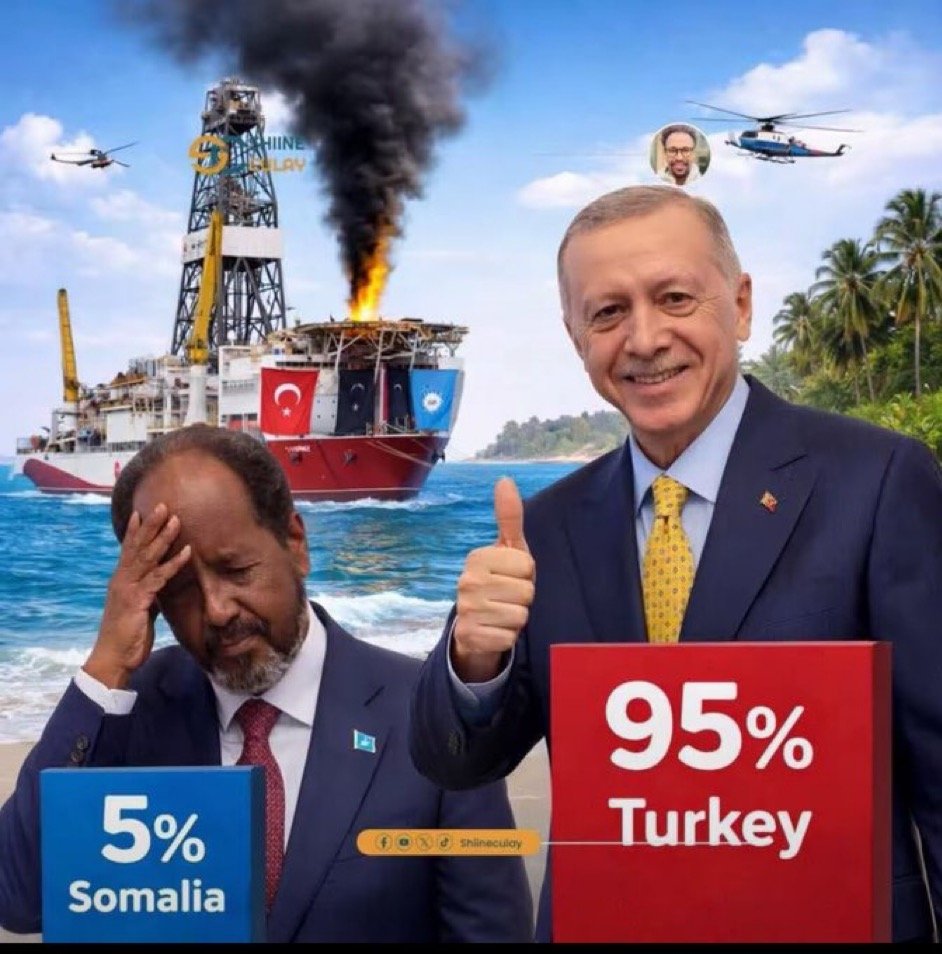
“REVIEWING” Somaliland’s status did not emerge from strategic thinking; it was triggered by Turkey’s panic over Israel’s diplomatic recognition of Somaliland.
President Hassan Sheikh Mohamud’s June 26 speech was not merely hypocritical; it was an insult to legal reality. His claim that he will “REVIEW and take a new approach to address the Somaliland case” was nothing more than a recycled performance meant to satisfy his domestic audience and foreign patrons.
This is the president who has spent years denying Somaliland’s legally grounded independence but now wants to pretend he is entering a phase of reflection. The contradiction is staggering.
Somaliland is not a “case” to be reviewed. It is a legally standing independent republic that reclaimed its sovereignty in 1991, restoring the same internationally recognized statehood it held on 26 June 1960 before voluntarily entering, and later exiting, a failed union with Somalia.
That union collapsed in blood, illegality, and genocide. No amount of metaphorical gymnastics can erase the fact that Somaliland’s withdrawal was lawful under international norms governing failed federations, self-determination, and the right to remedial secession after mass atrocities. These are not symbolic claims; they are legal facts.
Yet Hassan Sheikh continues to behave as if Somaliland’s restored independence is a misunderstanding that can be corrected with a speech.
Today, Hassan Sheikh still clings to the fantasy that a sovereign republic, with its own constitution, borders, currency, institutions, and democratic legitimacy, can be dragged back into a union that no longer exists in law or in practice. This is not just delusional; it is a refusal to confront the legal and historical record.
In fact, his entire approach rests on the belief that verbal pressure can override the sovereignty Somaliland has exercised for more than three decades.
But every attempt by Somalia to reassert authority over Somaliland without acknowledging its legal standing as a restored state has only strengthened Somaliland’s conviction that Mogadishu is incapable of engaging on lawful, equal terms. The more Hassan Sheikh speaks, the more he exposes the emptiness of his position.
And the hypocrisy runs deeper. Hassan Sheikh’s sudden talk of “REVIEWING” Somaliland’s status did not emerge from strategic thinking; it was triggered by Turkey’s panic over Israel’s diplomatic recognition of Somaliland. Ankara, desperate to counter Israeli influence in the Horn of Africa, has been pressuring Mogadishu to escalate its rhetoric and posture.
Hassan Sheikh’s speech was less a national address and more a Turkish-scripted reaction, designed to offset the geopolitical shock of Somaliland’s breakthrough with Israel. Instead of acting like a head of state, he acted like a subcontractor for Ankara’s regional anxieties.
This is why his words ring hollow. They are not grounded in law, not grounded in strategy, and not grounded in reality. They are grounded in fear—fear of losing the narrative, fear of losing regional leverage, and fear of acknowledging that Somaliland’s independence is not negotiable through speeches or committees.
International partners see through this. They prioritize stability, legality, and functional governance—all areas where Somaliland has demonstrated competence and Somalia has struggled. When Mogadishu insists on narratives that contradict the legal and political facts, it undermines its own credibility. Hassan Sheikh’s speech did not project strength; it projected desperation.
A responsible leader would begin by acknowledging that Somaliland’s restored independence is a durable legal reality, not a temporary deviation. This does not predetermine the outcome of future dialogue, but it does require abandoning the illusion that Somaliland’s status can be reshaped through rhetorical defiance or foreign-driven political theatre.
In the end, Hassan Sheikh’s insistence on “REVIEWING” Somaliland’s question is not a policy initiative; it is an admission of intellectual and diplomatic paralysis. It reveals a leader unable to confront the limits of his own assumptions, unable to break free from Turkey’s influence, and unable to speak honestly about the legal landscape he faces.
As long as this denial persists, the distance between Hargeisa and Mogadishu will continue to widen—not because of hostility, but because one side is grounded in law and political reality while the other remains trapped in a narrative that collapsed decades ago. To read more articles from the author click on this link:PRE-EMPTIVE STRATEGIC POSTURE: PRESIDENT IRRO’S CALCULATED RESPONSE TO A SHIFTING HORN OF AFRICA SECURITY LANDSCAPE

Ambassador Egal is a regular contributing writer for HOASR and the founder of Horn of Africa Herald, an independent digital newspaper