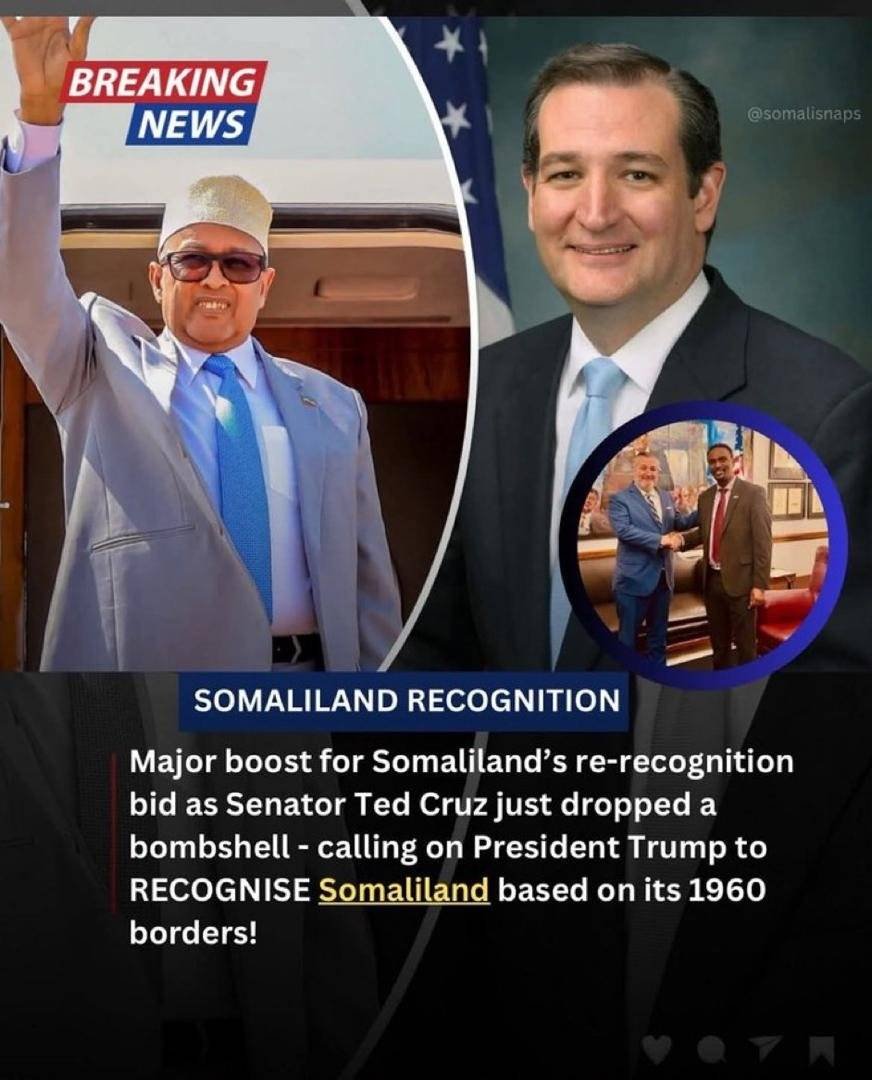
Thank You, Senator Ted Cruz
By Prof. Nassir Hussein Kahin
The newly released U.S. congressional directive entitled: “Report to Congress on Potential Areas for Improved United States Engagement with Somaliland- Section 709 (e) of the National Security Department of State and Related Programs Appropriations Act, 2026 F.P.L. 119-175 and House Report 119-217 “ is one of the most significant developments in U.S.-Somaliland relations in recent years—not because it grants recognition, but because of what it reveals about how Washington is beginning to think about Somaliland as a distinct strategic actor separate from “Somalia.” The key sentence in House Report 119-217 states:
“The Committee directs the Secretary of State to submit a report… on potential areas for improved United States engagement with Somaliland, including in security, diplomacy, trade, and development.”
That language may appear technical, but in U.S. foreign policy terms it is highly unusual.
The first thing to understand is that Congress did not ask for a report on “Somalia.” It specifically requested a report on “Somaliland.” That distinction matters enormously, because for more than three decades, official U.S. policy has operated under the framework of a united Somalia better known as “One Somalia Policy “ like the “One China Policy “ regarding Taiwan. But, Congress has now directed the State Department to examine how the United States can expand engagement with Somaliland separately, without Mogadishu. in four major areas: *security, *diplomacy, *trade, and *development.
From a recognition perspective, this creates what political scientists call a “policy differentiation process.” Before governments recognize disputed or unrecognized states, they often begin by treating them differently in practice long before they recognize them in law.
The historical pattern is familiar:
- The United States deepened unofficial relations with Taiwan long before formal policy adjustments.
- Western states increased separate engagement with Kosovo before recognition.
- Many countries developed extensive ties with South Sudan before diplomatic recognition.
Recognition usually comes at the end of a process, not at the beginning.
What makes this report especially important is the timing. Congress inserted the requirement amid growing American concern about strategic competition in the Red Sea, Chinese influence in Africa, Maritime Security, critical mineral supply chains, and military access points near key shipping routes. The Somaliland reporting requirement appears in the same section discussing *economic security, *communications networks, and *strategic infrastructure.
This suggests that Washington increasingly now views Somaliland through a geopolitical lens rather than merely through the traditional “One-Somalia lens.”
For Somaliland, the strategic advantages are obvious:
- Berbera’s location on the Gulf of Aden.
- Relative political stability compared with much of the region.
- Democratic elections and peaceful transfers of power.
- Existing partnerships with Western and regional actors.
- Proximity to Red Sea shipping lanes.
- Potential role in countering Chinese, Iranian, Russian, and extremist influence in the Horn of Africa.
These factors align closely with current American strategic priorities.
However, Somalilanders should also avoid overinterpreting the report.
The congressional directive does not constitute “recognition.”
The report reportedly reaffirms existing U.S. support for “Somalia’s territorial integrity” . That reflects a longstanding American position. However, this time and for the first time, Washington wants a separate engagement with Somaliland.
The real significance of the report lies elsewhere.
The most important question is not what the State Department answered.
The most important question is what Congress asked.
Congress essentially asked:
“How can the United States work more closely with Somaliland?”
That question itself would have been politically difficult to imagine several years ago.
From a recognition strategy perspective, I would rank the significance of this development as follows:
In the short term, expect the following;
- Expanded diplomatic contacts.
- More congressional visits.
- Increased security cooperation.
- Greater economic and development engagement.
- Strengthening of relations through representative offices rather than embassies.
In the medium term :
- Growing treatment of Somaliland as a separate strategic partner.
- More direct agreements on security, trade, maritime cooperation, and infrastructure.
- Increased pressure within Washington to reconsider and or get rid of the “One Somalia policy”.
In the long-term:
- Creation of political conditions that could make recognition more urgent if regional and international crisis emerge or geopolitical circumstances change.
The biggest signal one gets from this report is that a future U.S. recognition of Somaliland would be justified through the bureaucratic process in the United States.
Once Congress orders a report, agencies begin collecting data, assessing opportunities, consulting stakeholders, and building institutional knowledge. In Washington, policy change often begins with reports, studies, findings, hearings, and pilot engagements before major decisions are made.
For Somaliland’s recognition campaign, this report should therefore be viewed neither as a breakthrough nor as a disappointment.
It is best understood as a formal acknowledgment by the U.S. Congress that Somaliland has become strategically important enough to merit separate examination by the United States government. That alone represents a radical and meaningful shift from the period when Somaliland was discussed almost exclusively as a “regional issue”within Somalia.
- My assessment is that the report does not indicate imminent U.S. recognition. What it does indicate is that Somaliland has entered a new phase in Washington’s policy debate: from being primarily a Somalia issue to increasingly being viewed as a strategic Horn of Africa partner whose future status and Geopoliticsrelationship with the United States deserve independent consideration including possibly recognizing Somaliland.That is often how major foreign policy shifts begins and Somaliland’s Recognition Clock may have Just Started Ticking in Washington.
Prof. Nassir Hussein Kahin is a researcher, educator, journalist, and geopolitical analyst specializing in the Horn of Africa, the Red Sea, international law, diplomacy, and strategic affairs. To read Full Bio click on this link: ABOUT THE AUTHORProf. Nassir Hussein Kahin