The contrast between Hargeisa and Mogadishu may be approaching a historic inflection point!
By Prof. Nassir Hussein Kahin
- Somalia Constitutional Crisis!
Has Somalia Entered Its Most Dangerous Constitutional Crisis Since State Collapse?
When I wrote “Is Mogadishu Facing a Kabul-Style Collapse?” on May 16, many observers viewed the comparison as provocative. Some dismissed it as political commentary. Others argued that Somalia’s institutions, despite their weaknesses, remained sufficiently resilient to prevent a major constitutional breakdown.
Less than a month later, events on the ground suggest those warnings deserve serious reconsideration.
Somalia now finds itself confronting a convergence of crises that extend far beyond ordinary political disagreement. What began as a dispute over constitutional amendments and electoral arrangements has evolved into a broader struggle over legitimacy, authority, and the future direction of the Somali state itself.
At the center of this crisis stands President Hassan Sheikh Mohamud.
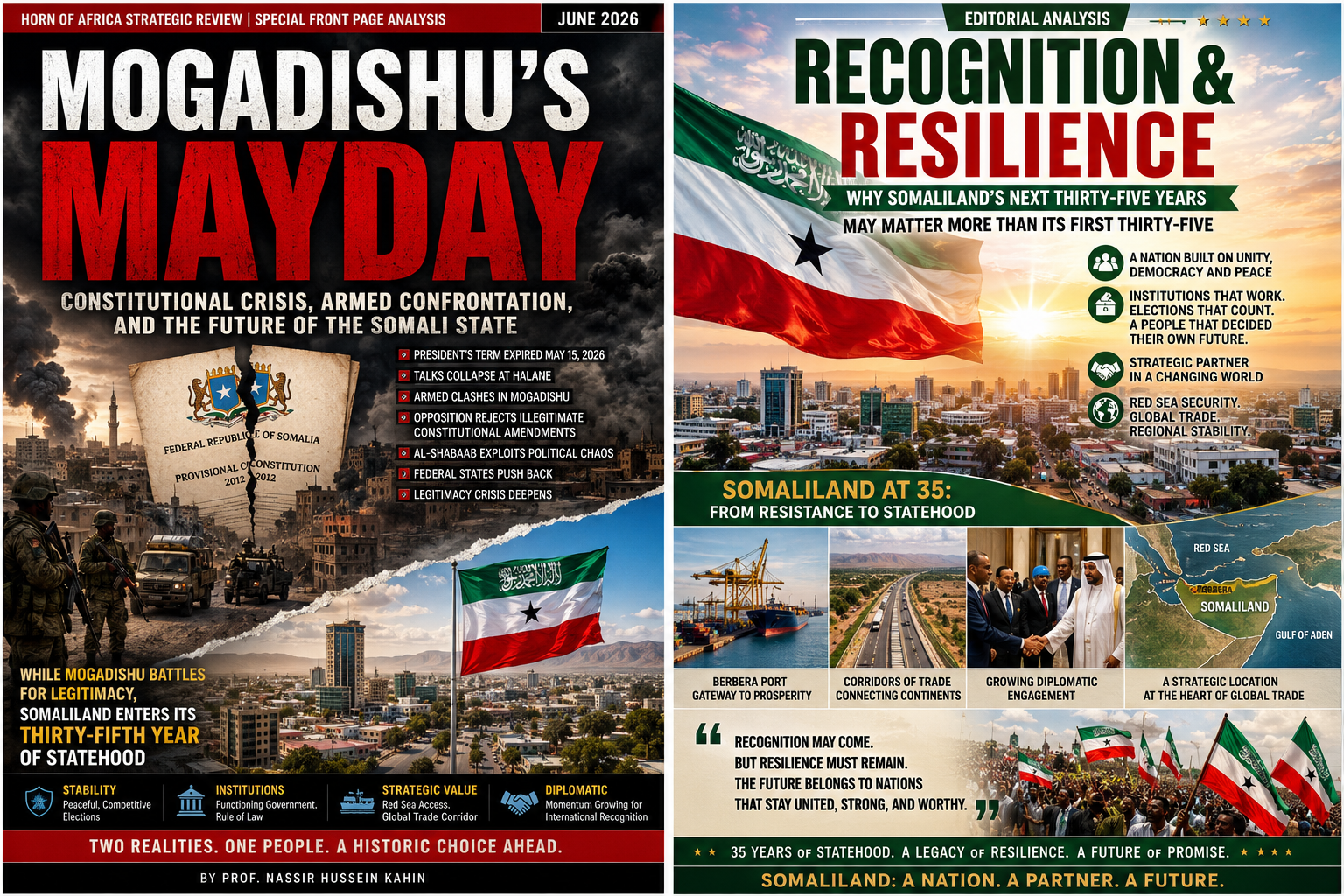
His constitutional mandate expired on May 15, yet his administration continues to govern under constitutional amendments that opposition leaders reject as illegitimate. Supporters argue that the amendments legally extended presidential and parliamentary terms to facilitate a transition toward one-person-one-vote elections. Critics view the move as a unilateral attempt to prolong executive power without national consensus.
The dispute is not merely legal. It is profoundly political.
For more than three decades, Somalia has struggled to establish a constitutional framework accepted by all major stakeholders. Every government since 1991 has faced the same challenge: how to balance federalism, clan representation, democratic legitimacy, and state authority in a deeply fragmented political landscape.
Those questions remain unresolved.
The collapse of internationally supported negotiations inside the heavily fortified Halane compound exposed the depth of the divide. Despite mediation efforts involving Western partners, opposition leaders and the federal government failed to reach common ground on elections, constitutional reform, or the political roadmap ahead.
The symbolism was striking.
Somalia’s most important political negotiations were taking place inside a foreign-protected enclave rather than through trusted national institutions. For many Somalis, this highlighted a reality that has persisted since the country’s collapse in 1991: the state’s dependence on external actors remains deeply embedded within its political architecture.
The security environment has further complicated matters.
Al-Shabaab continues to demonstrate remarkable resilience despite years of military operations, international assistance, and regional security interventions. The group’s ability to conduct attacks, maintain influence across large rural areas, and challenge government authority remains one of the most significant obstacles to state consolidation.
Yet the greatest threat facing Mogadishu may not be military defeat.
It may be institutional exhaustion.
History demonstrates that states rarely collapse because of a single battle or political disagreement. Instead, they weaken gradually as public confidence erodes, governing institutions lose legitimacy, and competing centers of authority emerge.
Somalia appears increasingly vulnerable to precisely that process.
Federal member states remain divided from the central government. Political opposition has hardened. Constitutional consensus is absent. Security challenges persist. Public frustration over corruption, governance failures, and economic hardship continues to grow.
These dynamics have led some analysts to draw uncomfortable parallels with Afghanistan before the fall of Kabul in 2021.
The comparison should not be interpreted literally. Al-Shabaab is not the Taliban, and Somalia’s circumstances differ significantly from Afghanistan’s. However, the underlying concern is similar: a government increasingly dependent on external support while struggling to secure broad domestic political legitimacy.
Whether Somalia ultimately experiences such an outcome remains uncertain.
What is increasingly clear, however, is that the country has entered one of the most dangerous political periods of the post-1991 era.
This reality inevitably raises another question.
What does Somalia’s instability mean for Somaliland?
For decades, the international community has maintained a policy centered on preserving Somalia’s territorial integrity while postponing a definitive resolution of Somaliland’s status.
That approach now faces growing scrutiny.
While Mogadishu struggles with constitutional disputes and political fragmentation, Somaliland enters its thirty-fifth year of restored sovereignty having built functioning institutions, conducted competitive elections, maintained relative stability, and expanded its strategic relevance within the Horn of Africa.
The contrast has become impossible to ignore.
Increasingly, policymakers and strategic planners are evaluating Somaliland not solely through the lens of historical grievances but through the lens of governance performance, Maritime Security, and regional stability.
The strategic importance of Berbera, the Red Sea corridor, and Somaliland’s geographic position near the Bab El-Mandeb has further elevated its international profile.
As global competition intensifies across the Red Sea region, the question facing external powers is changing.
The debate is no longer simply whether Somaliland deserves recognition.
The debate is becoming whether continued non-recognition serves the strategic interests of the international community.
That shift represents a profound geopolitical transformation.
The future remains uncertain. Somalia may yet find a political settlement capable of preserving national cohesion. Constitutional compromises remain possible. Dialogue could still prevail over confrontation.
But one fact is undeniable.
The political divergence between Mogadishu and Hargeisa has reached a historic magnitude.
And that divergence may ultimately become one of the defining geopolitical realities shaping the future of the Horn of Africa.

Prof. Nassir Hussein Kahin is a researcher, educator, journalist, and geopolitical analyst specializing in the Horn of Africa, the Red Sea, international law, diplomacy, and strategic affairs. To read Full Bio click on this link: ABOUT THE AUTHORProf. Nassir Hussein Kahin