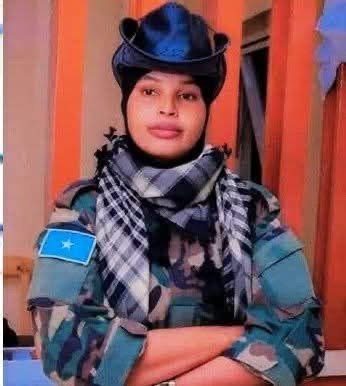
Fahiimo Yusuf Quuje- Reconciliation, Not Revenge, Will Define Somaliland's Future
Founder, Somaliland Unity and Recognition Initiative (SURI)
Reconciliation, Not Revenge, Will Define Somaliland’s Future
History offers nations moments that test not only their strength but also their wisdom. Somaliland now stands at one of those defining moments.
The return of prominent political figures associated with the Las Anod crisis—including Fahiimo Yusuf Quuje and several other influential personalities—has become one of the most discussed developments across Somaliland. Social media platforms have been flooded with reactions. Thousands of Somalilanders have welcomed the return of fellow citizens, viewing it as an opportunity for reconciliation and national healing. Others, however, continue to call for punishment, arguing that those who sided against Somaliland should face severe consequences.
These competing emotions are understandable. The conflict in Las Anod inflicted deep wounds. Families were displaced, lives were lost, and communities remain divided. Such pain cannot simply disappear because political figures return home.
Yet the defining question before Somaliland is not whether people remember the past.
It is whether Somaliland will allow the past to determine its future.
Somaliland Has Always Chosen the Harder Path
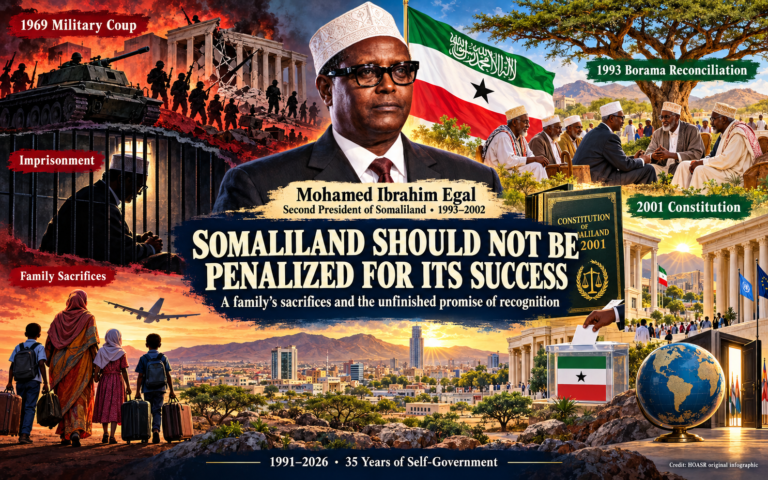
Since restoring its sovereignty in 1991, Somaliland has repeatedly confronted crises that could have destroyed the nation.
The internal conflicts of 1992–1993 and 1994–1996 were no less dangerous than today’s political divisions. Those years threatened to fracture the newly restored republic before its institutions had even taken root.
Instead of descending into permanent civil conflict, Somaliland made a remarkable choice.
Clan elders, religious scholars, intellectuals, political leaders, and ordinary citizens embraced dialogue instead of revenge. The Borama Conference and subsequent peace initiatives established a uniquely Somaliland model of reconciliation that attracted international scholarly attention.
Rather than governing through fear, Somaliland governed through consensus.
Rather than humiliating defeated rivals, it invited them back into the national project.
That decision transformed Somaliland from a war-torn society into one of Africa’s most stable democratic systems.
The Return of Political Figures Tests Somaliland’s Democratic Maturity
The arrival of Fahiimo Yusuf Quuje and other prominent political personalities is therefore much more than a political event.
It is a national test.
Strong democracies are measured not by how they treat loyal supporters but by how they deal with former opponents.
Every country eventually faces moments when yesterday’s adversaries become tomorrow’s partners in rebuilding the nation.
South Africa emerged stronger because Nelson Mandela chose reconciliation over revenge.
Rwanda rebuilt itself after unimaginable tragedy through national reconciliation mechanisms.
Even European democracies that endured civil wars ultimately found peace through political reintegration rather than endless retaliation.
Somaliland now faces its own version of that historic choice.
Justice and Reconciliation Must Walk Together
Welcoming citizens home should never be confused with abandoning justice.
The rule of law remains essential.
Where crimes may have been committed, constitutional institutions should investigate them fairly and impartially. Accountability strengthens democracy.
However, accountability should never become collective punishment or political vengeance.
A constitutional democracy distinguishes between individual responsibility and political disagreement.
If Somaliland wishes to demonstrate its democratic maturity to the international community, it must continue showing that disputes are resolved through institutions rather than emotions.
Justice without reconciliation risks permanent division.
Reconciliation without justice risks undermining public confidence.
A successful democracy requires both.
President Irro’s Peace Initiative Comes at the Right Time
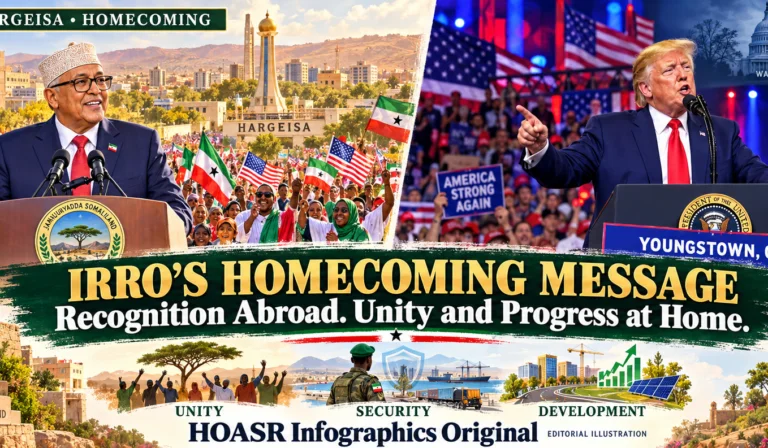
President Abdirahman Mohamed Abdillahi Irro’s peace and reconciliation initiative in Sool region arrives during one of the most important periods in Somaliland’s recent history.
Its emphasis on dialogue, community engagement, traditional mediation, and peaceful coexistence reflects the same philosophy that saved Somaliland during its most difficult years.
The initiative deserves broad national support—not because reconciliation is politically convenient, but because it has repeatedly proven to be Somaliland’s greatest strategic advantage.
Military victories may secure territory.
Political reconciliation secures nations.
Somaliland’s Strongest Argument for Recognition Is Not Military Power
International discussions about Somaliland often focus on geopolitics, Red Sea security, strategic ports, foreign investment, or regional alliances.
These are undoubtedly important.
Yet they are not Somaliland’s most persuasive argument.
The country’s greatest diplomatic asset is its political culture.
For more than three decades Somaliland has conducted competitive elections, maintained peaceful transfers of political authority, preserved functioning democratic institutions, protected relative stability, and repeatedly resolved internal crises through dialogue instead of prolonged violence.
Few states emerging from conflict possess such a record.
Every successful reconciliation effort strengthens Somaliland’s claim that it already behaves like a responsible sovereign state.
Recognition ultimately depends not only upon historical legal arguments but also upon demonstrated political maturity.
Somaliland continues providing exactly that evidence.
Social Media Reflects a Nation Ready to Heal
One striking aspect of the current developments has been the public response.
Across Facebook, X, YouTube, TikTok, and other platforms, overwhelming numbers of Somaliland citizens have welcomed returning political figures.
This reaction should not be dismissed as political enthusiasm alone.
It reflects something deeper.
Many Somalilanders appear exhausted by years of political polarization and conflict.
The public mood increasingly favors national unity over endless confrontation.
While a minority continues demanding retribution, the dominant public sentiment appears to recognize a simple reality:
No nation can permanently exclude large segments of its own society while expecting long-term stability.
Healing requires inclusion.
The Diaspora Also Has a Responsibility
Somaliland’s global diaspora has long played a central role in financing development, supporting democratic institutions, and advocating internationally for recognition.
That responsibility now extends to reconciliation.
Diaspora communities should resist inflammatory rhetoric that deepens internal divisions.
Instead, they should encourage dialogue, promote responsible public debate, and invest in peace-building initiatives that strengthen national cohesion.
Words spoken abroad often echo loudly at home.
Winning Back Citizens Is Greater Than Defeating Opponents
History rarely celebrates societies that mastered revenge.
It remembers those that mastered reconciliation.
Every citizen who chooses dialogue over hostility strengthens Somaliland.
Every community that rebuilds trust strengthens Somaliland.
Every political leader who places national unity above personal grievance strengthens Somaliland.
Winning back fellow Somalilanders is a far greater achievement than defeating them politically.
Reconciliation Must Also Bring Home the Captured
If Somaliland is to seize this moment as a genuine turning point, reconciliation should extend beyond the return of political figures. It should also create a pathway toward resolving one of the conflict’s most painful humanitarian legacies: the fate of those captured during the 2022–2023 Las Anod conflict.
For many families, the war did not end when the fighting subsided. Parents, spouses, children, and relatives continue to live with uncertainty while captured loved ones remain in detention. Regardless of political affiliation, these individuals are Somalilanders whose continued separation from their families serves as a constant reminder that the wounds of the conflict have yet to heal.
A comprehensive peace initiative should therefore include confidence-building measures such as the exchange or release of detainees through mutually agreed arrangements, facilitated where appropriate by respected clan elders, religious leaders, humanitarian organizations, and other trusted mediators. Such humanitarian gestures have often marked the beginning of lasting reconciliation in societies emerging from conflict.
President Abdirahman Mohamed Abdillahi Irro’s peace initiative presents a rare opportunity to address this issue with courage and statesmanship. Returning captured soldiers and detainees to their families would not erase the suffering of the past, nor would it diminish the importance of justice or accountability. Instead, it would demonstrate confidence in Somaliland’s long-standing tradition of resolving even the deepest divisions through dialogue, compassion, and respect for human dignity.
Nothing would symbolize national renewal more powerfully than seeing families reunited after years of separation. Such an achievement would send a clear message—not only to Somaliland’s citizens but also to the international community—that Somaliland remains committed to peace, reconciliation, and the rule of law.
The return of political leaders may open the door to reconciliation. The return of captured soldiers and detainees could help complete it.
Reconciliation Must Also Bring Home the Captured Soldiers
If Somaliland is to seize this moment as a genuine turning point, reconciliation should extend beyond the return of political figures. It should also create a pathway toward resolving one of the conflict’s most painful humanitarian legacies: the fate of those captured during the 2022–2023 Las Anod conflict.
For many families, the war did not end when the fighting subsided. Parents, spouses, children, and relatives continue to live with uncertainty while captured loved ones remain in detention. Regardless of political affiliation, these individuals are Somalilanders whose continued separation from their families serves as a constant reminder that the wounds of the conflict have yet to heal.
A comprehensive peace initiative should therefore include confidence-building measures such as the exchange or release of detainees through mutually agreed arrangements, facilitated where appropriate by respected clan elders, religious leaders, humanitarian organizations, and other trusted mediators. Such humanitarian gestures have often marked the beginning of lasting reconciliation in societies emerging from conflict.
President Abdirahman Mohamed Abdillahi Irro’s peace initiative presents a rare opportunity to address this issue with courage and statesmanship. Returning captured soldiers and detainees to their families would not erase the suffering of the past, nor would it diminish the importance of justice or accountability. Instead, it would demonstrate confidence in Somaliland’s long-standing tradition of resolving even the deepest divisions through dialogue, compassion, and respect for human dignity.
Nothing would symbolize national renewal more powerfully than seeing families reunited after years of separation. Such an achievement would send a clear message—not only to Somaliland’s citizens but also to the international community—that Somaliland remains committed to peace, reconciliation, and the rule of law.
The return of political leaders may open the door to reconciliation. The return of captured soldiers and detainees could help complete it.
The Editorial Verdict
The return of Fahiimo Yusuf Quuje and other prominent political figures should not be viewed as a victory for one political camp over another.
It should be viewed as an opportunity for Somaliland itself.
A confident nation does not fear reconciliation.
A democratic nation does not confuse forgiveness with weakness.
A mature republic understands that national unity is built not by demanding permanent loyalty but by creating pathways home for those willing to return peacefully and respect constitutional order.
If Somaliland succeeds once again in transforming political division into national reconciliation, it will reinforce the very qualities that have distinguished it since 1991.
The world has already witnessed Somaliland’s resilience.
It should now witness something even more powerful:
A nation confident enough to heal itself.
That, more than any diplomatic communiqué or foreign policy declaration, remains Somaliland’s strongest case for international recognition. Somaliland Unity and Recognition Initiative (SURI)
Prof. Nassir Hussein Kahin is a researcher, educator, journalist, and geopolitical analyst specializing in the Horn of Africa, the Red Sea, international law, diplomacy, and strategic affairs. To read Full Bio click on this link: ABOUT THE AUTHORProf. Nassir Hussein Kahin