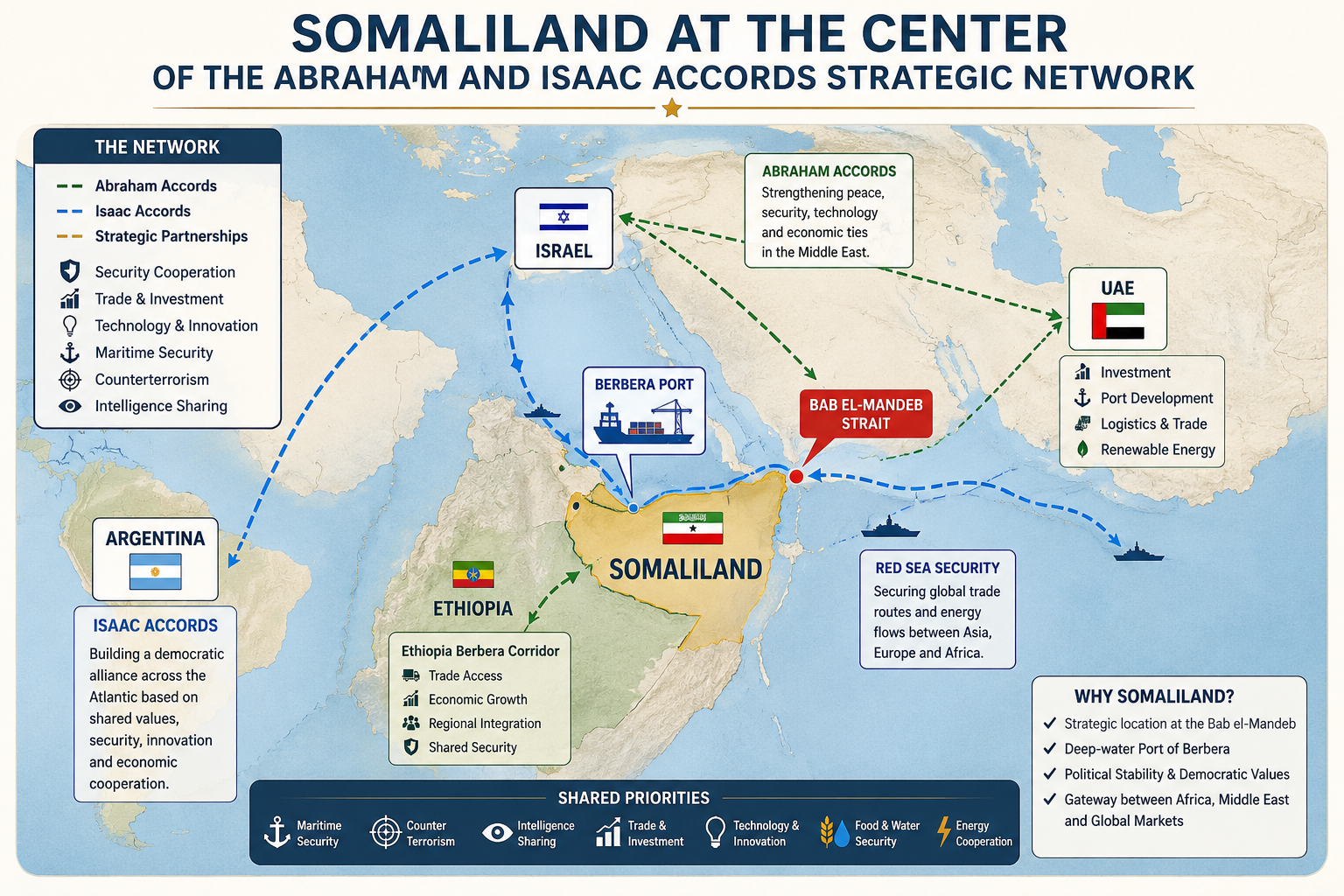
Somaliland's location near the Bab El-Mandel and its expanding Berbera Port could place it at the center of a new alliance connecting Israel, the UAE, Ethiopia and Latin American partners.
Somaliland’s Geopolitical Value Beyond International Recognition
By Prof. Nassir Hussein Kahin
Somaliland, the Red Sea and the Bab El-Mandeb are rapidly emerging as the strategic centerpiece of a new geopolitical architecture linking the Middle East, the Horn of Africa and Latin America. As Israel expands its diplomatic reach beyond the successful Abraham Accords through the emerging Isaac Accords, Somaliland’s strategic position overlooking one of the world’s most important maritime choke-points is becoming increasingly significant for regional security, global trade, maritime stability and international diplomacy.
The twenty-first century is witnessing a profound transformation in global geopolitics. Traditional military alliances are increasingly being complemented by strategic partnerships built upon economic integration, technological cooperation, maritime security, intelligence sharing, and shared democratic values. At the center of this evolving landscape stands Israel, whose diplomatic strategy has expanded far beyond the Middle East to encompass Africa, Europe, Asia, and increasingly Latin America.
The Abraham Accords, signed in 2020, marked the beginning of this transformation by reshaping relations between Israel and several Arab states. More recently, the emergence of the proposed Isaac Accords, spearheaded by Argentina and supported by like-minded democratic governments in Latin America, signals that Israel is constructing a broader geopolitical architecture extending well beyond its immediate neighborhood. Between these two diplomatic frameworks lies a region whose strategic importance is growing by the day: the Horn of Africa. At the center of that region stands Somaliland, overlooking the Bab El-Mandeb Strait and the increasingly vital waters of the Red Sea.
The Abraham Accords demonstrated that diplomacy in the modern era is no longer confined to peace treaties. Instead, they established an integrated framework encompassing security cooperation, intelligence sharing, cyber defense, artificial intelligence, trade, renewable energy, tourism, investment, and maritime security. Countries such as the United Arab Emirates, Bahrain, Morocco and Sudan found common strategic interests with Israel, driven not only by economic opportunity but also by shared concerns regarding regional stability and extremist threats. Consequently, the Abraham Accords evolved into one of the most significant geopolitical realignments in the Middle East since the Camp David Accords.
Building upon this momentum, the proposed Isaac Accords seek to extend similar principles into the Western Hemisphere. Under the leadership of Argentine President Javier Milei, Israel has found one of its strongest democratic partners in Latin America. Argentina’s support reflects more than bilateral friendship; it represents an emerging vision of democratic cooperation based upon innovation, free markets, technological advancement, counter-terrorism and political solidarity. Should additional Latin American nations embrace this initiative, the Isaac Accords could become the Western Hemisphere counterpart to the Abraham Accords, expanding Israel’s strategic partnerships across the Atlantic.
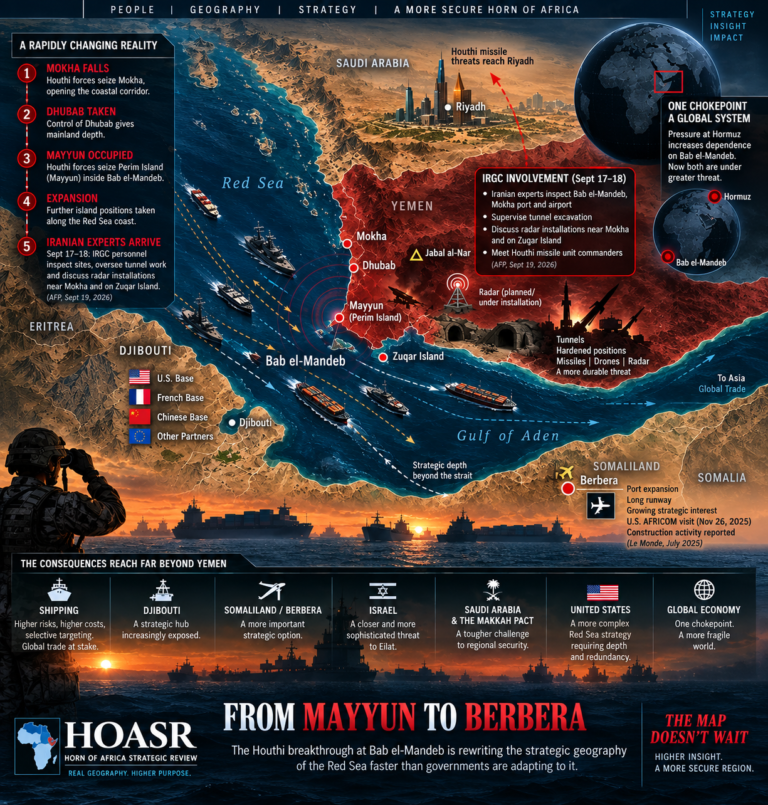
Yet the true geopolitical significance of these developments cannot be fully understood without examining the maritime dimension. Every major global power recognizes that the future of international commerce, energy security and military logistics increasingly depends upon secure sea lanes. Few waterways illustrate this reality more clearly than the Bab El-Mandel Strait, which connects the Red Sea to the Gulf of Aden and ultimately the Indian Ocean. Nearly fifteen percent of global maritime trade passes through this narrow corridor, linking Europe with Asia via the Suez Canal. Recent attacks against commercial shipping have underscored the vulnerability of this route and demonstrated how disruptions in the Red Sea reverberate throughout the global economy.
It is precisely here that Somaliland emerges as one of the most strategically significant territories in Africa. Although still awaiting formal international recognition, Somaliland occupies nearly 850 kilometers of coastline overlooking one of the world’s busiest maritime corridors. Unlike many neighboring regions affected by prolonged instability, Somaliland has developed functioning democratic institutions, maintained internal security, conducted peaceful transfers of political power and created an increasingly favorable environment for investment and international cooperation. These achievements have transformed Somaliland from a regional political anomaly into an increasingly valuable strategic partner.
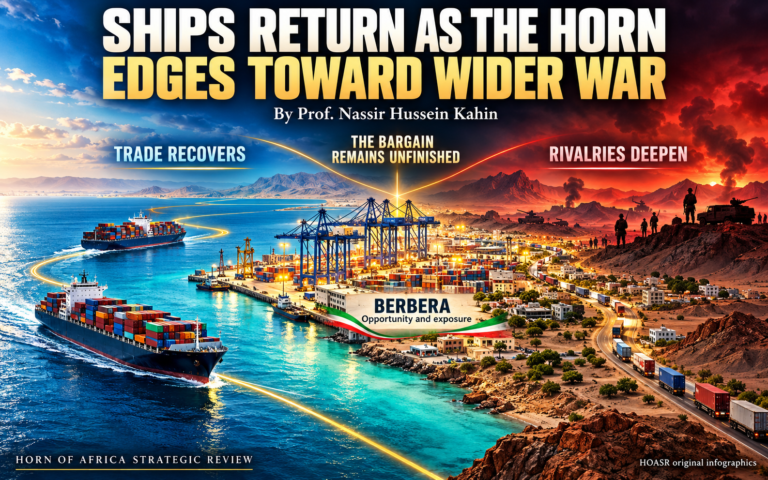
The Port of Berbera represents the centerpiece of this transformation. Once viewed primarily as a commercial harbor, Berbera has evolved into a modern deep-water port with expanding logistics infrastructure, a growing free economic zone and direct highway connections to Ethiopia. Supported by substantial investment from the United Arab Emirates through DP World, Berbera is steadily becoming one of the most important maritime gateways in East Africa. However, its importance extends beyond commerce. Modern ports serve as dual-use infrastructure capable of supporting humanitarian operations, naval logistics, maritime surveillance, disaster response, counter-piracy operations and intelligence cooperation. In this respect, Berbera is becoming a strategic asset not only for Somaliland but for the wider international community.
Meanwhile, Ethiopia provides another essential dimension of this emerging geopolitical framework. As Africa’s second-most populous nation and one of its largest economies, Ethiopia requires secure and diversified maritime access. The Berbera Corridor offers an increasingly important alternative trade route while strengthening economic integration across the Horn of Africa. Consequently, the relationship between Ethiopia and Somaliland extends beyond economics; it contributes to regional stability by creating shared incentives for infrastructure development, investment and long-term cooperation.
The United Arab Emirates further reinforces this strategic architecture. Through sustained investments in Berbera Port and associated logistics infrastructure, the UAE has positioned itself as a major stakeholder in Red Sea commerce. Abu Dhabi’s broader maritime strategy stretches from the Arabian Gulf through the Red Sea to East Africa, creating interconnected supply chains designed to withstand geopolitical disruptions. Within this framework, Berbera serves as an important logistical bridge connecting Gulf economies with African markets.
When these regional dynamics are viewed collectively, a larger strategic picture begins to emerge. The Abraham Accords provide Israel with an integrated network of partnerships across the Middle East. The Isaac Accords have the potential to extend that network into Latin America under Argentina’s leadership. Simultaneously, Somaliland occupies a pivotal position linking these diplomatic initiatives through one of the world’s most important maritime corridors. Rather than existing as separate regional arrangements, these frameworks could gradually evolve into an interconnected geopolitical network spanning the Middle East, Africa and the Western Hemisphere.
Indeed, Somaliland’s strategic importance derives not only from geography but also from its political trajectory. Democratic governance, relative stability, expanding infrastructure and a willingness to engage constructively with international partners distinguish Somaliland within a volatile region. As global powers increasingly prioritize secure maritime corridors, resilient supply chains and trusted regional partners, Somaliland’s value is likely to continue growing irrespective of the pace of formal diplomatic recognition.
Ultimately, the strategic competition unfolding across the Red Sea is about far more than ports and shipping lanes. It concerns the future architecture of international trade, energy security, technological cooperation and geopolitical influence. Countries occupying key maritime choke-points have historically shaped the course of global politics, and the Bab El-Mandel is rapidly becoming one of the defining strategic gateways of the twenty-first century.
If the Abraham Accords transformed the Middle East and the Isaac Accords ultimately redefine Israel’s engagement with Latin America, then Somaliland may emerge as the indispensable African pillar connecting these initiatives. Anchored by the Port of Berbera and overlooking the Bab El-Mandel Strait, Somaliland has the potential to become not merely a participant in this evolving strategic order but one of its central geographic anchors. In an era increasingly defined by connectivity, resilient partnerships and maritime security, Somaliland’s greatest strategic asset may not simply be its pursuit of international recognition, but its unique ability to bridge continents, safeguard one of the world’s most critical sea lanes and contribute to a new geopolitical architecture linking Jerusalem, Berbera, Addis Ababa, Dubai and, increasingly, Buenos Aires.
This article presents a forward-looking geopolitical analysis. It distinguishes between existing developments—such as the Abraham Accords, UAE investment in Berbera, and Israel’s growing ties with Argentina—and analytical projections about how these relationships could evolve. The notion of Somaliland serving as a central pillar in a future strategic architecture is an informed assessment rather than an announced policy of the governments concerned.
For further insight click on the following link:

Prof. Nassir Hussein Kahin is a researcher, educator, journalist, and geopolitical analyst specializing in the Horn of Africa, the Red Sea, international law, diplomacy, and strategic affairs. To read Full Bio click on this link: ABOUT THE AUTHORProf. Nassir Hussein Kahin