By Prof. Nassir Hussein Kahin
The recent academic article, “Incremental Statecraft or Strategic Entrapment? The Geopolitics of Contemporary U.S.–Somaliland Relations,” published on Facebook by Gulaid Yusuf Idaan, deserves recognition for identifying a critical reality often overlooked in discussions about Somaliland’s future: Washington increasingly treats Somaliland as a strategic actor while continuing to withhold formal diplomatic recognition.
The article correctly argues that the 2026 U.S. State Department report to Congress on potential areas of engagement with Somaliland represents an important shift in American thinking. The report’s emphasis on security cooperation, Maritime Security, trade, investment, and regional stability reflects Somaliland’s growing importance within American strategic calculations.
However, the article’s central warning—that Somaliland risks becoming trapped in a permanent state of strategic ambiguity—may underestimate how dramatically the geopolitical environment has changed.
Indeed, the same evidence cited in support of strategic ambiguity may now support the opposite conclusion.
The question facing Washington is no longer whether Somaliland is strategically relevant.
The question is whether American interests are now better served by formal recognition.
For more than three decades, U.S. policy toward Somaliland has largely been constrained by diplomatic caution, institutional inertia, and concerns about regional stability. Yet the assumptions that once justified that caution are rapidly eroding.
The Horn of Africa today bears little resemblance to the region of a decade ago.
The strategic environment has been transformed by intensifying competition between the United States and China, escalating instability in Somalia, expanding threats to international shipping, growing tensions across the Red Sea, and the emergence of Somaliland as one of the most stable political entities in the region.
Nowhere is this transformation more evident than in the maritime domain.
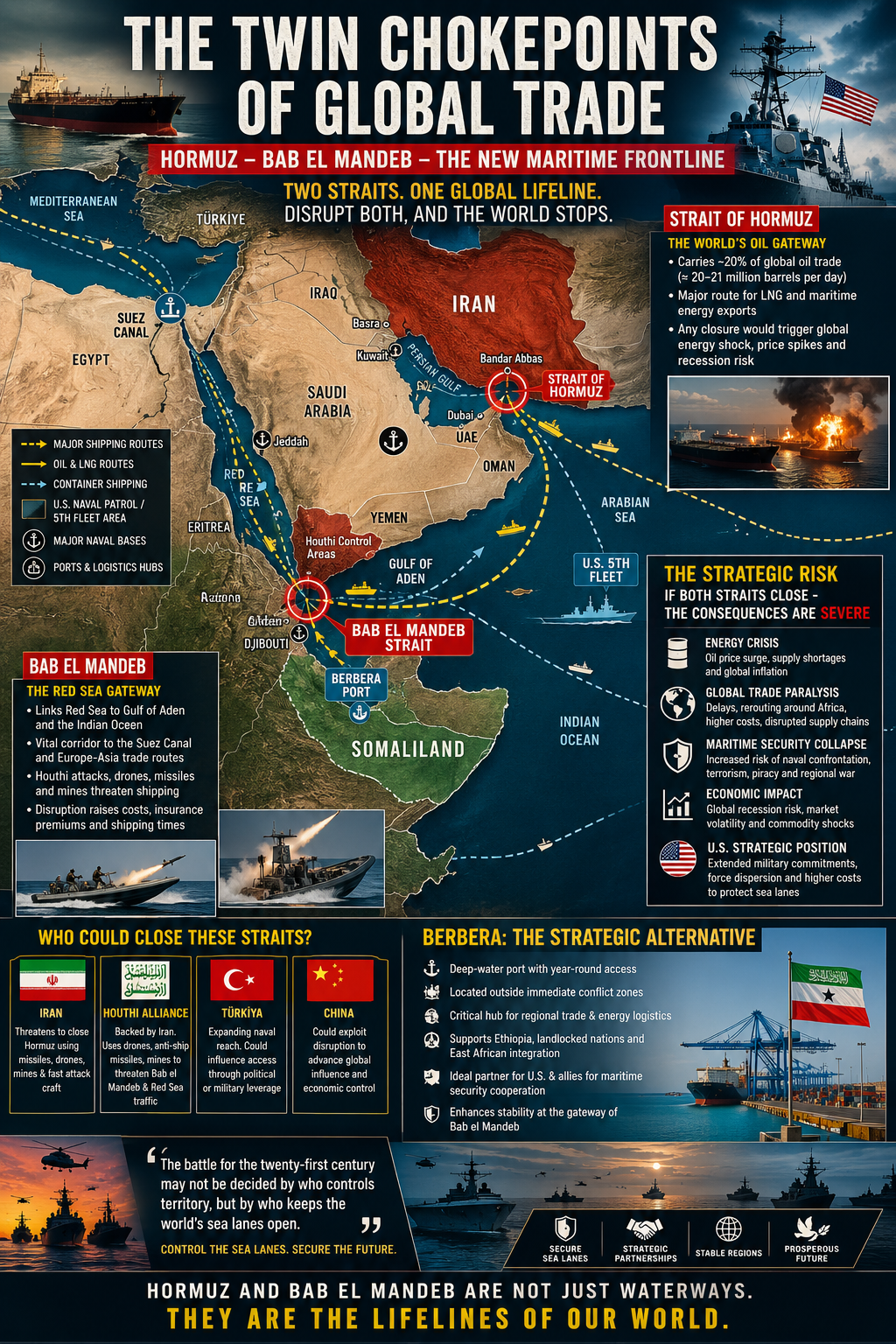
The ongoing confrontation involving Iran and repeated threats to shipping through the Strait of Hormuz have exposed the vulnerability of global trade routes. Any disruption in Hormuz immediately redirects attention toward alternative maritime chokepoints and supply corridors. In such circumstances, the Bab al-Mandab Strait assumes even greater significance.
The Bab al-Mandab is not merely a regional waterway. It is one of the world’s most critical strategic arteries, linking the Indian Ocean, Red Sea, Suez Canal, Europe, Asia, and the Middle East. A substantial portion of global trade and energy shipments pass through this corridor.
This reality places Somaliland in a uniquely strategic position.
Overlooking the Gulf of Aden and situated adjacent to one of the world’s most important maritime routes, Somaliland occupies geography that major powers cannot afford to ignore.
At the center of that geography stands Berbera.
The Port of Berbera has evolved far beyond its traditional role as a commercial harbor. It now represents a critical logistics hub with growing significance for maritime security, regional trade, military access, and economic connectivity throughout East Africa.
As Ethiopia’s population approaches 150 million and its demand for diversified access to international markets increases, Berbera’s strategic importance will continue to grow. American policymakers increasingly understand that securing maritime commerce in the Red Sea region requires reliable partners and dependable infrastructure. Somaliland offers both.
The comparison between Somaliland and Somalia further strengthens the case for recognition.
For thirty-five years Somaliland has maintained peace, built functioning institutions, conducted competitive elections, secured its borders, developed a professional security apparatus, and demonstrated a degree of political continuity that remains rare in the region.
During the same period, Somalia has continued to face recurring political crises, security challenges, disputes between federal institutions and member states, and dependence upon external military support.
Recognition should not be viewed as a reward.
Recognition should be viewed as an acknowledgment of political reality.
Increasingly, the international community finds itself in the paradoxical position of treating a functioning political entity as though it does not exist while continuing to invest diplomatic capital in arrangements that have repeatedly failed to produce durable outcomes elsewhere.
The geopolitical equation becomes even more compelling when viewed through the lens of great-power competition.
China’s expanding influence throughout Africa represents one of the defining strategic challenges confronting the United States in the twenty-first century. From infrastructure financing and port development to military basing and political influence operations, Beijing has steadily increased its presence across the continent.
The Horn of Africa has become one of the principal theaters of this competition.
Somaliland’s partnership with Taiwan further elevates its strategic significance.
The relationship between Somaliland and Taiwan represents more than a diplomatic partnership. It symbolizes a broader alignment among democratic societies resisting political coercion from larger neighboring powers.
For Washington, this alignment directly supports wider strategic objectives related to democratic resilience, regional stability, and balancing authoritarian influence.
At the same time, political attitudes within the United States appear to be evolving.
Recognition bills introduced in Congress, growing bipartisan interest in Somaliland, increasing engagement by congressional committees, and expanding cooperation with U.S. security institutions suggest that Somaliland is steadily moving from the margins toward the center of American policy discussions.
This trend is particularly significant in light of broader strategic thinking emerging from conservative foreign-policy circles and the priorities associated with a potential second Trump administration.
An emphasis on strategic competition with China, maritime security, transactional diplomacy, critical mineral supply chains, burden-sharing, and support for reliable regional partners aligns closely with Somaliland’s geopolitical profile.
Perhaps the most significant development of all, however, is the recognition of Somaliland by Israel.
For decades, opponents of Somaliland’s recognition argued that no state would be willing to establish the precedent.
That argument no longer exists.
Israel has already crossed that threshold.
Whether one agrees with every aspect of Israeli foreign policy is beside the point. The significance lies in the fact that a United Nations member state concluded that recognition of Somaliland serves its national interests and regional strategy.
History demonstrates that diplomatic recognition often begins with a small number of pioneering states before expanding more broadly. Recognition is rarely a single event. It is a process.
The United States now faces a choice.
It can continue managing Somaliland through a framework of strategic ambiguity developed under very different geopolitical circumstances.
Or it can recognize that the realities of 2026 differ fundamentally from those of previous decades.
Strategic ambiguity served a purpose when policymakers sought flexibility.
Today, ambiguity increasingly risks becoming an obstacle to strategic clarity.
The evidence is overwhelming.
Somaliland has demonstrated state capacity.
Somaliland has demonstrated democratic resilience.
Somaliland has demonstrated strategic value.
Somaliland has demonstrated reliability as a partner.
Most importantly, Somaliland has demonstrated all of these qualities consistently for more than thirty-five years.
Recognition would not create a new reality.
Recognition would acknowledge an existing one.
Israel has already recognized that reality.
The question before Washington is whether it intends to lead the emerging strategic order in the Horn of Africa—or continue allowing diplomatic caution and institutional inertia to dictate policy in a region that has become too important to ignore.
For the United States, the strongest argument for recognizing Somaliland is no longer moral, historical, or legal.
It is strategic.
And that argument grows stronger with every passing year.

Prof. Nassir Hussein Kahin is a researcher, educator, journalist, and geopolitical analyst specializing in the Horn of Africa, the Red Sea, international law, diplomacy, and strategic affairs. To read Full Bio click on this link: ABOUT THE AUTHORProf. Nassir Hussein Kahin