
By Prof. Nassir Hussein Kahin
A diplomatic visit can sometimes change more than relations between two countries. Occasionally, it alters the strategic geometry of an entire region.
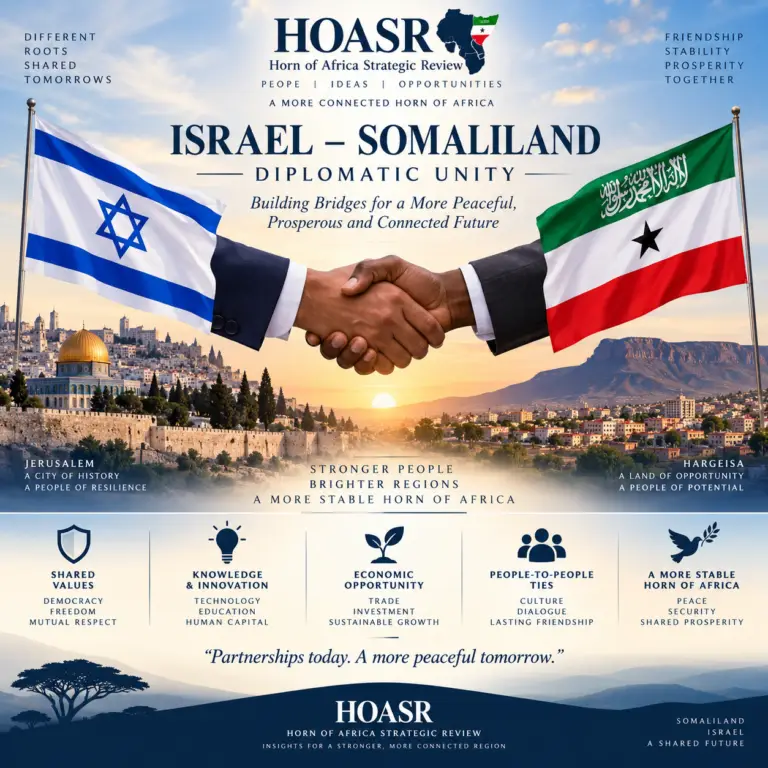
If the reported June 15–17 visit of Somaliland President Abdirahman Mohamed Abdillahi Irro to Israel proceeds as expected, history may record it as one of those moments.
According to multiple reports, President Irro is expected to meet Israeli President Isaac Herzog and Prime Minister Benjamin Netanyahu, officially inaugurate Somaliland’s embassy in Jerusalem, visit Israel’s Holocaust memorial, and advance a rapidly expanding strategic partnership between the two nations. The visit follows Israel’s historic recognition of Somaliland on December 26, 2025, making Israel the first United Nations member state to formally recognize Somaliland’s sovereignty after more than three decades of diplomatic isolation
For Somaliland, the visit represents the culmination of a 35-year struggle for international recognition.
For Israel, it represents something equally significant: a return to the strategic heart of the Red Sea.
The significance of the visit extends far beyond diplomatic symbolism. The real story lies thousands of kilometers away from Jerusalem, along the shores of the Gulf of Aden and the Bab El-Mandeb Strait—the narrow maritime chokepoint through which nearly all shipping entering and leaving the Red Sea must pass.
In recent years, the Red Sea has transformed from a commercial corridor into one of the world’s most contested strategic waterways. Houthi attacks on international shipping, Iranian influence across the region, growing Chinese military presence in Djibouti, Turkish expansion in Somalia, and renewed great-power competition have elevated the Horn of Africa from a peripheral theater to a central arena of global geopolitics.
At the center of this competition sits Berbera.
For decades, military planners from Washington, London, Tel Aviv, Abu Dhabi, and Addis Ababa have recognized Berbera’s unique strategic value. Located directly opposite Yemen and overlooking the approaches to Bab el-Mandeb, Berbera occupies one of the most advantageous positions on the African side of the Red Sea.
Should Somaliland and Israel deepen their partnership beyond diplomacy into intelligence and security cooperation, Berbera could emerge as one of the most important strategic locations in the broader Middle East security architecture.
Israeli strategic analysts have already argued that recognition of Somaliland strengthens Israel’s position in the Red Sea Basin and creates opportunities for deeper security cooperation in a region increasingly affected by Iranian and Houthi activity
That possibility explains why the anticipated opening of a Somaliland embassy in Jerusalem has generated intense opposition from Somalia and concern among several regional actors. Reports indicate that Somaliland would become only the second Muslim-majority state or territory to establish an embassy in Jerusalem after Kosovo, a move carrying enormous symbolic and geopolitical implications
The controversy is not really about an embassy.
It is about alignment.
The opening of an embassy in Jerusalem would publicly signal that Somaliland has chosen its strategic camp in an increasingly polarized regional environment.
For decades, Somaliland’s foreign policy focused primarily on gaining recognition. Today, the conversation is evolving toward partnerships, security architecture, and regional influence.
That shift creates both opportunities and risks.
On the opportunity side, Somaliland stands to gain access to Israeli expertise in agriculture, water management, cybersecurity, intelligence, technology, Maritime Security, and potentially advanced defensive capabilities. Israeli and Somaliland officials have repeatedly emphasized cooperation across multiple sectors since recognition was announced
The partnership could also accelerate Somaliland’s acceptance by other countries.
Recognition has historically behaved like a domino effect. Once one state breaks a diplomatic barrier, others often find it easier to follow. Israeli recognition has already forced governments throughout Africa, the Middle East, Europe, and North America to re-evaluate long-standing assumptions about Somaliland’s status.
Ethiopia, which has enormous strategic interests in securing reliable access to the Red Sea, will be watching developments closely.
The United States will also be paying attention.
Washington increasingly views the Horn of Africa through the lens of competition with China, maritime security, and the protection of critical trade routes. A stable, democratic, and strategically located Somaliland aligns with several long-term American interests.
Yet risks remain substantial.
A deeper Somaliland-Israel alliance could make Somaliland a target for hostile disinformation campaigns, cyberattacks, diplomatic pressure, and attempts at political destabilization by actors opposed to the emerging partnership.
Critics have already raised concerns about potential Israeli military facilities, surveillance installations, or intelligence cooperation in Somaliland. While no such agreements have been publicly announced, the speculation itself reflects how dramatically perceptions of Somaliland’s strategic importance have changed
What appears increasingly clear is that the old geopolitical map of the Red Sea is being redrawn.
For decades, Djibouti served as the uncontested gateway to the Horn of Africa for major powers. Today, Berbera is emerging as a second strategic gateway, attracting growing attention from international actors seeking alternatives in an increasingly competitive region.
President Irro’s expected visit to Israel therefore represents more than a diplomatic journey.
It is a test of whether Somaliland can successfully transition from an unrecognized state seeking legitimacy into a recognized strategic actor shaping the future of the Horn of Africa.
If successful, the visit may be remembered as the moment Somaliland ceased being merely a recognition issue and became a central pillar in the evolving security architecture of the Red Sea, the Gulf of Aden, and the wider Middle East.
History rarely announces when it is turning.
Sometimes it arrives quietly aboard a diplomatic aircraft bound for Jerusalem.

Prof. Nassir Hussein Kahin is a researcher, educator, journalist, and geopolitical analyst specializing in the Horn of Africa, the Red Sea, international law, diplomacy, and strategic affairs. To read Full Bio click on this link: ABOUT THE AUTHORProf. Nassir Hussein Kahin