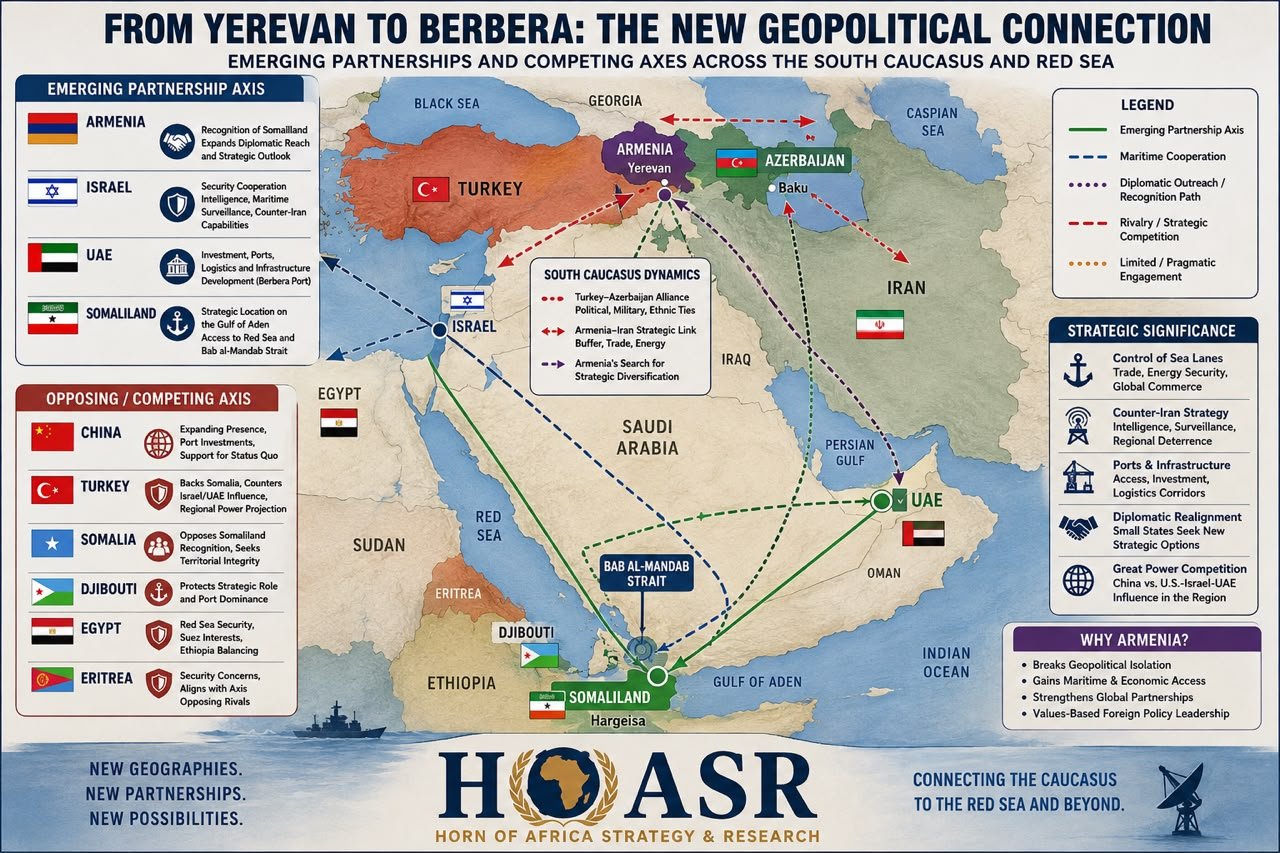
A geopolitical map connecting Armenia, Somaliland, Israel, the United Arab Emirates, Turkey, Azerbaijan, Iran and the Bab al-Mandab Strait, illustrating emerging strategic partnerships and competing regional alignments across the South Caucasus and Red Sea.
Michael Rubin’s call for Armenian recognition of Somaliland points toward a larger strategic possibility: a maritime partnership linking Somaliland, the United Arab Emirates and Israel—and offering landlocked Armenia a route into the geopolitics of the Red Sea
By Prof. Nassir Hussein Kahin
HARGEISA, Somaliland — Michael Rubin’s argument that Armenia should recognize Somaliland begins with history but ultimately arrives at strategy.
Writing in The Armenian Mirror-Spectator, Rubin draws a comparison between two societies whose modern identities were shaped by mass violence, interrupted sovereignty and national reconstruction. Armenia survived the destruction of its population under the Ottoman Empire, the collapse of its first modern republic and seven decades of Soviet incorporation.
Somaliland endured the destruction of Hargeisa and Burao, the mass killing and displacement of the Isaaq population under Mohamed Siad Barre, and the violent failure of its union with Somalia.
Rubin argues that Armenia should view Somaliland not as a distant and culturally unfamiliar territory, but as another survivor state whose sovereignty was interrupted and later restored.
Armenian recognition would give Somaliland diplomatic legitimacy from a UN member state, while Armenia could gain a new partner near the Bab al-Mandab, one of the world’s most consequential maritime chokepoints.
The moral case is significant. Both peoples place remembrance, survival and restoration at the centre of national identity. Both face adversaries that contest their historical narratives. Both have attempted to rebuild functioning states in difficult geopolitical environments.
But the more consequential element of Rubin’s proposal is not historical solidarity. It is the possibility that Armenia could use recognition of Somaliland to reposition itself within a wider strategic network stretching from the South Caucasus to the Gulf of Aden.
Such a network would not be a conventional alliance. It would be an alignment of complementary interests linking Armenia’s technology and diplomatic networks, Israel’s security capabilities, the UAE’s ports and investment power, and Somaliland’s strategic geography.
Its potential centre would be Berbera.
Its wider theatre would be the Red Sea.
And its underlying purpose would be to give a group of relatively small or strategically exposed states greater autonomy amid intensifying competition involving Turkey, China, Iran, Egypt and other regional powers.
The historical system surrounding Armenia
To understand why Armenia might look toward Somaliland, one must first understand the strategic trap created by Armenia’s geography.
Modern Armenia sits at the intersection of four historically powerful political systems: Turkey to the west, Azerbaijan to the east, Iran to the south and Russia beyond Georgia to the north.
Each has shaped Armenia’s security environment.
The Armenian relationship with Turkey remains burdened by the Armenian Genocide, Turkey’s rejection of the genocide designation and Ankara’s long-standing support for Azerbaijan. Turkey closed its land border with Armenia in 1993 during the first Nagorno-Karabakh war. Although normalization efforts have advanced periodically—and Turkey removed a restriction on direct trade with Armenia in May 2026—the border question and the absence of full diplomatic normalization continue to reflect the unresolved historical and strategic divide
Turkey’s relationship with Azerbaijan is qualitatively different. Ankara and Baku describe themselves as “one nation, two states.” Their cooperation rests upon linguistic affinity, ethnic nationalism, military coordination, energy corridors and a shared ambition to reshape the South Caucasus.
Turkey supported Azerbaijan politically and militarily during the 2020 Nagorno-Karabakh war. Azerbaijan’s battlefield success strengthened Ankara’s influence across the region and weakened Armenia’s traditional security position.
For Armenia, this produced a severe strategic imbalance. Turkey and Azerbaijan increasingly operated as a coordinated geopolitical space, while Armenia’s dependence on Russia yielded diminishing protection.
Iran became Armenia’s indispensable southern counterweight.
Despite being an Islamic republic, Iran has historically maintained pragmatic relations with Christian Armenia. Tehran’s calculations have never been primarily religious. Iran has sought to prevent Azerbaijan and Turkey from creating a continuous geopolitical corridor that could reduce Iranian access to Armenia, weaken Tehran’s regional position and stimulate Azerbaijani nationalism among Iran’s own large ethnic-Azerbaijani population.
Iran therefore values Armenia as a territorial buffer, trading partner and barrier against the expansion of Turkish and Azerbaijani influence.
Yet Armenia’s relationship with Iran also creates complications.
Israel regards Iran as its principal strategic adversary. Azerbaijan, meanwhile, has become an important Israeli energy, defence and intelligence partner. Baku’s position on Iran’s northern frontier gives it significance far beyond the South Caucasus. Recent analysis has described Azerbaijan’s posture toward Israel and Iran as one of alignment tempered by restraint: Baku benefits from Israeli cooperation while avoiding the appearance of becoming an open launching platform against Tehran.
Armenia is therefore positioned within an interlocking strategic system:
Turkey supports Azerbaijan.
Israel arms Azerbaijan.
Iran supports Armenia’s territorial continuity.
Russia seeks to preserve influence over both Armenia and Azerbaijan.
The United States and Europe promote normalization and new transit arrangements.
Armenia must operate inside this system without becoming fully dependent on any one participant.
That is the strategic context in which Rubin’s Somaliland proposal becomes relevant.
Recognition as strategic diversification
Recognition of Somaliland would not solve Armenia’s security dilemma. It would not reopen the Turkish border, neutralize Azerbaijan’s military advantage or replace Armenia’s relations with Iran.
But it could widen Armenia’s diplomatic horizon.
For most of its modern history, Armenia’s foreign policy has been dominated by immediate survival in the South Caucasus. Its diplomatic attention has centred on Russia, Iran, Turkey, Azerbaijan, Europe and the Armenian diaspora.
Somaliland would introduce Armenia to an entirely different geopolitical theatre: the Red Sea, Gulf of Aden and Horn of Africa.
That theatre is no longer peripheral.
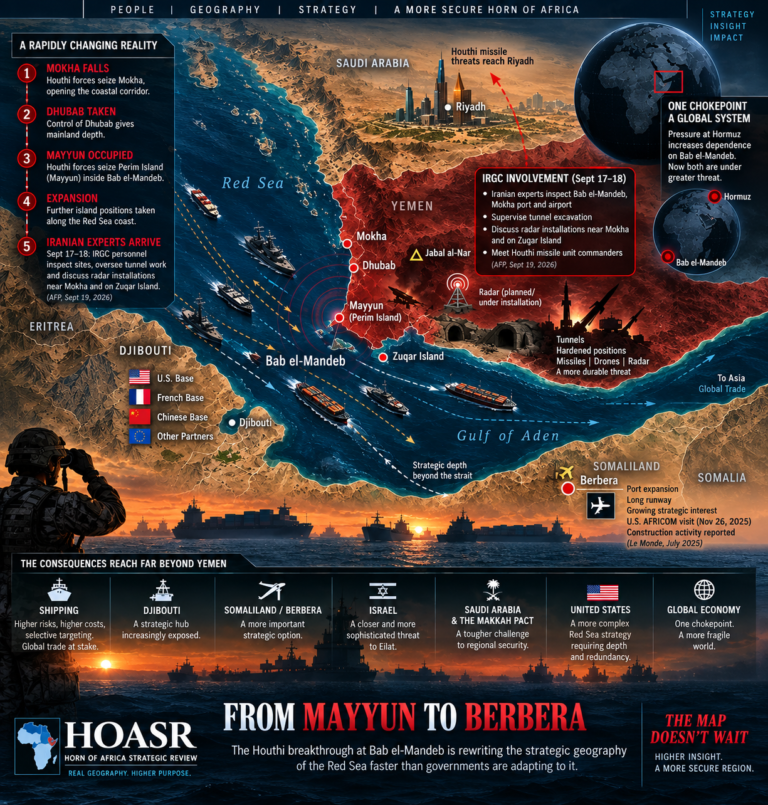
The Bab al-Mandab connects the Indian Ocean to the Red Sea and the Suez Canal. It carries commercial shipping, energy supplies and strategic naval traffic. Conflict in Yemen, Houthi attacks on shipping and wider tensions involving Iran have transformed the waterway into a central arena of global security competition.
Saudi Arabia’s July 2026 initiative to form a multinational maritime defence coalition, supported by countries including Turkey, Egypt and Djibouti, demonstrates how rapidly the Red Sea security environment is being reorganized. The UAE was notably absent from the initial group of formal supporters, reflecting the divergent interests now shaping maritime politics.
China, meanwhile, has expanded its diplomatic, commercial and military presence in the region, particularly through its base in Djibouti and its dependence on secure maritime commerce. Recent reporting also indicates that Beijing has engaged directly with the Houthis to facilitate the passage of Chinese-linked shipping through the Red Sea—a reminder that China may protect its commercial interests through selective arrangements rather than through a single alliance structure.
Somaliland stands beside this contested maritime system.
Its coastline, Berbera port, airport infrastructure and relative internal stability make it strategically valuable. Recognition by Israel in December 2025 elevated Somaliland’s position from that of an isolated de facto state to a potential participant in a wider Red Sea security architecture. (Mediterra Strategy Foundation)
Armenian recognition could add a new dimension to that development.
It could connect a landlocked South Caucasian state to an emerging maritime partnership based not on contiguous territory, but on logistics, technology, security and diplomatic exchange.
The theoretical Somaliland–UAE–Israel maritime axis
A future Somaliland–UAE–Israel axis would rest on three different but complementary forms of power.
Somaliland would provide geography.
The UAE would provide infrastructure, investment and maritime logistics.
Israel would provide security technology, intelligence capabilities and strategic deterrence.
Somaliland: geography and political access
Somaliland controls a long coastline on the Gulf of Aden and possesses the port of Berbera, situated east of the Bab al-Mandab approaches.
Berbera can serve several overlapping functions:
* a commercial gateway to Ethiopia;
* a logistics and transshipment hub;
* a maritime security platform;
* an aviation and surveillance location;
* an alternative to overdependence on Djibouti;
* a strategic point connecting the Gulf, East Africa and the Indian Ocean.
Somaliland’s political stability gives it an advantage over many parts of the surrounding region. Yet its lack of broad recognition has limited access to international finance, security agreements and formal diplomatic institutions.
Recognition by Israel—and potentially Armenia—could gradually reduce that isolation.
The UAE: ports, capital and strategic depth
The UAE has spent years building a network of ports, commercial facilities and political relationships around the Arabian Peninsula, the Red Sea and the Horn of Africa.
Its engagement with Berbera through DP World gave Somaliland major infrastructure investment and gave Abu Dhabi access to an important trade and strategic location.
The UAE’s approach is commercial but never merely commercial. Ports create political relationships. Logistics infrastructure creates leverage. Investment corridors create long-term security interests.
Abu Dhabi also maintains close security and technological relations with Israel, even while preserving diplomatic and trade channels with Iran. Recent reporting describes the UAE’s regional posture as a balance between deterrence and accommodation: it seeks Israeli and American security support while avoiding permanent confrontation with Tehran.
A UAE–Somaliland partnership therefore gives Abu Dhabi strategic depth on the African side of the Gulf of Aden without requiring Somaliland to become a formal Emirati military dependency.
Israel: intelligence, maritime security and counter-Iran strategy
Israel’s interest in Somaliland is closely related to Red Sea security.
The Houthi threat, Iranian influence in Yemen and vulnerability of shipping routes have increased Israel’s need for intelligence coverage and strategic partnerships near the southern entrance to the Red Sea.
Somaliland could offer Israel proximity without direct territorial occupation.
Israel could contribute:
* radar and early-warning technology;
* unmanned aerial surveillance;
* cybersecurity;
* maritime-domain awareness;
* counter-drone systems;
* intelligence cooperation;
* coast-guard training;
* protection of ports, airports and communications infrastructure.
The strategic logic is clear. Israel’s recognition of Somaliland creates the diplomatic basis for cooperation that previously could only occur discreetly or indirectly.
Combined with Emirati infrastructure and Somaliland’s location, Israel’s security capabilities could form the third component of a maritime triangle.
Yet this axis should not be romanticized.
Somaliland would have to ensure that cooperation strengthened national sovereignty rather than converting its territory into a forward operating arena for other states’ conflicts. The UAE would continue balancing relations with Iran, Saudi Arabia and other Arab powers. Israel would prioritize its own security calculations rather than Somaliland’s recognition agenda.
The axis would therefore be transactional, not sentimental.
That is precisely why it could become durable.
Where Armenia could enter the axis
Armenia has no coastline, major navy or direct territorial connection to Somaliland.
Its role would therefore be different from that of Israel or the UAE.
Armenia would enter as a diplomatic, technological and knowledge-based partner.
Recognition of Somaliland would be the political gateway.
Diplomatic recognition and normalization
Armenian recognition would demonstrate that Somaliland’s international position is expanding beyond Israel and its traditional partnerships.
For Yerevan, the decision would show that Armenia is capable of independent foreign-policy initiatives outside the South Caucasus.
It would also create direct ties with a Muslim-majority state at a time when Armenia needs to demonstrate that its conflict with Turkey and Azerbaijan is not a civilizational conflict between Christianity and Islam.
A formal relationship with Somaliland would weaken attempts to frame Armenian diplomacy in religious terms.
Technology and cybersecurity
Armenia possesses a strong technology sector, a highly educated diaspora and experience in software, engineering, cybersecurity and digital education.
Somaliland requires precisely these capacities.
Potential Armenian contributions could include:
* cyber-defence training;
* protection of government networks;
* digital identity and electoral systems;
* financial-technology security;
* coding and engineering education;
* drone-detection software;
* port-management technology;
* telecommunications resilience;
* archival digitization and genocide documentation.
This would allow Armenia to contribute to the axis without becoming a military frontline state.
Education and genocide documentation
Armenia has developed extensive institutions for genocide remembrance, historical research, archival preservation and international advocacy.
Somaliland continues to seek broader documentation and recognition of the Isaaq genocide.
Partnerships between Armenian and Somaliland institutions could establish:
* a genocide research centre in Hargeisa;
* exchanges between museums and universities;
* forensic and archival training;
* oral-history programmes;
* international conferences on genocide prevention;
* comparative research on denial, memory and reconstruction.
This would translate Rubin’s moral comparison into institutional cooperation.
Diaspora diplomacy
The Armenian diaspora is politically influential in the United States, France, Canada, Russia, the Middle East and parts of Latin America.
Somaliland’s diaspora is also highly active, particularly in the United Kingdom, North America, Scandinavia and the Gulf.
Cooperation between the two diasporas could broaden Somaliland’s recognition campaign while giving Armenia new relationships in African and Muslim political spaces.
Commercial and logistical access
Armenia’s goods would not reach Berbera directly without transit through Georgia, Iran, the Gulf or other intermediaries. Nonetheless, participation in a UAE-linked logistics network could give Armenian companies access to markets in the Horn of Africa and East Africa.
Berbera could eventually become a destination for:
* Armenian technology services;
* pharmaceuticals;
* agricultural expertise;
* educational products;
* engineering firms;
* processed foods;
* specialized industrial equipment.
The relationship would be modest at first. Its significance would lie in strategic diversification rather than immediate trade volume.
A competing defensive alignment
The emergence of a Somaliland–UAE–Israel axis, with Armenian diplomatic participation, would not occur in a vacuum.
Other states would interpret it through their own security concerns.
A theoretical counter-alignment might include China, Turkey, Somalia, Djibouti, Egypt and—under certain circumstances—Eritrea.
But it would be misleading to describe these states as a coherent alliance today.
Their interests overlap in some areas and conflict in others.
The more accurate description would be a collection of states adopting parallel defensive postures against changes they fear could weaken their influence, territorial claims or strategic access.
Somalia: defence of territorial claims
Somalia would be the most direct opponent of the axis.
Mogadishu regards Somaliland as part of Somalia and would view additional recognitions as a threat to its territorial claim.
It would likely respond through:
* diplomatic pressure at the African Union and United Nations;
* closer military cooperation with Turkey and Egypt;
* opposition to international agreements signed directly with Hargeisa;
* efforts to isolate Somaliland in Arab and Islamic organizations;
* legal challenges to maritime or security agreements;
* political engagement with communities opposed to Somaliland’s government.
Somalia’s objection would be territorial and constitutional rather than primarily ideological.
Its objective would be to prevent Somaliland’s de jure sovereignty from becoming progressively normalized through bilateral recognition and strategic partnerships.
Turkey: protecting influence and supporting Somalia
Turkey has made Somalia one of the central pillars of its Africa policy.
It operates a major military training facility in Mogadishu, supports Somali security forces and has expanded economic, diplomatic and defence cooperation with the federal government.
An Israeli-backed strategic presence in Somaliland would be interpreted in Ankara through several lenses:
* competition with Israel;
* protection of Turkey’s investments in Somalia;
* support for Somali territorial integrity;
* concern over Emirati influence;
* control of maritime access and defence contracts;
* the wider Turkey–Azerbaijan–Armenia balance.
Armenian entry into the Somaliland relationship could add another layer of sensitivity. Ankara might see it as an attempt by Yerevan to contest Turkish influence beyond the South Caucasus.
Turkey’s likely response would not necessarily be direct confrontation. It could deepen military assistance to Somalia, expand naval cooperation and increase diplomatic activity across the Horn.
China: preserving the Djibouti-centred order
China’s interests are different.
Beijing’s priorities are maritime access, commercial security, political stability, protection of investments and opposition to diplomatic precedents that could benefit Taiwan.
Somaliland’s close relationship with Taiwan already places it in conflict with China’s diplomatic position.
A Somaliland axis involving Israel, the UAE and Armenia could be interpreted by Beijing as part of a wider effort to reduce Chinese influence around the Bab al-Mandab.
China would likely respond by reinforcing:
* its strategic position in Djibouti;
* relations with Somalia;
* diplomatic pressure against Somaliland recognition;
* infrastructure investment in competing ports;
* economic incentives for governments supporting Somalia’s territorial claim;
* political opposition to Somaliland–Taiwan cooperation.
China’s objective would not necessarily be to create a military bloc. It would seek to ensure that no alternative strategic corridor undermined Djibouti’s importance or gave Taiwan’s partner in Hargeisa greater legitimacy.
Djibouti: defending monopoly and relevance
Djibouti’s interests are intensely practical.
Its economy and strategic status depend heavily on ports, military bases and Ethiopia’s reliance on Djiboutian trade corridors.
Berbera’s development represents commercial competition.
A stronger Somaliland backed by the UAE and Israel could reduce Djibouti’s relative monopoly over Ethiopian access to the sea.
Djibouti would therefore have incentives to support Somalia’s territorial position and resist Somaliland recognition.
At the same time, Djibouti hosts military facilities belonging to several external powers and has long survived by balancing rival states. It would be unlikely to subordinate itself entirely to either a Chinese- or Turkish-led bloc.
Its posture would remain opportunistic: oppose strategic changes that threaten its port revenues while preserving relations with all major powers.
Egypt: the Nile, Ethiopia and the Red Sea
Egypt’s response would be shaped primarily by Ethiopia.
Cairo views Ethiopian ambitions for greater maritime access through the lens of the dispute over the Grand Ethiopian Renaissance Dam and the broader balance of power in the Horn of Africa.
If Somaliland’s partnership with the UAE and Israel strengthened Ethiopia’s access to Berbera, Egypt could interpret the axis as indirectly enhancing Addis Ababa’s strategic position.
Egypt might therefore deepen cooperation with Somalia and expand its Red Sea defence posture.
Yet Egypt’s interests are not fully aligned with Turkey or China. Cairo has historically competed with Ankara, maintains complex relations with the UAE and cooperates with Israel on security matters.
Egypt’s participation in any counter-alignment would therefore be selective.
It would oppose developments that strengthened Ethiopia or weakened Somalia’s territorial claim, but it would not automatically become part of a permanent anti-Israel or anti-UAE bloc.
Eritrea: the uncertain actor
Eritrea is the least predictable component of the proposed opposition grouping.
Asmara occupies a strategic position on the Red Sea and traditionally guards its autonomy fiercely.
It has cooperated at different times with the UAE, Saudi Arabia, Ethiopia, Egypt, Iran and other states, but it rarely accepts permanent subordination.
Eritrea may oppose an arrangement that increases Ethiopian access to the sea or shifts the regional balance toward Somaliland. It could strengthen relations with Egypt, Somalia or China as a hedge.
It should therefore not be treated as a fixed member of an opposing axis. Eritrea’s likely strategy would be defensive flexibility: prevent encirclement, preserve sovereignty and extract advantage from competing coalitions.
Ultimately, Rubin’s point is less about whether Armenia should recognize Somaliland and more about whether Armenia is ready to think beyond its traditional geographic limits and see its role in the world in a more connected way. In this view, recognition is not the final goal, but possibly a first step toward building wider links between regions such as the Caucasus and the Red Sea.
Whether this kind of shift is realistic depends on careful judgment on both sides. Armenia would need to broaden its diplomatic reach without taking on risks it cannot manage, while Somaliland would need to show it can turn recognition into stable and effective governance. But the broader idea is that power today is increasingly shaped by relationships and connections rather than by simple geography. For Armenia, the key question is not just who to align with, but how it wants to position itself—whether to stay limited by its location or to become more actively connected within changing global networks.
Sources:
*Mirror Spectator. Armenia Should Recognize Somaliland. July 30, 2026
*Institute for National Security Studies. Alignment and Restraint: Azerbaijan following the 2026 Iran war,INSS Insight No. 2166, July, 2026
*Mediterra Strategy Foundation. The Red Sea Power Game: Israel’s Recognition of Somaliland and the contest for influence in the Horn of Africa by Marie De Vries, March 3, 2026
*AP News. Turkey removes a restriction on direct trade with Armenia to improve ties – May 13, 2026
*Reuters. Saudi Arabia unveils plans for multinational maritime defence coalition
*Financial Times. The UAE’s bold gamble on Iran-July 28,2026
To read Micheal Rubin’s article click on this link:Armenia Should Recognize Somaliland

Prof. Nassir Hussein Kahin is a researcher, educator, journalist, and geopolitical analyst specializing in the Horn of Africa, the Red Sea, international law, diplomacy, and strategic affairs. To read Full Bio click on this link: ABOUT THE AUTHORProf. Nassir Hussein Kahin