By Prof. Nassir Hussein Kahin
The true measure of a nation is not only how it celebrates victory, but how it remembers sacrifice. Every flag that flies in freedom, every peaceful election, every child who attends school without fear, and every citizen who sleeps safely at night owes a debt to those willing to defend their homeland. For Somaliland, that debt is profound.
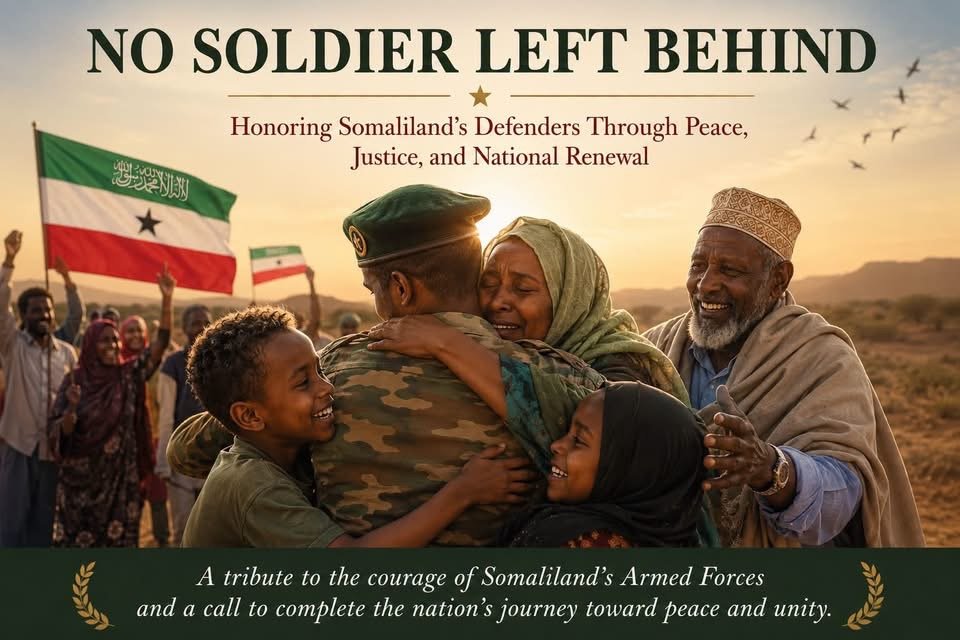
Among the many challenges confronting the Republic of Somaliland, none carries greater moral weight than the fate of the soldiers captured during the conflict in the eastern regions. These men answered their nation’s call, fought in defense of Somaliland’s sovereignty and constitutional order, and paid an extraordinary price. While political debates have evolved and governments have changed, the anguish endured by their families has remained constant.
Their story is not merely a military issue. It is a national obligation.
As Somaliland continues to strengthen its democratic institutions, expand its international engagement, modernize its economy, and consolidate its position as one of the Horn of Africa’s most stable political entities, the nation must ensure that those who defended its existence are never forgotten. No strategy for national renewal can be complete while brave soldiers remain separated from their loved ones.
The Republic of Somaliland restored its sovereignty on 18 May 1991, following the collapse of the Somali Democratic Republic and years of devastating conflict. Emerging from destruction, Somaliland embarked upon one of Africa’s most remarkable state-building journeys. Through the reconciliation conferences held in Burao, Sheekh, Borama, and other towns between 1991 and 1993, traditional elders, community leaders, religious scholars, women, and political representatives forged peace through dialogue rather than revenge. Those locally driven agreements established the foundations of constitutional governance, security, and national unity that continue to sustain Somaliland today.
Unlike many post-conflict societies, Somaliland’s peace was not imposed by external actors. It was built by Somalilanders themselves through compromise, consensus, and a shared determination to ensure that war would never again consume their homeland.
Those same principles must now guide efforts to heal the wounds left by the eastern conflict.
The inauguration of President Abdirahman Mohamed Abdillahi Irro marked the beginning of another important chapter in Somaliland’s national development. His administration inherited not only significant diplomatic opportunities but also complex humanitarian and security challenges requiring wisdom, patience, and decisive leadership.
Among the government’s early priorities has been the strengthening of Somaliland’s security institutions. Increasing military salaries, improving welfare for members of the armed forces, investing in modern military capabilities, and appointing energetic new leadership within the military and police all represent significant steps toward building a stronger and more professional national defense.
These reforms acknowledge an essential truth: national security depends not merely upon weapons but upon the confidence, professionalism, and morale of those entrusted with defending the Republic.
Yet military modernization alone cannot complete Somaliland’s national mission.
A professional armed force draws its greatest strength from the certainty that the nation it protects will never abandon its defenders. Every Somaliland soldier serving today should know that if called upon to sacrifice for the Republic, Somaliland will stand firmly behind them and their families.
This principle defines the world’s most respected military institutions.
The continued effort to secure the safe return of captured soldiers must therefore remain among Somaliland’s highest humanitarian priorities. Their release would not simply reunite families; it would strengthen military morale, reinforce public confidence in national institutions, and demonstrate that Somaliland fulfills its obligations to those who defend its sovereignty.
Behind every captured soldier stands a family living through silent hardship.
Parents continue waiting for the return of their sons. Wives shoulder the burden of raising families alone. Children grow older knowing their fathers only through memories, photographs, and stories told by relatives. Time has become measured not by calendars but by hope, uncertainty, and unanswered prayers.
Their suffering deserves recognition alongside the courage displayed on the battlefield.
History consistently demonstrates that the strongest nations combine firmness in defending their sovereignty with wisdom in pursuing reconciliation. Somaliland itself stands as compelling proof of this principle.
The reconciliation process in the eastern regions should therefore remain a national priority. Peace-building offers the most sustainable path toward healing divisions, rebuilding trust, and preventing future conflict. Genuine reconciliation requires meaningful engagement with traditional elders, religious leaders, women, youth representatives, civil society organizations, and local communities whose voices remain indispensable to achieving durable peace.
Dialogue should never be mistaken for weakness.
Rather, it reflects confidence in the enduring strength of Somaliland’s institutions and its people.
Peace, however, cannot rest solely upon dialogue. It must be reinforced through development.
Communities affected by conflict deserve renewed investment in schools, hospitals, roads, water systems, agricultural development, vocational education, fisheries, livestock services, digital infrastructure, and employment opportunities. Such investments strengthen confidence in government while demonstrating that peace delivers tangible improvements to people’s daily lives.
Young Somalilanders deserve opportunities that direct their talents toward education, entrepreneurship, innovation, and national development instead of conflict. A generation equipped with knowledge, technical skills, and meaningful employment represents one of the strongest guarantees of long-term national security.
Somaliland’s growing strategic importance further reinforces the need for lasting internal stability.
Situated along the Gulf of Aden and overlooking the Bab El-Mandeb Strait—one of the world’s most vital maritime corridors—Somaliland occupies a position of increasing significance in global trade, Maritime Security, and regional geopolitics. The expanding international interest in the Red Sea reflects Somaliland’s importance as a reliable partner in promoting freedom of navigation, combating terrorism, countering piracy, and supporting regional stability.
As international attention increasingly focuses upon the Horn of Africa, Somaliland’s greatest strategic advantage remains not geography alone but the political stability it has built over more than three decades.
That stability has earned growing international respect.
The African Union’s 2005 Fact-Finding Mission concluded that Somaliland’s case was unique and self-justified in African political history. Since then, Somaliland has continued demonstrating political maturity through constitutional governance, multiple competitive elections, peaceful transfers of presidential power, an independent electoral process, and functioning democratic institutions despite the absence of formal international recognition.
These achievements distinguish Somaliland within a region frequently challenged by political instability and violent conflict.
International credibility begins at home.
A nation that protects its citizens, honors its soldiers, resolves disputes peacefully, strengthens democratic institutions, and respects the rule of law presents a compelling case for deeper international engagement.
Caring for those who defended these achievements strengthens Somaliland’s moral authority abroad as much as its unity at home.
The humane treatment and eventual repatriation of detainees following armed conflict are longstanding humanitarian principles reflected in the Geneva Conventions. While the legal framework applicable to any specific conflict depends upon its particular circumstances, the broader humanitarian imperative remains clear: every effort should be made to reduce human suffering and reunite families whenever possible.
The soldiers captured during the eastern conflict should never become forgotten names in official reports or fading memories within national history.
They are sons.
They are fathers.
They are husbands.
They are brothers.
They are patriots.
Their sacrifice represents the human face of Somaliland’s long struggle to preserve peace, Democracy, sovereignty, and self-government.
The responsibility to bring them home belongs not only to one administration but to the entire nation. Government institutions, traditional leaders, religious authorities, civil society organizations, the Somaliland diaspora, humanitarian organizations, and international partners should support every lawful and peaceful initiative capable of advancing dialogue, confidence-building, humanitarian cooperation, and family reunification.
There is no contradiction between defending Somaliland’s sovereignty and pursuing reconciliation.
The two objectives reinforce one another.
Lasting peace strengthens sovereignty.
National unity enhances security.
Justice deepens reconciliation.
Compassion strengthens patriotism.
As Somaliland approaches the fourth decade since restoring its sovereignty, its greatest achievement will not ultimately be measured by diplomatic breakthroughs, economic development, military modernization, or growing international partnerships alone.
It will be measured by the values that define the Republic itself.
Justice over vengeance.
Dialogue over division.
Democracy over authoritarianism.
National unity over political polarization.
An unwavering commitment to those who stood in its defense.
Every soldier who wore the Somaliland uniform carried more than a rifle.
They carried the hopes of an entire nation determined never again to surrender its freedom.
Their courage safeguarded the democratic institutions that today serve millions of Somalilanders. Their sacrifices protected the peace painstakingly built through reconciliation. Their service preserved a Republic that continues to inspire many across Africa through its resilience, stability, and democratic achievements.
Their sacrifice must never fade into history.
Bringing every captured soldier home, supporting their families, caring for wounded veterans, honoring the families of the fallen, and preserving the dignity of those who defended the Republic are not simply acts of compassion.
They are acts of nation-building.
They reaffirm the sacred covenant between a Republic and those who defend it.
Somaliland has always demonstrated extraordinary resilience.
From the ashes of war, it built peace.
From political isolation, it built democratic institutions.
From uncertainty, it forged hope.
The next chapter should be written with the same courage that inspired the liberation struggle and the same wisdom that produced reconciliation in the years that followed.
Let history record that Somaliland never forgot its defenders.
Let future generations inherit a nation that rewards sacrifice with gratitude, answers courage with loyalty, and proves through both word and deed that those who defend the Republic are never abandoned.
For a nation founded upon resilience, reconciliation, democracy, and sacrifice, there can be no greater national pledge than this:
No Soldier Left Behind.
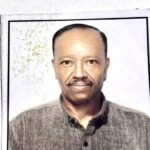
Prof. Nassir Hussein Kahin is a researcher, educator, journalist, and geopolitical analyst specializing in the Horn of Africa, the Red Sea, international law, diplomacy, and strategic affairs. To read Full Bio click on this link: ABOUT THE AUTHORProf. Nassir Hussein Kahin