By Prof. Nassir Hussein Kahin
For centuries, control of the Red Sea has determined the balance of power between Africa, the Middle East, Europe and Asia. Today, that historic waterway is once again becoming one of the world’s principal geopolitical fault lines. Stretching from the Suez Canal to the Bab El-Mandeb Strait and into the Gulf of Aden, the region is witnessing the emergence of competing strategic alignments whose decisions will shape international trade, military access, energy security and diplomatic influence for decades to come.
Unlike the ideological rivalries of the Cold War, today’s competition is driven by Maritime Security, supply chains, military logistics, energy infrastructure and access to strategic ports. The Horn of Africa has become the principal arena where these interests converge.
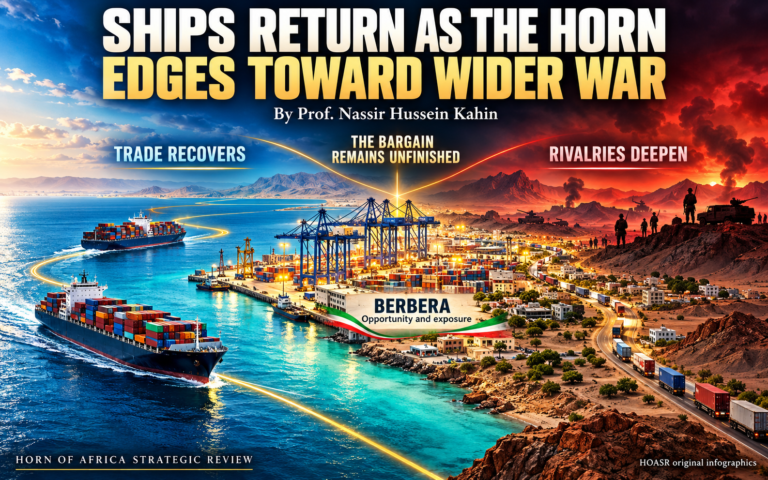
At the center of this transformation stands Somaliland. For more than three decades, the Republic of Somaliland remained politically unrecognized while quietly developing functioning democratic institutions, maintaining internal stability and modernizing the Port of Berbera through investment by the UAE. Today, Berbera’s location overlooking the Gulf of Aden has elevated Somaliland from a diplomatic anomaly to one of the most strategically significant territories in the wider Red Sea basin.
Recent reports indicating further military expansion around Berbera, together with Israel’s recognition of Somaliland and expanding security cooperation with the UAE, have fundamentally altered regional calculations. Whether every reported military project ultimately materializes is less important than the perception among regional governments that Berbera may become an important Western-aligned logistics and security hub overlooking one of the world’s busiest maritime corridors.
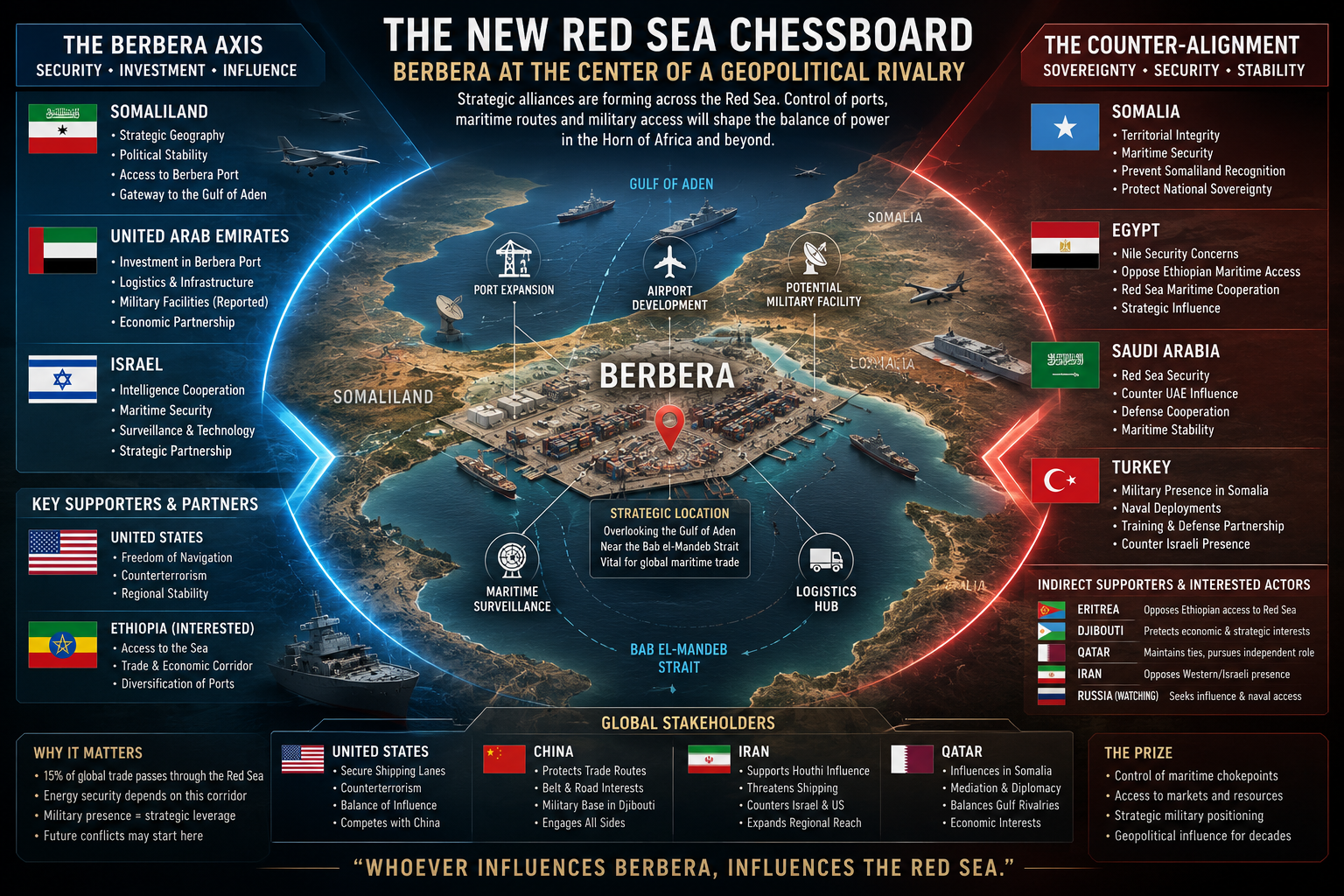
As one strategic alignment consolidates around Berbera, another appears to be emerging across the opposite side of the geopolitical equation.
The first alignment consists of Somaliland, the United Arab Emirates and Israel. Each brings different strategic assets. Somaliland contributes geography, political stability and access to Berbera. The UAE contributes investment, port management expertise, logistics and military infrastructure. Israel contributes intelligence cooperation, maritime security, technology and broader diplomatic influence among Western partners.
This alignment is also broadly compatible with long-term American interests in ensuring freedom of navigation through the Bab el-Mandeb Strait, countering terrorism, containing Iranian influence and maintaining secure commercial shipping routes between Europe and Asia. Although Washington has not formally endorsed every aspect of this emerging partnership, many of its strategic objectives overlap.
Ethiopia also has significant interests in this alignment. As Africa’s second-most populous nation, Ethiopia seeks reliable maritime access that reduces its overwhelming dependence on Djibouti. The original memorandum with Somaliland demonstrated Addis Ababa’s determination to diversify its maritime options. Even though implementation remains politically contested, Ethiopia continues to regard Berbera as one of its most strategically valuable potential trade corridors.
Across the region, however, another strategic grouping is taking shape.
Somalia has significantly expanded defence cooperation with both Egypt and Saudi Arabia while maintaining its already extensive military partnership with Turkey. Egypt and Somalia recently approved new maritime cooperation arrangements covering ports, transport and wider maritime coordination. Saudi Arabia and Somalia have signed a defence cooperation agreement explicitly linked to Red Sea security. Turkey continues to expand its military, naval and security presence inside Somalia through Camp TURKSOM, naval deployments, energy cooperation and advanced defence projects.
Each participant enters this alignment with distinct national interests.
For Somalia, the principal objective remains preserving internationally recognized territorial integrity and preventing Somaliland’s growing international acceptance.
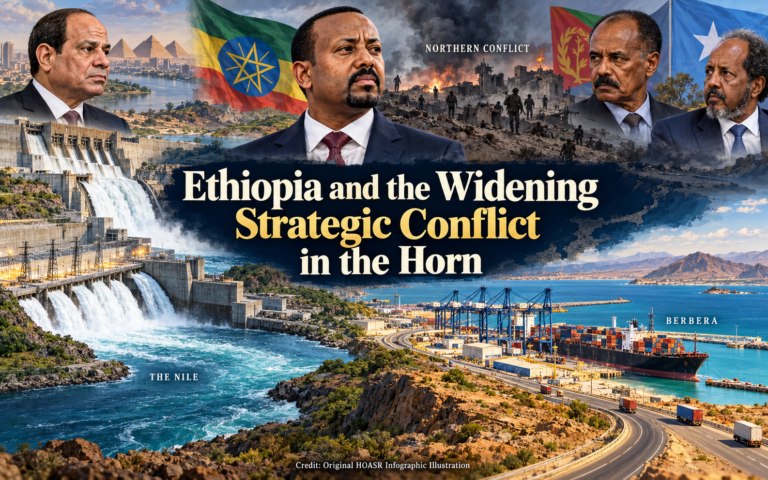
Egypt views Ethiopia’s maritime ambitions through the broader lens of the Nile dispute and seeks to ensure that Addis Ababa does not obtain strategic leverage along the Red Sea outside existing regional arrangements.
Turkey seeks to preserve its position as Somalia’s primary defence partner while simultaneously limiting Israeli and Emirati strategic expansion across the Horn of Africa.
Saudi Arabia’s calculations are more nuanced. While maintaining important relations with the UAE, Riyadh has increasingly pursued its own independent Red Sea strategy aimed at securing maritime trade, limiting instability and preserving its leadership role among Red Sea littoral states.
The result is not a formal military alliance comparable to NATO. Rather, it is an increasingly coordinated network of overlapping security partnerships whose combined effect is to balance the growing influence of the Berbera axis.
Other regional actors occupy more ambiguous positions.
Eritrea shares Egypt’s opposition to any Ethiopian military access to the Red Sea that bypasses existing regional understandings. Djibouti faces potentially significant economic consequences should Ethiopian commerce increasingly shift toward Berbera. Both therefore possess strong incentives to resist developments that could permanently alter existing regional trade patterns.
Qatar also remains an important stakeholder. Doha has historically maintained close relations with Somalia while often pursuing regional policies distinct from those of Abu Dhabi. Although recent Gulf reconciliation has reduced open confrontation, strategic competition between Qatar and the UAE continues to influence political alignments throughout the Horn of Africa.
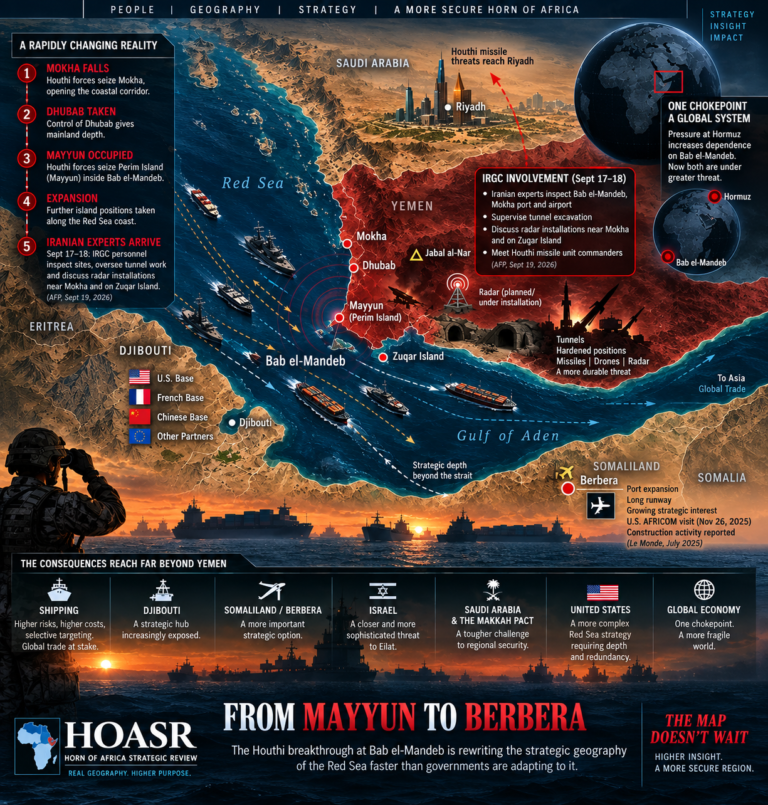
Iran approaches the region from an entirely different strategic perspective. Through its support for the Houthis in Yemen, Tehran seeks to pressure Israel, challenge American naval operations and threaten international shipping during periods of heightened regional conflict. Any future Israeli security presence in Berbera would inevitably attract Iranian strategic attention, even if indirectly.
China’s interests are equally significant but fundamentally different. Beijing already operates its first overseas military base in Djibouti while simultaneously remaining Ethiopia’s largest infrastructure investor and maintaining expanding economic relations throughout the Horn of Africa. China’s overriding objective is not ideological alignment but the uninterrupted protection of trade routes supporting the Belt and Road Initiative. Stability serves Chinese interests, yet Beijing also benefits from maintaining productive relationships with nearly every government involved in the current competition.
The United States occupies perhaps the most complex position of all. Washington seeks freedom of navigation, secure maritime commerce, counterterrorism cooperation and strategic competition with China while simultaneously preserving relations with Somalia, Djibouti, Ethiopia, Gulf partners and increasingly with Somaliland. American policy therefore reflects strategic flexibility rather than exclusive commitment to any single regional bloc.
The cumulative effect of these overlapping relationships is the gradual emergence of a new regional security architecture.
Unlike previous eras dominated by civil wars or piracy, today’s competition revolves around ports, logistics corridors, military infrastructure, submarine communication cables, intelligence sharing, unmanned systems and maritime surveillance. Economic investments increasingly carry strategic implications, while diplomatic recognition has become inseparable from security calculations.
For Somaliland, this transformation presents extraordinary opportunities alongside significant risks. Greater strategic importance may strengthen the case for international recognition and attract further investment. At the same time, increased geopolitical relevance inevitably exposes Somaliland to the rivalries of much larger powers whose interests may not always coincide with Somaliland’s own national priorities.
For Ethiopia, access to the sea remains an enduring national objective that will continue shaping regional diplomacy. For Somalia, preserving territorial claims remains central to national policy. For Egypt, Turkey, Saudi Arabia, the UAE, Israel, Iran, China and the United States, the Horn of Africa has become an increasingly important theatre within a wider contest extending from the Mediterranean to the Indian Ocean.
The Red Sea is no longer simply a maritime corridor. It has become one of the principal geopolitical crossroads of the twenty-first century.
Whether these competing alignments ultimately produce deterrence, cooperation or confrontation will depend upon the ability of regional leaders to balance legitimate national interests with collective maritime security. The stakes extend well beyond the Horn of Africa. Nearly fifteen percent of global trade passes through these waters, linking Europe, Asia and Africa. Any sustained instability would reverberate throughout the global economy.
History suggests that control of strategic waterways has often determined the rise and decline of great powers. The Red Sea is once again assuming that historic role. This time, however, the outcome may be decided not only by the world’s traditional powers, but also by the choices of smaller states such as Somaliland, whose geography has become one of the defining strategic assets of a rapidly changing international order.

Prof. Nassir Hussein Kahin is a researcher, educator, journalist, and geopolitical analyst specializing in the Horn of Africa, the Red Sea, international law, diplomacy, and strategic affairs. To read Full Bio click on this link: ABOUT THE AUTHORProf. Nassir Hussein Kahin