
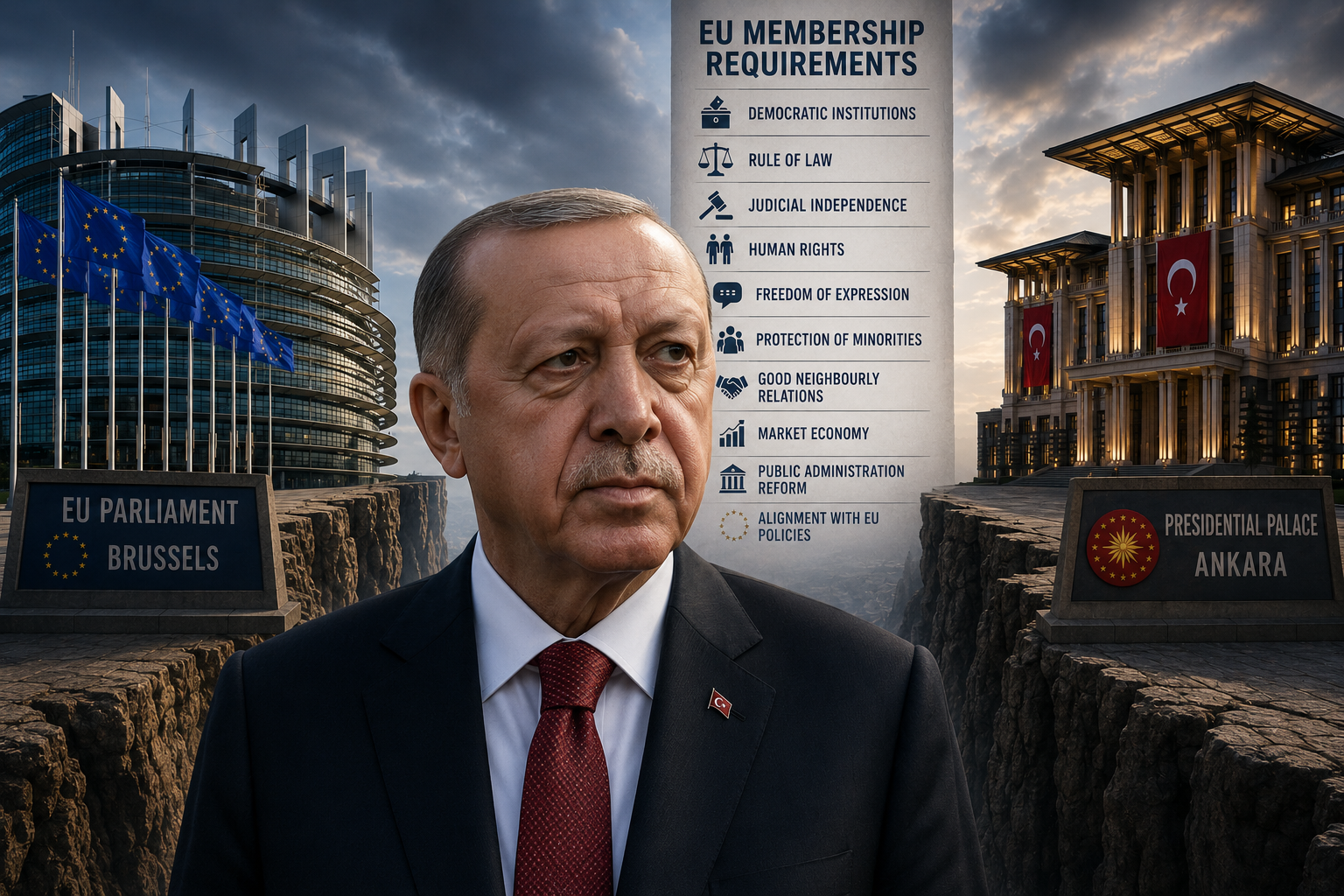
Turkey’s exclusion from the European Union is not simply the product of politics in Brussels. It also reflects profound questions about democratic governance and the rule of law.
By Prof. Nassir Hussein Kahin
President Recep Tayyip Erdoğan’s latest declaration that Turkey has waited 53 years to join the European Union resonates with many Turks who genuinely believe their country has been subjected to unequal treatment. There is truth in the historical claim. Turkey has maintained formal ties with the European project since the Ankara Agreement of 1963, became an official candidate for membership in 1999, and began accession negotiations in 2005. Yet, after decades of dialogue, Turkey remains outside the European Union.
However, President Erdogan did not say why Turkey has been waiting for over five decades for EU membership.
The answer cannot be reduced to prejudice, religious identity, or European hypocrisy alone. Those factors have occasionally influenced political debates inside Europe, but they do not fully explain the collapse of Turkey’s accession process. The deeper explanation lies in a widening divergence between the democratic values required for membership and the political trajectory Turkey has followed over the past decade.
Membership in the European Union is neither a reward for strategic importance nor compensation for historical grievances. It is the culmination of a demanding political process grounded in the Copenhagen Criteria: democratic governance, judicial independence, respect for human rights, protection of minorities, and adherence to the rule of law. Every candidate, regardless of its size or geopolitical significance, must satisfy these standards before joining.
Turkey undoubtedly remains one of Europe’s most important strategic partners. As NATO’s second-largest military power, it occupies a critical geographic position linking Europe, the Black Sea, the Caucasus, and the Middle East. It plays a central role in migration management, energy transit, counterterrorism, and regional security. European leaders understand that reality better than anyone.
However, strategic value cannot substitute for democratic accountability.
Following the failed coup attempt in July 2016, Turkey faced an undeniable national security crisis. Every sovereign state has the right—and indeed the obligation—to defend its constitutional order against violent attempts to overthrow an elected government. Few reasonable observers dispute that principle.
The controversy arose from the scale and duration of the government’s response. Mass dismissals of judges, academics, journalists, military officers, and civil servants, combined with restrictions on media freedom and concerns over judicial independence, fundamentally altered European perceptions of Turkey’s democratic progress.
Whether Ankara considers those measures justified is ultimately a matter of domestic politics. Whether Brussels considers them compatible with EU membership is a matter of European law and institutional standards.
Neither side has succeeded in convincing the other.
At the same time, unresolved disputes continue to deepen the divide. The Cyprus question remains frozen after half a century. Maritime disagreements with Greece periodically inflame tensions in the Eastern Mediterranean. Differences over relations with Russia, military operations in neighboring countries, and Turkey’s pursuit of an increasingly independent foreign policy have further widened political distance between Ankara and Brussels.
Ironically, Turkey and the European Union have never been more dependent on one another strategically while simultaneously becoming more distant politically.
Migration illustrates this problem perfectly. Europe relies heavily on Turkey to help manage refugee flows, while Turkey expects financial support and political recognition in return. This relationship has produced cooperation, but not trust.
Perhaps the greatest misconception surrounding the debate is the suggestion that Turkey would somehow “bring Democracy” to the European Union.
The European Union does not recruit countries to improve its democratic standards. It admits countries that have already demonstrated a sustained commitment to those standards. From Brussels’ perspective, the central concern is not what Turkey could contribute after joining, but whether Turkey currently satisfies the political conditions required before joining.
This distinction is critical.
None of this diminishes Turkey’s remarkable achievements. It possesses a dynamic economy, a resilient society, competitive elections, a sophisticated industrial base, and growing diplomatic influence across multiple regions. Opposition parties continue to win major municipalities, including Istanbul and Ankara, demonstrating that political competition remains alive despite growing concerns over the broader democratic environment.
Yet democracy cannot be measured solely by elections. Independent courts, a free press, constitutional checks and balances, and equal protection under the law are equally indispensable pillars of democratic governance.
Europe is therefore confronting a dilemma of its own making. Some member states undoubtedly remain reluctant to admit Turkey because of its large population, Muslim-majority identity, migration implications, and geopolitical weight. Those political reservations have existed for years and cannot be ignored.
Nevertheless, even if those concerns disappeared tomorrow, Turkey would still face substantial challenges in meeting the institutional and democratic standards expected of every EU member.
The tragedy is that what was once envisioned as a shared political future has gradually evolved into a pragmatic strategic partnership. Both sides continue to cooperate where their interests align, yet both appear increasingly resigned to the possibility that full membership may never materialize.
President Erdoğan is correct about one thing: fifty-three years is an extraordinarily long time to wait.
But history also teaches an equally important lesson.
The European Union has never measured membership by patience alone. It measures membership by democratic institutions, constitutional governance, and adherence to common legal principles. Until Ankara and Brussels rebuild the mutual trust that has steadily eroded over the past two decades, Turkey’s long journey toward Europe is likely to remain exactly that—a journey rather than a destination.
For both Turkey and Europe, the challenge now is not merely to reopen membership negotiations. It is to restore the confidence, credibility, and shared democratic vision without which no negotiation, however long it lasts, can ultimately succeed.

Prof. Nassir Hussein Kahin is a researcher, educator, journalist, and geopolitical analyst specializing in the Horn of Africa, the Red Sea, international law, diplomacy, and strategic affairs. To read Full Bio click on this link: ABOUT THE AUTHORProf. Nassir Hussein Kahin