How the Inclusion of Minority Communities Could Shape Somaliland’s Next Chapter: A Political and Diplomatic Analysis.
By Prof. Nassir Hussein Kahin
For more than thirty-five years, Somaliland has built its case for international recognition on two enduring foundations: political stability and effective state institutions.
While much of the Horn of Africa has experienced prolonged conflict, military coups, insurgencies, and institutional fragility, Somaliland has followed a markedly different trajectory. It has restored peace after civil war, established functioning government institutions, maintained a relatively secure environment, conducted multiple competitive elections, and created an administrative system that operates independently of Mogadishu.
These achievements have enabled Somaliland to present itself as one of the most stable and governable territories in the region and to argue that its historical and political circumstances constitute a unique case deserving international recognition.
Those arguments remain compelling.
Yet the international conversation surrounding Somaliland is gradually evolving.
The question is no longer simply:
Does Somaliland possess the attributes of a functioning state?
It is increasingly becoming:
Does that state provide equal opportunity, protection, and participation for all of its citizens?
As Somaliland expands its diplomatic engagement and seeks broader international partnerships, this second question is becoming increasingly important.
From Legal Statehood to Political Legitimacy
Traditionally, statehood has been assessed according to the widely accepted principles reflected in the Montevideo Convention of 1933:
- A defined territory.
- A permanent population.
- A functioning government.
- The capacity to enter into relations with other states.
Measured against these classical criteria, Somaliland has consistently argued that it satisfies the essential legal characteristics of statehood.
In practice, however, international recognition has never been determined solely by legal doctrine.
Recognition remains a political decision made by sovereign states, influenced by strategic interests, regional politics, diplomatic considerations, and increasingly by the quality of governance within aspiring states.
In the twenty-first century, governments are judged not only by whether they exercise authority, but by how they exercise it.
International partners increasingly assess states according to broader governance indicators, including:
- Protection of citizens’ rights.
- Inclusive political participation.
- Equal economic opportunity.
- Respect for diversity.
- Representation of marginalized communities.
- Transparency and accountable institutions.
- Social cohesion and national integration.
These factors are not formal legal requirements for recognition, but they increasingly influence diplomatic credibility, development partnerships, foreign investment, and international confidence.
For Somaliland, this represents an important evolution in its state-building journey.
Building on Somaliland’s Democratic Success
Somaliland enters this discussion from a position of considerable strength.
Over three decades, it has demonstrated that peace can be sustained through locally developed institutions rather than external intervention. It has held competitive elections, maintained relative political stability, managed peaceful transfers of power, and built institutions that continue to function despite the absence of formal international recognition.
These accomplishments distinguish Somaliland from many conflict-affected states across the region.
The challenge today is therefore not to replace these achievements, but to build upon them.
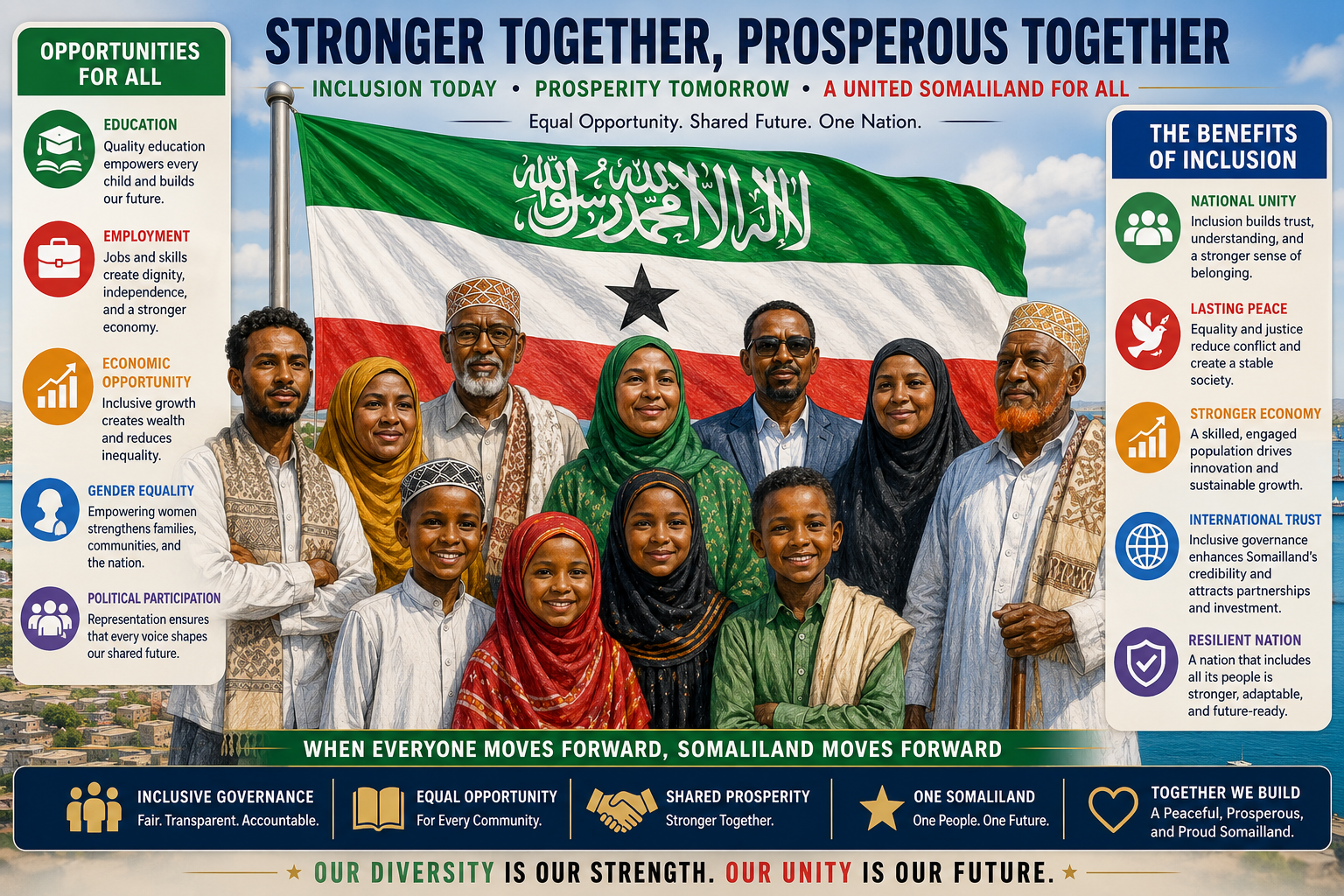
The next phase of state-building requires ensuring that every citizen—regardless of clan affiliation, social background, or minority status—shares fully in the country’s political, economic, and social progress.
Strong institutions become even stronger when every community believes those institutions also serve them.
The VOSOMWO Report: More Than Social Statistics
The report produced by the Voice of Somaliland Minority Women Organization (VOSOMWO) appears, at first glance, to focus primarily on education and employment.
A closer reading, however, reveals broader governance questions.
The report identifies continuing challenges facing sections of Somaliland’s minority communities, including:
- Limited educational opportunities.
- Higher levels of unemployment.
- Lower participation in public institutions.
- Limited representation in leadership positions.
These findings extend beyond social policy.
They raise a larger question central to modern state-building:
To what extent does every citizen feel fully included in Somaliland’s national project?
Successful states derive legitimacy not only from constitutions and institutions but also from the confidence citizens place in them.
When individuals believe they can participate equally in public life and benefit from national development, social cohesion becomes stronger, institutions become more resilient, and political stability becomes more durable.
Berbera: Measuring Success Beyond Infrastructure
Few places better symbolize Somaliland’s economic ambitions than Berbera.
The modernization of the port, expanding trade corridors, foreign investment, infrastructure development, and growing commercial activity have transformed Berbera into one of the Horn of Africa’s most strategically important economic gateways.
Its success has attracted growing international attention.
Yet one important question deserves equal consideration:
Is economic growth benefiting all sections of Somaliland society?
Experience from around the world demonstrates that economic expansion alone does not automatically produce social stability.
When prosperity is perceived as unevenly distributed, societies can experience:
- Greater social divisions.
- Reduced confidence in public institutions.
- Political grievances.
- Long-term governance challenges.
For this reason, Berbera’s success should not be measured solely through investment figures, cargo volumes, or infrastructure projects.
It should also be measured by whether economic opportunities are expanding across all communities, including historically marginalized groups.
Inclusive growth is not simply social policy.
It is sound statecraft.
Why Inclusion Matters for Diplomacy
Modern diplomacy extends far beyond treaties and bilateral relations.
National reputation increasingly shapes international partnerships.
As Somaliland strengthens engagement with Western governments, the European Union, the United Nations, the African Union, international financial institutions, development agencies, and foreign investors, evaluations increasingly extend beyond security and political stability.
International partners frequently examine questions such as:
- Human rights protections.
- Equality before the law.
- Minority representation.
- Gender inclusion.
- Access to education.
- Employment opportunities.
- Institutional accountability.
These considerations often influence development assistance, investment decisions, governance partnerships, and political confidence.
They may not determine recognition by themselves, but they significantly shape how governments and international organizations evaluate emerging states.
In this context, strengthening minority inclusion becomes more than a domestic governance objective.
It becomes a diplomatic asset.
A country that demonstrates both stability and inclusiveness presents a stronger and more persuasive case for deeper international engagement.
Domestic Legitimacy Comes First
Every state ultimately seeks two forms of recognition.
The first comes from other governments.
The second comes from its own citizens.
The latter is more enduring.
When citizens experience fairness, equal opportunity, political participation, and economic mobility, they develop confidence in public institutions and strengthen the legitimacy of the state itself.
Recognition abroad becomes more sustainable when it rests upon confidence in society.
A nation whose citizens feel invested in its future possesses a stronger foundation than one that relies solely on external diplomatic support.
Somaliland’s Opportunity
The VOSOMWO report should therefore be viewed not simply as a catalogue of social challenges.
It should be understood as an opportunity for institutional improvement.
An opportunity to:
- Strengthen democratic governance.
- Deepen national cohesion.
- Expand educational opportunity.
- Improve economic participation.
- Increase public representation.
- Reinforce Somaliland’s international credibility.
If Somaliland invests meaningfully in education, employment, and political inclusion for minority communities, it can further distinguish itself as a model of peaceful, democratic, and inclusive state-building in the Horn of Africa.
Its international case would become stronger not because its legal arguments have changed, but because its governance continues to evolve.
Conclusion
For more than three decades, Somaliland has argued that it deserves international recognition because of its peace, democratic governance, institutional resilience, and historical uniqueness.
Those arguments remain persuasive.
Yet the next phase of Somaliland’s state-building may require an even broader vision.
The future international conversation will increasingly focus not only on how Somaliland differs from Somalia, but also on how effectively Somaliland serves every one of its citizens.
Recognition may confirm Somaliland’s place among nations.
Inclusion will determine the strength of the nation itself.
A state earns international respect through diplomacy, but it earns lasting legitimacy by ensuring that every citizen has an equal stake in its future.
If Somaliland succeeds in achieving both international recognition and inclusive national development, it will do more than secure its sovereignty.
It will offer one of Africa’s most compelling examples of modern, democratic, and inclusive state-building—demonstrating that the strongest states are those whose citizens believe the state belongs equally to them all.
Source:
The report was produced by the Voice of Somaliland Minority Women Organization (VOSOMWO), a Somaliland civil society organization committed to advancing equal opportunities, social inclusion, education, economic empowerment, and the protection of the rights of historically marginalized communities. Through research, community outreach, advocacy, and policy dialogue, the organization seeks to bridge longstanding gaps in education, employment, public participation, and access to opportunities while contributing to a more inclusive and equitable Somaliland for all its citizens.
If Somaliland embraces this opportunity, it can strengthen not only the lives of minority communities but also the legitimacy of the state itself. A nation that demonstrates its commitment to equality, inclusion, and shared prosperity enhances both its domestic unity and its international credibility.Somaliland Unity and Recognition Initiative (SURI)
Prof. Nassir Hussein Kahin is a researcher, educator, journalist, and geopolitical analyst specializing in the Horn of Africa, the Red Sea, international law, diplomacy, and strategic affairs. To read Full Bio click on this link: ABOUT THE AUTHORProf. Nassir Hussein Kahin